
I’ve lost track of how long I’ve known Melanie K. Hutsell, but it’s been a few years. She’s a native of East Tennessee, and we share a mentor and many writer friends from this region. In the time we’ve known each other, she has published two novels, The Dead Shall Rise: A Tale of the Mountains, and The Book of Susan, which received the Award of Merit in the fiction category of the 2023 Christianity Today Book Awards. About a year ago, I ran into Melanie at a writers conference, and she told me about her new collection of short stories, The Art of Lost Souls, which she was in the process of sending out to publishers.
The Art of Lost Souls and Other Stories quickly found a home with Main Street Rag (MSR), and is currently available for pre-order. MSR and Editor Scott Douglass have a long history of publishing beautiful books. MSR is the press that published my first poetry collection, Crimes Against Birds. I’m forever grateful to MSR and Scott for taking a chance with my book, and I’m always excited to see MSR continue to publish good work like Melanie’s collection of short fiction.
In The Art of Lost Souls Melanie has created a cast of characters that are both achingly strange and sad. They are misunderstood dreamers, people on the verge of big transitions, wonderers asking what life would look like if all the pieces fit together. But as Hutsell’s characters face loss and uncertain futures, they reveal themselves to be creative souls with imaginations that help them survive. Melanie agreed to answer a few questions about writing, publishing, and not giving up on old projects.
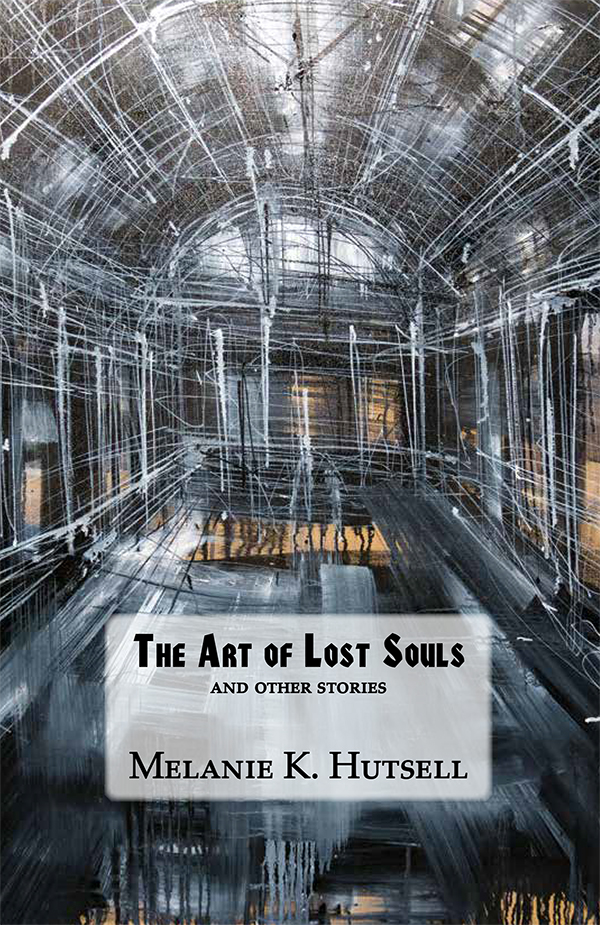
DL: The title of this collection sets up how so many of your characters are some kind of artists, and usually, it’s their creativity that provides a sense of salvation to their stories. You’ve written in the past about having bipolar disorder. How does your background and your own experience of being a creative inform the characters you want to write about?
MH: This is interesting for me to consider. I’ve been aware that I do tend to write characters who are creatives—but until you asked this, I’d never really considered how seldom I write about writers. Because I do tend to think of my background as being fairly focused on words and pages, from an early age. And my fictional creatives tend toward other pursuits, like music or cooking or visual art. Maybe I tend to think, fictionally, of creativity as a way of expressing a character’s superpower, and of course, not everybody writes. I guess I tend to subscribe to the notion that all humans are here to create. I’m drawn towards the philosophy/theology in books like Divine Beauty by John O’Donohue or Art + Faith by Makoto Fujimura, which suggest humans are here to do and experience beauty and that creativity can be expressed in doing anything with love, and by love I mean with intention and giving, in the direction of God and humans.
DL: Some of the stories in The Art of Lost Souls are set in towns and locations that are real places, meaning you didn’t create them out of thin air. The first story is even titled Still Life in Townsend, referencing the town of Townsend, Tennessee. When you’re writing a story, how much do you draw on what you know about the place where it’s set?
MH: For someone who grew up reading a lot of fantasy, my adult work is pretty grounded in the Appalachia of East Tennessee. And I grew up in upper East Tennessee, and that is where most of my work is set, and Appalachian identity almost always is an important facet of my characters. Most of my settings are fictional, with strong underpinnings of reality to them. My two novels, The Dead Shall Rise and The Book of Susan, share some fictional towns with the short stories. Creating a fictional geography allows me to create needed settings or maybe to transport real-life places and set them down in new locations. But, yes, I do sometimes use real settings. In The Art of Lost Souls and Other Stories, both “Celestial Images” and “Still Life in Townsend” are set in real places, and the settings there really define the kind of stories they are. “Celestial Images” is about a homesick Appalachian living in Bloomington, Indiana, and “Still Life in Townsend” is about a motel family who specifically runs a business in the quiet—as opposed to the more tourist-deluged—side of the Smokies, and that’s pretty central to the story. The title story in the collection is set in Knoxville, though it’s a rather magical Knoxville. I was going there for a sense of urban history in that setting, something about time and distance. And sometimes I will invoke real places to make my fictional ones seem more real.
DL: One of the things I admire with the stories in The Art of Lost Souls is that you’re not afraid to go into some pretty dark spaces. But you usually bring some relief to the reader, too. Do good stories require pushing into that darkness?
MH: I do think the best writing is that which costs the author something to make and also requires great honesty. Often when something’s false in what I’m working on, it’s because I haven’t pushed myself enough in that spot, really faced what’s trying to be said there. I haven’t gone to where the story is demanding to go. And I think all of this is true whether one is writing realistic fiction or not, literary fiction or not. Because art is about being human. And there is a lot of darkness there. I consider myself to be generally wired up as someone who believes, but it’s dishonest not to acknowledge the dark.

DL: The Art of Lost Souls is your third book publication. But you’ve also been working for a long time on a magical realism novel. How do you balance multiple projects at the same time? And what keeps you returning to this unfinished novel?
MH: Well, the short answer is, I really don’t balance multiple projects at once. I actually become very absorbed in my writing projects, which is one reason—among many—that the unfinished novel remains unfinished. It’s a work that I’ve been wrestling with in many different variations since college. It began life as a fantasy novel and is a magic realism novel now. The Dead Shall Rise actually started, when I was in graduate school twenty-five or so years ago, as a manuscript written around a misbehaving character carved from the other work. After many years plagued by mental illness (though I didn’t know at the time that was what ailed me) and then devoted to recovery, the unfinished novel came back to me. But I set it aside to focus on writing and publishing short fiction to hone my craft and get a publication history. And then I opted to revise The Dead Shall Rise and seek publication with it, being a more complete manuscript, than to finish the messy, half-done one. And then The Book of Susan got written because of an agent’s interest engendered by reading one of my published short stories. (The agent ultimately passed on Susan.) And I’ve long wanted to have a collection of my short work appear all in one place, and Main Street Rag publishing The Art of Lost Souls is a realization of that dream. Meanwhile, in between these projects, I’m writing along on the poor, longsuffering, untitled novel, because I can only do one thing at once. I suppose I find the protagonist compelling. Possibly he is my alter ego, more so than any other character I’ve written.
DL: I think you know that I have so much respect for small and independent publishers. Now that you’ve published three books with different small presses, do you have advice for writers about how to get published?
MH: You don’t need an MFA, and you don’t need an agent. Not that those are not good, helpful, and desirable things. But I have neither. I say: write and be a student of writing. I was fortunate to have a mentor when I was in high school, poet Jane Hicks, who was my guidance counselor and who taught me to approach writing professionally. Back then, it was the Writer’s Market and SASEs. Now it’s Submittable and Substack and unknown frontiers. Stay abreast of the ever-evolving business. Always read the guidelines. Don’t be afraid to submit. Don’t let rejection define you – learn from it. And definitely consider small presses as options for submitting your work. I’ve loved working with each press I’ve worked with. Each has devoted such care to seeing my manuscript through the process, helped me better realize the vision I’ve had for that particular work. I’ll pass along advice once given to me—you’re looking for the press that loves your manuscript as much as you do. There’s a lot to be said for sending your work to an indie press.
Many thanks to Melanie K. Hutsell for answering these questions. Find out more about Melanie here, and be sure to pre-order The Art of Lost Souls from Main Street Rag Publishers.
In case you missed it… I recently read with Georgann Eubanks for the Spoken & Heard series. And I’m so grateful that Feller has had some great reviews from Jake Lawson in MicroLit: a Tiny Journal of Prose & Poetry, Noah Soltau in Red Branch Review, and from Meredith Sue Willis in Books for Readers. I hope you’ll take a look.
If you’re not already receiving these posts directly to your inbox, please subscribe.
 Denton Loving
[…] case you missed it…Check out past conversations about writing and publishing with Melanie K. Hutsell, Zackary Vernon, and David Wesley Williams, whose new novel, Come Again No More, is out this […]
LikeLike
[…] it… check out some of my past conversations about writing and publishing with Kendra Winchester, Melanie K. Hutsell and Georgann Eubanks. Also, I hope you’ll have a look at Bill Griffin’s wonderful site, […]
LikeLike