A Conversation with Jeremy B. Jones about his New Book, Cipher

One of my favorite reads this year has been Cipher by Jeremy B. Jones. I first heard Jeremy speak about his work on this project more than five years ago, and when I finally got my hands on the finished book, I devoured it. I often feel a sense of pleasure from the books I read, but some books actively call for some kind of engagement with the text or the writer. Cipher spoke to many of my interests, notably place, history, genealogy and genetics. As quickly as I read Cipher, I found myself laying the book aside, over and over, for just long enough to make notes and jot down questions. I’m fortunate that Jeremy was willing to answer those questions, and the result of our conversation is available for you to read at Electric Literature.

I said that I had a lot (a lot!) of questions, and they didn’t all make it into the final publication. So I thought this would be a good place to share Jeremy’s responses when I asked him about editing nonfiction books and teaching nonfiction to his students at Western Carolina University.

Denton Loving: You’re also an editor for In Place, the nonfiction book series published by WVU Press. What makes an essay or a memoir resonate with you?

Jeremy B. Jones:  I read and write a lot about place. When I was presented with the opportunity to pitch a book series to WVU Press, I thought immediately of books that had shaped me in my younger days, books like Annie Dillard’s Pilgrim at Tinker Creek and Gretel Ehrlich’s The Solace of Open Spaces and Wendell Berry’s The Long-Legged House. It’s hard to imagine those books being released by a big publisher today and getting the press and attention they deserve in the process. The publishing landscape (pun alert) has changed, so my hope with In Place was to create a space for thoughtful books about place to find a home.

Serving as series co-editor (alongside Elena Passarello) can be pretty catalytic for my writing, as I’m getting to see manuscripts that are engaging with the physical world in exciting (often formally exciting) ways. Even if the manuscripts aren’t quite right for the series or quite ready for publication, just getting access to drafts of these projects spurs on my own work and my own thinking.

DL: What about as a teacher? How do you teach students to shape their work, particularly nonfiction?

JBJ: Nonfiction is especially fun to teach at the undergraduate level because few of the students know exactly what they’ve gotten into. “Nonfiction” isn’t an especially helpful term—it only tells us what the form isn’t. That means I get to open up lots of possibilities for young writers, and that’s a gift. That opening of possibilities was my experience in college. I wrote a short essay in a first-year writing course in college that I now recognize was a memoir, even though I don’t think that was a term I knew then. My professor, Dr. Jane Stephens, pushed me deeper into that form and encouraged my explorations of memory and place that semester, and it was life-changing. I recognize that not every student who shows up in my classroom is going to have their life changed by literary nonfiction, but it’s a privilege to be able to show them what they can do with the world around them, especially if their default nonfiction form is the academic essay. Because of that, I tend to offer students tons of models and encourage lots of experimentation. I want them leaving with a lit spark more than I care about a perfect, polished essay.

Thanks to Jeremy B. Jones for taking the time to talk with me about Cipher. I hope you’ll read the book as well as my full conversation with Jeremy over at Electric Literature.

In case you missed it… Last week’s guest post featured a conversation between Ruth Mukwana and Lynne Sharon Schwartz, and I recently was a guest on Ben Tanzer’s podcast with the wonderfully apt name, This Podcast Will Save Your Life.

If you’re not already receiving these posts directly to your inbox, please subscribe.

Guest Post: A Conversation with Lynne Sharon Schwartz and Ruth Mukwana

Last month, EastOver Press published the novel A Stranger Comes to Town by Lynne Sharon Schwartz. This project was very dear to me not only because I think the novel is superb in every way but also because Lynne Sharon Schwartz has been an incredible mentor and friend to me since I studied with her at the Bennington Writing Seminars. It was an honor and joy to help usher this book into publication. In today’s guest post, my friend and fellow Bennington graduate Ruth Mukwana speaks to Lynne about her new novel.

Ruth Mukwana: I met Lynne when I was an MFA student at Bennington College. She was my mentor and advisor in my last year at Bennington. Before working with her, I had read her book, Disturbances in the Field, an ambitious book about family which I’ve gone back to several times when searching for craft ideas. Lynne and I have remained in touch, and she has always been very kind and generous to me. Her words of encouragement and belief in me have spurred me on in moments of doubt. So, I was thrilled and honored to talk with her about her new book, A Stranger Comes to Town.

Set in the Upper West Side, a neighborhood that Lynne knows very well, A Stranger Comes to Town is a masterful novel of self-discovery, revealing the multitude of histories and lives we each inhabit, as well as the many ways we seek to reinvent ourselves and reshape our pasts. The novel’s protagonist, Joe, searches to discover his true identity, exposing how even the most ordinary aspects of our lives are often extraordinarily felt.

~

RM: You’ve written a lot. How were you able to write thirty books?

LSS: It was over a long period of time, and many of them are essay collections by other writers and translations. For W.G. Sebald’s anthology – The Emergency of Memory: Conversations with W.G. Sebald – I researched and curated interviews with W.G. Sebald. I worked hard at writing and treated it like a regular job. I taught at Bennington, and I used to get these manuscripts every month and wrote letters to my students, but it didn’t take the whole month. On the days I didn’t teach, I’d get up, do what I had to do and then sit down and write. But I was also free. One day if I wanted to have lunch with a friend, I could do that. I didn’t have a set schedule.

RM: Where did you get inspiration for all your work?

LSS: They’re all different. Some were based on events that happened, but I altered them a lot. Two-Part Inventions is based on a pianist, Joyce Hatto, whom I read about in the newspaper. She was a good pianist, not great. Her husband, a recording engineer, wanted her recordings to be better known and put her name on recordings by more distinguished and famous pianists. All of this was written about in the newspapers, and there was a court case. The central question in the novel is whether the character was aware of the deception. In Balancing Acts, which was my second novel, I wanted to write about older people. Disturbances in the Field was a big undertaking; it was about family. And then this one, A Stranger Comes to Town, I started writing at the beginning of the pandemic in 2020. I had just finished something, and I didn’t know what I was going to do next, and I wanted to do something that’d get me through the pandemic. And it did.

RM: It’s a short book and easy to read. What was the process of writing it like for you?

LSS: Indeed, it’s not a long book, about two hundred pages, but it wasn’t quick to write. It took me more than three years for a short book. The pandemic was going on, and I was teaching. So, there were other things happening. But it was very hard to write, and there were times when I didn’t know where to go with it. What would happen to the main character, Joe? I let it go where it wanted to go, but I’ve always been interested in amnesia, in forgetting, in what makes the self, and I set it in a neighborhood that I know very well. I researched amnesia and found several books, but they’re mostly mistaken about amnesia. Your memory often comes back, and in A Stranger Comes to Town, Joe’s memory starts to come back.

RM: At some point the narrator says amnesia isn’t a disease, and it isn’t, but given how debilitating it is, I’ve always thought of it as a disease. Trying to remember or reconstruct your life when everyone else around you knows it.

LSS: He’s searching for who he is. He no longer knows whom he is or what kind of person he is. And every time he discovers a lot of negative things about himself (that’s what happens when you start looking) or finds another negative thing or something that he did to somebody close to him, he has to go back and reflect about it. And it’s a very hard process for him. When you reflect about your life, when you remember it, often you wonder, why did I do that? How did I do that? What was it in me that made me do that kind of thing?

RM: And one of those negative incidents is that he let his sister take the blame for an accident. He wrestles with himself as he can’t comprehend how he could have done something like that to his sister.

LSS: When we meet Joe, he’s blank and you think, what a nice guy who seems nice to everybody. But then you learn these terrible things he has done. He’s wondering how he could have done such horrible things that he has forgotten and that he now has to integrate into his conception of whom he is. I wish there are more good things that he has done, but he has done more bad things than good, and he doesn’t remember all the good. He does have a good marriage. His wife got pregnant, and he didn’t quite know what to do, and they got married. Their marriage has turned out good, and their children are great. But all these terrible things he’s being told he has done, not only can’t he remember doing them, he also can’t fathom how they’d have happened because he’s not the sort of person who’d have done such things! And he’ll never know unless the people he wronged decide to tell him everything or if his memory comes back.

RM: And it’s incomprehensible to him that the things he has forgotten are things that are unforgivable like the death of his baby brother.

LSS: There are memories from his childhood that barely registered with him. But on the other hand, his mother didn’t want to make her children dwell on that tragedy, the death of their brother. It slipped to the back of his mind, and he forgot, but it’s lodged somewhere in his brain, and it’s hard that it happened. I think there are things that happen when we’re very young that we forget. But if his mother hadn’t tried so hard to keep it from the children, he might have had an easier time remembering it. She was pained by her son’s death, and she didn’t want her children to also suffer.  He’s carrying a lot that we don’t know and he doesn’t know. Does he have more? Is he carrying around more sad stuff? He asks himself, What else might I have done? What else have I forgotten? This is a book that makes you think about your own life.

RM: The other reason the book was easy for me to read is because it also has a great plot. I was expecting to discover that the family that took him in wasn’t his real family, something Joe wonders about!

LSS: He’s thinking any woman could have come to the hospital, somebody looking for a husband, and claimed to be his wife. And when he meets the children, the awkwardness of meeting them is overwhelming for him. They know him, of course, and he doesn’t know them, and they don’t know that he has lost his memory!

RM: Amnesia is a horrible thing to happen to anyone. But for Joe, it has given him an opportunity to examine his life and confront who he really is. Every time he finds out he did a hurtful thing, it’s an opportunity for him to repent and repair which wouldn’t have happened otherwise. He’s rebuilding his relationship with his sister and has the opportunity to acknowledge how he has wronged her and apologize, which he wouldn’t have otherwise done.

LSS: That’s a nice point. I hadn’t thought of that. If he hadn’t had an accident and lost his memory, he’d have just gone on doing what he was doing. He’d remember all these things, but he probably would never think about them. You know he did those things, some of them when he was about eighteen years old and moved on, but this time he’s a grown man, and as a grown man, he must confront that. If you look back on your life, you might find there are things that you wonder how you did them. How did I do that? Did I really do that? Not all our lives are so dramatic, but his life is, and there are many things that he must reconsider and go over and integrate into his conception of who he is and who he is going to be from now on.

~

Lynne Sharon Schwartz is the author of thirty books of fiction, essays, and poetry, including her novels Leaving Brooklyn, a finalist for the PEN/Faulkner Award, and Rough Strife, a finalist for the National Book Award. She has also published two memoirs, Ruined by Reading and Not Now, Voyager, and has translated from the Italian. Schwartz has been the recipient of fellowships from the Guggenheim Foundation, the National Endowment for the Arts in Fiction and, separately, for Translation, and the New York State Foundation for the Arts. She has taught widely, most recently at the Bennington College Writing Seminars and the Columbia University School of Arts.

Ruth Mukwana is an Adjunct Lecturer at Columbia School of International and Public Affairs. She has formerly worked with the Office for the Coordination of Humanitarian Affairs (OCHA), United Nations High Commissioner for Refugees (UNHCR), the United Nations Special Coordinator for the Middle East Peace Process (UNSCO), and the United Nations Mission in South Sudan (UNMISS). Ruth is also a fiction writer and a 2020 Center for Fiction/Susan Kamil NYC Emerging Fellow. Her work has appeared in several magazines including Bomb, Solstice, Consequence and the Black Warriors Review.  She is the Creator and Host of the Stories and Humanitarian Action Podcast and a Fiction Co-Editor for Solstice magazine. Ruth is a Ugandan national with a Law degree from Makerere University, a Masters in International and Comparative Law from the Free University of Brussels, and a Masters in Fine Arts from Bennington College. She is currently working on a novel and a collection of short stories.

Thanks to Lynne Sharon Schwartz and Ruth Mukwana for sharing their conversation. I hope you’ll read and enjoy A Stranger Comes to Town, available wherever books are sold.

In case you missed it… I have three new poems published online at Porchlight: A Journal of Southern Literature, and I recently read some poems from Feller with Kendra Winchester on episode 50 of Read Appalachia, and I had a fun time hanging out with Ben Tanzer on episode 371 of This Podcast Will Save Your Life.

If you’re not already receiving these posts directly to your inbox, please subscribe.

A Conversation with Yearling Editor Manny Grimaldi

Earlier this month at the Kentucky Book Festival, I met Manny Grimaldi, who gifted me with a beautiful copy of Yearling: A Poetry Journal for Working Writers. Yearling is an annual publication that operates under the umbrella of Workhorse of Lexington, which in itself is a cool, wide-ranging operation that supports publishing and building community for writers. Manny is Yearling’s managing editor, and he agreed to answer a few questions about the journal that will be interesting and helpful for those of you looking for good publications where you can submit your writing.

DL: It was great to meet you at the Kentucky Book Festival, and to find out about Yearling. How long has Yearling been publishing? How long have you served as managing editor?

MG:  It was a pleasure conversing with you, Denton. Yearling: A Poetry Journal for Working Writers is an offshoot of a poetry feedback program through Workhorse of Lexington. I approached our editor-in-chief for work, and he instructed I take helm of the feedback program where folks sent in work only for response. Soon after in 2021, we launched Yearling with that ethos.

DL: The fact that Yearling provides feedback to submitters really sets the journal apart from so many others. As an editor, I know that requires a lot of work, but it’s also such a benefit to submitters. As managing editor, do you still provide that feedback yourself?

MG: I do provide the feedback, and a resounding yes to what you are stating, this is difficult work. But I do this with the helpful impressions of team readers. Never in the community of artists, whether actors, poets, editors, musicians, or novelists do I claim to do and develop in a vacuum. We help each other. In the end, I re-read each poem, draw together our conversations, solidify my impressions, and compose meaningful feedback. I read much gratitude for the deep reads from our authors, and some encounters with poets create avenues to their outstanding revisions.

DL: Yearling is a journal dedicated strictly for poetry. Are there any specific forms or styles that you’re especially looking to publishing in Yearling?

MG: As managing editor, I focus upon this principle: Does the work move me to forget I am reading a poem? A sonnet can do that. A villanelle can transcend form. I also hold anyone can do that, Denton. Provided they are telling the truth, and telling it well! Short answer: any style, any length, any form, we can print—we enjoy a book format now. We take everything from single poem submissions, up to six poem. Currently, in this issue, I hope to cull the heart of Kentucky writers and our surrounds as much as possible. That said, everything is read, considered, and published if it sings.

DL: If I understand correctly, then Yearling publishes in December of every year, and acceptances for that issue are sent out by October 1st. Is Yearling currently accepting submissions for the 2026 issue?

MG: We process submissions all year. Yes. Yearling prints December of every year, once a year. In practice, we have closed a year’s volume with the requisite number of poets, which is 40, as soon as April. We respond generally, schedules permitting, as promptly as possible.

DL: In addition to being an editor, you have also published multiple books of your own writing. Where can readers find your work, and how can they connect with you?

MG: Three books! Two are self-published—Riding Shotgun with the Mothman (2024) and ex libris Ioannes Cerva (2024), and the latest was published by Whiskey City Press, entitled Finding a Word to Describe You.

Mothman and Finding are full length. ex libris is a satirical chapbook released by anonymus scriptus. Mothman connects people with a window into family and personal demons. Finding is about romance, reveling in poetic forms, from the historical persona poem, to the broken sonnet, to tanka.

My work pops up on internet and print in everything from Club Plum, Rye Whiskey Review, Moss Puppy Magazine, and Jerry Jazz Musician. I appeared on Katerina Stoykova’s ACCENTS Nov. 5, 2025, podcast on WUKY, also available on Apple and NPR. I am easily reached by email: m.grimaldi2019 (at) gmail.com.

~

Thanks to Manny Grimaldi for taking the time to speak to me. Be sure to take a look at Yearling’s full submission guidelines and to follow on Patreon.

In case you missed it… check out some of my past conversations about writing and publishing with Kendra Winchester, Melanie K. Hutsell and Georgann Eubanks. Also, I hope you’ll have a look at Bill Griffin’s wonderful site, Verse and Image, where he recently shared some poems from my newest collection, Feller.

If you’re not already receiving these posts directly to your inbox, please subscribe.

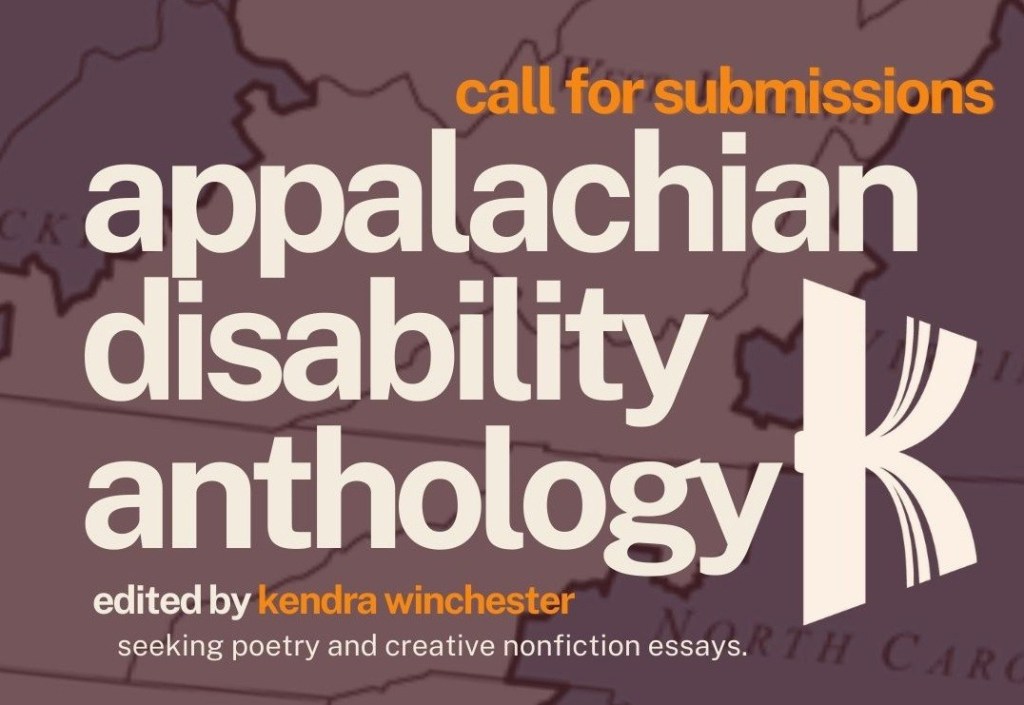
Submission Call for Disabled Writers from Appalachia: An Anthology Edited by Kendra Winchester

Many readers of this blog will be familiar with Kendra Winchester’s name from her work as the host of the popular Read Appalachia podcast, which celebrates Appalachian literature and writing. Kendra is also a Contributing Editor for Book Riot where she writes about audiobooks and disability literature. Kendra and I had a chance to spend some time together in person this past summer during the Appalachian Writers’ Workshop. One day while we were having lunch, Kendra started to tell me about her new project to compile and edit an anthology of work by disabled writers from Appalachia. The dining hall that day was so loud with conversation and laughter that we struggled to hear each other. So Kendra agreed to answer some questions over email about this anthology, which is actively accepting submissions.

DL: I was excited to learn that you will be editing an anthology of work by Appalachians writing about disability. How did the idea of this anthology form?

KW: Far too often, disabled people are treated like we’re invisible. When we are mentioned, we’re featured as inspirations, side characters, or burdens for the nondisabled people around us. Sometimes the very existence of our disability makes other people uncomfortable.

When I first read Disability Visibility, edited by Alice Wong, I didn’t realize how rarely I saw my disabled self in books. Reading stories about people like me was something I never knew I needed. This led me to seeking out as many books by disabled authors as I could get my hands on. Little did I know that there was a whole disability community waiting for me. We have our own culture and history. People just have to realize that it’s there.

In the vein of Disability Visibility, I wanted to bring together Appalachian writers to tell their own stories of what it’s like being disabled in Appalachia. With poetry being such a vibrant tradition in the region, I also wanted to include poets, and my goodness, so many Appalachian poets have shown up in such a big way. My hope is that this anthology will be the first of many anthologies of disabled writers from the region sharing their work with the world. The more voices, the better.

Sometimes people ask me if their disability “counts,” but we’re using the big umbrella for disability. So anyone who is disabled, chronically ill, deaf, or neurodivergent is most welcome to submit.

DL: Do people with disabilities in our region face challenges that are unusual or different from other regions?

KW: Appalachia has higher rates of disability than the national average. Some disabled people have had to completely leave the region to seek treatment. Some disabled people can still live in the region but have to travel back and forth to urban centers to see specialists. And others are disabled because they worked in major Appalachian industries, such as coal mines and paper mills. Whatever our experience, we all have stories to tell. 

DL: What genres are you seeking for this anthology, and how long should submissions be?

KW: I’m looking for creative nonfiction essays—around 2,500 – 3,000 words—that center the writer’s experience with living with disability in Appalachia. I’m also looking for poetry—3-5 poems—informed by personal experiences with disability in the region. I also welcome previously published work.

DL: Are you only looking for work from published, experienced writers?

KW:  I’m looking for writers of all experience levels! The anthology includes experienced, prize-winning writers and people who have never had a published piece before. 

DL: How can writers submit to your anthology, or reach out to you if they have questions?

KW: To submit their work or if anyone has questions, they can reach me at Kendra (at) readappalachia.com. I’m happy to answer any questions that they may have.

DL: When we were at the Appalachian Writers Workshop this past summer, you read a wonderful piece about growing up with a disability. Where can readers find that essay or any of your other recent work?

KW: Owning It: Our Disabled Childhoods in Our Own Words just came out in the U.S. this past August. It includes dozens of essays by disabled adults who were also disabled as kids. I was so honored to be included with writers like Ilya Kaminsky, Imani Barbarin, Ashley Harris Whaley, Rebekah Taussig, and Carly Findlay. I also write for Book Riot and have an occasional newsletter called.

Many thanks to Kendra Winchester for this important work and for answering my questions. You can find out more about Kendra and all of her projects by following her on Instagram or Twitter, or by subscribing to her occasional newsletter called Winchester Ave.

In case you missed it…Check out past conversations about writing and publishing with Melanie K. Hutsell, Zackary Vernon, and David Wesley Williams, whose new novel, Come Again No More, is out this week.

If you’re not already receiving these posts directly to your inbox, please subscribe.

Where the Story Demands to Go: A Conversation with Melanie K. Hutsell

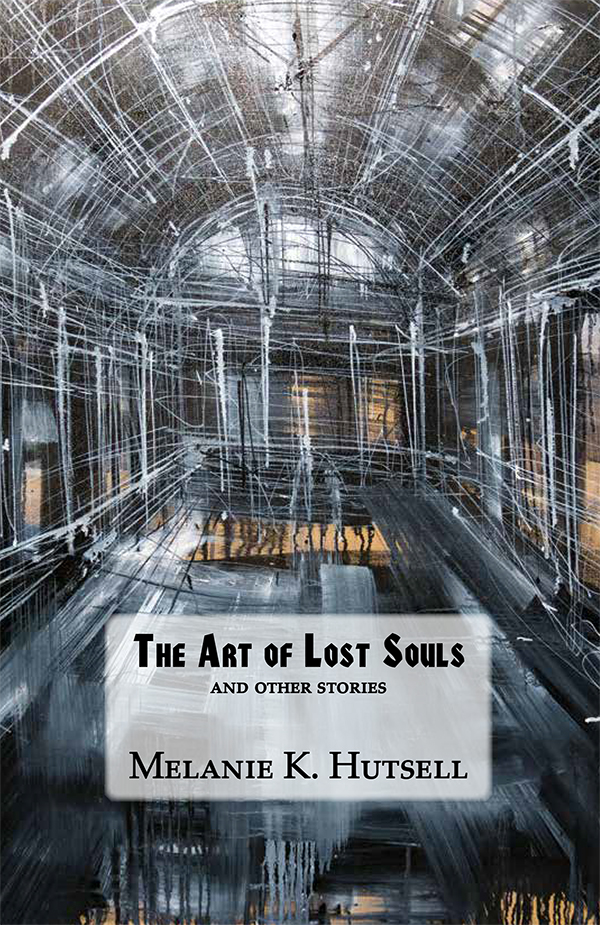
I’ve lost track of how long I’ve known Melanie K. Hutsell, but it’s been a few years. She’s a native of East Tennessee, and we share a mentor and many writer friends from this region. In the time we’ve known each other, she has published two novels, The Dead Shall Rise: A Tale of the Mountains, and The Book of Susan, which received the Award of Merit in the fiction category of the 2023 Christianity Today Book Awards. About a year ago, I ran into Melanie at a writers conference, and she told me about her new collection of short stories, The Art of Lost Souls, which she was in the process of sending out to publishers.

The Art of Lost Souls and Other Stories quickly found a home with Main Street Rag (MSR), and is currently available for pre-order. MSR and Editor Scott Douglass have a long history of publishing beautiful books. MSR is the press that published my first poetry collection, Crimes Against Birds. I’m forever grateful to MSR and Scott for taking a chance with my book, and I’m always excited to see MSR continue to publish good work like Melanie’s collection of short fiction.

In The Art of Lost Souls Melanie has created a cast of characters that are both achingly strange and sad. They are misunderstood dreamers, people on the verge of big transitions, wonderers asking what life would look like if all the pieces fit together. But as Hutsell’s characters face loss and uncertain futures, they reveal themselves to be creative souls with imaginations that help them survive. Melanie agreed to answer a few questions about writing, publishing, and not giving up on old projects.

DL: The title of this collection sets up how so many of your characters are some kind of artists, and usually, it’s their creativity that provides a sense of salvation to their stories. You’ve written in the past about having bipolar disorder. How does your background and your own experience of being a creative inform the characters you want to write about?

MH: This is interesting for me to consider. I’ve been aware that I do tend to write characters who are creatives—but until you asked this, I’d never really considered how seldom I write about writers. Because I do tend to think of my background as being fairly focused on words and pages, from an early age. And my fictional creatives tend toward other pursuits, like music or cooking or visual art. Maybe I tend to think, fictionally, of creativity as a way of expressing a character’s superpower, and of course, not everybody writes. I guess I tend to subscribe to the notion that all humans are here to create. I’m drawn towards the philosophy/theology in books like Divine Beauty by John O’Donohue or Art + Faith by Makoto Fujimura, which suggest humans are here to do and experience beauty and that creativity can be expressed in doing anything with love, and by love I mean with intention and giving, in the direction of God and humans.

DL: Some of the stories in The Art of Lost Souls are set in towns and locations that are real places, meaning you didn’t create them out of thin air. The first story is even titled Still Life in Townsend, referencing the town of Townsend, Tennessee. When you’re writing a story, how much do you draw on what you know about the place where it’s set?

MH: For someone who grew up reading a lot of fantasy, my adult work is pretty grounded in the Appalachia of East Tennessee. And I grew up in upper East Tennessee, and that is where most of my work is set, and Appalachian identity almost always is an important facet of my characters. Most of my settings are fictional, with strong underpinnings of reality to them. My two novels, The Dead Shall Rise and The Book of Susan, share some fictional towns with the short stories. Creating a fictional geography allows me to create needed settings or maybe to transport real-life places and set them down in new locations. But, yes, I do sometimes use real settings. In The Art of Lost Souls and Other Stories, both “Celestial Images” and “Still Life in Townsend” are set in real places, and the settings there really define the kind of stories they are. “Celestial Images” is about a homesick Appalachian living in Bloomington, Indiana, and “Still Life in Townsend” is about a motel family who specifically runs a business in the quiet—as opposed to the more tourist-deluged—side of the Smokies, and that’s pretty central to the story. The title story in the collection is set in Knoxville, though it’s a rather magical Knoxville. I was going there for a sense of urban history in that setting, something about time and distance. And sometimes I will invoke real places to make my fictional ones seem more real.

DL: One of the things I admire with the stories in The Art of Lost Souls is that you’re not afraid to go into some pretty dark spaces. But you usually bring some relief to the reader, too. Do good stories require pushing into that darkness?

MH: I do think the best writing is that which costs the author something to make and also requires great honesty. Often when something’s false in what I’m working on, it’s because I haven’t pushed myself enough in that spot, really faced what’s trying to be said there. I haven’t gone to where the story is demanding to go. And I think all of this is true whether one is writing realistic fiction or not, literary fiction or not. Because art is about being human. And there is a lot of darkness there. I consider myself to be generally wired up as someone who believes, but it’s dishonest not to acknowledge the dark.

DL: The Art of Lost Souls is your third book publication. But you’ve also been working for a long time on a magical realism novel. How do you balance multiple projects at the same time? And what keeps you returning to this unfinished novel?

MH: Well, the short answer is, I really don’t balance multiple projects at once. I actually become very absorbed in my writing projects, which is one reason—among many—that the unfinished novel remains unfinished. It’s a work that I’ve been wrestling with in many different variations since college. It began life as a fantasy novel and is a magic realism novel now. The Dead Shall Rise actually started, when I was in graduate school twenty-five or so years ago, as a manuscript written around a misbehaving character carved from the other work. After many years plagued by mental illness (though I didn’t know at the time that was what ailed me) and then devoted to recovery, the unfinished novel came back to me. But I set it aside to focus on writing and publishing short fiction to hone my craft and get a publication history. And then I opted to revise The Dead Shall Rise and seek publication with it, being a more complete manuscript, than to finish the messy, half-done one. And then The Book of Susan got written because of an agent’s interest engendered by reading one of my published short stories. (The agent ultimately passed on Susan.)  And I’ve long wanted to have a collection of my short work appear all in one place, and Main Street Rag publishing The Art of Lost Souls is a realization of that dream. Meanwhile, in between these projects, I’m writing along on the poor, longsuffering, untitled novel, because I can only do one thing at once. I suppose I find the protagonist compelling. Possibly he is my alter ego, more so than any other character I’ve written.

DL: I think you know that I have so much respect for small and independent publishers. Now that you’ve published three books with different small presses, do you have advice for writers about how to get published?

MH: You don’t need an MFA, and you don’t need an agent. Not that those are not good, helpful, and desirable things. But I have neither. I say: write and be a student of writing. I was fortunate to have a mentor when I was in high school, poet Jane Hicks, who was my guidance counselor and who taught me to approach writing professionally. Back then, it was the Writer’s Market and SASEs. Now it’s Submittable and Substack and unknown frontiers. Stay abreast of the ever-evolving business. Always read the guidelines. Don’t be afraid to submit. Don’t let rejection define you – learn from it. And definitely consider small presses as options for submitting your work. I’ve loved working with each press I’ve worked with. Each has devoted such care to seeing my manuscript through the process, helped me better realize the vision I’ve had for that particular work. I’ll pass along advice once given to me—you’re looking for the press that loves your manuscript as much as you do. There’s a lot to be said for sending your work to an indie press.

Many thanks to Melanie K. Hutsell for answering these questions. Find out more about Melanie here, and be sure to pre-order The Art of Lost Souls from Main Street Rag Publishers.

In case you missed it… I recently read with Georgann Eubanks for the Spoken & Heard series. And I’m so grateful that Feller has had some great reviews from Jake Lawson in MicroLit: a Tiny Journal of Prose & Poetry, Noah Soltau in Red Branch Review, and from Meredith Sue Willis in Books for Readers. I hope you’ll take a look.

If you’re not already receiving these posts directly to your inbox, please subscribe.

Official Cover Reveal for Feller

Friends, I’ve been really excited for today to come! After what feels like a long wait, I can finally share the cover for my new collection of poems, Feller. But first, here’s one last teaser:

To view the entire image, head over to Electric Literature who very graciously is hosting the official cover reveal. I’m incredibly grateful for Electric Lit’s support and help in launching this new book.

I’m also grateful to Mary-Frances and Jim Burt of Burt & Burt who designed this cover image. It’s really striking and hits the exact right emotional key. I’m always grateful to Mercer University Press, especially my editor Marc Jolley, for believing in my work in general and Feller in particular. And huge thanks to Kelly March for coordinating this cover reveal in the first place. She’s amazing!

Feller is a book that has been a long time in the making. Some of these pieces took over ten years to transform from first draft to finished poem. There will be more opportunities later to talk about the individual poems and what the collection is about. And as always, I’m more excited to hear what the poems and the book mean to you. So I hope you’ll read Feller. The official pub date is August 5th, 2025, but if you want to hear a few of the new poems, you can listen to this episode of The Beat, a poetry podcast hosted by Alan May.

And don’t forget to take a look at the whole image over at Electric Literature. I hope you like it as much as I do.

Book Launch for Claudia Stanek’s Beneath Occluded Shine

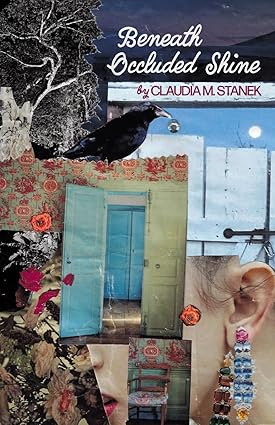
Last week, I was invited to be part of the launch of Claudia Stanek’s poetry chapbook, Beneath Occluded Shine. This is a short collection of 16 powerful poems all written in response to poems from Pablo Neruda’s Book of Questions. Neruda’s questions are essentially unanswerable. Claudia doesn’t attempt to answer Neruda although responding to a question with a question is sometimes its own answer. But I prefer to read these poems as wrestling with all of the deepest parts of our shared humanity.

You can read one of Claudia’s poems, Sunday Morning in Broken November, originally published here in Bitterzoet Magazine.

The book launch took place virtually as part of Jules’ Poetry Playhouse, hosted by Jules Nyquist and John Roche, who are based out of New Mexico. In one of the most unique reading events I’ve ever been part of, Claudia invited Jules and John, as well as poets Catherine Faurot, Gail Hosking and me to alternate reading all of the poems in Beneath Occluded Shine. The result was something that felt meditative if not downright spiritual.

You can watch and listen to our reading of Claudia’s work on YouTube.

And don’t forget to order Beneath Occluded Shine from Finishing Line Press.

Thanks for reading. If you’re not already receiving these posts directly to your inbox, please subscribe.

And in case you missed it, I celebrated National Poetry Month by reading new poems from my forthcoming collection, Feller, forthcoming in August 2025. You can listen to the reading by following the links here.

Wrapping Up National Poetry Month

I don’t ever remember a past April where I could visibly see poetry celebrated so often and in so many ways. Maybe one of the things we couldn’t predict about living in a dystopian world is how people would turn to poetry. Regardless, it was beautiful.

For my part, I had the privilege of reading poems to the monthly book discussion group, All Over the Page, at Lawson McGhee Library in Knoxville, Tennessee. I read poems from Tamp, as well as some new poems from a new book that will coming out in August.

Yeah, I sort of just buried the lede there, didn’t I? But that’s right. I have a new collection of poems coming out in August from Mercer University Press. It’s called Feller. I just saw the cover for the first time this week, and I love it so much. I can’t wait to share it with you all very soon.

In the meantime, that reading at Lawson McGhee Library was recorded as an episode of their podcast The Beat. You can listen to the episode here: https://the-beat.captivate.fm/episode/denton-loving-joins-us-live-for-all-over-the-page.

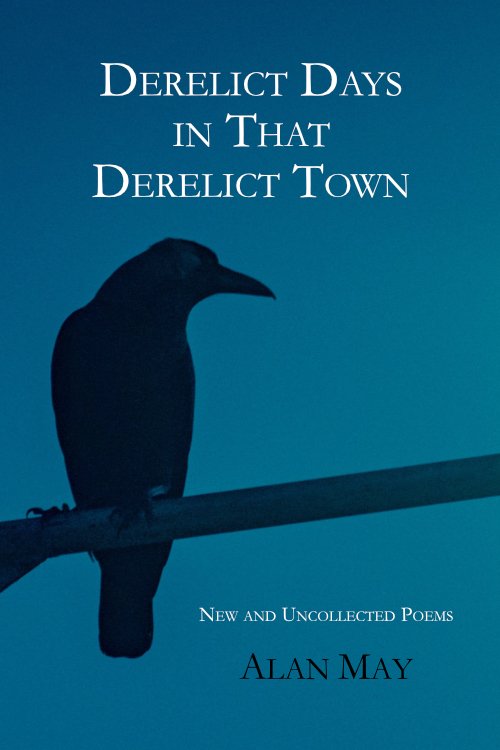
Special thanks to Alan May, Lawson McGhee librarian and host of The Beat, who invited me. Alan has a great book of poems out himself: Derelict Days in That Derelict Town: New and Uncollected Poems, published through BlazeVOX Books. I hope you’ll check it out.

There’s another lovely book recently out that you should know about, and that’s Beneath Occluded Shine by Claudia Stanek, published by Finishing Line Press. Claudia will be celebrating an online book launch on Wednesday, April 30, 2025, at Jules’ Poetry Playhouse. I’ll also be there reading a couple of poems along with poets Gail Hosking and Catherine Faurot. The reading is at 6:00 p.m. Pacific / 9:00 p.m. Eastern. It would be so nice to see you there.

Thanks for reading. If you’re not already receiving these posts directly to your inbox, please subscribe.

Book Launch for Darnell Arnoult’s Incantations

Last week, I had the privilege to be part of the book launch for Darnell Arnoult’s new collection of poems, Incantations. This collection is a mesmerizing group of poems that celebrates language in unique but powerful ways. Many of the poems came out of a period of grief, but the poems are also celebratory and full of hope. They speak simultaneously to the personal and the political, addressing some of the most significant challenges of our times.

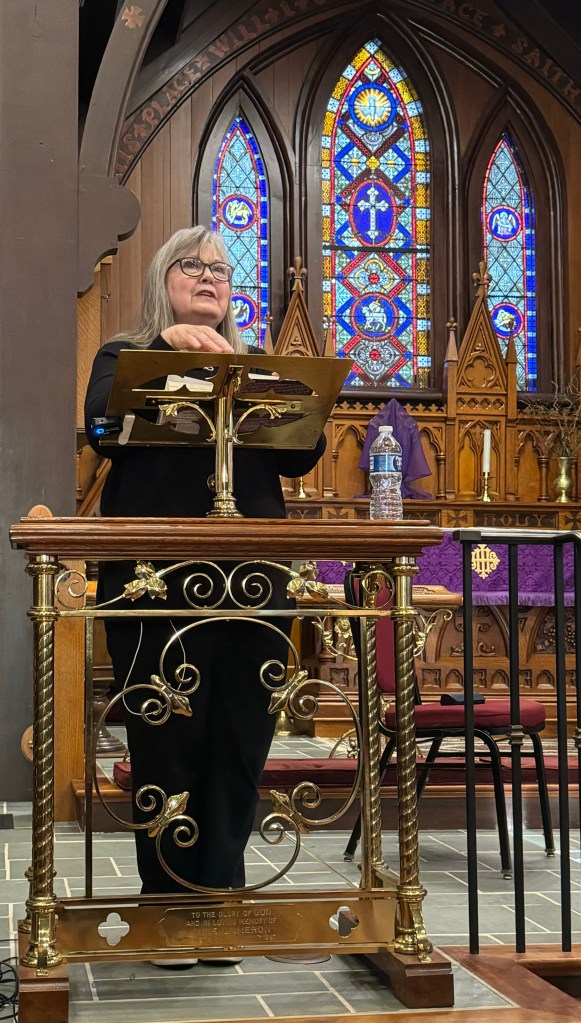
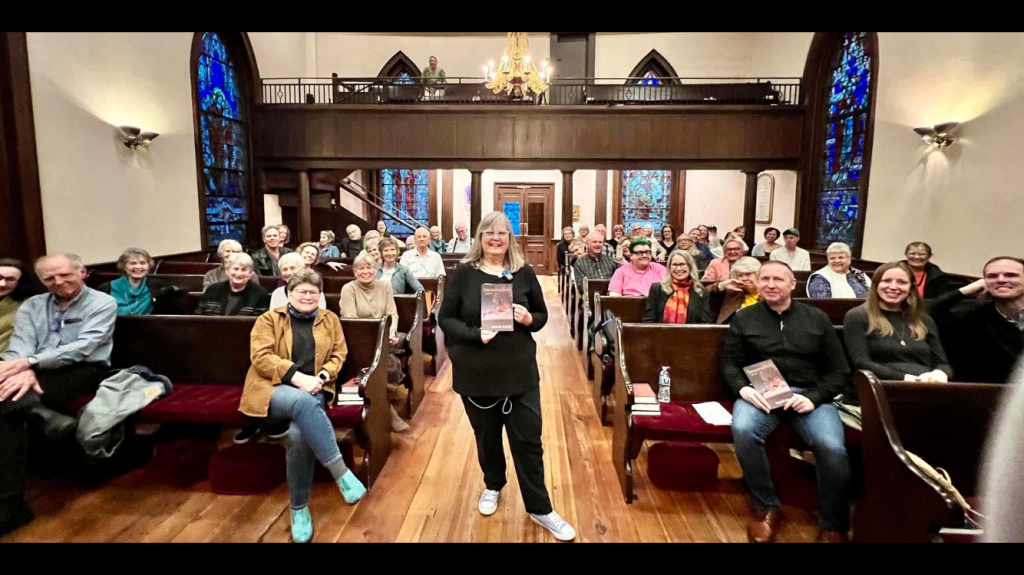
The launch took place in Hillsborough, North Carolina, at St. Matthew’s Episcopal Church as part of their Faith and Arts Series. Darnell gave a beautiful reading of her new work. The church was filled, and Purple Crow Books sold all of their copies after the reading. Alison Weiner accompanied her on the piano. And I had double duty that night, first introducing Darnell and then following up with an on-stage discussion about her work. The on-stage discussion was especially fun, and I hope an audio recording of it will be available at a later time. Until then, I want to share my introduction. It was such an honor to be part of welcoming this new book into the world, as well as to celebrate my good friend. I may have also added a little good-natured ribbing.

Welcome, and thank you all for coming out tonight to celebrate our friend Darnell Arnoult and her newest collection of poems, Incantations!

If you are here tonight, there is a good chance that you already know Darnell. Before I get too personal, allow me to properly impress you with a few of Darnell’s professional accomplishments.

Darnell is the author of the novel Sufficient Grace, and two previous collections of poems: Galaxie Wagon and What Travels With Us, and she has published stories, poems and essays in a variety of journals and anthologies.

She is the recipient of the Southern Indie Booksellers Alliance Poetry Book of the Year Award, the Weatherford Award for Appalachian Literature, the Thomas and Lillie D. Chaffin Award, and the Mary Frances Hobson Medal for Arts and Letters. In 2007 she was named Tennessee Writer of the Year by the Tennessee Writers Alliance. She holds degrees from The University of Memphis, North Carolina State University, and The University of North Carolina at Chapel Hill.

If you know Darnell, it’s likely because you have studied with Darnell, perhaps at the Table Rock Writers Workshop, the John C. Campbell Folk School, the Appalachian Writers Workshop, the Tennessee Mountain Writers annual conference, through Learning Events, the Mountain Heritage Literary Festival, or perhaps even as an undergraduate student from Lincoln Memorial University where Darnell served as Writer-in-Residence from 2010 to 2020.

Lincoln Memorial University is the place where Darnell’s and my lives began to intertwine. We co-directed the Mountain Heritage Literary Festival. And we also created and shared editing responsibilities for the literary journal drafthorse, a journal dedicated to writing about labor and occupation. Darnell and I worked together, often getting each other in and out of trouble, and we became wonderful friends in the process.

I cannot list all of the pieces of good fortune that have come to me because of Darnell, mostly because Darnell told me to do something—often something I didn’t want to do or didn’t have faith that I could do. There are too many of these instances to list, but I will tell you that when I decided to apply to MFA programs, Darnell decided I would go to Bennington College’s low residency program in Vermont. I, on the other hand, lacked the ability to imagine being accepted in that program. I didn’t even have any intention of trying. But if you know Darnell, you know that once she’s made up her mind, you might as well agree or get out of the way. It is no exaggeration to tell you that the only reason I applied to Bennington was to shut Darnell up. As she seemed to know in advance, my life changed in innumerable ways because of that program, all for the better.

Darnell is the person who has encouraged me the most as a writer and certainly as a poet. Darnell probably knows my poetry better than anyone, and she has probably influenced my poetry more than anyone. A lot of my early poems originated in workshops Darnell taught. She was the first person who thought I had enough poetry to form my first book, and she largely arranged the order of that book, which in itself was another incredible lesson in learning how to shape individual pieces into a larger narrative. She has seen so many first and early drafts that it’s a wonder she still opens my emails.

In the 10 years that Darnell taught at LMU and lived in Cumberland Gap, Tennessee, my life was richer, and a lot more exciting. In her absence, there are fewer people asking me if I have seen Darnell, if I have any idea where Darnell is, if I can find her, please, help, she’s not answering her phone, she never answers her phone! Why doesn’t she ever answer her phone? There are fewer reasons to rush to the emergency room. There are fewer visits from the fire department. In short, there is much less excitement, and my life is poorer for her absence.

To answer the question as to why Darnell rarely ever answers her phone, I can report that she may have turned the ringer off two days earlier and can’t find the phone, she may have left her phone at home or at someone else’s home, or any number of other places along the way, the battery may be dead, or more likely, she is just already on the other line with someone else who needs to talk to her just as badly as you may need to talk to her. The number of people who rely on Darnell is uncountable. The number of people whose lives have been enriched by Darnell is legion.

I would be remiss to not acknowledge that the 10 years in which Darnell lived in Cumberland Gap were not completely happy. For Darnell, I know that time period is framed by her husband William’s recurring illnesses, his battle with cancer, and his passing in 2020. The poems in Incantations were born from that grief. The deepest kinds of grief. Grief that comes, as she would describe, from worlds burning, from death that dances and glides, from widowhood with its slaughtered and emptied heart.

And yet, within these poems, Darnell also rejoices in the curative properties of language, how it can bewitch and rescue us from despair. When you look at the beautiful cover of Darnell’s new book, you will see an image of fire and light bursting into the darkness. As that image suggests, these poems tell us that there is salvation in the darkness. There is salvation in these poems that are also charms for remembrance, charms for protection and rebirth, and always charms for love, no matter how it may shift its shape.

Join me in welcoming Darnell to the stage as we celebrate her new collection of poems, Incantations.

~

You can read a sample of poems from Incantations online at Cutleaf. Or you can order a copy through Purple Crow Books, directly from Madville Publishing, from your own local bookstore or anywhere books are sold. (Photos courtesy of Donna Campbell and Kelly March.)

~

In case you missed it… check out my conversation with David Wesley Williams about his novel Everybody Knows.

~

If you’re not already receiving these posts directly to your inbox, please subscribe.

Honesty is Bravery Enough: Conversation with David Wesley Williams

Last October, as I was preparing to drive to Nashville for the Southern Festival of Books, my friend Patti Meredith told me to keep an eye out for David Wesley Williams. I found him quickly enough, signing books after his panel with George Singleton. We only had a brief time to chat, but I picked up his new novel, Everybody Knows, and asked him to sign it, not guessing that I would not have time to read it until the new year rolled around. But what a way to say goodbye to 2023 and hello to 2024.

Everybody Knows is a post-apocalyptic satire, but it’s also incredibly beautiful and smart, and a real pleasure to read. As far as apocalypses go, floating across Tennessee on a river boat is not a bad way to go. And it’s always a joy to read the work of an author who clearly enjoys language and is a master at putting words through their paces.

In addition to Everybody Knows, David Wesley Williams is the author of the novel Long Gone Daddies. His short fiction has been featured in Oxford American, Akashic Books’ Memphis Noir, Harper Perennial’s Forty Stories, and journals such as The Pinch and The Common. He spent thirty-five years as a reporter and editor, most of them in Memphis, where he still lives. David agreed to answer a few questions about his writing, his love of music, and the great state of Tennessee.

DL: As a fellow Tennessean, I have to tell you that I thoroughly enjoyed watching you destroy our state. Was that destruction as fun for you to write? And will you talk about how this narrative started for you? Would you say the tone of this book, especially the satirical nature, is similar or different from your first novel and your other writings?

DWW: I didn’t wish destruction upon Tennessee—really!—but I did relish the idea of Memphis, City on the Bluff, being the last hope and refuge for the state. Because as a long-time Memphian I know the ill will—in some cases, the outright hatred—a lot of Tennesseans hold toward Memphis. I suspect some Tennesseans would rather take their chances with a flood than come here.

The novel was written over several years and revised many times, but it always began with the couple on their porch, watching the rain and the coming flood, and one saying, “It’s not the end of the world,” and the other saying, “I think the end of the world’s been called on account of rain.” Later, it actually became a book about the end of the world.

I’d never written satire—or intended to. My first novel, Long Gone Daddies (2013), was about three generations of musicians and the family guitar they handed down. But with Everybody Knows, I was writing at a time when it was impossible to ignore what was going on with the country, the world, the planet: climate change, issues of race, religion, public health, gun violence, crime and punishment, the political divide. Everything was (and still is) so fraught. I felt like I had to write about those things, but in a way that made sense for me. In a way that helped me cope. Writing angry doesn’t work for me. Humor does. So I wrote a self-described “Southern Gothic, mock-apocalyptic, shrunken-epic satire.”

DL: Music is a driving engine in Everybody Knows. Even the title comes from an O.V. Wright song, which I’m so very glad to know now because of your book. It’s clear that you have a passion for all kinds of music, as well as an academic and historical understanding of music. How did you come to see music and particularly the state of country music and Music City as a way to talk about culture and politics?

DWW: I love music, particularly Southern music, which shows up in pretty much everything I write. Music gives Memphis so much of its cultural identity, and also some of its finest moments as a city—white and Black Memphians, working together, to create sublime art.

Also, I think Memphis musicians have always sought success, but on their terms. You can’t easily bend them to the will of the commercial gods. It’s about the song, not a gold record. Sure, we had a band that called itself Big Star, but it didn’t actually sell many records.

Nashville is a whole other place. It’s about business there. How can I say this? I hate modern country music. And when I say modern, I think they’ve been ruining country music in Nashville—turning it to pop—since at least Patsy Cline.

All that said, there’s a lot of Nashville music I love, past and present. One of the characters in Everybody Knows names his boat after Emmylou Harris. Gillian Welch and David Rawlings are on a short list of my favorite performers, alongside the likes of Bob Dylan, Neil Young and—another Nashville favorite—John Prine. Classic country is matchless music. And the Ryman is a national treasure. So there. I don’t hate Nashville. I don’t.

DL: In addition to using humor, irony, and exaggeration to make your readers laugh, you touch on some important topics, especially about race. I took note of how Emmett Till and George Floyd’s deaths were both touchstones within your narrative. Do you have advice for other writers about how to address big cultural moments in fiction?

DWW: I think it really comes down to one thing: Be honest. Say what you believe, say what you feel, say what needs to be said, by you, in the moment. Don’t pander, don’t hedge, don’t calculate. I guess I could add “be brave,” but honesty is bravery enough.

Now, all this may be easy for me to say, because not many people are reading what I write. Everybody Knows was published by a small press and not widely reviewed—but trust me, dear reader, there’s some wild stuff in there, hiding in plain sight!

DL: I’m always interested in the way we identify ourselves with location. You live in Western Tennessee, but you’re originally from Kentucky, as are several important characters in your novel. How does place inform your identity, and impact your writing?

DWW: I think place is everything in fiction. I tend to think of place as a character. Certainly Memphis is a character in most of my stories and novels. And what a character it is—“the old Delta synonym for pleasure, trouble, and shame,” as Eudora Welty called it in one of her books.

Kentucky keeps showing up in my books, in small ways. I think I’m working up to a full Kentucky novel, inspired by my hometown, Maysville—another character worthy of fiction. Daniel Boone lived there. Casey Stengel played ball there. It was Rosemary Clooney’s hometown.

DL: I often ask writers about the process of submitting their manuscripts for publication. Can you describe the time between writing and publishing Everybody Knows? How did you connect with Jackleg Press?

DWW: I queried some 60 agents with the first version of the book, in 2019. The majority didn’t respond. It was already a book about the country unraveling, so it felt natural to revise in 2020 amid the pandemic and the George Floyd murder and the country on fire. I started submitting again, this time with a query letter that began, “What would Kurt Vonnegut write about these times and those ahead for America, if he were alive today — and if he were Southern?”

I sent to a combination of agents and publishers—another 60 or so. The response was the same. They didn’t reject it as much as ignore it. They weren’t even reading it. Which was fine—I just needed one person to give it a chance. Then in early August 2021, I came across a small publisher called JackLeg Press. They asked to read the full manuscript, loved it, and within a couple of weeks I had a signed contract. They’ve been great partners, and we’re looking forward to another novel together. More news on that soon, hopefully.

I’m so grateful to David Wesley Williams for answering these questions. If you haven’t already read Everybody Knows, be sure to order your copy, available at bookshop.org or wherever books are sold.

~

In case you missed it… check out my conversation with Georgann Eubanks, where we discussed her travels across North Carolina celebrating some of the state’s most unique foodways in The Month of Their Ripening.

~

If you’re not already receiving these posts directly to your inbox, please subscribe.