Conversation with Patti Frye Meredith

I can’t exactly remember the first time I met Patti Frye Meredith. I definitely have memories of her at one of the early Mountain Heritage Literary Festivals making people laugh and playing music late at night. One thing I know for certain is that Patti can make anyone laugh. That’s true whether you’re fortunate enough to sit down and share a meal with her, or whether you’re reading her beautiful new novel, South of Heaven, a multi-generation narrative set in Carthage, a small town in the Sandhills of North Carolina. At the center of the novel are two sisters, Fern and Leona. Both have secrets they are keeping from each other and from the world. There’s also Fern’s son Dean who, as Fern says, doesn’t have any secrets. South of Heaven is a meaningful exploration of how the things we try to keep bottled up complicate relationships. The novel is deeply Southern, completely universal and wonderfully fun to read.
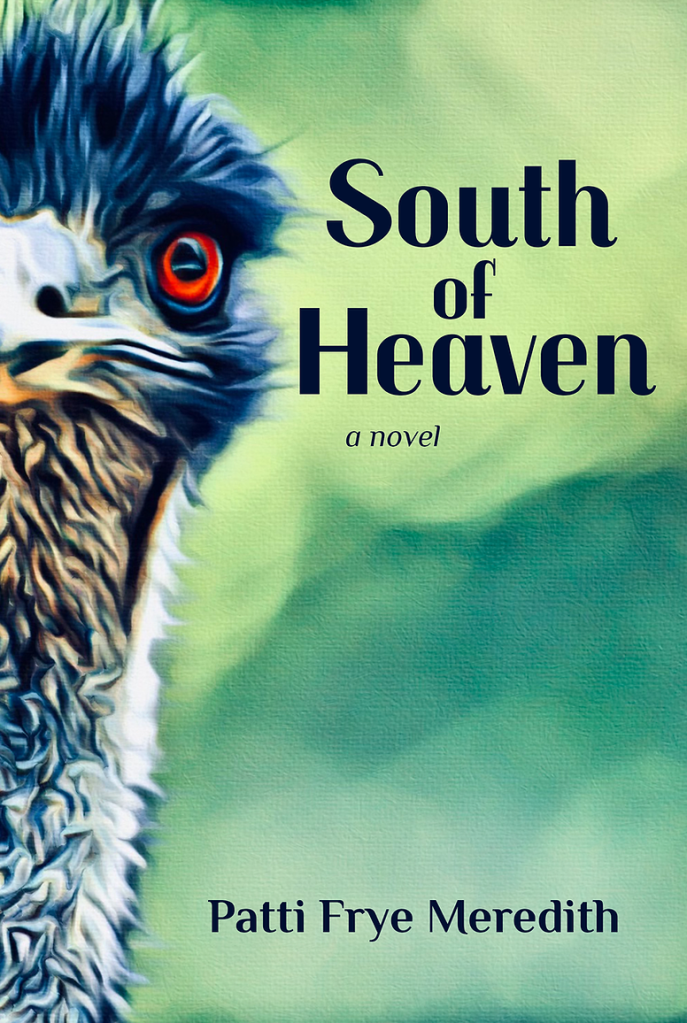
DL: South of Heaven centers on the McQueen family, and it’s set in the late 1990’s, a time not so long ago but a time that feels infinitely different in hindsight. Do you have any advice for other writers writing about the recent past?

PM: When Dean first “talked to me in my head,” he told me his dad was MIA in Vietnam, and how as a child he pretended to find his daddy in the overgrown bamboo patch in his backyard.

I wrote the book from that one scene. I knew Dean was in his early 20’s, and that his father went missing at the very end of the war. That’s why I set the novel in 1998. After I got into it, other 1998 occurrences came into play like the Clinton/Lewinsky drama. There’s a lot in the book about the lengths we will go to avoid the truth, so that worked.

Early readers suggested that I move the story up in time, to make it more contemporary, to use the Iraq War instead of the Vietnam War and put it in present tense. I tried, but I couldn’t make it work. By that time, too, I felt like I knew Fern and Leona very well, and I realized they wouldn’t be the same people if they hadn’t grown up like they did in the sixties.

There are pitfalls. It’s not historic, and it’s not contemporary. The characters are just modern enough for readers to wonder, “Why would they think that?” or “Why would they do that?” It’s embarrassing, but I had to do research to remember if everyone had cell phones in 1998, or if fax machines were still a thing. We’ve seen a lot of change in twenty-four years, and it’s amazing how quickly we forget recent history.

DL: I loved reading the “Backstory” on your website about your job at University of North Carolina Public Television, and how you met so many writers there. The authors you mention (Lee Smith, Doris Betts, Reynolds Price, Fred Chappell) all come from the Southern tradition, and South of Heaven feels like a very Southern novel. How natural was it for you to write in that tradition?

PM: Like so many others, reading Eudora Welty, Elizabeth Spencer, Lee Smith, Jill McCorkle, Tim McLaurin, and so on and so on, showed me that stories set in small towns were okay to write.

I grew up in Galax, Virginia, population around 6,000. So, it was natural to stick to the world I knew. Thinking about it, I’ve now lived in Memphis and Chattanooga, Tennessee, Huntsville, Alabama, Durham and Charlotte, North Carolina, Columbia, South Carolina, and Baton Rouge, Louisiana. Cities large and small, but with the same southern sensibilities. (Or maybe I think all those places have the same southern sensibilities because “wherever you go, there you are”!)

DL: Did you feel any pressure to “live up” to the works of those writers you admired so much?

PM: If I thought I had to live up to their work, I’d never write another word! Back when I first started writing, I didn’t know what I didn’t know, however, it didn’t take long to realize I was never going to be in the same league with the writers I admired most. I’d give anything to see the world and put that world on the page like Fred Chappell, but I don’t have his complexity or depth. That doesn’t mean I don’t love reading his work. But, even when you study the craft and learn what makes great literature, even when you can recognize it, it’s still not possible to re-engineer your brain to create it. Thank heavens. There should be only one Lee Smith, one Jill McCorkle, one Darnell Arnoult.

That’s not to say I don’t spend a lot of time being discouraged! But you have to write what you write, be who you are, I mean, you can’t fake your subconscious! We all have our own perspectives and experiences, and we’ve all drawn our own conclusions.

I’m hooked on the joy of writing. The discoveries, the occasional good sentence, exploring the minds of my imaginary people. Writing helps me understand what matters and it’s my way of expressing what strikes me—good and bad—about being human.

And, since I love a cliché, I’ll say, “It’s the journey, not the destination.” Chasing after the “secret” to good writing has led me to friends who absolutely make my whole life better. Having the opportunity to be with other writers is the best reason to write!  Sorry for getting off on a tangent, but maybe that’s the southern tradition!

DL: How long did it take you to write South of Heaven? How many drafts did you go through?

PM: There’s no telling how many drafts I have. Dean’s voice came to me at Hindman Settlement School in 2005. I wrote the original draft in first person present tense. Then changed it to third person present tense for my MFA thesis at the University of Memphis in 2012. Then I wrote a draft in third person past tense. I was always changing something, adding, taking away. Starting over. We moved seven times in twenty-eight years for my husband’s job, so I had a lot of distractions (excuses) through the years.

When my husband retired and we moved back to North Carolina, I set up my little office and joined a weekly writer’s group. Then the pandemic hit. Everyone is different. I know there are many great writers with extremely busy lives, but for me, the stillness of the pandemic quarantine made it possible to devote the time I needed to work. No travel, no socializing. I don’t think I understood what it meant to really work until the pandemic. I discovered the long stretches of uninterrupted time helped keep the story together in my head, helped me play out the scenes I needed to make the story more cohesive. I think of it as bandwidth. Writing South of Heaven took a lot of bandwidth!

DL: Your novel is published by Mint Hill Books, an imprint of Main Street Rag which published my poetry collection, Crimes Against Birds. What was your experience like in finding a publisher?

PM: I can’t remember if I saw Main Street Rag’s call for novel chapters on social media or in Poets & Writers, but I had one of those “What the heck” moments and sent chapters. Months later, I got an e-mail saying they were interested in publishing the novel, and Scott Douglass sent a contract and a detailed explanation of how the process would go.

I had sent out query letters to agents off and on for years. (One agent had almost taken it years ago, but that fell through when the third reader in her office didn’t think they could sell it.) I knew South of Heaven wasn’t the kind of book that was getting the attention of traditional publishing, or the independent presses I was familiar with. It wasn’t full-blown literary, and it wasn’t quirky enough to be chick-lit.

I didn’t think it was going to set the literary world on fire, but I wanted my imaginary people to live in a real book. So, I asked you, Sue Dunlap, and Darnell Arnoult to read it and tell me if I was about to embarrass myself, and you all said, “Do it.” So, I did. I fiddled with it after I got it back from you all, and I hired an editor to make sure I hadn’t added a lot more typos. Then I fiddled with it some more, and my niece, Becki Vasques, found my last snafus. We made it a family and friend affair! You and Darnell suggested I put an emu on the cover, and my husband, Lee, and I put it together (with Darnell on the phone). It’s been fun. Not “have lunch with your agent in New York City” fun, but better. A true labor of love. And I like that my North Carolina story is published by a North Carolina press. Scott Douglass does something very special with Main Street Rag. He publishes wonderful poetry and stories. I’ve gotten to know him and his wife and his dog, Harley, and I really appreciate the work he does.

DL: Do you have any advice for other writers ready to send their novel out?

PM: Don’t discount the small independent presses. We all appreciate independent bookstores. These presses deserve our appreciation, too.

Do ask yourself if you’re ready to be in the book marketing business, though, and the weird thing is part of that is selling not just the book but yourself. The great thing about the small press is, “You have a book to sell.” The scary thing about the small press is “YOU have a book to sell.” Just be honest with yourself about what you want to accomplish and why you’re doing it.

For me, the experience has been amazing because it has reminded me that I have the very best family and friends in the world. The support has been phenomenal. People I haven’t seen or talked to in ages bought my book after seeing my Facebook posts. Friends talk about my characters like they’re real people they care about. So, if I don’t sell another book, I’m very happy with the response South of Heaven has gotten.

CYNICAL ALERT!

The truth is, without Facebook, I wouldn’t have sold m(any) books. South of Heaven is in two bookstores, Chapters in Galax, my hometown, and McIntyre’s in Chapel Hill, where I live now. I’ve had one reading at McIntyre’s. I hired a publicist, and maybe there will be more readings, but maybe not. Even if I devote a lot of time to driving around, going to bookstores, taking them a book and a nice press kit, there’s no guarantee they’ll carry it. I have a couple of book club gatherings coming up. The bottom line is: It’s up to you to promote your book, to make yourself known. I believe even if you have an agent and a traditional press, they want you to have a “platform” meaning they want you to use your social media connections to publicize and sell your book.

DL: You’ve described South of Heaven as coming out “late in life.” We could argue about what that means, but I’m more interested in something else you said which is that having the novel out in the world helped clarify where and on what you want to focus your energies. Can you talk more about that?

PM: I know for sure I don’t want to be an author who dresses up and talks about writing. I want to be a writer who writes. I want to spend more time with my imaginary people and less time telling real people why they ought to like my book! Ha! I recently got together with a group of my writing friends, and afterwards I realized all we’d talked about was how close each of us were to having finished products to try to get published. Like there was some big door we were all clamoring to walk through to get to a different, more perfect life. I want to spend more time talking about ideas, or break-through moments, or what we’ve discovered about the craft. I don’t want my energy focused on end-products. I want to focus on better writing and storytelling.

DL: What are you working on now?

PM: Not much. I’m caught up doing what I think I ought to be doing to sell books. It’s uncomfortable and not much fun. I did have a little “conversation” with one of the characters in South of Heaven the other day. So, I wrote that down.

* * *

Find out more about Patti on her website, and don’t forget to order South of Heaven, now available from the Main Street Rag Bookstore. Coming soon, I’ll share my conversation with Tony Taddei about his debut story collection, The Sons of the Santorelli. Make sure you never miss a post by subscribing here:

Conversation with Julia Wendell

Julia Wendell is a poet currently living in Aiken, South Carolina. She is also a three-day event rider, the experience of which considerably informs her newest collection of poetry, The Art of Falling, published by FutureCycle Press. Amanda Moore said this about The Art of Falling: “…knowing how to fall allows Wendell’s open-eyed work to acknowledge pain but not be weighed down by it, moving instead to consider what blossoms and grows each passing season. Love here is represented by and extended to plants and animals—reluctant gladiolas, bursting peonies, a menagerie of dogs and birds—but nothing so beloved as horses, an anchoring and comforting presence throughout.”

I found The Art of Falling to be a powerful book encompassing decades of Julia’s life, moving from childhood traumas to complexities of adulthood. In one poem, Julia describes the art of falling as a practice perfected through pain and intense self-awareness, visible in “the coat hook / of my separated shoulder, / my spine’s bumpy lane, / sunspots littering my back— / the parts of me / I can’t see without mirrors.” In other poems, the art of falling is also made known in far less visible ways. Julia was kind enough to speak to me about her new book, her writing process, ekphrastic poetry and what it’s like to be married to another poet.

DL: Many of the poems in “The Art of Falling” touch on a fall you suffered from a horse that caused significant physical pain. But these poems reveal other traumas as well. What’s your process like for transforming writing about trauma into a well-crafted poem?

JW: It wasn’t one fall from a horse, but many: actually, a lifetime of falls. The old directive is true for me—you fall off a horse, you get back on. You fall off a poem, you get back on. Some falls are worse than others. And the older you get, the worse they tend to be, and the harder it is to get back on. Several years ago, I broke my hip as well as my leg falling from one of my horses, and that fall transformed my life for a year, as well as the writing of The Art of Falling. I found ways to live through the pain and to see through it. I had to change my life pretty drastically during that time, and my poems became both a respite and a way to work through the ordeal. I couldn’t get on a horse, but I could go to my desk with the help of a cane or just steadying myself on furniture as I went across the room.

DL: I was thrilled to read your poem, “Horse in the Landscape” which is an ekphrastic work related to Franz Marc’s painting with the same name. This is also the image used for the book’s cover. I recently taught a workshop on ekphrastic writing. Can you talk about the relationship that can exist between visual art and written work? Are you also a visual artist?

JW: No, I’m not a visual artist, but the piano is my brush; has been all my life, and music often finds its way into my poems. In reference to the above question about writing through pain: while writing the poems in The Art of Falling, I re-visited Frida Kahlo’s life and work. Her example taught me how to keep making art while in terrible pain. I read everything I could get my hands on about her life and artistic process, and studied her strange, surreal self-portraits. I even went to Mexico City after I had partially healed and visited her house, Casa Azul. I was drawn to her for the obvious parallel between her life and mine at the time. Both of us had our hips gored by rods, except that hers was put there by a bus and mine was put there by a surgeon. Here was an artist who experienced a lifetime of pain, and yet she kept getting back on the horse of her art to create her organic, visceral, paintings. The poem “Portrait Chinois” came directly from my re-experience with Frida’s work.

Similarly, the figure of the broken girl in Wyeth’s Christina’s World reminded me of my own plight; and through her semi-reclined pull and yearning for the gray house on the hill, despite her infirmities and inability to walk, drew me to ponder what it would be like for her to crawl to the house, to go inside, to open up her world and reach her dream destination.

I have always loved Franz Marc’s work for its ebullience and movement, and of course for its subject matter. But what pulled me to Horse in the Landscape is also what struck me about Christina’s World—we see a still landscape through the girl’s and horse’s perspectives, as they turn their backs to us. It is a world of no movement, only thought and perspective, possibility and possible movement, which is what my life had become during the time I was so badly injured. I had to contemplate my life through quiet and stillness, and find my poems there.

I chose the cover for The Art of Falling before I had written Horse in the Landscape. The pdf’s of the interior of the book were almost ready for the printer. Suddenly, I had the urge to write the poem and spent last Christmas season writing and re-writing it, thinking I would save it for some other project. Then Diane Kistner, the editor at FutureCycle Press, contacted me. Did I have another poem that might fit into the book? The way the pages were laying out, she needed one. Uncanny coincidence.

DL: I always ask writers about the process of compiling, submitting and publishing their books, and I’m especially interested in asking you because this is, I believe, your eleventh book. How long did it take you to write and shape the poems in this collection? How did you find and form a relationship with FutureCycle Press?

JW: The poems in The Art of Falling span at least a decade. The last book, Take This Spoon, had a very specific theme of poems about family, and the relationship to food and eating and anorexia, and even incorporated old family recipes. I was already working on the poems in The Art of Falling when Take This Spoon came out in 2016. The manuscript has seen many, many revisions: different title, different order, new poems. It’s actually my sixth, full-length collection, having published a number of chapbooks in addition to the longer books. I submitted to FutureCycle at the suggestion of April Ossmann, with whom I worked on an earlier draft of The Art of Falling. Diane Kistner, editor at FutureCycle, was very good at managing the publication details of the book, though not so much involved with line edits or broader editorial suggestions. For those I relied on April, Jack Stephens, D.W. Fenza, and most especially my husband, Barrett Warner.

DL: I have to ask you about Barrett Warner who is also a writer. To what extent do you and he read and comment on each other’s work?

JW: Barrett reads and helps edit everything I write, as well as a tone of what other people are writing. When he likes reading something his hand twists up his hair, and if he comes back to me with really messy hair, I know he liked it. I am dependent upon him as my first reader. He is a bit more independent of me, perhaps because as an editor he has such rich connections with other writers. I am more of an artistic recluse, and I like it that way. But everyone needs a first reader, and Barrett’s mine. In sickness and in first drafts, as they say.

DL: In addition to being a writer, you’re a three-day event rider. It’s also clear in your poetry how much you love and respect horses. Are there lessons from the equestrian world that also apply to writing?

JW: Ride the rhythm, create the energy from behind, send it forward, don’t let the poem go against your hand. Talk to your poem. Give it confidence by having clear intentions. Give it treats. There must be a daily devotion to the art of riding, as there must be to writing. The development of a poem, as well as a horse, comes in the smallest of increments, and must be addressed day after day after day. Writing is re-writing; riding is re-riding. The daily devotional is how you get there.

DL: What are you working on now?

JW: The next poem. Then, the one after that.

Seriously, though: recently I’ve collected poems I’ve written about my daughter in her lifetime (and even before that), and have compiled a collection called “Daughter Days.”  I have plans to get back to that manuscript to revise it and see if I still like it before I send it out into the world. Writing is re-writing, and submitting is re-submitting.

***

Find out more about Julia on her website, and don’t forget to order her newest publication, The Art of Falling. My next post will feature a writing exercise inspired by one of Julia Wendell’s poems. Make sure you never miss a post by subscribing here:

Conversation with Christopher Linforth

I first met Christopher Linforth in 2014 at Sewanee Writers’ Conference. Our paths crossed again in 2019 at Writers in Paradise – Eckerd College Writers Conference. Christopher is a graduate of Virginia Tech’s MFA program, and recently, he was appointed Editor-in-Chief of Atticus Review. Christopher’s first two books are When You Find Us We Will Be Gone (Lamar University Press, 2014) and Directory (Otis Books/Seismicity Editions, 2020).

His third collection of short fiction, The Distortions, was named winner of the 2020 Orison Books Fiction Prize and has just been released by Orison Press. The Distortions is a beautiful collection of stories, thematically linked by the Croatian-Serbian War, particularly its aftermath. In each story, the weight of the past continues to press against the present. For many of these characters, historical events have had generational effects. These are not war stories although the war is a villainous character, always looming in the background. More than war stories, these stories are often about love–all kinds of love including the kinds that are sadly insufficient as well as the kinds that keep trying.

Christopher is a gifted writer. His own experience living in Zagreb was surely useful in writing these stories, but each story is subtly elevated by detailed knowledge that must have required significant research. In the same way that these are not war stories, this is also not a book about Croatia, Bosnia, Serbia, etc. as much as it’s a book about displacement and identity and the universal ways we humans struggle to put the past behind us. Christopher agreed to answer some questions about The Distortions as well as about his writing and publishing.

DL: Your new collection of short stories, The Distortions, centers on the aftermath of the Yugoslav Wars, mostly focusing though on the Croatian-Serbian conflict. Although you lived in Zagreb for some time, you come from a very different background. Did you find your outside perspective to be helpful or more challenging as you wrote these stories? Can you talk about how the kinds of research that were required for these stories?

CL: In some ways, my position as an outsider helped me to broach the aftermath of the war in new and different ways. Josip Novakovich talks in the afterword to Infidelities about the reluctance of people in the former Yugoslavia to talk or write about the war. Though this has changed in recent years and has led many writers from those countries to write compelling novels about the war, I still felt I had something to say. Over the years, to aid my poor memory, I read dozens of history books on the subject and watched documentaries, and delved into tranches of original documents and news reports, and I talked with people from that area. Much of that information, though, never appears in the book. Instead, I focused more on the characters and the stories while hewing—as much as one can—to the historical, political, and cultural realities of the time.

DL: So much of the tension in your stories comes from the weight of the past pressing into a character’s present. Moving back and forth through time can be tricky, but it can also enrich a narrative as it clearly does in your stories.

CL: Whenever possible, I try to eschew as much backstory as possible and instead focus the story on the present action. With the stories being set in former Yugoslavia and revolving around a major but little-known war, I tried to strike a balance of including information (in non-expository ways) that would help an American audience understand the ramifications of the war for the characters while also keeping the pacing tight and the stories interesting.

DL: Two of my favorite stories in The Distortions are epistolary. I’m thinking about “brb” (seemingly told through a long Instant Message) and “Sojourn (told through a more traditional letter). What I appreciate about both stories are their gestures toward the confessional. Do you have advice for writers who want to explore the epistolary form? Does a story told through a letter have special considerations?

CL: It’s funny. For me, “Sojourn,” is an imagined letter, not an actual one. The story reads and feels like a letter and perhaps contains a vestigial element of that form. The story, to me at least, has an uncertain form: part letter, part monological confession, part a story being told. The hybrid nature perhaps also reflects the vacillating nature and identity of the narrator. Similarly, “brb” uses misdirection about the narrator’s identity to say something about the stylized IM form. The intersection of the confession and the letter form, or variants thereof, often work well together. They allow a “natural” unfolding of thought on the page addressed to someone off it. For me, that is where the intimacy and magic of the epistolary form lie.

DL: I’ve been working on a collection of short stories for several years, and through that time, the manuscript keeps shifting. How long did it take you to write and shape these stories? What was the submission and publication process like for The Distortions?

CL: The earliest stories were drafted around 2014 and the latest around 2019. It was a long process of revision and then discarding the lesser stories (perhaps another six or seven). Some stories, like “brb,” emerged fully formed, with only minor edits later. Others, like “The Little Girls,” I rewrote several times over the years. I entered the manuscript into a handful of contests in late 2019 and early 2020, perhaps only five or six altogether, while constantly fine-tuning it the whole time. The collection won the Orison Fiction Book Prize in July 2020 and then underwent another year of refinement.

DL: What are you working on now?

CL: I’m working on two books. One is a sister project to The Distortions. Tentatively titled The Homeland War, it’s centered on two young men in Zagreb just before the outbreak of war. The novel explores toxic masculinity and social class and the football hooliganism endemic in the 1990s. The other book, currently untitled, examines the intersections of internet culture and the New York art scene. Stories from this collection are forthcoming in Cutleaf and in the Irish magazine, Banshee.

DL: Are there any opportunities coming up for readers to meet you or study with you via Zoom or in person?

CL: Yes, I teach online creative writing classes for The Writer’s Center in DC, and I take on private editing clients now and again. I’m also available for workshops and readings and so forth. I also have some more on the origins of the book over at Necessary Fiction.

Thanks for reading. To receive posts like this one directly in your inbox, subscribe here:

Conversation with Walter M. Robinson

Walter M. Robinson is a writer and physician. Originally from Nashville, Tennessee, Walter now lives in Massachusetts. His collection of essays, What Cannot Be Undone—True Stories of a Life in Medicine, won the River Teeth Book Prize for 2020 and was published by University of New Mexico Press. Walter has been a fellow at MacDowell and Yaddo and was a PEN-New England “New Discovery in Non-Fiction.”

What Cannot Be Undone relates stories from a lifetime of professional experience, primarily working with cystic fibrosis patients. That experience expertly shows the complexity of cystic fibrosis, of the body in general, and of the inner workings of the mind and soul of a medical professional. Among the many aspects of Walter’s work, I admire how he is able to break down complicated medical information so that I, as a lay person, am able to understand it. Walter also served as a medical/hospital ethicist, and the ethical questions—about why and how a person is treated—are some of my favorite parts of these essays.

Walter and I first met as students in the Bennington Writing Seminars, and now we work together as editors at EastOver Press and Cutleaf. Walter agreed to answer some questions about What Cannot Be Undone as well as about the writing and publishing process. Come back tomorrow for a writing exercise inspired by Walter’s work in non-fiction.

DL: The full title of your book is What Cannot Be Undone: True Stories of a Life in Medicine, and yet, you explain in the book’s foreword that you’ve relied on an imperfect memory to write these essays. Can you talk about the challenge of relying on memory in nonfiction, some of the workarounds, and what added measures you took to protect the privacy of patients?

WR: Everything in the book is just as I remember it, but I acknowledge in the foreword that others might remember these events differently than I do. Everyone’s memory is imperfect because we only notice fragments of any event while it is happening, and as time passes, the act of remembering brings some things into sharper focus while others fade away. This is the fallible nature of human memory.

I chose the term “true stories” because these essays are not case reports or journalistic accounts, but nor are they fiction. I wrote them in a style that tries to give life to my experience as a doctor rather than simply recounting a clinical case. Medical case reports never use the first person, but I use it in some of these essays to accentuate that the story is about my perspective. In other essays I use the third person to remove myself somewhat as a character, while in still others I use third person to emphasize how I see myself in the past as a very different person. None of these approaches are typical in medical reports, so it seemed like the term “true stories” was the best fit.

I changed the identifying details of patients and families because I didn’t want my version of events to crowd out the families’ or patients’ versions. I was just one doctor among many, and I was often present at a very difficult part of their lives. I hope the story they live with now is not about me but about their loved one.

One way a nonfiction writer can address natural flaws of memory is to acknowledge in the essay that his version of events is not necessarily the only accurate account, as I did in “Nurse Clappy Gets His.” Another way is to take care not to re-configure the story to make himself look smarter, wiser, or kinder than he was in the moment. I hope I succeeded in that. As I wrote in the foreword, I am “no hero, no wizard, no saint.”  

DL: At the time we met, your goal was to find a way to write about your experiences as a doctor, particularly one who worked with cystic fibrosis patients. So it seems like What Cannot Be Undone is the successful answer to that pursuit. Is this book exactly as you imagined it?

WR: I didn’t call myself a writer when I started at Bennington, though I had written scores of academic papers. I had finished about 60% of what I called a “social history” of cystic fibrosis. It was overly academic and unbearably dull. I knew it, and anyone who tried to read it knew it. Thank goodness my teacher at Bennington, Susan Cheever, told me at our very first meeting, “Walter, this is terrible, just start over.” I will forever be grateful to her for that advice because it saved me from trying to rescue something that wasn’t worth the effort.

And while I started over, I followed the Bennington method: Read one hundred books to write one. Pay close attention to the work of others. Read the work of the past in order to make the work of the present. Gather up the tools of art to see if they fit your own work. What a gift those reading lists have been to me!

By the time I finished I had some idea of what I was doing, and I’ve just kept at it. So I’d say this book is the descendent of that early draft, but they have very little in common. Or at least I hope so.

DL: The essays in What Cannot Be Undone describe traumatic events, particularly for the patients whose lives you write about. But what has always been clear to me in reading your work is that you as a medical professional have carried much of that traumatic history with you. Do you have advice for writers writing about their own trauma?

WR: I think of my work as a doctor as meaningful, moving, difficult, exhausting, and completely absorbing. Yes, it was sometimes heartbreaking, but sometimes it was joyful. I loved being a doctor most of the time, even though I worked mostly with patients with life-limiting illnesses. I admit that I am a person who concentrates more than most on the tragic aspects of human life, and many of the stories in this book end with the death of a patient because being at the bedside of these patients may be the most meaningful work I have ever done.

In the most personal essays in the book, “The Necessary Monster” and “White Coat, Black Habit,” I write about my work in a way that most doctors keep private. I try to bear witness to my uncertainty about my value as a doctor and a human.

I think anyone trying to write about difficult experiences should be as honest as they can but also hold things in reserve. Not every part of a life should be open to public view.

DL: In my recent conversation with Lauren Davis, she said that it took her about five years and 48 rejections before she found a publisher for her first full-length collection of poems. How long did it take you to write and shape these essays? What was the submission and publication process like for What Cannot Be Undone?

WR: I worked on these essays much longer than I work on essays now because I was learning how to write while I was writing this book. I revised all of them over and over and started over with a blank page many times. I’ve gotten much faster over the years, especially in knowing what is not working and starting over.

Once I had enough essays for a book, I submitted the manuscript to an agent and was floored when she said “yes.” I thought it would be smooth sailing from then on, but eighteen months later most of the publishers had not replied. I thanked the agent for her time, and I gave up.

But then two friends from Bennington—one of them you––told me about contests for manuscripts run by journals, and so I submitted it to as many contests as I could find.  A year later, I had gotten form rejections from every single contest. I thanked my two friends, and I gave up, again.

I told myself, “This is no tragedy. You learned so much by writing these essays. This is your second career, and you started in your late fifties. What did you expect? Time to move on to something else.”

As is so often the case, I was wrong again. I thought I had gotten rejections from every contest, but one day I got a call from an unknown number. I didn’t pick up; surely it was those people who are so worried about my warranty expiring, right? But no, the voicemail was from the very kind editor at River Teeth, telling me I had won their Literary Nonfiction Prize. I smiled so hard the rest of that day my face hurt.

After winning the Prize, the publication process was a breeze. The folks at University of New Mexico Press have been delightful and kind to a first-time author. I didn’t count the number of rejections, but I wrote the first very rough draft of one of the essays, “Nurse Clappy Gets His,” in July 2012, and the book came out in February 2022. So it took about ten years.

DL: What are you working on now?

WR: I have been working on two projects. One is another essay collection about medicine and medical ethics tentatively titled “Deciding the Fate of Others.” The other is a more speculative book about the lives my ancestors did not lead so that I might be here to write a book. 

DL: Are there any opportunities coming up for readers to meet you or study with you via zoom or in person? (workshops, readings, interviews, AWP?)

WR: I’ll be at AWP with EastOver Press and Cutleaf, so please stop by our booth and say hello if you’d like to talk about the book. And I am happy to try to arrange readings or other interviews or talks about the book, over Zoom or in person. Contact me at words (at) wmrobinson (dot) com.

* * *

My next post will feature a writing exercise inspired by one of Walter M. Robinson’s essays in What Cannot Be Undone—True Stories of a Life in Medicine.

Conversation with Lauren Davis

Lauren Davis is a writer who lives on the Olympic Peninsula. I first met Lauren when we were both MFA students at Bennington College. Since that time, Lauren has published two chapbooks of poetry, and, most recently, a full-length collection, Home Beneath the Church. “Lauren Davis is the poet you need to be reading,” says Kelli Russell Agodon, and I couldn’t agree more.

Home Beneath the Church includes deeply personal poems about the body and then moves into writing about religious spaces. Clearly, the body is one such religious space, perhaps even the holiest. But there are also churches, French basilicas, grottoes reserved for anchoresses and saints. And there is also the outside world: the forest, the bay, the moon, and everything that lives and endures in that outside world. Davis finds the holiness in it all.

Lauren agreed to answer some questions about Home Beneath the Church as well as about the writing and publishing process. Come back tomorrow for a writing exercise inspired by Lauren’s new collection.

DL: So many of the poems in Home Beneath the Church explore deeply personal material about your body and particularly your health. I often feel that we poets are inherently confessional, but can you talk about the process of writing these poems?

LD: I sometimes wept while putting pen to paper. One thing that kept me going was my absolute rage at the shame that surrounds women’s bodies. There was nothing for me to be ashamed of in these poems, and yet, I struggled. I found this struggle infuriating, so I pressed forward.

DL: Do you have advice for writers who are attempting to write about the body? Were there other poets or specific poems you referred to for guidance?

LD: Read, read, read. That’s my advice. Somewhere someone has taken the plunge, or they’ve taken a similar risk. I turned many times to Sharon Olds and Jason Shinder. I also made use of therapy. There’s so much to unravel when we talk about bodies.

DL: One of the questions I’m asked the most, especially by poets early in their career, is how to not sound overly prosaic. What kind of craft elements do you employ to identify and modify those prosaic turns of phrase?

LD: We’re not supposed to be overly prosaic? That’s news to me! I often find the opposite situation in new writers. They’re writing in such a complicated or elevated manner that the music, imagery, and meaning gets lost. But my advice, whether the new writer is dealing with either side of the spectrum, is to read, read, read. There is no substitute. And read living poets. Give the Greats a rest for a moment. Come back to them in a couple of years. For now, find those writers that are winning awards and branch out from there.

DL: In my conversation with Rosemary Royston last month, she said that it took her about six years of reorganizing, resending, and hoping before she found a publisher for her most recent collection of poems. How long did it take you to write and shape this collection? What was the submission and publication process like for Home Beneath the Church?

LD: Oh, Lord. Who really knows how long this took? Five years? And forty-eight rejections, I think. Each rejection helped shape the book in its own way. The publication process was a little rocky. We entered the pandemic shutdown, and I just took my hands off of it. Full surrender. And I could not be happier with the final product that Fernwood Press delivered.

DL: I know you have another collection of poems already in the works. If it’s not too early, can you tell us when that will be available? And what are you working on now?

LD: When I Drowned will be available in Winter 2023 through Aldrich Press. At the moment, I’m working on a novel titled The Sleeping Cure, and I’m seeking a publisher for my short-story collection The Milk of Dead Mothers.

* * *

My next post will feature a writing exercise inspired by one of Lauren Davis’s poems in Home Beneath the Church, as well as more information about where you can hear Lauren read this spring.

Sue Weaver Dunlap’s “Place Names”

A Walk to the Spring House, Iris Press

I received a wonderful surprise in the mail last week in the form of Sue Weaver Dunlap’s newest collection of poems, A Walk to the Spring House, published by Iris Press. Sue Weaver Dunlap is a retired teacher who lives deep in the Southern Appalachian Mountains near Walland, Tennessee, where she and her husband Raymond live and work a mountain farm. She has published poems in venues such as Appalachian Journal, Anthology of Appalachian Writers, Pine Mountain Sand and Gravel, and Southern Poetry Anthology, and elsewhere. “A Walk to the Spring House” includes many beautiful poems, but one that especially caught my attention is “Place Names” which I’m sharing here.

Place Names

from “A Bear Hunt in the Smokies”
Our Southern Highlanders by Horace Kephart

Mountain men slide through place names, their bear dogs ready.
They rest at Siler’s Meadow, slap cold water on stubbled faces
at Fortney’s Creek, camp at Rip Shin Thicket near Gunstick Laurel,
head out at day’s first break, think to find meat at Clingman Dome.
They don’t cross Sugarland Mountains, follow sign from Little River
near Thunderhead and Briar Knobb, track an old fellow around
Devil’s Court House, Block House, and Wooly Ridge near Bear Pen.
Dogs take chase between Briar Knob and Laurel Top, end him near
Saddle-back. Two shots. His parts shared among highlander hunters.

After reading this poem several times, I wrote Sue to ask her if she’d share the background of this poem. Here is what Sue was kind enough to write back to me:

“My first memory is of me standing between my parents in our Chevrolet truck, Dad driving us back from visiting my maternal grandparents. It’s December, 1956. A Sunday. We’ve left Ducktown through the Boyd Gap and across the White Bridge, and then along the Ocoee River Road, flanked on either side by the Big and Little Frog Mountains. I know this because Mama wrapped my memory in place names, places my people rooted long before I was born. The complexity and beauty of mountain language hypnotized me then and now. My mama grew up in places like Turtletown, Ducktown, Isabella, and Farner. The train depot was at Postelle. My Poppy worked mines in the Copper Basin, mines with names like Burra Burra and Mary. Place names like these girded me. In college, I listened to my older brother talk about his hikes in the Southern Appalachian Mountains, his love of places like Siler’s Bald, Gunstick Laurel, and Clingman’s Dome. All those place names rolled off his tongue like the language of our people. I also encountered the writings of Horace Kephart for the first time, especially his Our Southern Highlanders, his comprehensive accounting of his time spent with the people and places of our region. Over the last fifty or so years, I continue to visit Kephart’s book, a beautiful written reminder of what threads through my DNA. It was one of those “pick up the book and open to a random essay” entitled “A Bear Hunt in the Smokies” that I was inspired to write my poem “Place Names.” I could see those mountain men on their hunt for bear and hear the dogs tracking the scent. The catalogue of places they passed through became part of my own catalogue of place names. And then the poem was born, basically as it appears on the page.”

Many thanks to Sue Weaver Dunlap for sharing the history and inspiration of her poem “Place Names.” In my next post, I’ll share a writing exercise based on “Place Names.”

Conversation with Rosemary Royston

According to Rosemary Royston’s own description, she is a poet, writer, re-imaginer of things. I couldn’t agree more, especially with that last part. Her most recent publication—a full-length collection of poetry, Second Sight, available through Kelsay Press and Amazonis all about reimagining things. Reading the poems in Second Sight causes me as a reader to want to reimagine things too.

Rosemary agreed to answer some questions about Second Sight as well as about the writing and publishing process. Come back tomorrow for a writing prompt from Rosemary, inspired by her new collection.

* * *

DL: The poems in Second Sight are often about intuition and premonition. A number of poems such as “Mountain Hoodoo” explore rich traditions of superstition. How did you first become interested in these traditions, and why/how did it occur to you that they were ripe for poetry?

RR: Having lived in many places in northeast Georgia, I found Appalachia, where I’ve spent the last 30 years, to be full of wonderful traditions and superstitions that intrigued me greatly. Always one open to the sixth sense and the power of suggestion or intention, I wanted to know more. Where did these “spells” come from? Why did some contain scripture from the Bible (something I stumbled upon), and why were others different? These questions led me in two directions: one, asking my friends and acquaintances in Southern Appalachia for their stories, and two, doing research that ranged from academic to collections based totally on experience or wisdom passed down. There were two sources that were very rich with history and on both ends of the spectrum: Anthony Cavander’s Folk Medicine in Appalachia, and Edain McCoy’s Mountain Magick: Folk Wisdom from the Heart of Appalachia. Cavender’s text is based on significant research, and identifies the “magic” or superstitions that have a level of legitimacy (such as medical magic that uses herbs of the region), along with identifying folk” treatments” that can be confounding and not based on scientific evidence. One of the examples Cavender shared that stayed with me is the act of “passing” a colicky baby around table legs nine times to end the colic. On the other hand, Edain McCoy (an actual relative of the famous McCoy’s) recorded a substantial amount of wisdom that had been passed down from her family. So before I began crafting the poems, I did a good bit of research as I wanted to honor the traditions and be as accurate as possible. Nothing in the poems with “Mountain Hoodoo” are totally made-up by me: they are references to the texts listed in the end of the book, or based on oral traditions shared with me by those who have lived in Appalachia for the majority of their lives.

As for their ripeness for poetry, I know that the traditions of any culture begin to slip away as society changes. I do not want the heritage of Southern Appalachia to evaporate. To capture them in poems allowed me to not only practice my well-loved craft of poetry, but also pass on some of the practices that I found most intriguing.

Second Sight, available through Kelsay Press and Amazon


DL: The third section of Second Sight begins with your son’s at-first undiagnosed illness, but the section includes poems about other traumatic experiences from your life. Can you talk about the benefits of writing about trauma? What’s your process like for transforming that kind of therapeutic writing into a well-crafted poem?

RR: Early in my writing career, I had the luxury of working with Heather McHugh. I had written a poem about my (favorite) dog passing away. She read the poem and put it down and said in the kindest way, “this is too close.” What she meant was that not enough time had not passed. I needed time to grieve. To reflect. She was 100% correct. So my thoughts on trauma are to definitely journal the pain and spiraling that trauma throws us in. But then let it sit. Because if a writer does not, the writing can be too painful to process, or come out in a way that is too sentimental. Even today, when I read “Type 1” or “Sudden Awareness of Embodying the Dialectical” I may tear up. It took years for me to be able to write poetically and with somewhat of a psychic distance about our son’s near-death experience, and my own experiences in this miraculous but aging body. I’m glad I did, but processing and grieving take time, and the writer must honor that. I’d also posit that turning therapeutic writing into poetry is not unlike writing creative nonfiction. The writer must decide what details are necessary, and they must be comfortable editing details or events in order to support the essence of the poem—this includes language, chronology, and the actual event in order to convey the emotions that the writer wishes the poem to convey to its audience.


DL: One of the questions I’m asked the most, especially by poets early in their career, is how to not sound overly prosaic. What kind of craft elements do you employ to identify and modify those prosaic turns of phrase?

RR: Oh, this is a great question and extremely relevant. In the first drafts of many of these poems, I would go back and read them and see that I’d just made more or less a list of my research findings. Making the language poetic was a big factor in taking research and shaping or conjuring it into poetic form. To do this, I had multiple drafts, with specific attention to diction, sound, line breaks, and form. I think that those of us who have grown up in the South have an innate ear for sound, and we often incorporate it without even thinking about it, but I made a concerted effort to take advantage of sound. I turned some of the research I’d gathered into narrative poems. Also, I used the ghazal form, which is a Persian form that allows for repetition. Since spells often involve repetition, I found this to be an applicable form. I intentionally steered away from ballads because not only was I not good at doing them, I felt they were a form already done well by my Appalachian literary aunts and uncles. Finally, I went for the scientific—Latinate titles for some of the poems with the intent that the reader be both aware of sound and craft, but also intellectually engaged—having to read further or deduce exactly what is being described.


DL: My first book took two years to find the right publisher, and that time while you’re searching can be really disheartening. What was the submission and publication process like for Second Sight?

RR: Just as hard as the first process! However, I’m grateful for both opportunities, which took about six years of reorganizing, resending, and hoping. I was proud of myself for being more assertive this go around, though. Initially, Kelsay Books accepted a chapbook submission. But I felt that the submission was too thin for the work I’d done; it did not feature everything I wanted. I asked if they would consider my full-length, and they did! It was very rewarding.


DL: What are you working on now?

RR: Of all the questions, this one (which should be easy) was the most challenging to answer! I will always write poetry. It’s in my bones. However, I’ve found that I’m branching out and experimenting with all types of art, from mixed media, needle felting, and playing barbies! LOL. Yesbarbies. But not only in the sense of play, but also of conveying a message, which is often based on issues such as gender, feminism, and sexism. Often, I’ll “enact” the essence of a poem in one of these forms (for readers who want to see this, follow midge_and_midge on Instagram). I’ve also done some collaborative work with the painter and artist Larry Caveney through ekphrastic poems based on his paintings. For the most part, I feel like I’m in that necessary lull between poetic projects, and I’m enjoying it (as opposed to berating myself!).

* * *

My next post will feature a writing prompt supplied by Rosemary Royston, as well as more information for opportunities to study with Rosemary this spring.