Conversation with Patti Frye Meredith

I can’t exactly remember the first time I met Patti Frye Meredith. I definitely have memories of her at one of the early Mountain Heritage Literary Festivals making people laugh and playing music late at night. One thing I know for certain is that Patti can make anyone laugh. That’s true whether you’re fortunate enough to sit down and share a meal with her, or whether you’re reading her beautiful new novel, South of Heaven, a multi-generation narrative set in Carthage, a small town in the Sandhills of North Carolina. At the center of the novel are two sisters, Fern and Leona. Both have secrets they are keeping from each other and from the world. There’s also Fern’s son Dean who, as Fern says, doesn’t have any secrets. South of Heaven is a meaningful exploration of how the things we try to keep bottled up complicate relationships. The novel is deeply Southern, completely universal and wonderfully fun to read.

DL: South of Heaven centers on the McQueen family, and it’s set in the late 1990’s, a time not so long ago but a time that feels infinitely different in hindsight. Do you have any advice for other writers writing about the recent past?

PM: When Dean first “talked to me in my head,” he told me his dad was MIA in Vietnam, and how as a child he pretended to find his daddy in the overgrown bamboo patch in his backyard.

I wrote the book from that one scene. I knew Dean was in his early 20’s, and that his father went missing at the very end of the war. That’s why I set the novel in 1998. After I got into it, other 1998 occurrences came into play like the Clinton/Lewinsky drama. There’s a lot in the book about the lengths we will go to avoid the truth, so that worked.

Early readers suggested that I move the story up in time, to make it more contemporary, to use the Iraq War instead of the Vietnam War and put it in present tense. I tried, but I couldn’t make it work. By that time, too, I felt like I knew Fern and Leona very well, and I realized they wouldn’t be the same people if they hadn’t grown up like they did in the sixties.

There are pitfalls. It’s not historic, and it’s not contemporary. The characters are just modern enough for readers to wonder, “Why would they think that?” or “Why would they do that?” It’s embarrassing, but I had to do research to remember if everyone had cell phones in 1998, or if fax machines were still a thing. We’ve seen a lot of change in twenty-four years, and it’s amazing how quickly we forget recent history.

DL: I loved reading the “Backstory” on your website about your job at University of North Carolina Public Television, and how you met so many writers there. The authors you mention (Lee Smith, Doris Betts, Reynolds Price, Fred Chappell) all come from the Southern tradition, and South of Heaven feels like a very Southern novel. How natural was it for you to write in that tradition?

PM: Like so many others, reading Eudora Welty, Elizabeth Spencer, Lee Smith, Jill McCorkle, Tim McLaurin, and so on and so on, showed me that stories set in small towns were okay to write.

I grew up in Galax, Virginia, population around 6,000. So, it was natural to stick to the world I knew. Thinking about it, I’ve now lived in Memphis and Chattanooga, Tennessee, Huntsville, Alabama, Durham and Charlotte, North Carolina, Columbia, South Carolina, and Baton Rouge, Louisiana. Cities large and small, but with the same southern sensibilities. (Or maybe I think all those places have the same southern sensibilities because “wherever you go, there you are”!)

DL: Did you feel any pressure to “live up” to the works of those writers you admired so much?

PM: If I thought I had to live up to their work, I’d never write another word! Back when I first started writing, I didn’t know what I didn’t know, however, it didn’t take long to realize I was never going to be in the same league with the writers I admired most. I’d give anything to see the world and put that world on the page like Fred Chappell, but I don’t have his complexity or depth. That doesn’t mean I don’t love reading his work. But, even when you study the craft and learn what makes great literature, even when you can recognize it, it’s still not possible to re-engineer your brain to create it. Thank heavens. There should be only one Lee Smith, one Jill McCorkle, one Darnell Arnoult.

That’s not to say I don’t spend a lot of time being discouraged! But you have to write what you write, be who you are, I mean, you can’t fake your subconscious! We all have our own perspectives and experiences, and we’ve all drawn our own conclusions.

I’m hooked on the joy of writing. The discoveries, the occasional good sentence, exploring the minds of my imaginary people. Writing helps me understand what matters and it’s my way of expressing what strikes me—good and bad—about being human.

And, since I love a cliché, I’ll say, “It’s the journey, not the destination.” Chasing after the “secret” to good writing has led me to friends who absolutely make my whole life better. Having the opportunity to be with other writers is the best reason to write!  Sorry for getting off on a tangent, but maybe that’s the southern tradition!

DL: How long did it take you to write South of Heaven? How many drafts did you go through?

PM: There’s no telling how many drafts I have. Dean’s voice came to me at Hindman Settlement School in 2005. I wrote the original draft in first person present tense. Then changed it to third person present tense for my MFA thesis at the University of Memphis in 2012. Then I wrote a draft in third person past tense. I was always changing something, adding, taking away. Starting over. We moved seven times in twenty-eight years for my husband’s job, so I had a lot of distractions (excuses) through the years.

When my husband retired and we moved back to North Carolina, I set up my little office and joined a weekly writer’s group. Then the pandemic hit. Everyone is different. I know there are many great writers with extremely busy lives, but for me, the stillness of the pandemic quarantine made it possible to devote the time I needed to work. No travel, no socializing. I don’t think I understood what it meant to really work until the pandemic. I discovered the long stretches of uninterrupted time helped keep the story together in my head, helped me play out the scenes I needed to make the story more cohesive. I think of it as bandwidth. Writing South of Heaven took a lot of bandwidth!

DL: Your novel is published by Mint Hill Books, an imprint of Main Street Rag which published my poetry collection, Crimes Against Birds. What was your experience like in finding a publisher?

PM: I can’t remember if I saw Main Street Rag’s call for novel chapters on social media or in Poets & Writers, but I had one of those “What the heck” moments and sent chapters. Months later, I got an e-mail saying they were interested in publishing the novel, and Scott Douglass sent a contract and a detailed explanation of how the process would go.

I had sent out query letters to agents off and on for years. (One agent had almost taken it years ago, but that fell through when the third reader in her office didn’t think they could sell it.) I knew South of Heaven wasn’t the kind of book that was getting the attention of traditional publishing, or the independent presses I was familiar with. It wasn’t full-blown literary, and it wasn’t quirky enough to be chick-lit.

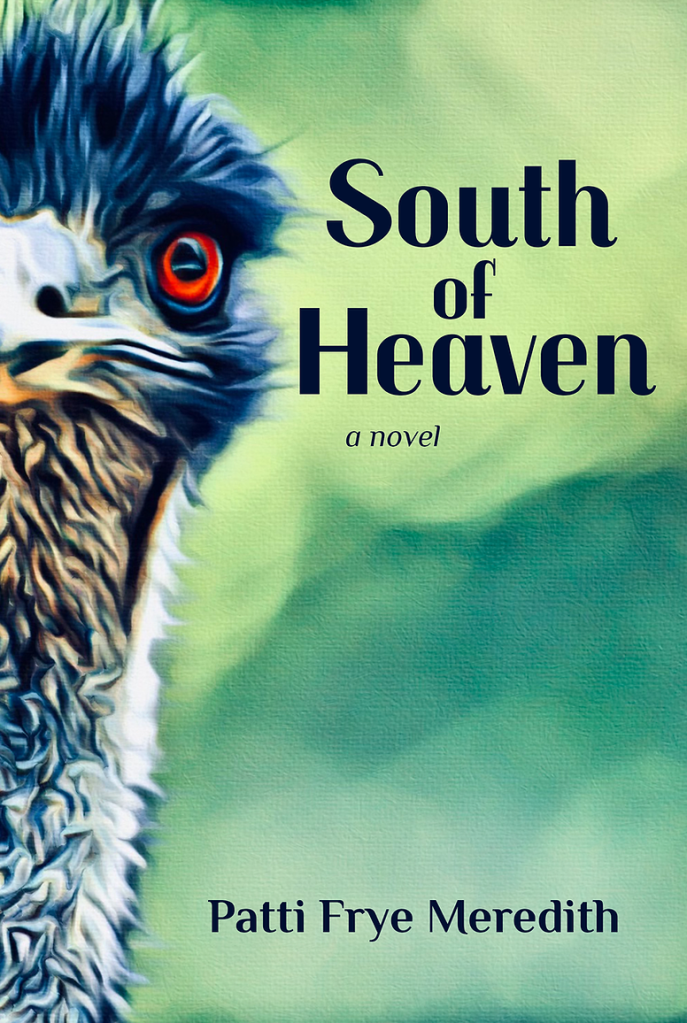
I didn’t think it was going to set the literary world on fire, but I wanted my imaginary people to live in a real book. So, I asked you, Sue Dunlap, and Darnell Arnoult to read it and tell me if I was about to embarrass myself, and you all said, “Do it.” So, I did. I fiddled with it after I got it back from you all, and I hired an editor to make sure I hadn’t added a lot more typos. Then I fiddled with it some more, and my niece, Becki Vasques, found my last snafus. We made it a family and friend affair! You and Darnell suggested I put an emu on the cover, and my husband, Lee, and I put it together (with Darnell on the phone). It’s been fun. Not “have lunch with your agent in New York City” fun, but better. A true labor of love. And I like that my North Carolina story is published by a North Carolina press. Scott Douglass does something very special with Main Street Rag. He publishes wonderful poetry and stories. I’ve gotten to know him and his wife and his dog, Harley, and I really appreciate the work he does.

DL: Do you have any advice for other writers ready to send their novel out?

PM: Don’t discount the small independent presses. We all appreciate independent bookstores. These presses deserve our appreciation, too.

Do ask yourself if you’re ready to be in the book marketing business, though, and the weird thing is part of that is selling not just the book but yourself. The great thing about the small press is, “You have a book to sell.” The scary thing about the small press is “YOU have a book to sell.” Just be honest with yourself about what you want to accomplish and why you’re doing it.

For me, the experience has been amazing because it has reminded me that I have the very best family and friends in the world. The support has been phenomenal. People I haven’t seen or talked to in ages bought my book after seeing my Facebook posts. Friends talk about my characters like they’re real people they care about. So, if I don’t sell another book, I’m very happy with the response South of Heaven has gotten.

CYNICAL ALERT!

The truth is, without Facebook, I wouldn’t have sold m(any) books. South of Heaven is in two bookstores, Chapters in Galax, my hometown, and McIntyre’s in Chapel Hill, where I live now. I’ve had one reading at McIntyre’s. I hired a publicist, and maybe there will be more readings, but maybe not. Even if I devote a lot of time to driving around, going to bookstores, taking them a book and a nice press kit, there’s no guarantee they’ll carry it. I have a couple of book club gatherings coming up. The bottom line is: It’s up to you to promote your book, to make yourself known. I believe even if you have an agent and a traditional press, they want you to have a “platform” meaning they want you to use your social media connections to publicize and sell your book.

DL: You’ve described South of Heaven as coming out “late in life.” We could argue about what that means, but I’m more interested in something else you said which is that having the novel out in the world helped clarify where and on what you want to focus your energies. Can you talk more about that?

PM: I know for sure I don’t want to be an author who dresses up and talks about writing. I want to be a writer who writes. I want to spend more time with my imaginary people and less time telling real people why they ought to like my book! Ha! I recently got together with a group of my writing friends, and afterwards I realized all we’d talked about was how close each of us were to having finished products to try to get published. Like there was some big door we were all clamoring to walk through to get to a different, more perfect life. I want to spend more time talking about ideas, or break-through moments, or what we’ve discovered about the craft. I don’t want my energy focused on end-products. I want to focus on better writing and storytelling.

DL: What are you working on now?

PM: Not much. I’m caught up doing what I think I ought to be doing to sell books. It’s uncomfortable and not much fun. I did have a little “conversation” with one of the characters in South of Heaven the other day. So, I wrote that down.

* * *

Find out more about Patti on her website, and don’t forget to order South of Heaven, now available from the Main Street Rag Bookstore. Coming soon, I’ll share my conversation with Tony Taddei about his debut story collection, The Sons of the Santorelli. Make sure you never miss a post by subscribing here:
Conversation with Christopher Linforth

I first met Christopher Linforth in 2014 at Sewanee Writers’ Conference. Our paths crossed again in 2019 at Writers in Paradise – Eckerd College Writers Conference. Christopher is a graduate of Virginia Tech’s MFA program, and recently, he was appointed Editor-in-Chief of Atticus Review. Christopher’s first two books are When You Find Us We Will Be Gone (Lamar University Press, 2014) and Directory (Otis Books/Seismicity Editions, 2020).

His third collection of short fiction, The Distortions, was named winner of the 2020 Orison Books Fiction Prize and has just been released by Orison Press. The Distortions is a beautiful collection of stories, thematically linked by the Croatian-Serbian War, particularly its aftermath. In each story, the weight of the past continues to press against the present. For many of these characters, historical events have had generational effects. These are not war stories although the war is a villainous character, always looming in the background. More than war stories, these stories are often about love–all kinds of love including the kinds that are sadly insufficient as well as the kinds that keep trying.

Christopher is a gifted writer. His own experience living in Zagreb was surely useful in writing these stories, but each story is subtly elevated by detailed knowledge that must have required significant research. In the same way that these are not war stories, this is also not a book about Croatia, Bosnia, Serbia, etc. as much as it’s a book about displacement and identity and the universal ways we humans struggle to put the past behind us. Christopher agreed to answer some questions about The Distortions as well as about his writing and publishing.

DL: Your new collection of short stories, The Distortions, centers on the aftermath of the Yugoslav Wars, mostly focusing though on the Croatian-Serbian conflict. Although you lived in Zagreb for some time, you come from a very different background. Did you find your outside perspective to be helpful or more challenging as you wrote these stories? Can you talk about how the kinds of research that were required for these stories?

CL: In some ways, my position as an outsider helped me to broach the aftermath of the war in new and different ways. Josip Novakovich talks in the afterword to Infidelities about the reluctance of people in the former Yugoslavia to talk or write about the war. Though this has changed in recent years and has led many writers from those countries to write compelling novels about the war, I still felt I had something to say. Over the years, to aid my poor memory, I read dozens of history books on the subject and watched documentaries, and delved into tranches of original documents and news reports, and I talked with people from that area. Much of that information, though, never appears in the book. Instead, I focused more on the characters and the stories while hewing—as much as one can—to the historical, political, and cultural realities of the time.

DL: So much of the tension in your stories comes from the weight of the past pressing into a character’s present. Moving back and forth through time can be tricky, but it can also enrich a narrative as it clearly does in your stories.

CL: Whenever possible, I try to eschew as much backstory as possible and instead focus the story on the present action. With the stories being set in former Yugoslavia and revolving around a major but little-known war, I tried to strike a balance of including information (in non-expository ways) that would help an American audience understand the ramifications of the war for the characters while also keeping the pacing tight and the stories interesting.

DL: Two of my favorite stories in The Distortions are epistolary. I’m thinking about “brb” (seemingly told through a long Instant Message) and “Sojourn (told through a more traditional letter). What I appreciate about both stories are their gestures toward the confessional. Do you have advice for writers who want to explore the epistolary form? Does a story told through a letter have special considerations?

CL: It’s funny. For me, “Sojourn,” is an imagined letter, not an actual one. The story reads and feels like a letter and perhaps contains a vestigial element of that form. The story, to me at least, has an uncertain form: part letter, part monological confession, part a story being told. The hybrid nature perhaps also reflects the vacillating nature and identity of the narrator. Similarly, “brb” uses misdirection about the narrator’s identity to say something about the stylized IM form. The intersection of the confession and the letter form, or variants thereof, often work well together. They allow a “natural” unfolding of thought on the page addressed to someone off it. For me, that is where the intimacy and magic of the epistolary form lie.

DL: I’ve been working on a collection of short stories for several years, and through that time, the manuscript keeps shifting. How long did it take you to write and shape these stories? What was the submission and publication process like for The Distortions?

CL: The earliest stories were drafted around 2014 and the latest around 2019. It was a long process of revision and then discarding the lesser stories (perhaps another six or seven). Some stories, like “brb,” emerged fully formed, with only minor edits later. Others, like “The Little Girls,” I rewrote several times over the years. I entered the manuscript into a handful of contests in late 2019 and early 2020, perhaps only five or six altogether, while constantly fine-tuning it the whole time. The collection won the Orison Fiction Book Prize in July 2020 and then underwent another year of refinement.

DL: What are you working on now?

CL: I’m working on two books. One is a sister project to The Distortions. Tentatively titled The Homeland War, it’s centered on two young men in Zagreb just before the outbreak of war. The novel explores toxic masculinity and social class and the football hooliganism endemic in the 1990s. The other book, currently untitled, examines the intersections of internet culture and the New York art scene. Stories from this collection are forthcoming in Cutleaf and in the Irish magazine, Banshee.

DL: Are there any opportunities coming up for readers to meet you or study with you via Zoom or in person?

CL: Yes, I teach online creative writing classes for The Writer’s Center in DC, and I take on private editing clients now and again. I’m also available for workshops and readings and so forth. I also have some more on the origins of the book over at Necessary Fiction.

Thanks for reading. To receive posts like this one directly in your inbox, subscribe here:

My 2021 Reading List

It’s been almost 8 months since my last blog post here. I’m afraid a lot of my plans for this space escaped me as the year rushed by. Probably the biggest reason for this is because of the role I accepted as an editor for EastOver Press and EOP’s literary journal Cutleaf. In our first year, we published 23 bi-weekly issues of the journal. We also published 4 wonderful books of poetry that I’m really proud of. (See the links below to purchase EOP books and others!) This new position as an editor requires a lot of reading, and so my list of published books I read last year (2021) isn’t quite as robust as I’d like. But I love seeing other people’s what-I’ve-read lists, so here’s mine.

  1. Julia Cameron – Finding Water
  2. Haruki Murakami – What I Talk About When I Talk About Running
  3. Wesley Browne – Spoon (manuscript)
  4. Jennifer Stewart Miller – Thief
  5. Haruki Murakami – After Dark
  6. Jay McCoy – The Occupation
  7. Britton Shurley – Spinning the Vast Fantastic
  8. Matthew Landrum – Berlin Poems
  9. Katrin Ottarsdóttir – Are There Copper Pipes in Heaven
  10. Chaelee Dalton – Mother Tongue
  11. Frank Jamison – Marginal Notes
  12. Daniel Corrie – For the Future
  13. Jesse Donaldson – On Homesickness
  14. Matt Urmy – The Rain in the Bell
  15. Liz Ahl – Beginning Ballroom Dance
  16. Cathryn Hankla – Galaxies
  17. Erica Anderson-Senter – Midwestern Poet’s Incomplete Guide to Symbolism
  18. Ralph Sneeden – Surface Fugue
  19. Rosemary Royston – Second Sight
  20. John Davis, Jr. – The Places That Hold
  21. Marie Parsons – An Echo in the Wind
  22. Katherine Hauswirth – The Book of Noticing
  23. Larry Pike – Even in the Slums of Providence
  24. A.E. Hines – Any Dumb Animal
  25. Tarn Wilson – In Praise of Inadequate Gifts
  26. Ross Gay – The Book of Delights
  27. Virginia Woolf – To the Lighthouse
  28. Megan Culhane Galbraith – The Guild of the Infant Saviour: An Adopted Child’s Memory Book
  29. Sylvia Woods – What We Take With Us
  30. Lauren Davis – The Missing Ones
  31. Ralph Sneeden – Evidence of the Journey
  32. Shawna Kay Rodenberg – Kin: A Memoir

I’d like to think that my list for next year will be at least twice this long. And maybe it will be. But it really doesn’t matter. These days, I’m trying to be more comfortable with the idea of slowing down the process. What this means to me is sometimes reading fewer books, but giving more time to think about and engage with each one.

If you’ve posted your own 2021 list or have recommendations for what to read in 2022, please post links and ideas in the comments section. I’d love to hear from you. Happy New Year!

My 2018 Reading List

I love to read, but I struggle constantly with my own expectations of how and what to read and specifically with how much to read. The struggle comes to a head about this time of year when I look back and make some kind of judgment about how I spent my limited time and energy. For 2018, I ended up reading 52 books, obviously, an average of one per week, although it wasn’t paced out that way at all.

Dorie and Book Shelf
Seen here, my cat Dorie picks out her next book to read.

Does it matter? Does the number of books I’ve read make me a better person? Does it make me a better writer? There’s some science to back up both possibilities. But more importantly, I enjoy reading. I love a book that captures me with its language and its characters, and yeah, a great narrative helps too.

Two of the books I loved the most this past year are Jacob Shores-Arguello’s In the Absence of Clocks and John Brandon’s Further Joy. Neither writer was familiar to me when I came across their work in magazines. Arguello’s poetry was found in The New Yorker, and I found a short story by Brandon in Oxford American. Both journal pieces blew me away. I felt so lucky to discover that each had books that were as thoroughly good as their individual publications.

Here’s the list of all 52 books I read this year. I’d love to see what you read in 2018. And I’d love to year which books were your favorites and which ones will stick with you.

1. Russell Banks – A Permanent Member of the Family
2. Virgil – Eclogues
3. Julia Cameron – The Artist’s Way
4. Laura Hunter – Beloved Mother
5. Elaine Fletcher Chapman – Hunger For Salt
6. Jacob Shores-Arguello – In the Absence of Clocks
7. Michael Dowdy – Urbilly
8. Eric Shonkwiler – Moon Up, Past Full
9. William Shakespeare – The Merchant of Venice
10. Marie Howe – What the Living Do
11. Robert Pinsky – At the Foundling Hospital (Feb)
12. William Shakespeare – As You Like It
13. Marie Howe – The Good Thief
14. Jacob Shores-Arguello – Paraiso
15. Madeline Ffitch – Valparaiso, Round the Horn
16. Susan Goldsmith Wooldridge – Poemcrazy
17. Todd Boss – Tough Luck: Poems
18. Walt Whitman – Song of Myself (Mar)
19. Marc Harshman – Believe What You Can
20. Rita Quillen – The Mad Farmer’s Wife
21. Linda Parsons Marion – This Shaky Earth
22. Greg Wrenn – Centaur
23. John Brandon – Further Joy
24. John Lane – Anthropocene Blues
25. Larry Thacker – Drifting in Awe
26. Rachel Danielle Peterson – A Girl’s A Gun
27. Michael Knight – The Holiday Season
28. Jia Oak Baker – Well Enough to Travel
29. James M. Gifford – Jesse Stuart, Immortal Kentuckian
30. Manuel Gonzales – The Miniature Wife
31. Sharon Kay Penman – Falls the Shadow
32. Crystal Wilkinson – The Birds of Opulence
33. James Herriot – All Things Wise and Wonderful
34. Ottessa Moshfegh – My Year of Rest and Relaxation
35. Rowling, Tiffany & Thorne – Harry Potter and the Cursed Child
36. William Glasser – Choice Theory
37. James Herriot – All Creatures Great and Small
38. Sylvia Lynch – Jack Lord: An Acting Life
39. Kevin Fitton – Dropping Ballast (manuscript)
40. Jane Smiley – A Thousand Acres
41. Stephen Mitchell – Gilgamesh
42. C.D. Wright – One with Others
43. Kevin Canty – Into the Great Wide Open
44. George Eliot – Silas Marner
45. Michael Kardos – The Three-Day Affair
46. Christopher Smith – Salamanders of the Silk Road
47. Grant Faulkner, Lynn Mundell, Beret Olsen – Nothing Short of 100
48. Maureen Seaton – Fisher
49. Amy D. Clark – Success in Hill Country
50. Langston Hughes – Let America Be America Again and other poems
51. Cassie Pruyn – Lena
52. Kathryn Stripling Byer – Catching Light

New Short Story: Fiddlers

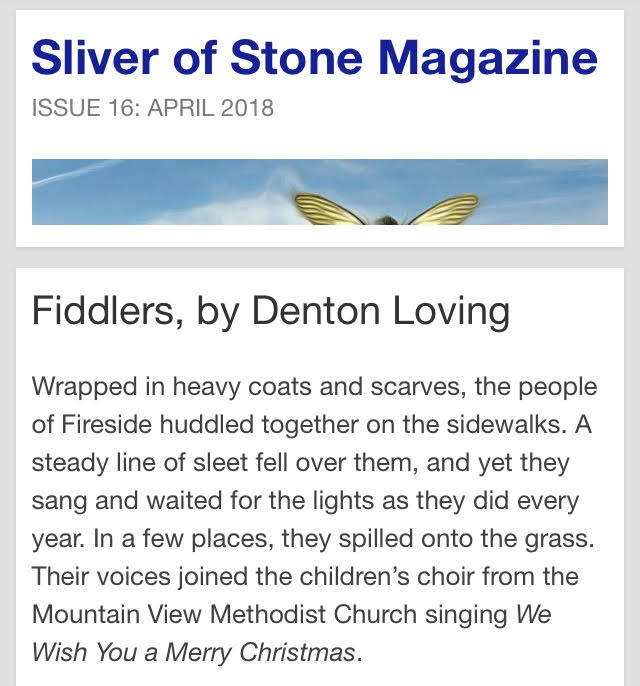
Thanks to Sliver of Stone Magazine for publishing my short story, Fiddlers, in their 16th issue. Fiddlers is sort of a dark Christmas story, so it might feel a little strange to read in this July heat wave. Or else, it might remind you what snow and cold feel like.

Sliver of Stone

The entire story can be read online at https://sliverofstonemagazine.com/fiddlers-by-denton-loving/.

One of my favorite writers, John Lane, also has an experimental essay in this issue: https://sliverofstonemagazine.com/the-father-box-by-john-lane/. It’s called The Father Box, and you should give it a read. It’s an honor to have my work anywhere in the vicinity of his!

There’s also some info about Darren Demaree’s new poetry book, Two Towns Overhttps://sliverofstonemagazine.com/2018/03/31/new-publications/.

Love Letters to Ourselves

I’m so fortunate to have interesting friends who are always doing creative things. Case in point is my friend Megan Galbraith. Below, you’ll see a letter Megan wrote calling for people to write love letters to ourselves. Megan has written one to herself, and if you’re game, she’ll trade with you. I’m working on my own love letter to myself right now. It’s not an easy task, but I’m glad Megan asked me to try it. I hope you will too. Check out Megan’s directions below.

Love Letters to Ourselves Image_edited

Dear Lover,

Earlier this year, in the midst of personal despair, I came across a self-care tip that seemed simple enough: write a love letter to myself. I tried it. It knocked me on my ass.

As much as I poo-poo the self-care industrial complex, writing that letter did help. It also got me thinking hard about love, wanting more of it in my life, and about ways to collectively build each other up instead of tearing each other down.

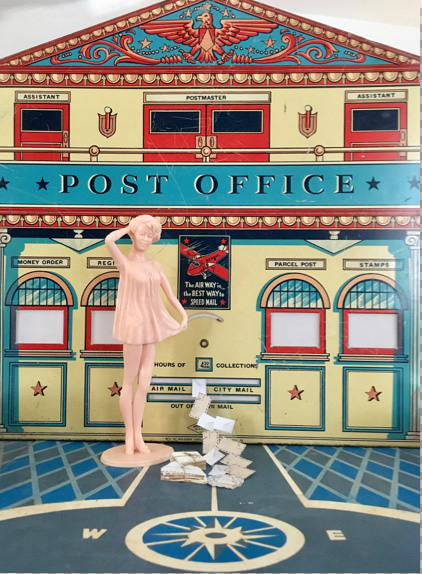
So, as part of The Dollhouse, I’m launching a collaborative project called “Love Letters to Ourselves.”

I want to revive the art of letter writing, spread the love around, and understand how other people love themselves.

Will you write one? I want to see your beautiful soul.

Here’s what to do:
1. Write a love letter to yourself in any form
2. Include your name and return address
3. Put it in an envelope, lick a stamp and . . .
4. Mail your letter to:
Lisette Ophelia Von Elsevier (see what I did there?)
P.O. Box 483
Cambridge, NY 12816
5. When I receive it, I’ll mail you my love letter to myself.
6. Voila! Pen Pals.

Send me some love!

All my love,
Megan

Recommended Reading 2/2/2018 – Short Stories

The best part about January being so long and cold was that it was a great time to read.  It was literally too cold to do anything else. February is starting off the same way. If you’re stuck inside this weekend and not sure what to read, here are some of the short stories I read last month. Try one or two or more.

“No Good” by Hala Alyan

“Freezer Burn” by Ron Austin

“Shine” by Ron Austin

“August 2026: There Will Come Soft Rains” by Ray Bradbury

“The Ceiling” by Kevin Brockmeier

demonman-1-768x461

“Demonman” by Julialicia Case is an amazing story that appeared online this month at The Master’s Review. Here’s how it begins:

“I am eleven the spring Demonman comes, first to the alley behind the Kroger, where the dumpsters reek like fermented orange juice, then to the train tracks by the boarded-up video store, then to the Harding mansion, still for sale, then to a snot-colored van with flattened tires. He comes to our nightmares, our whispered worries, to newspapers and televisions and notices in the post office. He’s called something else, a different name, although, of course, he is still Demonman. Since the shootings upstate, the police struggle with the race riots, but they claim to be searching for him, following the leads.”

“Expensive Lessons” by Anton Chekhov

“These Certain Young People” by Dave Eggers

First Night

“First Night” by Kevin Fitton appeared online this month at Storgy. I loved reading this story that covers a large emotional range but still manages to impart some humor. Here’s how it begins:

“It was the morning of New Year’s Eve, and a dull light confessed the start of another winter day. In Vermont this time of year, the days were short. It was dark when Brian woke in the morning for work and dark when he drove home from the office. It was the time of year Vermonters did their best to survive by taking vacations to the Caribbean, talking to their therapist, and drinking. The night before it was snowing when he went to sleep, and Brian dreamt that the roof was covered with two feet of heavy snow. In his dream, he could feel the house sweating as it tried to hold the weight, could hear the rafters cracking under their burden—pop, pop, pop, like the last kernels of corn on the stove.”

“The Miniature Wife” by Manuel Gonzalez

“Mermaid in the Jar” by Sheila Heti

“Plan B” by Michele Johnson

 “The Things They Carried” by Tim O’Brien

“My Name is Jean-Pierre and I am Still an End Table” by Dana Schwartz

“Saying Goodbye to Yang” by Alexander Weinstein


If you’ve read a great short story lately, please tell me about it in the comments.

Eric Shonkwiler’s Moon Up, Past Full

Frank Bill may have said it best when he said that Eric Shonkwiler “has an eye for detail and a lot of heart. His words stay with you.”

I picked up Shonkwiler’s collection of novellas and stories, Moon Up, Past Full, when I was in Washington DC in 2017 for AWP.  For the rest of the year, the book sat at the top of my to-read pile, but I was having a hard time reading anything. When I finally picked the book up this week, it was like taking a shot of good whiskey—smoother than you could hope for and over quicker than you want it to be.

MUPFfc

I admire this book and Shonkwiler’s writing so much.  His stories are perfectly balanced between character and action. His imagery is great. His language has some beautifully poetic turns but is also perfectly precise. So much happens in each story that even the shorter pieces feel completely developed and novelistic in scope. However, it is in the longer works in this collection where Shonkwiler really shines.

The longest piece in the collection, “GO21,”—an apocalypse-type story that I didn’t want to end—was also one of my favorites. The story works on so many levels.  It’s a must read.

Another favorite was the story, “Rene,” originally serialized in three parts online at Fiddleblack. Rene is a young woman on a horse with a sick mother.  Like all of Shonkwiler’s stories, the complications keep adding up as the story goes along. Unlike most of the other pieces, Shonkwiler is exploring issues of race and class in this story. I highly recommend you click the link and read the story for yourself.

It’s not by any means one of the longest stories in the collection, but “My Wakeup” is probably my absolute favorite of these stories.  The story was originally published online at Splinter Generation, and again, I recommend you read it now. Like Shonkwiler’s other work, this story is detailed and deceptively simple.  It starts off with Geier, an Iraq war vet, on his return home from the base in Kuwait. Once back and unsure of what to do with himself, he hooks up with another former soldier, Jones, and the two take a road trip cross country.  Some of the drinking and drugging and whoring might be predicable, but (like all of Shonkwiler’s stories) the feeling behind it all feels tragically sincere which makes it unique. And beautiful. And well worth the read.

For more about Eric Shonkwiler and his writing, check out his webpage: http://www.ericshonkwiler.com/.  Follow him on Twitter: @eshonkwiler

My 2017 Reading List

Some year, I’m going to read 100 books within a space of 12 months.  It wasn’t 2017 though.  My list for this past year is so short, I’m almost ashamed to show it.  But here it is anyway.  Several of these books were read in manuscript form and aren’t available on the market yet.  Look for them in 2018.

I’ve talked a lot about how problematic I find J.D. Vance’s Hillbilly Elegy.  And I never skip a chance to say again what a bad book it is. Beyond that, I recommend so many of the beautiful books on this list for various reasons.

I suppose the book I’m most proud of reading this year is Cormac McCarthy’s The Orchard Keeper.  I started this book about 15 years ago–maybe longer.  I suppose I wasn’t read y for McCarthy.  And though I’ve read several of his other novels in the past decade, The Orchard Keeper sat on the shelf, never finished.  Going back to it this year, I found it to be a really beautiful book, and I was glad I had kept it around all those years.

I’d love to hear what your favorite books were from 2017, or the one you’re most proud of reading. Let’s all read more this new year.

Here’s my full list:

1. Jim Wayne Miller – The Mountains Have Come Closer
2. J.D. Vance – Hillbilly Elegy
3. Alison Stine – Ohio Violence
4. Lincoln Michel – Upright Beasts
5. Ron Houchin – The Man Who Saws Us in Half
6. Iris Tillman Hill – All This Happened Long Ago – It Happens Now
7. Blas Falconer – A Question of Gravity and Light
8. Claudia Emerson – The Late Wife
9. Charles River Editors – The Library of Alexandria and the Lighthouse of Alexandria
10. Gerry Wilson – Crosscurrents and Other Stories
11-18. 8 manuscripts for a poetry contest
19. Mark Wunderlich – The Earth Avails
20. Timothy Liu – Don’t Go Back to Sleep
21. Anais Duplan – Take This Stallion
22. Peter LaBerge – Makeshift Cathedral
23. Jeanne Bryner – Both Shoes Off
24. Keith Lesmeister – We Could Have Been Happy Here
25. James Arthur – Charms Against Lightning
26. Ocean Vuong – Night Sky with Exit Wounds
27. Sean Frederick Forbes – Providencia
28. Clifford Garstang – Everywhere Stories Volume 2
29. Jenson Beach – Swallowed By the Cold
30. Adam Clay – Stranger
31. Joanne Nelson – If Not For the Mess
32. Katlin Brock – The Dead Always Stay OR Between the Wounds
33. Wes Sims – Taste of Change
34. Mark Powell – Small Treasons
35. Carol Grametbauer – Homeplace
36. Cormac McCarthy – The Orchard Keeper
37. Richard Hugo – The Triggering Town
38. Donald Morrill – Beaut
39. Lynne Sharon Schwartz – No Way Out But Through

Recommended Reading 12/12/2017

The year is slipping away, but here are a few last-minute reading recommendations.  Enjoy!

Megan Culhane Galbraith has a short essay about sex, virginity, and Planned Parenthood online at Boink: http://boinkzine.com/2017/11/10/losing-it/.

Linda Michel-Cassidy’s essay, “This Snow, This Day,” (originally published at Harpur Palate) has been republished at Entropy: https://entropymag.org/this-snow-this-day/.

Rosemary Royston has two poems in the new issue of museum of americahttps://themuseumofamericana.net/current-issue/two-poems-by-rosemary-royston/.

Brian Tierney’s poem, “Morning in Galilee,” is online at Cincinnati Reviewhttps://www.cincinnatireview.com/samples/morning-in-galilee-by-brian-tierney/

You don’t want to miss this fascinating conversation in real pants, “HALF REVEALING, AND HALF CONCEALING THE SOUL: BARRETT WARNER INTERVIEWS CASSIE PRUYN”: https://realpants.com/half-revealing-and-half-concealing-the-soul-barrett-warner-interviews-cassie-pruyn/.

And Christian Whitney’s story, “Acceptance,” was a finalist in the summer fiction contest at Gulf Stream Literary Magazine.  Check out the story here: https://gulfstreamlitmag.com/acceptance/.