The writing community lost a fine poet and friend last month when Ron Houchin passed away from a rare form of kidney cancer. I first met Ron when he attended the inaugural Mountain Heritage Literary Festival (MHLF), and our paths crossed many times in the years since then.
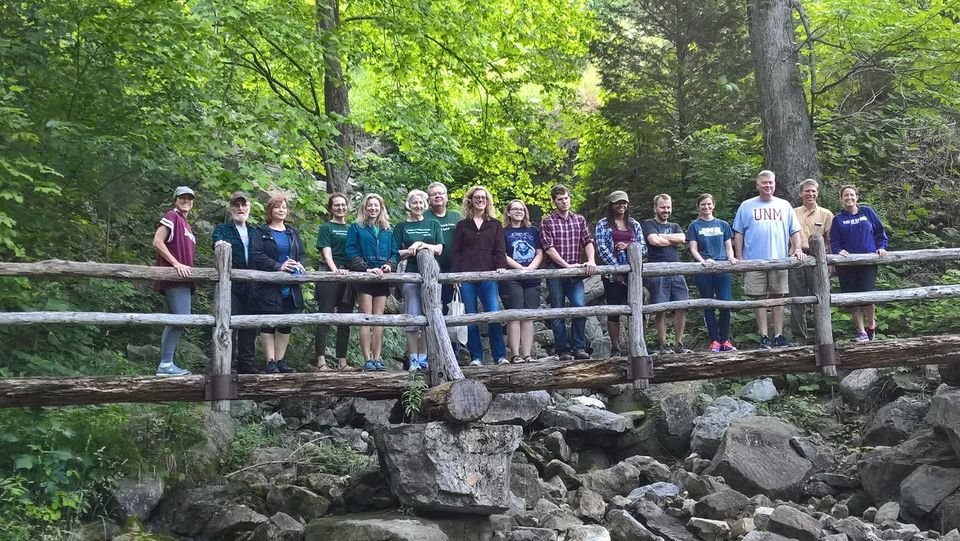
Ron was a consistent attendee at MHLF, and he never missed the Saturday morning hike led by my friend Tony Maxwell. Each year, Tony chose a walk that would eventually lead to the Pinnacle Overlook at the top of Cumberland Mountain, and Ron was always there. In the photo below, taken in 2017 and shared by Thomas Alan Holmes, you can see Ron standing second from the left, wearing his trademark baseball cap.
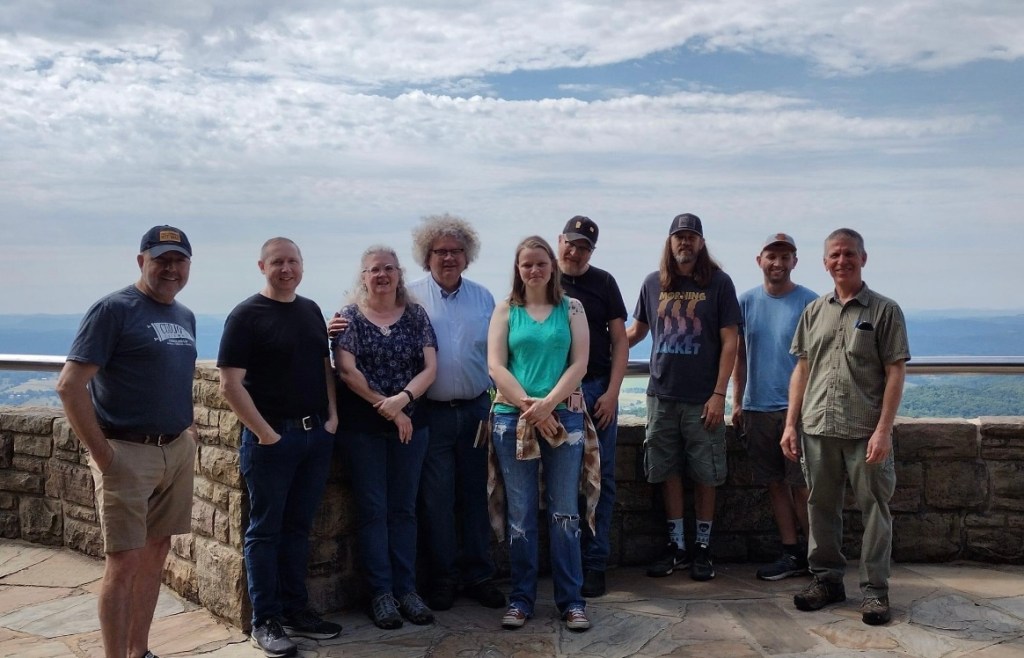
Thanks to Tony’s suggestion and Alan’s organization, a small group gathered at the Pinnacle Overlook on Sunday morning to remember Ron.
I wish I could share all of the wonderful stories that were told. Ron was often quiet, especially in group settings. He was one of the most thoughtful people I’ve ever met. Those factors combined with his obvious talent as a writer could feel intimidating. And yet he was incredibly kind and generous with his time and energy, and he often surprised us with his witty sense of humor and his always perfect delivery.
Ron published a remarkable body of work ranging from poetry to short fiction and a young adult novel—ten volumes that will keep him and his voice from ever completely dying. We read a few of his poems on Sunday when we gathered on top of the mountain. I didn’t read a poem, myself, although for weeks now, I’ve been carrying around my copy of his 2009 collection, Museum Crows, one of four titles published by Salmon Poetry. The first poem I opened to was, “When you are not there,” a perfect poem for a time of loss.
When you are not there
Five granules of pepper and three of salt lie on the table beside two clear shakers. On the floor a ray of sunlight lands beside the dog dish. It creeps over the bowl while the dog sleeps.
In his dream, he growls, but the sun beam does not hesitate. Its bright tongue licking over the edge of the dry food wets it with light. The dog blows out his breath, feet twitching.
Across the room, a tall glass, empty but for three ice cubes, clinks and settles its coldness. Behind the refrigerator, frail cobwebs, in the pattern of someone’s initials, wave in wind from the furnace vent.
Like the music of fear, the red light of the security system keeps time. When you are still not back, a full, pastel moon peers in the big window over the breakfast nook.
These things, and the bright planet Venus shining through the storm door, will not ask your whereabouts or why the car is not ticking toward coolness in the garage.
But the dog will wake soon and whine for you and fresh food. The philodendra will take a week to miss you. The tall water glass, still on the counter, whispers tragedy in strains of evaporation.
In my previous post, I had a wonderful conversation with Julia Wendell about her new poetry collection, The Art of Falling. One of the subjects we discussed was ekphrastic writing, and particularly her poem, Horse in the Landscape, which works in dialogue with a 1910 painting with the same name (sometimes titled Horse in a Landscape) by Franz Marc.
Born in Germany in 1880, Franz Marc was an Expressionist painter who died in 1916 during a battle in France. Many of his paintings feature animals whom Marc believed had a spirituality that had been lost in humans. This article from wikiart.org mentions that in works such as Horse in the Landscape Marc “tried to emulate the animal’s point of view and experience of the world.” This is meaningful because Julia Wendell makes the same gesture in her poem, shared here with Wendell’s permission:
Horse in the Landscape
I was given the power to gaze and ears pricked to hear across the mustard-yellow distance. I wait and listen.
I was created before Franz Marc ever marched into a trench, created because he yearned for the opposite of movement.
I gaze out to a slice of water, to the stillness of the future, its impenetrable line. Think of all the other horses he never painted during the years he never had.
Surely beauty, for young Franz, lived only in the present tense, in the twitch of an ear, color splashed on canvas, confirming the impulse to be.
I sport a bold red coat and blue mane, more than a century of perception behind me. My heart taps out on its old chest a staccato that just might make the landscape tremble.
For this writing exercise, I ask you to focus on the way Wendell identifies or writes from the perspective of the horse. One of the most important elements to consider in an ekphrastic work is the angle or the specific point of view that the writer/narrator chooses. One way to write about a piece of art is from a more-literal angle, meaning from your own perspective as a person viewing the art work. Sometimes, a writer using this more-literal angle will then enter the image, usually as themselves.
What Wendell does in Horse in the Landscape is to give voice to the horse inside the painting from the very first sentence: “I was given the power to gaze / and ears pricked to hear / across the mustard-yellow distance.”
It’s entirely up to you as the writer to judge which mode is better for the image you’re working with and for the poem (or story or essay) that you’re attempting to write. But for this exercise, do try to capture the voice of one of the subjects within the art work. As I’ve written about in the past, taking on the voice of a non-human form sometimes allows us to better express our very human emotions.
There are other important elements to Wendell’s poem such as the nod she gives to Marc’s tragically short life. You could interpret this poem as speaking in some ways to the waste of war, and there is also a great deal of simple but beautiful description. Your own work can move in similar directions or branch off in a new way. But begin from the perspective of the subject within the work.
Ekphrastic writing is not limited to poetry. I’ve read wonderful ekphrastic prose in addition to ekphrastic poems. For examples of ekphrasis in every genre, have a look at The Ekphrastic Review which might be a great place to send the finished draft of this writing exercise.
You can try this exercise with any painting or any other piece of art. But why not start with one of Franz Marc’s many paintings which you can see by returning to the wikiart.org page. Horse in the Landscape is one of Marc’s best known works. It’s not his only painting that features horses, but he also depicts animals like weasels, cattle, foxes, goats, etc. I’ll leave you with one of my favorites, The Steer, from 1911.
Huge thanks to Julia Wendell for speaking to me about her new book and for inspiring this writing exercise. Make sure you never miss writing exercises like this one by subscribing here:
Julia Wendell is a poet currently living in Aiken, South Carolina. She is also a three-day event rider, the experience of which considerably informs her newest collection of poetry, The Art of Falling, published by FutureCycle Press. Amanda Moore said this about The Art of Falling: “…knowing how to fall allows Wendell’s open-eyed work to acknowledge pain but not be weighed down by it, moving instead to consider what blossoms and grows each passing season. Love here is represented by and extended to plants and animals—reluctant gladiolas, bursting peonies, a menagerie of dogs and birds—but nothing so beloved as horses, an anchoring and comforting presence throughout.”
I found The Art of Falling to be a powerful book encompassing decades of Julia’s life, moving from childhood traumas to complexities of adulthood. In one poem, Julia describes the art of falling as a practice perfected through pain and intense self-awareness, visible in “the coat hook / of my separated shoulder, / my spine’s bumpy lane, / sunspots littering my back— / the parts of me / I can’t see without mirrors.” In other poems, the art of falling is also made known in far less visible ways. Julia was kind enough to speak to me about her new book, her writing process, ekphrastic poetry and what it’s like to be married to another poet.
DL: Many of the poems in “The Art of Falling” touch on a fall you suffered from a horse that caused significant physical pain. But these poems reveal other traumas as well. What’s your process like for transforming writing about trauma into a well-crafted poem?
JW: It wasn’t one fall from a horse, but many: actually, a lifetime of falls. The old directive is true for me—you fall off a horse, you get back on. You fall off a poem, you get back on. Some falls are worse than others. And the older you get, the worse they tend to be, and the harder it is to get back on. Several years ago, I broke my hip as well as my leg falling from one of my horses, and that fall transformed my life for a year, as well as the writing of The Art of Falling. I found ways to live through the pain and to see through it. I had to change my life pretty drastically during that time, and my poems became both a respite and a way to work through the ordeal. I couldn’t get on a horse, but I could go to my desk with the help of a cane or just steadying myself on furniture as I went across the room.
DL: I was thrilled to read your poem, “Horse in the Landscape” which is an ekphrastic work related to Franz Marc’s painting with the same name. This is also the image used for the book’s cover. I recently taught a workshop on ekphrastic writing. Can you talk about the relationship that can exist between visual art and written work? Are you also a visual artist?
JW: No, I’m not a visual artist, but the piano is my brush; has been all my life, and music often finds its way into my poems. In reference to the above question about writing through pain: while writing the poems in The Art of Falling, I re-visited Frida Kahlo’s life and work. Her example taught me how to keep making art while in terrible pain. I read everything I could get my hands on about her life and artistic process, and studied her strange, surreal self-portraits. I even went to Mexico City after I had partially healed and visited her house, Casa Azul. I was drawn to her for the obvious parallel between her life and mine at the time. Both of us had our hips gored by rods, except that hers was put there by a bus and mine was put there by a surgeon. Here was an artist who experienced a lifetime of pain, and yet she kept getting back on the horse of her art to create her organic, visceral, paintings. The poem “Portrait Chinois” came directly from my re-experience with Frida’s work.
Similarly, the figure of the broken girl in Wyeth’s Christina’s World reminded me of my own plight; and through her semi-reclined pull and yearning for the gray house on the hill, despite her infirmities and inability to walk, drew me to ponder what it would be like for her to crawl to the house, to go inside, to open up her world and reach her dream destination.
I have always loved Franz Marc’s work for its ebullience and movement, and of course for its subject matter. But what pulled me to Horse in the Landscape is also what struck me about Christina’s World—we see a still landscape through the girl’s and horse’s perspectives, as they turn their backs to us. It is a world of no movement, only thought and perspective, possibility and possible movement, which is what my life had become during the time I was so badly injured. I had to contemplate my life through quiet and stillness, and find my poems there.
I chose the cover for The Art of Falling before I had written Horse in the Landscape. The pdf’s of the interior of the book were almost ready for the printer. Suddenly, I had the urge to write the poem and spent last Christmas season writing and re-writing it, thinking I would save it for some other project. Then Diane Kistner, the editor at FutureCycle Press, contacted me. Did I have another poem that might fit into the book? The way the pages were laying out, she needed one. Uncanny coincidence.
DL: I always ask writers about the process of compiling, submitting and publishing their books, and I’m especially interested in asking you because this is, I believe, your eleventh book. How long did it take you to write and shape the poems in this collection? How did you find and form a relationship with FutureCycle Press?
JW: The poems in The Art of Falling span at least a decade. The last book, Take This Spoon, had a very specific theme of poems about family, and the relationship to food and eating and anorexia, and even incorporated old family recipes. I was already working on the poems in The Art of Falling when Take This Spoon came out in 2016. The manuscript has seen many, many revisions: different title, different order, new poems. It’s actually my sixth, full-length collection, having published a number of chapbooks in addition to the longer books. I submitted to FutureCycle at the suggestion of April Ossmann, with whom I worked on an earlier draft of The Art of Falling. Diane Kistner, editor at FutureCycle, was very good at managing the publication details of the book, though not so much involved with line edits or broader editorial suggestions. For those I relied on April, Jack Stephens, D.W. Fenza, and most especially my husband, Barrett Warner.
DL: I have to ask you about Barrett Warner who is also a writer. To what extent do you and he read and comment on each other’s work?
JW: Barrett reads and helps edit everything I write, as well as a tone of what other people are writing. When he likes reading something his hand twists up his hair, and if he comes back to me with really messy hair, I know he liked it. I am dependent upon him as my first reader. He is a bit more independent of me, perhaps because as an editor he has such rich connections with other writers. I am more of an artistic recluse, and I like it that way. But everyone needs a first reader, and Barrett’s mine. In sickness and in first drafts, as they say.
DL: In addition to being a writer, you’re a three-day event rider. It’s also clear in your poetry how much you love and respect horses. Are there lessons from the equestrian world that also apply to writing?
JW: Ride the rhythm, create the energy from behind, send it forward, don’t let the poem go against your hand. Talk to your poem. Give it confidence by having clear intentions. Give it treats. There must be a daily devotion to the art of riding, as there must be to writing. The development of a poem, as well as a horse, comes in the smallest of increments, and must be addressed day after day after day. Writing is re-writing; riding is re-riding. The daily devotional is how you get there.
DL: What are you working on now?
JW: The next poem. Then, the one after that.
Seriously, though: recently I’ve collected poems I’ve written about my daughter in her lifetime (and even before that), and have compiled a collection called “Daughter Days.” I have plans to get back to that manuscript to revise it and see if I still like it before I send it out into the world. Writing is re-writing, and submitting is re-submitting.
***
Find out more about Julia on her website, and don’t forget to order her newest publication, The Art of Falling. My next post will feature a writing exercise inspired by one of Julia Wendell’s poems. Make sure you never miss a post by subscribing here:
I find it nearly impossible to accomplish anything at the moment without first checking the news to see what’s happening in Ukraine, hoping and praying that the Ukrainians can stay strong and hold off Putin’s forces.
In between news checks, I started looking for some Ukrainian writing, and I came across this poem written by Lyudmyla Khersonska, translated by Katherine E. Young, and published in 2016 by WORDS without BORDERS that I wanted to share.
[The whole soldier doesn’t suffer]
The whole soldier doesn’t suffer— it’s just the legs, the arms, just blowing snow, just meager rain. The whole soldier shrugs off hurt— it’s just missile systems “Hail” and “Beech,” just bullets on the wing, just happiness ahead. Just meteorological pogroms, geo-Herostratos wannabes, just the girl with the pointer poking the map in the stomach. Just thunder, lightning, just dreadful losses, just the day with a dented helmet, just God, who doesn’t protect.
If you missed my previous post, please check out my conversation with Lauren Davis about her new poetry collection, Home Beneath the Church. Lauren talked about how difficult it was her to write deeply personal poems about her body and health. The poems in Home Beneath the Church also explore holy spaces. Those holy spaces begin and end with the body, but there are also churches, French basilicas, and other spaces reserved for traditional religious figures. And there is also the outside world. Lauren’s poems are never far from nature. It’s clear that she is a gifted student of observation, although I must assume there’s some amount of research that supports her knowledge of the natural world.
Two of my favorite poems in this collection are “If I Were a Resurrection Fern” and “I am a New Caledonian Owlet-Nightjar.”
If I Were a Resurrection Fern
And you were the wind-shipped rain, I’d draw you up. My fronds bright soaked
without shame. Imagine my grief this past drought. I shivered in my little
plot of lack. Come my mineral nip, my sky-dropped lake.
Nothing can keep us apart, not even climate nor gods.
You come down and down and never stop coming down,
and I revive, baptized.
I am a New Caledonian Owlet-Nightjar
Unseen since 1998, I am nearly a lost breed.
No one has heard my voice but you— a different genus of bird who sought and discovered me.
I beat my wings against yours unable to mate, but look
how groomed my semiplumes. I pluck them into dead air.
Now I am ready to be collected beneath your breast.
Let scientists say I dared to survive— that you came down from your perch
to quiver against me, my last known touch.
They will find me in the brushweed, virgin. But a song in my throat.
In both poems, the narrator takes on the identity of non-human forms in order to express very human yearning. One poem is qualified with the word “if.” The second poem is more declaratory: “I am.” But in both poems, the narrator embodies another form.
For this writing exercise, start with a quick online search for vulnerable species in the region where you live or within a geographic area that has significance for you.
Reading these poems prompted me to think about what animal or plant I would choose to speak through in a poem. So I started with a quick online search for “endangered birds of Appalachia.” The first link expanded my original idea by taking me to a website that listed vulnerable species beyond birds. I chose to search for species in Appalachia because that’s where I live, and it felt more appropriate for my writing.
I love that a minimal amount of research can keep me from feeling that I don’t know what to write. So once you’ve selected your species, see what you can find about their behaviors. This will help you embody that species for yourself by borrowing where they are and what they do.
Notice that in both poems, the narrator speaks directly to a beloved by addressing that person as “you.” Do the same in your poem by speaking directly to someone.
Speaking from a non-human voice is not limited to poetry. A New Caledonian Owlet-Nightjar likely would have just as much to say in a short story as she does in a poem. The same is true in an essay, and in an essay, there’s even more room for research. Whatever form you’re writing in, you may find it wonderfully freeing to speak through this other voice.
Lauren Davis is a writer who lives on the Olympic Peninsula. I first met Lauren when we were both MFA students at Bennington College. Since that time, Lauren has published two chapbooks of poetry, and, most recently, a full-length collection, Home Beneath the Church. “Lauren Davis is the poet you need to be reading,” says Kelli Russell Agodon, and I couldn’t agree more.
Home Beneath the Church includes deeply personal poems about the body and then moves into writing about religious spaces. Clearly, the body is one such religious space, perhaps even the holiest. But there are also churches, French basilicas, grottoes reserved for anchoresses and saints. And there is also the outside world: the forest, the bay, the moon, and everything that lives and endures in that outside world. Davis finds the holiness in it all.
Lauren agreed to answer some questions about Home Beneath the Church as well as about the writing and publishing process. Come back tomorrow for a writing exercise inspired by Lauren’s new collection.
DL: So many of the poems in Home Beneath the Church explore deeply personal material about your body and particularly your health. I often feel that we poets are inherently confessional, but can you talk about the process of writing these poems?
LD: I sometimes wept while putting pen to paper. One thing that kept me going was my absolute rage at the shame that surrounds women’s bodies. There was nothing for me to be ashamed of in these poems, and yet, I struggled. I found this struggle infuriating, so I pressed forward.
DL: Do you have advice for writers who are attempting to write about the body? Were there other poets or specific poems you referred to for guidance?
LD: Read, read, read. That’s my advice. Somewhere someone has taken the plunge, or they’ve taken a similar risk. I turned many times to Sharon Olds and Jason Shinder. I also made use of therapy. There’s so much to unravel when we talk about bodies.
DL: One of the questions I’m asked the most, especially by poets early in their career, is how to not sound overly prosaic. What kind of craft elements do you employ to identify and modify those prosaic turns of phrase?
LD: We’re not supposed to be overly prosaic? That’s news to me! I often find the opposite situation in new writers. They’re writing in such a complicated or elevated manner that the music, imagery, and meaning gets lost. But my advice, whether the new writer is dealing with either side of the spectrum, is to read, read, read. There is no substitute. And read living poets. Give the Greats a rest for a moment. Come back to them in a couple of years. For now, find those writers that are winning awards and branch out from there.
DL: In my conversation with Rosemary Royston last month, she said that it took her about six years of reorganizing, resending, and hoping before she found a publisher for her most recent collection of poems. How long did it take you to write and shape this collection? What was the submission and publication process like for Home Beneath the Church?
LD: Oh, Lord. Who really knows how long this took? Five years? And forty-eight rejections, I think. Each rejection helped shape the book in its own way. The publication process was a little rocky. We entered the pandemic shutdown, and I just took my hands off of it. Full surrender. And I could not be happier with the final product that Fernwood Press delivered.
DL: I know you have another collection of poems already in the works. If it’s not too early, can you tell us when that will be available? And what are you working on now?
LD: When I Drowned will be available in Winter 2023 through Aldrich Press. At the moment, I’m working on a novel titled The Sleeping Cure, and I’m seeking a publisher for my short-story collection The Milk of Dead Mothers.
* * *
My next post will feature a writing exercise inspired by one of Lauren Davis’s poems in Home Beneath the Church, as well as more information about where you can hear Lauren read this spring.
I’m thrilled to have two poems included in I Thought I Heard A Cardinal Sing, a new anthology that celebrates Appalachian writers and particularly those from the Appalachian region of Ohio. Kari Gunter-Seymour, who edited this collection, wrote:
“Within these pages you will find a lavish mix of voices—Affrilachian, Indigenous, non-binary and LGBTQ; from teens to those creatively aging; poets in recovery, some with disabilities or developmental differences; emerging and well established; some living in the state, others from assorted locations throughout the country—all with a deep connection to Appalachian Ohio. The work speaks honestly and proudly as it represents Ohio’s Appalachian population, providing examples of honor, endurance, courage, history, love of family, the land; and provides evidence of how even against the odds our people continue to thrive, to work hard to build awareness and overcome mainstream America’s negative response to those with a strong Appalachian heritage.”
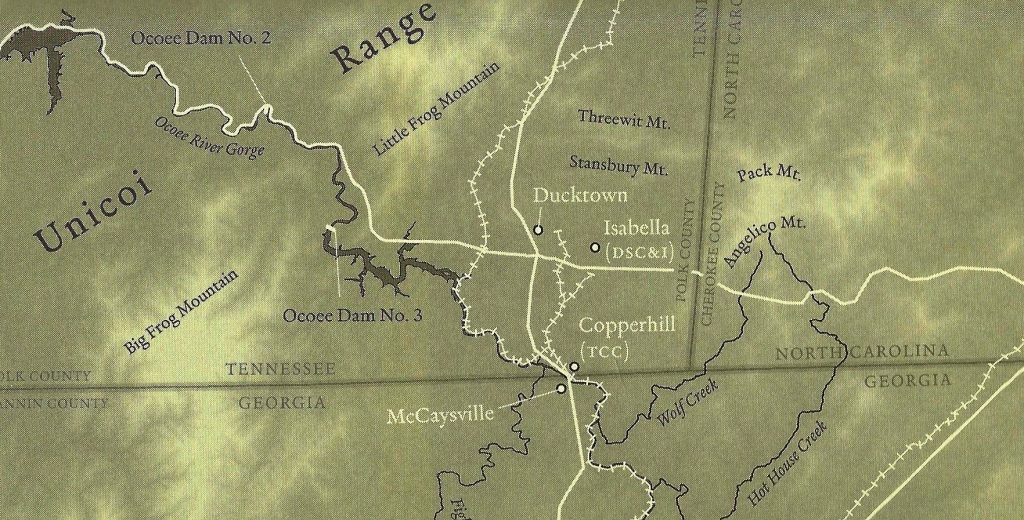
Reading “Place Names” prompted me to think about some of the wonderful place names near where I live. For this writing exercise, begin by making a list of location names near you. Or if not near you, consider making a list of location names that are important to you for one reason or another. You might even consider looking at some historical maps in case some more-interesting names have been replaced over the years.
Historic map of the Copper Basin region of Tennessee, referenced in yesterday’s post.
“Place Names” should probably be considered a narrative poem because the story of the bear hunt leads the reader through the locations. But because the names of the locations are so musical and interesting, the place names tend to rise above the narrative, and for this reason, “Place Names” feels a bit like a list poem.
Caki Wilkinson’s poem “Flyover Country” is an actual list poem. There’s no narrative structure in this poem although the epigraph “Between Memphis and Bristol” does a lot of work. I love this poem in part because Wilkinson includes my home town, Speedwell, but also because of the sound and culminating meaning of the poem.
Once you have created your list of location names that are meaningful or relevant to you, you can think about how they might work as a poem. I love a well-designed list poem like “Flyover Country,” but use Sue Weaver Dunlap’s poem as an example for how to give your own poem a narrative structure.
There’s a writing exercise to be found here for prose writers too. Think of the narrative that holds the place names together in “Place Names.” Think also of the original essay by Horace Kephart. And there’s always the question of how these place names originated. Who bestowed these names. A little research might go a far way.
I received a wonderful surprise in the mail last week in the form of Sue Weaver Dunlap’s newest collection of poems, A Walk to the Spring House, published by Iris Press. Sue Weaver Dunlap is a retired teacher who lives deep in the Southern Appalachian Mountains near Walland, Tennessee, where she and her husband Raymond live and work a mountain farm. She has published poems in venues such as Appalachian Journal, Anthology of Appalachian Writers, Pine Mountain Sand and Gravel, and Southern Poetry Anthology, and elsewhere. “A Walk to the Spring House” includes many beautiful poems, but one that especially caught my attention is “Place Names” which I’m sharing here.
Place Names
from “A Bear Hunt in the Smokies” Our Southern Highlanders by Horace Kephart
Mountain men slide through place names, their bear dogs ready. They rest at Siler’s Meadow, slap cold water on stubbled faces at Fortney’s Creek, camp at Rip Shin Thicket near Gunstick Laurel, head out at day’s first break, think to find meat at Clingman Dome. They don’t cross Sugarland Mountains, follow sign from Little River near Thunderhead and Briar Knobb, track an old fellow around Devil’s Court House, Block House, and Wooly Ridge near Bear Pen. Dogs take chase between Briar Knob and Laurel Top, end him near Saddle-back. Two shots. His parts shared among highlander hunters.
After reading this poem several times, I wrote Sue to ask her if she’d share the background of this poem. Here is what Sue was kind enough to write back to me:
“My first memory is of me standing between my parents in our Chevrolet truck, Dad driving us back from visiting my maternal grandparents. It’s December, 1956. A Sunday. We’ve left Ducktown through the Boyd Gap and across the White Bridge, and then along the Ocoee River Road, flanked on either side by the Big and Little Frog Mountains. I know this because Mama wrapped my memory in place names, places my people rooted long before I was born. The complexity and beauty of mountain language hypnotized me then and now. My mama grew up in places like Turtletown, Ducktown, Isabella, and Farner. The train depot was at Postelle. My Poppy worked mines in the Copper Basin, mines with names like Burra Burra and Mary. Place names like these girded me. In college, I listened to my older brother talk about his hikes in the Southern Appalachian Mountains, his love of places like Siler’s Bald, Gunstick Laurel, and Clingman’s Dome. All those place names rolled off his tongue like the language of our people. I also encountered the writings of Horace Kephart for the first time, especially his Our Southern Highlanders, his comprehensive accounting of his time spent with the people and places of our region. Over the last fifty or so years, I continue to visit Kephart’s book, a beautiful written reminder of what threads through my DNA. It was one of those “pick up the book and open to a random essay” entitled “A Bear Hunt in the Smokies” that I was inspired to write my poem “Place Names.” I could see those mountain men on their hunt for bear and hear the dogs tracking the scent. The catalogue of places they passed through became part of my own catalogue of place names. And then the poem was born, basically as it appears on the page.”
Many thanks to Sue Weaver Dunlap for sharing the history and inspiration of her poem “Place Names.” In my next post, I’ll share a writing exercise based on “Place Names.”
If you missed my previous post, please check out my conversation with Rosemary Royston where Rosemary talked about the process that inspired the poems in her poetry collection, Second Sight. She also talked about how writers should think about writing about traumatic events, and some revision tricks to make poetry sound and feel less prosaic. The poems in Second Sight combine folk traditions, superstitions, sixth sense, and the powers of suggestion and intention. Now, I’m sharing a writing exercise that Rosemary shared with me. Before you start, read Rosemary’s “Appalachian Ghazal” online at the museum of americana, and “Rumex acetosella” online at Split Rock Review.
Writing Exercise 22.1: I challenge readers to do some quick research on a superstition, belief, colloquialism, or a nagging question they’ve had, and to take what they find and turn it into a poem (or an essay or a scene for a short story or a novel chapter). It can be a narrative or list poem or even a lyric! Whatever comes out, but be sure to pay close attention to sound, imagery, and diction.
I love prompts like this one that involve a little research. For this one, I suggest writing into any superstition or belief that you already hold, but if you need more help to get started, check out ScaryMommy.com’s list of common superstitions, or Good Housekeeping’s list of 55 of the Strangest Superstitions From Around the World.
Rosemary Royston, author of Second Sight
I’m so grateful for the time and energy Rosemary took to talk about her writing and to offer this prompt. Please buy Rosemary’s book, Second Sight, available through Kelsay Press and Amazon), and give her a follow for regular updates at her blog “The Luxury of Trees.”
Rosemary is also teaching at two upcoming events, both of which I highly recommend:
February 5, 2022 — Poetry Workshop, Mildred Haun Conference, Walters State Community College. Rosemary says, “In this poetry workshop, I’m addressing the overall theme of the conference: Coming or Staying Home: the Appalachian Dilemma, by focusing on places/emotions/relationships/etc. that we wrestle leaving or staying with. So the workshop will be both place-based and universal.”
May 8-14, 2022 —Creative Writing across the Genres, John C. Campbell Folk School. Rosemary says, “In this week-long class at the wonderful John C. Campbell Folk School in North Carolina, participants will read, write, and discuss poetry, creative nonfiction, and fiction. It is always lovely to be at the Folk School.”








 Denton Loving