A Poem by Stephanie Niu

Happy New Year, friends!

Last week, as I was taking stock of the past year, I was disappointed to realize how few books I had read in 2025. I could only count 17 total books, far fewer than usual. I won’t go into the excuses for why I read less than usual. But I know that reading helps me process information, and it inspires me to be a better writer, editor and teacher. It’s also still one of the few things in life that I find purely enjoyable. So one of my goals for 2026 is simply to read more. I shy away from setting new year resolutions, but I do like to articulate some goals for where to place my energy in the coming year. And so far, so good. In the last week, I’ve dedicated time to reading some of the books I collected along my 2025 travels.

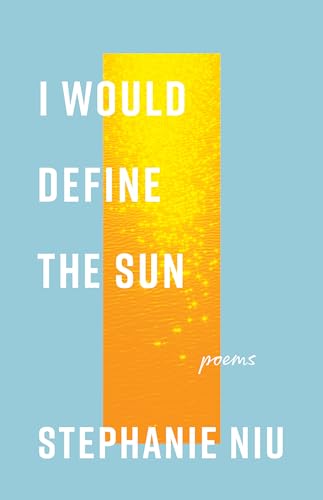
The first book I read in 2026 was Stephanie Niu’s I Would Define the Sun, which received the Vanderbilt University Literary Prize. In the book’s foreword, Major Jackson writes, “Occasionally, one encounters a voice so attuned to the groundswell of their being that their poems arrive like luxuriant explorations of language and feeling. Such is the work of Stephanie Niu and her debut collection of poetry.” I agree.

I met Stephanie briefly last October when we were both readers at the Decatur Book Festival. You can watch Stephanie’s reading from that day on YouTube. Stephanie’s poems about her family are some of my favorite from the multiple threads that she weaves together in I Would Define the Sun. So it was especially lovely to meet Stephanie’s parents at her reading, and to see how proud they are of her and her work. One of my favorite poems from the book, “Information Worker at the End of the World,” was originally published in Ecotone.

Information Worker at the End of the World
Stephanie Niu

When the ship to Mars has already departed,
and my wealthiest friends have plots in New Zealand
for their children, or have no children, what box
do I put my treasure in? I have one waterproof bag
that clips at the top. Every month, money drips
into my retirement account. You think the world
will still be around when you’re sixty-five? I don’t know
what it means to survive. I’ve learned all I can
about the Svalbard seed vault. I used to spend time
on the names of birds until the warblers disappeared.
The earth is more burned out than my coworkers.
The mantle is deathly dry. My doctor tells me
I ought to moisturize. Weekly, my milk expires.
I panic when I flip to a new month on my free
Audubon calendar. There is too much time
and not enough of it. I’m a bad steward caught
red-eyed. I board flights, order takeout high,
forget to recycle. Some days I wake and resolve
to arm myself for a righteous fight. I will make
coffee grounds into face scrub, eat kombucha
bacteria raw. Other days I wake already late
to my first meeting, say hello brightly
though the laptop screen is all my gunked-up
eyes can see. A blue glow sized to a day, an hour,
an act of speech. Everything else beyond me.

~

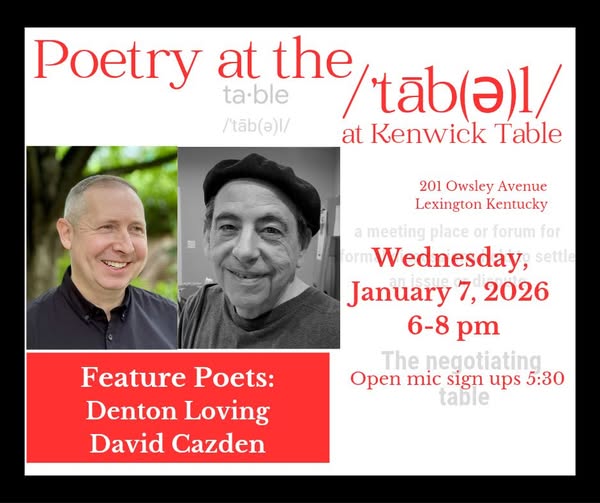
If you live in or around Lexington, Kentucky, I invite you to come out to Poetry at the Table on Wednesday, January 7th. I’ll be reading with the very talented David Cazden, and I’m looking forward to hearing others read during the open mic portion of the evening. This is a hugely popular event, held monthly at Kenwick Table in Lexington and hosted by B. Elizabeth Beck, and I’m so glad to have the chance to read some poems from Feller to this audience.

In case you missed it…

In case you missed it… I recently shared a guest post featuring a conversation between Ruth Mukwana and Lynne Sharon Schwartz, and Emily Choate’s review of Feller appeared recently in The Chattanooga Times Free Press.

If you’re not already receiving these posts directly to your inbox, please subscribe.
A Conversation with Jeremy B. Jones about his New Book, Cipher

One of my favorite reads this year has been Cipher by Jeremy B. Jones. I first heard Jeremy speak about his work on this project more than five years ago, and when I finally got my hands on the finished book, I devoured it. I often feel a sense of pleasure from the books I read, but some books actively call for some kind of engagement with the text or the writer. Cipher spoke to many of my interests, notably place, history, genealogy and genetics. As quickly as I read Cipher, I found myself laying the book aside, over and over, for just long enough to make notes and jot down questions. I’m fortunate that Jeremy was willing to answer those questions, and the result of our conversation is available for you to read at Electric Literature.

I said that I had a lot (a lot!) of questions, and they didn’t all make it into the final publication. So I thought this would be a good place to share Jeremy’s responses when I asked him about editing nonfiction books and teaching nonfiction to his students at Western Carolina University.

Denton Loving: You’re also an editor for In Place, the nonfiction book series published by WVU Press. What makes an essay or a memoir resonate with you?

Jeremy B. Jones:  I read and write a lot about place. When I was presented with the opportunity to pitch a book series to WVU Press, I thought immediately of books that had shaped me in my younger days, books like Annie Dillard’s Pilgrim at Tinker Creek and Gretel Ehrlich’s The Solace of Open Spaces and Wendell Berry’s The Long-Legged House. It’s hard to imagine those books being released by a big publisher today and getting the press and attention they deserve in the process. The publishing landscape (pun alert) has changed, so my hope with In Place was to create a space for thoughtful books about place to find a home.

Serving as series co-editor (alongside Elena Passarello) can be pretty catalytic for my writing, as I’m getting to see manuscripts that are engaging with the physical world in exciting (often formally exciting) ways. Even if the manuscripts aren’t quite right for the series or quite ready for publication, just getting access to drafts of these projects spurs on my own work and my own thinking.

DL: What about as a teacher? How do you teach students to shape their work, particularly nonfiction?

JBJ: Nonfiction is especially fun to teach at the undergraduate level because few of the students know exactly what they’ve gotten into. “Nonfiction” isn’t an especially helpful term—it only tells us what the form isn’t. That means I get to open up lots of possibilities for young writers, and that’s a gift. That opening of possibilities was my experience in college. I wrote a short essay in a first-year writing course in college that I now recognize was a memoir, even though I don’t think that was a term I knew then. My professor, Dr. Jane Stephens, pushed me deeper into that form and encouraged my explorations of memory and place that semester, and it was life-changing. I recognize that not every student who shows up in my classroom is going to have their life changed by literary nonfiction, but it’s a privilege to be able to show them what they can do with the world around them, especially if their default nonfiction form is the academic essay. Because of that, I tend to offer students tons of models and encourage lots of experimentation. I want them leaving with a lit spark more than I care about a perfect, polished essay.

Thanks to Jeremy B. Jones for taking the time to talk with me about Cipher. I hope you’ll read the book as well as my full conversation with Jeremy over at Electric Literature.

In case you missed it… Last week’s guest post featured a conversation between Ruth Mukwana and Lynne Sharon Schwartz, and I recently was a guest on Ben Tanzer’s podcast with the wonderfully apt name, This Podcast Will Save Your Life.

If you’re not already receiving these posts directly to your inbox, please subscribe.
Guest Post: A Conversation with Lynne Sharon Schwartz and Ruth Mukwana

Last month, EastOver Press published the novel A Stranger Comes to Town by Lynne Sharon Schwartz. This project was very dear to me not only because I think the novel is superb in every way but also because Lynne Sharon Schwartz has been an incredible mentor and friend to me since I studied with her at the Bennington Writing Seminars. It was an honor and joy to help usher this book into publication. In today’s guest post, my friend and fellow Bennington graduate Ruth Mukwana speaks to Lynne about her new novel.

Ruth Mukwana: I met Lynne when I was an MFA student at Bennington College. She was my mentor and advisor in my last year at Bennington. Before working with her, I had read her book, Disturbances in the Field, an ambitious book about family which I’ve gone back to several times when searching for craft ideas. Lynne and I have remained in touch, and she has always been very kind and generous to me. Her words of encouragement and belief in me have spurred me on in moments of doubt. So, I was thrilled and honored to talk with her about her new book, A Stranger Comes to Town.

Set in the Upper West Side, a neighborhood that Lynne knows very well, A Stranger Comes to Town is a masterful novel of self-discovery, revealing the multitude of histories and lives we each inhabit, as well as the many ways we seek to reinvent ourselves and reshape our pasts. The novel’s protagonist, Joe, searches to discover his true identity, exposing how even the most ordinary aspects of our lives are often extraordinarily felt.

~

RM: You’ve written a lot. How were you able to write thirty books?

LSS: It was over a long period of time, and many of them are essay collections by other writers and translations. For W.G. Sebald’s anthology – The Emergency of Memory: Conversations with W.G. Sebald – I researched and curated interviews with W.G. Sebald. I worked hard at writing and treated it like a regular job. I taught at Bennington, and I used to get these manuscripts every month and wrote letters to my students, but it didn’t take the whole month. On the days I didn’t teach, I’d get up, do what I had to do and then sit down and write. But I was also free. One day if I wanted to have lunch with a friend, I could do that. I didn’t have a set schedule.

RM: Where did you get inspiration for all your work?

LSS: They’re all different. Some were based on events that happened, but I altered them a lot. Two-Part Inventions is based on a pianist, Joyce Hatto, whom I read about in the newspaper. She was a good pianist, not great. Her husband, a recording engineer, wanted her recordings to be better known and put her name on recordings by more distinguished and famous pianists. All of this was written about in the newspapers, and there was a court case. The central question in the novel is whether the character was aware of the deception. In Balancing Acts, which was my second novel, I wanted to write about older people. Disturbances in the Field was a big undertaking; it was about family. And then this one, A Stranger Comes to Town, I started writing at the beginning of the pandemic in 2020. I had just finished something, and I didn’t know what I was going to do next, and I wanted to do something that’d get me through the pandemic. And it did.

RM: It’s a short book and easy to read. What was the process of writing it like for you?

LSS: Indeed, it’s not a long book, about two hundred pages, but it wasn’t quick to write. It took me more than three years for a short book. The pandemic was going on, and I was teaching. So, there were other things happening. But it was very hard to write, and there were times when I didn’t know where to go with it. What would happen to the main character, Joe? I let it go where it wanted to go, but I’ve always been interested in amnesia, in forgetting, in what makes the self, and I set it in a neighborhood that I know very well. I researched amnesia and found several books, but they’re mostly mistaken about amnesia. Your memory often comes back, and in A Stranger Comes to Town, Joe’s memory starts to come back.

RM: At some point the narrator says amnesia isn’t a disease, and it isn’t, but given how debilitating it is, I’ve always thought of it as a disease. Trying to remember or reconstruct your life when everyone else around you knows it.

LSS: He’s searching for who he is. He no longer knows whom he is or what kind of person he is. And every time he discovers a lot of negative things about himself (that’s what happens when you start looking) or finds another negative thing or something that he did to somebody close to him, he has to go back and reflect about it. And it’s a very hard process for him. When you reflect about your life, when you remember it, often you wonder, why did I do that? How did I do that? What was it in me that made me do that kind of thing?

RM: And one of those negative incidents is that he let his sister take the blame for an accident. He wrestles with himself as he can’t comprehend how he could have done something like that to his sister.

LSS: When we meet Joe, he’s blank and you think, what a nice guy who seems nice to everybody. But then you learn these terrible things he has done. He’s wondering how he could have done such horrible things that he has forgotten and that he now has to integrate into his conception of whom he is. I wish there are more good things that he has done, but he has done more bad things than good, and he doesn’t remember all the good. He does have a good marriage. His wife got pregnant, and he didn’t quite know what to do, and they got married. Their marriage has turned out good, and their children are great. But all these terrible things he’s being told he has done, not only can’t he remember doing them, he also can’t fathom how they’d have happened because he’s not the sort of person who’d have done such things! And he’ll never know unless the people he wronged decide to tell him everything or if his memory comes back.

RM: And it’s incomprehensible to him that the things he has forgotten are things that are unforgivable like the death of his baby brother.

LSS: There are memories from his childhood that barely registered with him. But on the other hand, his mother didn’t want to make her children dwell on that tragedy, the death of their brother. It slipped to the back of his mind, and he forgot, but it’s lodged somewhere in his brain, and it’s hard that it happened. I think there are things that happen when we’re very young that we forget. But if his mother hadn’t tried so hard to keep it from the children, he might have had an easier time remembering it. She was pained by her son’s death, and she didn’t want her children to also suffer.  He’s carrying a lot that we don’t know and he doesn’t know. Does he have more? Is he carrying around more sad stuff? He asks himself, What else might I have done? What else have I forgotten? This is a book that makes you think about your own life.

RM: The other reason the book was easy for me to read is because it also has a great plot. I was expecting to discover that the family that took him in wasn’t his real family, something Joe wonders about!

LSS: He’s thinking any woman could have come to the hospital, somebody looking for a husband, and claimed to be his wife. And when he meets the children, the awkwardness of meeting them is overwhelming for him. They know him, of course, and he doesn’t know them, and they don’t know that he has lost his memory!

RM: Amnesia is a horrible thing to happen to anyone. But for Joe, it has given him an opportunity to examine his life and confront who he really is. Every time he finds out he did a hurtful thing, it’s an opportunity for him to repent and repair which wouldn’t have happened otherwise. He’s rebuilding his relationship with his sister and has the opportunity to acknowledge how he has wronged her and apologize, which he wouldn’t have otherwise done.

LSS: That’s a nice point. I hadn’t thought of that. If he hadn’t had an accident and lost his memory, he’d have just gone on doing what he was doing. He’d remember all these things, but he probably would never think about them. You know he did those things, some of them when he was about eighteen years old and moved on, but this time he’s a grown man, and as a grown man, he must confront that. If you look back on your life, you might find there are things that you wonder how you did them. How did I do that? Did I really do that? Not all our lives are so dramatic, but his life is, and there are many things that he must reconsider and go over and integrate into his conception of who he is and who he is going to be from now on.

~

Lynne Sharon Schwartz is the author of thirty books of fiction, essays, and poetry, including her novels Leaving Brooklyn, a finalist for the PEN/Faulkner Award, and Rough Strife, a finalist for the National Book Award. She has also published two memoirs, Ruined by Reading and Not Now, Voyager, and has translated from the Italian. Schwartz has been the recipient of fellowships from the Guggenheim Foundation, the National Endowment for the Arts in Fiction and, separately, for Translation, and the New York State Foundation for the Arts. She has taught widely, most recently at the Bennington College Writing Seminars and the Columbia University School of Arts.

Ruth Mukwana is an Adjunct Lecturer at Columbia School of International and Public Affairs. She has formerly worked with the Office for the Coordination of Humanitarian Affairs (OCHA), United Nations High Commissioner for Refugees (UNHCR), the United Nations Special Coordinator for the Middle East Peace Process (UNSCO), and the United Nations Mission in South Sudan (UNMISS). Ruth is also a fiction writer and a 2020 Center for Fiction/Susan Kamil NYC Emerging Fellow. Her work has appeared in several magazines including Bomb, Solstice, Consequence and the Black Warriors Review.  She is the Creator and Host of the Stories and Humanitarian Action Podcast and a Fiction Co-Editor for Solstice magazine. Ruth is a Ugandan national with a Law degree from Makerere University, a Masters in International and Comparative Law from the Free University of Brussels, and a Masters in Fine Arts from Bennington College. She is currently working on a novel and a collection of short stories.

Thanks to Lynne Sharon Schwartz and Ruth Mukwana for sharing their conversation. I hope you’ll read and enjoy A Stranger Comes to Town, available wherever books are sold.

In case you missed it… I have three new poems published online at Porchlight: A Journal of Southern Literature, and I recently read some poems from Feller with Kendra Winchester on episode 50 of Read Appalachia, and I had a fun time hanging out with Ben Tanzer on episode 371 of This Podcast Will Save Your Life.

If you’re not already receiving these posts directly to your inbox, please subscribe.
Where the Story Demands to Go: A Conversation with Melanie K. Hutsell

I’ve lost track of how long I’ve known Melanie K. Hutsell, but it’s been a few years. She’s a native of East Tennessee, and we share a mentor and many writer friends from this region. In the time we’ve known each other, she has published two novels, The Dead Shall Rise: A Tale of the Mountains, and The Book of Susan, which received the Award of Merit in the fiction category of the 2023 Christianity Today Book Awards. About a year ago, I ran into Melanie at a writers conference, and she told me about her new collection of short stories, The Art of Lost Souls, which she was in the process of sending out to publishers.

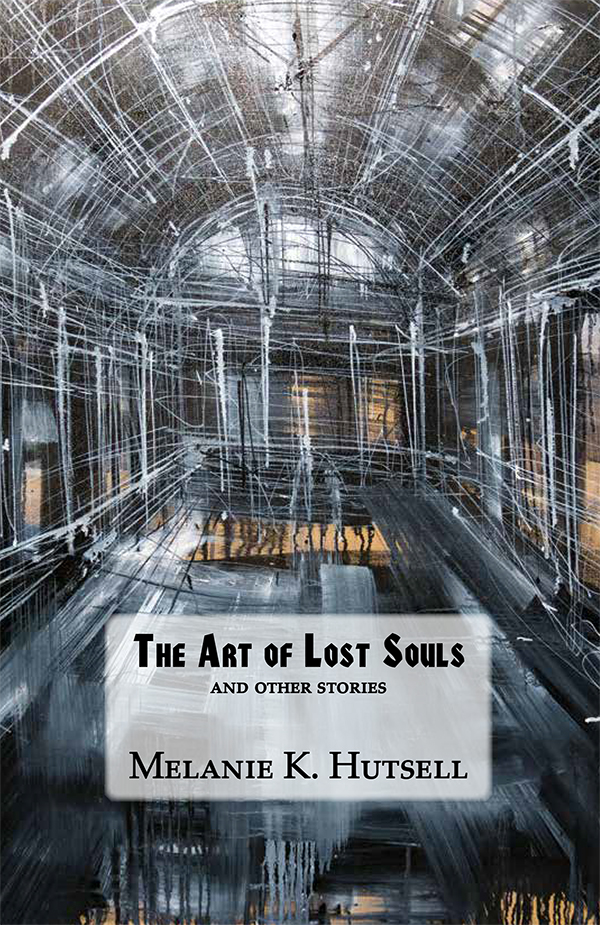
The Art of Lost Souls and Other Stories quickly found a home with Main Street Rag (MSR), and is currently available for pre-order. MSR and Editor Scott Douglass have a long history of publishing beautiful books. MSR is the press that published my first poetry collection, Crimes Against Birds. I’m forever grateful to MSR and Scott for taking a chance with my book, and I’m always excited to see MSR continue to publish good work like Melanie’s collection of short fiction.

In The Art of Lost Souls Melanie has created a cast of characters that are both achingly strange and sad. They are misunderstood dreamers, people on the verge of big transitions, wonderers asking what life would look like if all the pieces fit together. But as Hutsell’s characters face loss and uncertain futures, they reveal themselves to be creative souls with imaginations that help them survive. Melanie agreed to answer a few questions about writing, publishing, and not giving up on old projects.

DL: The title of this collection sets up how so many of your characters are some kind of artists, and usually, it’s their creativity that provides a sense of salvation to their stories. You’ve written in the past about having bipolar disorder. How does your background and your own experience of being a creative inform the characters you want to write about?

MH: This is interesting for me to consider. I’ve been aware that I do tend to write characters who are creatives—but until you asked this, I’d never really considered how seldom I write about writers. Because I do tend to think of my background as being fairly focused on words and pages, from an early age. And my fictional creatives tend toward other pursuits, like music or cooking or visual art. Maybe I tend to think, fictionally, of creativity as a way of expressing a character’s superpower, and of course, not everybody writes. I guess I tend to subscribe to the notion that all humans are here to create. I’m drawn towards the philosophy/theology in books like Divine Beauty by John O’Donohue or Art + Faith by Makoto Fujimura, which suggest humans are here to do and experience beauty and that creativity can be expressed in doing anything with love, and by love I mean with intention and giving, in the direction of God and humans.

DL: Some of the stories in The Art of Lost Souls are set in towns and locations that are real places, meaning you didn’t create them out of thin air. The first story is even titled Still Life in Townsend, referencing the town of Townsend, Tennessee. When you’re writing a story, how much do you draw on what you know about the place where it’s set?

MH: For someone who grew up reading a lot of fantasy, my adult work is pretty grounded in the Appalachia of East Tennessee. And I grew up in upper East Tennessee, and that is where most of my work is set, and Appalachian identity almost always is an important facet of my characters. Most of my settings are fictional, with strong underpinnings of reality to them. My two novels, The Dead Shall Rise and The Book of Susan, share some fictional towns with the short stories. Creating a fictional geography allows me to create needed settings or maybe to transport real-life places and set them down in new locations. But, yes, I do sometimes use real settings. In The Art of Lost Souls and Other Stories, both “Celestial Images” and “Still Life in Townsend” are set in real places, and the settings there really define the kind of stories they are. “Celestial Images” is about a homesick Appalachian living in Bloomington, Indiana, and “Still Life in Townsend” is about a motel family who specifically runs a business in the quiet—as opposed to the more tourist-deluged—side of the Smokies, and that’s pretty central to the story. The title story in the collection is set in Knoxville, though it’s a rather magical Knoxville. I was going there for a sense of urban history in that setting, something about time and distance. And sometimes I will invoke real places to make my fictional ones seem more real.

DL: One of the things I admire with the stories in The Art of Lost Souls is that you’re not afraid to go into some pretty dark spaces. But you usually bring some relief to the reader, too. Do good stories require pushing into that darkness?

MH: I do think the best writing is that which costs the author something to make and also requires great honesty. Often when something’s false in what I’m working on, it’s because I haven’t pushed myself enough in that spot, really faced what’s trying to be said there. I haven’t gone to where the story is demanding to go. And I think all of this is true whether one is writing realistic fiction or not, literary fiction or not. Because art is about being human. And there is a lot of darkness there. I consider myself to be generally wired up as someone who believes, but it’s dishonest not to acknowledge the dark.

DL: The Art of Lost Souls is your third book publication. But you’ve also been working for a long time on a magical realism novel. How do you balance multiple projects at the same time? And what keeps you returning to this unfinished novel?

MH: Well, the short answer is, I really don’t balance multiple projects at once. I actually become very absorbed in my writing projects, which is one reason—among many—that the unfinished novel remains unfinished. It’s a work that I’ve been wrestling with in many different variations since college. It began life as a fantasy novel and is a magic realism novel now. The Dead Shall Rise actually started, when I was in graduate school twenty-five or so years ago, as a manuscript written around a misbehaving character carved from the other work. After many years plagued by mental illness (though I didn’t know at the time that was what ailed me) and then devoted to recovery, the unfinished novel came back to me. But I set it aside to focus on writing and publishing short fiction to hone my craft and get a publication history. And then I opted to revise The Dead Shall Rise and seek publication with it, being a more complete manuscript, than to finish the messy, half-done one. And then The Book of Susan got written because of an agent’s interest engendered by reading one of my published short stories. (The agent ultimately passed on Susan.)  And I’ve long wanted to have a collection of my short work appear all in one place, and Main Street Rag publishing The Art of Lost Souls is a realization of that dream. Meanwhile, in between these projects, I’m writing along on the poor, longsuffering, untitled novel, because I can only do one thing at once. I suppose I find the protagonist compelling. Possibly he is my alter ego, more so than any other character I’ve written.

DL: I think you know that I have so much respect for small and independent publishers. Now that you’ve published three books with different small presses, do you have advice for writers about how to get published?

MH: You don’t need an MFA, and you don’t need an agent. Not that those are not good, helpful, and desirable things. But I have neither. I say: write and be a student of writing. I was fortunate to have a mentor when I was in high school, poet Jane Hicks, who was my guidance counselor and who taught me to approach writing professionally. Back then, it was the Writer’s Market and SASEs. Now it’s Submittable and Substack and unknown frontiers. Stay abreast of the ever-evolving business. Always read the guidelines. Don’t be afraid to submit. Don’t let rejection define you – learn from it. And definitely consider small presses as options for submitting your work. I’ve loved working with each press I’ve worked with. Each has devoted such care to seeing my manuscript through the process, helped me better realize the vision I’ve had for that particular work. I’ll pass along advice once given to me—you’re looking for the press that loves your manuscript as much as you do. There’s a lot to be said for sending your work to an indie press.

Many thanks to Melanie K. Hutsell for answering these questions. Find out more about Melanie here, and be sure to pre-order The Art of Lost Souls from Main Street Rag Publishers.

In case you missed it… I recently read with Georgann Eubanks for the Spoken & Heard series. And I’m so grateful that Feller has had some great reviews from Jake Lawson in MicroLit: a Tiny Journal of Prose & Poetry, Noah Soltau in Red Branch Review, and from Meredith Sue Willis in Books for Readers. I hope you’ll take a look.

If you’re not already receiving these posts directly to your inbox, please subscribe.
Official Publication Day for Feller

Hello Friends,

Today, August 5th, is the official publication day for Feller, my new book of poems from Mercer University Press that explores themes of connection, longing, and the pursuit of a fully lived life. I’ve been writing these poems for about 12 years, so I’m really excited to finally be able to send this book out into the world, and to share it with you.

There’s a short window of time surrounding a book’s release where every action is amplified. If you’re inclined to help me help Feller reach more readers, here are a few things you can do.

1) Please buy the book. You can order Feller directly from Mercer University Press or from online retailers like AmazonBarnes & Noble and Bookshop.orgTertulia is offering a 25% discount if you order through their site by August 7th. You don’t even have to create an account. Just enter the code FELLER at checkout.

Feller is also available at great independent bookstores, such as City Lights, Parnassus Books, Novel Memphis, and others. If your local bookstore doesn’t already have copies of Feller in stock, please ask them to order it.

2) Please rate and review Feller or add it to your “Want to Read” shelf on Goodreads or any similar platforms such as StoryGraph, BookWyrm, or LibraryThing.

Remember that you don’t have to purchase a book from Amazon in order to rate and review it there. There are legitimate reasons not to support Amazon, but reviews there do make a difference. Reviews don’t need to be lengthy. Any short, simple message to recommend the book is appreciated.

3) Post about the book on social media and tag me. Photos of the book (with your pet or your baby, on a beach or a park bench, etc.) are especially great to share! You can find me on Facebook, Instagram and LinkedIn.

4) Come to events and invite me to read. I’ll be traveling a lot this fall. Check out my calendar of events to see if I’ll be near you. More dates are in the works and will be added soon. But I’m also still looking for opportunities to connect with more readers. If you host a book club or reading series, I’d love the opportunity to come talk about Feller. Let’s talk about getting something scheduled.

5) Teach it: If you’re a teacher and would like to teach from Feller, let me know. I’d love to connect with you and your students by visiting your classroom either in person or virtually.

PHOTO COURTESY OF KARI GUNTER-SEYMOUR.

In the days leading to publication, Feller has ranked as high as #9 on Amazon’s new releases chart for poetry, which feels remarkable! And look at these excepts from longer blurbs from three writers I deeply admire.

“Loving makes lyric sense of complex issues in poem after poem in Feller, with his special blend of eco-poetics and earthly reason.” — Elaine Sexton, Site Specific          “At once timely and timeless, Feller is a superbly striking and essential book.” — Matt W. Miller, Tender the River          “Reading Feller is a transformative, joyful, loneliness-alleviating experience.” — Annie Woodford, Where You Come From Is Gone

I feel incredibly blessed for Feller to receive some early attention, beginning with the exclusive cover reveal in Electric Literature! I gave my first official reading from Feller at the 48th Annual Appalachian Writers Workshop in Hindman, Kentucky. I spoke to Greg Lehman on his Moonbeams podcast. I answered some questions about poetry and shared a poem on Deborah Zenha-Adams’ wonderful blog. I spoke to Emily Mohn-Slate for one of her great Beginner’s Mind interviews. A poem from Feller was recently featured at Verse Daily. Two poems from the book were published this week at Salvation South.

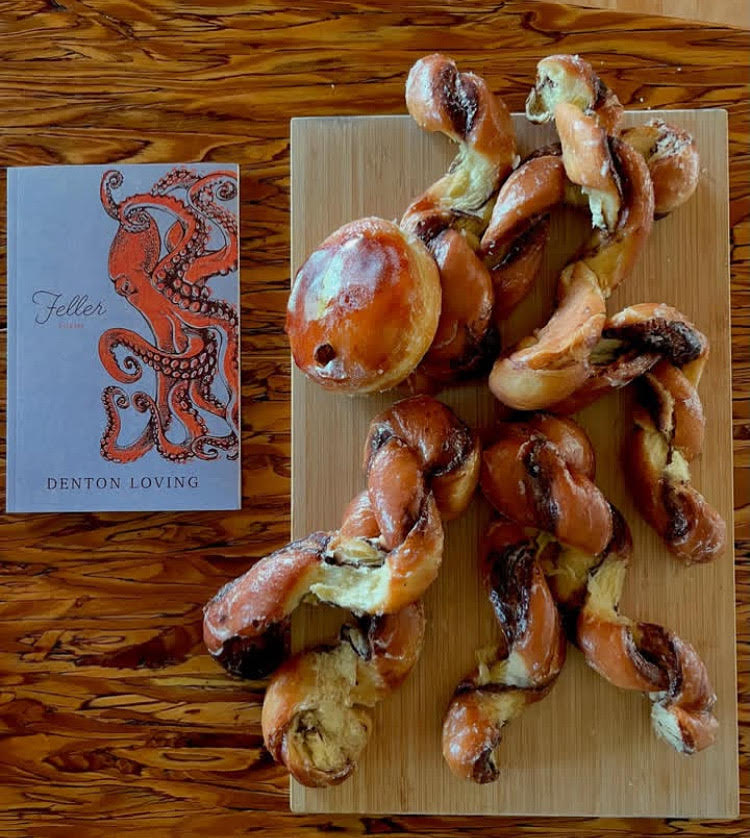
And my friend Davin Malasarn—who is a one of the most artistic and imaginative people I know—created one of his famous book-and-donut pairings to celebrate the launch.

One of the most exciting things about publishing a book is to see it interpreted and reflected through the eyes of readers. The other exciting thing is to connect with all of you. I can’t wait. Thanks for all you’ve done and what you still might do!

If you’re not already receiving these posts directly to your inbox, please subscribe. And in case you missed it… check out my recent conversation with Zackary Vernon about his YA novel, Our Bodies Electric.

Official Cover Reveal for Feller

Friends, I’ve been really excited for today to come! After what feels like a long wait, I can finally share the cover for my new collection of poems, Feller. But first, here’s one last teaser:

To view the entire image, head over to Electric Literature who very graciously is hosting the official cover reveal. I’m incredibly grateful for Electric Lit’s support and help in launching this new book.

I’m also grateful to Mary-Frances and Jim Burt of Burt & Burt who designed this cover image. It’s really striking and hits the exact right emotional key. I’m always grateful to Mercer University Press, especially my editor Marc Jolley, for believing in my work in general and Feller in particular. And huge thanks to Kelly March for coordinating this cover reveal in the first place. She’s amazing!

Feller is a book that has been a long time in the making. Some of these pieces took over ten years to transform from first draft to finished poem. There will be more opportunities later to talk about the individual poems and what the collection is about. And as always, I’m more excited to hear what the poems and the book mean to you. So I hope you’ll read Feller. The official pub date is August 5th, 2025, but if you want to hear a few of the new poems, you can listen to this episode of The Beat, a poetry podcast hosted by Alan May.

And don’t forget to take a look at the whole image over at Electric Literature. I hope you like it as much as I do.

Book Launch for Claudia Stanek’s Beneath Occluded Shine

Last week, I was invited to be part of the launch of Claudia Stanek’s poetry chapbook, Beneath Occluded Shine. This is a short collection of 16 powerful poems all written in response to poems from Pablo Neruda’s Book of Questions. Neruda’s questions are essentially unanswerable. Claudia doesn’t attempt to answer Neruda although responding to a question with a question is sometimes its own answer. But I prefer to read these poems as wrestling with all of the deepest parts of our shared humanity.

You can read one of Claudia’s poems, Sunday Morning in Broken November, originally published here in Bitterzoet Magazine.

The book launch took place virtually as part of Jules’ Poetry Playhouse, hosted by Jules Nyquist and John Roche, who are based out of New Mexico. In one of the most unique reading events I’ve ever been part of, Claudia invited Jules and John, as well as poets Catherine Faurot, Gail Hosking and me to alternate reading all of the poems in Beneath Occluded Shine. The result was something that felt meditative if not downright spiritual.

You can watch and listen to our reading of Claudia’s work on YouTube.

And don’t forget to order Beneath Occluded Shine from Finishing Line Press.

Thanks for reading. If you’re not already receiving these posts directly to your inbox, please subscribe.

And in case you missed it, I celebrated National Poetry Month by reading new poems from my forthcoming collection, Feller, forthcoming in August 2025. You can listen to the reading by following the links here.

Book Launch for Darnell Arnoult’s Incantations

Last week, I had the privilege to be part of the book launch for Darnell Arnoult’s new collection of poems, Incantations. This collection is a mesmerizing group of poems that celebrates language in unique but powerful ways. Many of the poems came out of a period of grief, but the poems are also celebratory and full of hope. They speak simultaneously to the personal and the political, addressing some of the most significant challenges of our times.

The launch took place in Hillsborough, North Carolina, at St. Matthew’s Episcopal Church as part of their Faith and Arts Series. Darnell gave a beautiful reading of her new work. The church was filled, and Purple Crow Books sold all of their copies after the reading. Alison Weiner accompanied her on the piano. And I had double duty that night, first introducing Darnell and then following up with an on-stage discussion about her work. The on-stage discussion was especially fun, and I hope an audio recording of it will be available at a later time. Until then, I want to share my introduction. It was such an honor to be part of welcoming this new book into the world, as well as to celebrate my good friend. I may have also added a little good-natured ribbing.

Welcome, and thank you all for coming out tonight to celebrate our friend Darnell Arnoult and her newest collection of poems, Incantations!

If you are here tonight, there is a good chance that you already know Darnell. Before I get too personal, allow me to properly impress you with a few of Darnell’s professional accomplishments.

Darnell is the author of the novel Sufficient Grace, and two previous collections of poems: Galaxie Wagon and What Travels With Us, and she has published stories, poems and essays in a variety of journals and anthologies.

She is the recipient of the Southern Indie Booksellers Alliance Poetry Book of the Year Award, the Weatherford Award for Appalachian Literature, the Thomas and Lillie D. Chaffin Award, and the Mary Frances Hobson Medal for Arts and Letters. In 2007 she was named Tennessee Writer of the Year by the Tennessee Writers Alliance. She holds degrees from The University of Memphis, North Carolina State University, and The University of North Carolina at Chapel Hill.

If you know Darnell, it’s likely because you have studied with Darnell, perhaps at the Table Rock Writers Workshop, the John C. Campbell Folk School, the Appalachian Writers Workshop, the Tennessee Mountain Writers annual conference, through Learning Events, the Mountain Heritage Literary Festival, or perhaps even as an undergraduate student from Lincoln Memorial University where Darnell served as Writer-in-Residence from 2010 to 2020.

Lincoln Memorial University is the place where Darnell’s and my lives began to intertwine. We co-directed the Mountain Heritage Literary Festival. And we also created and shared editing responsibilities for the literary journal drafthorse, a journal dedicated to writing about labor and occupation. Darnell and I worked together, often getting each other in and out of trouble, and we became wonderful friends in the process.

I cannot list all of the pieces of good fortune that have come to me because of Darnell, mostly because Darnell told me to do something—often something I didn’t want to do or didn’t have faith that I could do. There are too many of these instances to list, but I will tell you that when I decided to apply to MFA programs, Darnell decided I would go to Bennington College’s low residency program in Vermont. I, on the other hand, lacked the ability to imagine being accepted in that program. I didn’t even have any intention of trying. But if you know Darnell, you know that once she’s made up her mind, you might as well agree or get out of the way. It is no exaggeration to tell you that the only reason I applied to Bennington was to shut Darnell up. As she seemed to know in advance, my life changed in innumerable ways because of that program, all for the better.

Darnell is the person who has encouraged me the most as a writer and certainly as a poet. Darnell probably knows my poetry better than anyone, and she has probably influenced my poetry more than anyone. A lot of my early poems originated in workshops Darnell taught. She was the first person who thought I had enough poetry to form my first book, and she largely arranged the order of that book, which in itself was another incredible lesson in learning how to shape individual pieces into a larger narrative. She has seen so many first and early drafts that it’s a wonder she still opens my emails.

In the 10 years that Darnell taught at LMU and lived in Cumberland Gap, Tennessee, my life was richer, and a lot more exciting. In her absence, there are fewer people asking me if I have seen Darnell, if I have any idea where Darnell is, if I can find her, please, help, she’s not answering her phone, she never answers her phone! Why doesn’t she ever answer her phone? There are fewer reasons to rush to the emergency room. There are fewer visits from the fire department. In short, there is much less excitement, and my life is poorer for her absence.

To answer the question as to why Darnell rarely ever answers her phone, I can report that she may have turned the ringer off two days earlier and can’t find the phone, she may have left her phone at home or at someone else’s home, or any number of other places along the way, the battery may be dead, or more likely, she is just already on the other line with someone else who needs to talk to her just as badly as you may need to talk to her. The number of people who rely on Darnell is uncountable. The number of people whose lives have been enriched by Darnell is legion.

I would be remiss to not acknowledge that the 10 years in which Darnell lived in Cumberland Gap were not completely happy. For Darnell, I know that time period is framed by her husband William’s recurring illnesses, his battle with cancer, and his passing in 2020. The poems in Incantations were born from that grief. The deepest kinds of grief. Grief that comes, as she would describe, from worlds burning, from death that dances and glides, from widowhood with its slaughtered and emptied heart.

And yet, within these poems, Darnell also rejoices in the curative properties of language, how it can bewitch and rescue us from despair. When you look at the beautiful cover of Darnell’s new book, you will see an image of fire and light bursting into the darkness. As that image suggests, these poems tell us that there is salvation in the darkness. There is salvation in these poems that are also charms for remembrance, charms for protection and rebirth, and always charms for love, no matter how it may shift its shape.

Join me in welcoming Darnell to the stage as we celebrate her new collection of poems, Incantations.

~

You can read a sample of poems from Incantations online at Cutleaf. Or you can order a copy through Purple Crow Books, directly from Madville Publishing, from your own local bookstore or anywhere books are sold. (Photos courtesy of Donna Campbell and Kelly March.)

~

In case you missed it… check out my conversation with David Wesley Williams about his novel Everybody Knows.

~

If you’re not already receiving these posts directly to your inbox, please subscribe.

Honesty is Bravery Enough: Conversation with David Wesley Williams

Last October, as I was preparing to drive to Nashville for the Southern Festival of Books, my friend Patti Meredith told me to keep an eye out for David Wesley Williams. I found him quickly enough, signing books after his panel with George Singleton. We only had a brief time to chat, but I picked up his new novel, Everybody Knows, and asked him to sign it, not guessing that I would not have time to read it until the new year rolled around. But what a way to say goodbye to 2023 and hello to 2024.

Everybody Knows is a post-apocalyptic satire, but it’s also incredibly beautiful and smart, and a real pleasure to read. As far as apocalypses go, floating across Tennessee on a river boat is not a bad way to go. And it’s always a joy to read the work of an author who clearly enjoys language and is a master at putting words through their paces.

In addition to Everybody Knows, David Wesley Williams is the author of the novel Long Gone Daddies. His short fiction has been featured in Oxford American, Akashic Books’ Memphis Noir, Harper Perennial’s Forty Stories, and journals such as The Pinch and The Common. He spent thirty-five years as a reporter and editor, most of them in Memphis, where he still lives. David agreed to answer a few questions about his writing, his love of music, and the great state of Tennessee.

DL: As a fellow Tennessean, I have to tell you that I thoroughly enjoyed watching you destroy our state. Was that destruction as fun for you to write? And will you talk about how this narrative started for you? Would you say the tone of this book, especially the satirical nature, is similar or different from your first novel and your other writings?

DWW: I didn’t wish destruction upon Tennessee—really!—but I did relish the idea of Memphis, City on the Bluff, being the last hope and refuge for the state. Because as a long-time Memphian I know the ill will—in some cases, the outright hatred—a lot of Tennesseans hold toward Memphis. I suspect some Tennesseans would rather take their chances with a flood than come here.

The novel was written over several years and revised many times, but it always began with the couple on their porch, watching the rain and the coming flood, and one saying, “It’s not the end of the world,” and the other saying, “I think the end of the world’s been called on account of rain.” Later, it actually became a book about the end of the world.

I’d never written satire—or intended to. My first novel, Long Gone Daddies (2013), was about three generations of musicians and the family guitar they handed down. But with Everybody Knows, I was writing at a time when it was impossible to ignore what was going on with the country, the world, the planet: climate change, issues of race, religion, public health, gun violence, crime and punishment, the political divide. Everything was (and still is) so fraught. I felt like I had to write about those things, but in a way that made sense for me. In a way that helped me cope. Writing angry doesn’t work for me. Humor does. So I wrote a self-described “Southern Gothic, mock-apocalyptic, shrunken-epic satire.”

DL: Music is a driving engine in Everybody Knows. Even the title comes from an O.V. Wright song, which I’m so very glad to know now because of your book. It’s clear that you have a passion for all kinds of music, as well as an academic and historical understanding of music. How did you come to see music and particularly the state of country music and Music City as a way to talk about culture and politics?

DWW: I love music, particularly Southern music, which shows up in pretty much everything I write. Music gives Memphis so much of its cultural identity, and also some of its finest moments as a city—white and Black Memphians, working together, to create sublime art.

Also, I think Memphis musicians have always sought success, but on their terms. You can’t easily bend them to the will of the commercial gods. It’s about the song, not a gold record. Sure, we had a band that called itself Big Star, but it didn’t actually sell many records.

Nashville is a whole other place. It’s about business there. How can I say this? I hate modern country music. And when I say modern, I think they’ve been ruining country music in Nashville—turning it to pop—since at least Patsy Cline.

All that said, there’s a lot of Nashville music I love, past and present. One of the characters in Everybody Knows names his boat after Emmylou Harris. Gillian Welch and David Rawlings are on a short list of my favorite performers, alongside the likes of Bob Dylan, Neil Young and—another Nashville favorite—John Prine. Classic country is matchless music. And the Ryman is a national treasure. So there. I don’t hate Nashville. I don’t.

DL: In addition to using humor, irony, and exaggeration to make your readers laugh, you touch on some important topics, especially about race. I took note of how Emmett Till and George Floyd’s deaths were both touchstones within your narrative. Do you have advice for other writers about how to address big cultural moments in fiction?

DWW: I think it really comes down to one thing: Be honest. Say what you believe, say what you feel, say what needs to be said, by you, in the moment. Don’t pander, don’t hedge, don’t calculate. I guess I could add “be brave,” but honesty is bravery enough.

Now, all this may be easy for me to say, because not many people are reading what I write. Everybody Knows was published by a small press and not widely reviewed—but trust me, dear reader, there’s some wild stuff in there, hiding in plain sight!

DL: I’m always interested in the way we identify ourselves with location. You live in Western Tennessee, but you’re originally from Kentucky, as are several important characters in your novel. How does place inform your identity, and impact your writing?

DWW: I think place is everything in fiction. I tend to think of place as a character. Certainly Memphis is a character in most of my stories and novels. And what a character it is—“the old Delta synonym for pleasure, trouble, and shame,” as Eudora Welty called it in one of her books.

Kentucky keeps showing up in my books, in small ways. I think I’m working up to a full Kentucky novel, inspired by my hometown, Maysville—another character worthy of fiction. Daniel Boone lived there. Casey Stengel played ball there. It was Rosemary Clooney’s hometown.

DL: I often ask writers about the process of submitting their manuscripts for publication. Can you describe the time between writing and publishing Everybody Knows? How did you connect with Jackleg Press?

DWW: I queried some 60 agents with the first version of the book, in 2019. The majority didn’t respond. It was already a book about the country unraveling, so it felt natural to revise in 2020 amid the pandemic and the George Floyd murder and the country on fire. I started submitting again, this time with a query letter that began, “What would Kurt Vonnegut write about these times and those ahead for America, if he were alive today — and if he were Southern?”

I sent to a combination of agents and publishers—another 60 or so. The response was the same. They didn’t reject it as much as ignore it. They weren’t even reading it. Which was fine—I just needed one person to give it a chance. Then in early August 2021, I came across a small publisher called JackLeg Press. They asked to read the full manuscript, loved it, and within a couple of weeks I had a signed contract. They’ve been great partners, and we’re looking forward to another novel together. More news on that soon, hopefully.

I’m so grateful to David Wesley Williams for answering these questions. If you haven’t already read Everybody Knows, be sure to order your copy, available at bookshop.org or wherever books are sold.

~

In case you missed it… check out my conversation with Georgann Eubanks, where we discussed her travels across North Carolina celebrating some of the state’s most unique foodways in The Month of Their Ripening.

~

If you’re not already receiving these posts directly to your inbox, please subscribe.

Conversation with Patricia Hudson

I live in the shadows of the Cumberland Gap. The idea of westward expansion and the mythology of Daniel Boone are very present in my mind and in my daily life. This weekend, I found myself engrossed in the lives of the Boone women as I read Patricia Hudson’s novel, Traces, written from the perspectives of Daniel’s wife Rebecca and their two daughters Susannah and Jemima. Hudson has combined years of meticulous research along with the tools of fiction to give voice to women who were often forgotten or purposely omitted from the historic record. Before publishing Traces, Hudson worked as a journalist, writing for publications such as Americana, Country Living, and Southern Living. She also co-edited Listen Here: Women Writing in Appalachia, and coauthored The Carolinas and the Appalachian States, a volume in the Smithsonian Guide to Historic America series. Patricia agreed to answer some questions about Traces, the Boone women, and her writing process.

DL: In your acknowledgments in Traces, you mention that it took you nearly 25 years to write this book. As a freelance journalist, you were working during those 25 years, and you were also focusing on various other projects. But you must have been continually living with the Boone women in the back of your mind. Can you talk about what motivated you to never give up on this project?

PH: I suspect my husband would say it’s because of my innate stubbornness. It’s hard for me to abandon something I feel strongly about, and for whatever reason, these three women never let me forget about them, even though pieces of this manuscript spent decades in my desk drawer. Like so many other women, Rebecca, Susannah and Jemima had been neglected within the historical record, and I didn’t want to be guilty of yet another “forgetting.” However, at one point, when folks asked me how the novel was progressing, my response was: “Rebecca has climbed out of my desk drawer, given me a disgusted look, and told me she was walking back to Kentucky because I was no count.” Thankfully, she eventually came back.

DL: Of all genres of writing, historical fiction feels perhaps the most daunting to me. I know you employed countless years of research, and you also learned from visiting living history sites. What advice do you have for others interested in in this genre?

PH: Historical fiction authors are sometimes accused of having “research rapture” — that is, researching endlessly rather than actually writing. My first piece of advice for anyone who wants to write historical fiction is that from the beginning you should accept that you’ll never know everything about a historical period. Author L.P. Huntley said, “The past is a foreign country — they do things differently there.” As hard as you try, you won’t get every detail right.

You’ll also be faced with situations where — for reasons of clarity, or to corral a sprawling manuscript — you have to depart from a strict reconstruction of the historical record. For example, I didn’t want to depict more than one of the Boone family’s journeys through Cumberland Gap, so I combined several actual events from several years into a single trip. The rule of thumb is that a writer of historical fiction is allowed to bend history, but not break it.

DL: You have a wonderful map on www.patricia-hudson.com that illustrates the journeys made by the Boones throughout their lives. You also continue to post a “Boone Blog.” Does this mean that you aren’t finished with the Boones? Will you continue to write about them? Are the voices of these women still speaking to you?

PH: I think I’m “done” with the Boones in the fictional sense, but the Boone Blog will likely continue for a while. I’ve always loved getting to see “behind the scenes” of creative endeavors. During college I worked on the stage crew of various theatre productions because I loved watching a play come together, observing all the ways a director would tweak various elements of the show between performances. The Boone Blog pulls back the curtain on how Traces was created. I wanted to highlight the many folks I encountered during the research and acknowledge them — historians, living history reenactors, librarians, and so forth. It’s one small way of saying “thank you” to them for their help.

DL: Reclaiming the stories of historic women in itself makes Traces a political novel in some ways. Another way is in how you address the complications of race, both with whites and Blacks and even more so with whites and indigenous people such as the Cherokee and Shawnee. Can you talk about how you balanced narrative and historical accurateness with cultural sensitivities and modern perspectives?

PH: One of the main reasons I wanted to depict the lives of three of the Boone women, rather than just Rebecca, was because each of the women had unique experiences that allowed me to show a variety of responses to the cultural norms of the time.

As a young wife and mother, Rebecca had tragic interactions with the tribes who called Kentucky home, which I felt sure colored her view of the Indians and their culture. Yet somehow, towards the end of her life, she welcomed Daniel’s Shawnee friends as guests in her home. As a novelist, it was my job to imagine how that change of heart might have come about.

The historical record tells us that Jemima Boone harbored friendly feelings towards Native-Americans, even though she’d had the harrowing experience of being kidnapped by them. She reportedly said that the Indians “treated her as kindly as they could” under the circumstances. Her attitude, which was much like her father’s, allowed me to offer readers a more nuanced portrayal of the Indians than would have been possible otherwise.

My third protagonist, Susannah, accompanied her father and several dozen axmen into the wilderness as they cut the initial trace through Cumberland Gap, and then on to the site along the Kentucky River that would become Boonesborough. The only other woman in that party was an enslaved woman, whose name may have been Dolly. One reviewer doubted my depiction of these two women — one black, one white — developing a friendship. Under normal circumstances, they probably wouldn’t have, but when you consider that Susannah was not quite fifteen years old, that she’d had very little experience with slavery up to that point, and that Richard Callaway’s slave was the only other woman in a party of several dozen men, I believe the two women would have supported one another during that very arduous journey. Their relationship allowed me to portray an enslaved person as a fully formed human being.

DL: Through reading Robert Morgan’s Boone: A Biography, I learned that Richard Callaway, not the most admirable characters, was my 7x-great uncle. (Another of my grandmothers was a Bryan, related to Rebecca Bryan Boone.) I later shared this with Mr. Morgan, and he replied, “One reward of writing the Boone biography has been hearing from many people who are connected with Boone or others in his story. It’s like Boone’s life unites us in a unique way.” Have you found a similar response in regard to the lives of the Boone women?

PH: Definitely. At nearly every place I’ve spoken, someone has come up to me and said they were related to the Boones, or had ancestors in the Yadkin Valley, or at Boonesborough, or some other place mentioned in the book. During my research, I discovered that I had ancestors that went through the Gap not long after the Boones did. They tried to establish a homestead near present-day Danville, Kentucky, but when the Indians burned  them out, the family retreated back through the Gap and settled in Powell Valley. My father’s side of the family sank deep roots along the Powell River until TVA flooded their land. If things had worked out differently, I might have been a Kentuckian instead of a Tennessean.

As for Richard Callaway — I depicted him as seen through the eyes of the Boone family. Of course, the Calloway family’s version of the story would have been told very differently. Callaway sought to have Boone court martialed, so there was no love lost there. However, everyone, including the Boones, recognized that Calloway was a brave man who worked hard to protect the inhabitants of Boonesborough during the settlement’s early years. Richard Callaway was fiery, while Boone was more low-key, so from the very beginning, it was a clash of personalities. Maybe you need to write your great uncle’s side of the story? In historical fiction, as in life, truth is multi-faceted. There’s always more than one way to tell a story.

I’m so grateful to Patricia Hudson for answering these questions. If you haven’t already read Traces, be sure to order your copy, available at https://bookshop.org/p/books/traces-patricia-l-hudson/18102062 or wherever books are sold.

~

In case you missed it… check out my conversation with Davin Malasarn, where we discussed my poetry collection Tamp on The Artist’s Statement.

~

If you’re not already receiving these posts directly to your inbox, please subscribe.

~