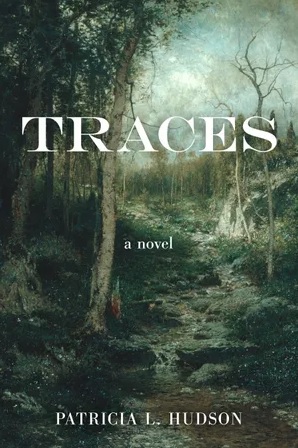
You may have seen that the writer Martin Amis died last week. I’ve never read any of Amis’s novels, but on hearing the news, I immediately recalled Amis’s short story ”Oktober,” a story that has lingered in my memory because of how much I have admired it ever since the first time I read it 7 or 8 years ago.
I’ve seen this story criticized as “non-fiction-ish” and “lightly fictionalized.” It doesn’t matter to me how much Amis heavily drew from his own experience and observations, as if there’s only a certain amount that’s okay. Rather, this story should be held up as an example of how we can fictionalize our own experiences to find deeper, emotional meaning on the page. Perhaps one reason this story speaks to me is because it’s archetypal in that it portrays a character on a journey, and, as Amis said:
“Even the dullest journey resembles a short story: beginning, middle, end, with the traveler displaced and, we hope, alerted.”
I admire this story for many reasons, most notably because it’s such a well-executed political story. It addresses world events on both the largest and smallest scales. In this case, the story centers on an Englishman in Munich during Oktoberfest, and more importantly, during an influx of Middle Eastern refugee movement. What the narrator witnesses is framed both by literature (Vladimir Nabokov & Thomas Wolfe) and history (Russian refugees in 1917 & German refugees following World War II).
The story’s refugee thread holds continued relevance in light of the migrations being politicized in the United States, centered around the expiration of Title 42.
One of the characters in “Oktober,” Bernhardt, is Iranian-German. He says about the migrants: “You know, they won’t stop coming. They pay large sums of money to risk their lives crossing the sea and then they walk across Europe. They walk across Europe. A few policemen and a stretch of barbed wire can’t keep them out. And there are millions more where they came from. This is going to go on for years. And they won’t stop coming.”
There are also mothers of various types appearing on virtually every page of “Oktober.” And in regard to the mothers that Amis portrays here, I would mention that one thing I admire about this story is how tightly he weaves all the threads of the story. It may not always seem so because the language is conversational, but everything seems to serve a purpose. Everything is connected. Meanwhile, the story is not so economical that it feels austere or lacking. It feels rather sprawling instead.
Amis received criticism during the last several years for some sloppy comments he made about terrorism and extremism. Some of these comments are not so far from those of Geoffrey, a British businessman in “Oktober” who has a less than welcoming attitude towards migrants. Geoffrey is also the character who brings the most shock value to the story. So while he is not a likeable character, he’s incredibly dramatic to follow.
I don’t know if I’ll ever get around to reading any of Amis’s better known works, but it was a pleasure to revisit this story and to remember all of the reasons I admired it in the first place. You can read Martin Amis’s short story, “Oktober,” online at The New Yorker: https://www.newyorker.com/magazine/2015/12/07/oktober. And I hope you will.
~
Thanks for reading. If you’re not already receiving these posts directly to your inbox, please subscribe.
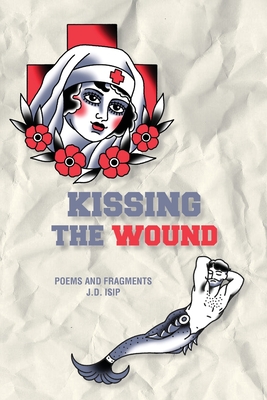
J.D. Isip is originally from Long Beach, California, but has lived the last decade or so in Plano, Texas. He received his MA from California State University, Fullerton, and his PhD from Texas A&M University-Commerce. He is a Professor of English at Collin College in North Texas, and he serves as an editor for The Blue Mountain Review. His poetry, plays, short fiction, and essays have appeared in a variety of journals and magazines. His first full-length collection, Pocketing Feathers, was published by Sadie Girl Press (2015). His new collection, Kissing the Wound, was published earlier this year by Moon Tide Press. In Kissing the Wound, J.D. asks readers to look through a multiversal lens to consider how our lives and our loves, our traumas and our triumphs, fold in on one another. J.D. was kind enough to answer some questions about Kissing the Wound, as well as to offer advice about how to approach writing about trauma, and how to mix forms—including fragments—to inform a larger narrative.
DL: I love the title of your newest collection, Kissing the Wound, and how it speaks to the ways our most traumatic experiences shape us. I’m thinking too of the beautiful opening lines from your poem Tornado Radio, “Nostalgia, defined, is a scar in your mind, / that pulled at or picked, bleeds across time…” Do you have advice for writing about trauma, particularly the difficult task of stepping outside of yourself to craft personal experience into art?
JI: Thank you so much, Denton. The story behind this title, but also behind a lot of things I’ve written and revised over the years is that we (the writers) are sometimes too laser focused on a particular idea. This can be useful, and I personally love many poets who would fall into this category (Victoria Chang, Richie Hofmann, and Patrick Phillips come to mind) of being meticulous almost to the point of obsession. With this book, I had picked the title Number Our Days early on. There’s a lot of Bible in much of what I write, so it seemed a good choice. Plus, the fragmented nature of the book seemed to pair well with this idea of trying to count or recount the days we live, have lived, and will live. Well, very late into the editing process, my publisher calls me and says, “We have a problem, J.D. Neil Hilborn has a book and a poem called Our Numbered Days, and, man, I just don’t feel comfortable doing something that sounds so much like that title.” I kinda panicked, but I had just finished a poem that I moved to the front of the book – “Kissing the Wound.” I suggested it as an alternative, and my publisher, Eric, was like, “Oh man! That’s perfect! It’s better!” That was that.
See, in my mind the book was about recounting, about “memoir-izing” my past in lyric form. But, as you point out, it was much simpler than that. It was about trauma, both individual and collective. What I want to say, the advice I would give here about writing trauma, is maybe not something I always follow, but it is certainly something I strive for. I think it’s important for us to push against two impulses: one, to relive the trauma in some masochistic or voyeuristic way; two, to homilize the trauma to the “all things happen for a reason” point of dishonesty. Instead, I think it’s better to pluck out the particulars, as much as you can remember, and let the scene and/or the action take the lead over whatever “lesson” we are trying to communicate. Also, be gut-wrenchingly honest, or what is the point? I think of student papers where maybe they spend pages talking about a really screwed up relationship with a parent or an abusive love, then the last paragraph is, “But I am happy that happened, or I wouldn’t be who I am today. I don’t even think about it anymore.” Um, Sure, Jan.
To that final point of, to paraphrase, moving from “Dear Diary” to something more universal, or at least welcoming to readers – read, read, read. What you are talking about is something that we learn by watching (reading) others do it well. How can I read Audre Lorde or John Keats and feel like I have anything in common with them? But I do. Why? Because I may have never felt romantic love for a woman, but I have felt love… and longing, and all of that. I think when you read widely, your writing starts to feel more like you are in conversation rather than screaming from a soapbox. You’re not under the impression you’re the only one who ever said this or felt this, but your story adds to what has come before. So, yeah, there’s my traditionalist leanings showing!
DL: Kissing the Wound is described as containing “poems and fragments”. I would describe some of these fragments as prose pieces, even as essays. How do poems and nonfiction overlap in terms of their autobiographical qualities? Are there other ways the two forms connect in your mind? Are there challenges to interweaving different genres into one cohesive book?
JI: I love that more and more writers are crossing genre lines or hobbling together so-called “new” genres. Not to get too pedantic, but I think we generationally tend to congratulate ourselves for innovation that has always been there. Take this delineation between poem and play and essay and recipe and whatever else. Alexander Pope, Christine de Pizan, Borges, Eliot, tons of folks were crossing those genre lines decades, centuries before us. But, we forget, and it is always nice when some memory of “permission” stirs in us: Can I do this? Why the hell not?
That preamble is my way of saying, “I know what I am about to say has probably been said before.” Years ago, I had started jotting down “fragments” I thought might be part of something bigger. A book? A memoir? Poems? Maybe. For the most part, I was a little desperate not to lose these moments or images that would pop into my mind. I’ve seen a lot of friends and family die now, and it pains me to see them try to recall something. You see it in their face, in that disappointment: they can’t, it’s gone forever. As writers, we have this unique gift to preserve a little time. That’s how the fragments started.
Because they are more like prose, these pieces definitely lean more into the “lesson” aspect, or homily. Unlike poems, I feel like prose needs to land somewhere for a reader (a poem can just leave you hanging – many times, that’s the point). Donald Murray said that all writing was autobiographical, and I tend to agree. Walt Disney chose Snow White and the Seven Dwarfs as his first feature based almost exclusively on the fact that he remembered reading the story to his daughters. Charlie Brown is basically Charles Schulz. If we accept that whatever we write is going to tell our story, I think it gives us permission to tell bigger stories, stories with more characters, stories where we don’t have to be at the center of the action.
The first prose piece in the book, “How Long Was I Gone,” helped to pull the whole collection together. The night I wrote the first draft, I sent it to my friend Allyson (who wrote my spectacular forward). I was over the moon because all of a sudden I had this idea of how to tie everything I had been working on together. My first book was published in 2015, so it had been years since I had even thought about pulling together another collection. However, just like with that first book, I think when you know you’ve landed on something you have to follow your gut. That’s tricky, because there are many, many writers who will tell you, “My gut tells me every day I should be jotting out a whole collection.” I mean, if that works for you, awesome. Darren Demaree, Nicole Tallman, and Jenn Givhan are my friends who do this—and they just pump out gem after gem. For us mere mortals, it takes a little more time. I think you have to trust your writing to lead you… and you can’t do that if you’re trying to keep up with others. I am a lot happier being able to be truly happy for my friends getting published all over, getting all of the awards – rather than grousing about things being unfair, or “they’re just so much more talented” or “so much more connected” etc. Who cares? Do you. You’ll be okay.
Oh, the interweaving of the prose and poems. One, I saw someone on Twitter griping (shocker, I know) about “people who divide their poetry collections into individual sections”; it’s such a specific and therefore hilarious thing to be miffed about. I have done it with both of my collections, and I am doing it with my third collection. I don’t have any plans to stop. It helps to have those guideposts. It gives you more freedom so your collection can be about one overarching idea but also several smaller ones. Not that a collection has to be about anything, but I tend to like collections that are about something. I feel like the hodgepodge approach is an odd one. If I wanted a grab bag of subject matter, I can just read a poetry journal or magazine. Anyway, the prose pieces in Kissing the Wound started working as these kinds of guideposts, too. I could group them with poems that would, hopefully, emphasize or challenge the point or lesson of the prose piece. I liked that idea of having my cake and eating it too – here’s a lesson, but do I actually buy it? Should you? I had a lot of fun pulling it together, moving things around. I was lucky to have a patient and enthusiastic publisher. And good friends to read over drafts! So important!
DL: I’d like to go back to the idea of the word “fragment” as you use it alongside “poem”. Can you talk about what a poem is or does, for you, in its perfect form? Is it supposed to center on a single moment, an image, an emotion? All of the above or something else?
JI: I did an interview a couple of weeks ago, and I thought of an answer to this question after I said whatever I said during that interview. So, thank you for this chance to redeem myself! For me, poems are questions at their heart. They can sometimes sound like statements, proclamations, edicts, arguments, solutions, and all of that. But not so far behind even the most self-assured poem is a do you think? And I don’t think there is any other genre that has that consistency (except maybe American musical theater). The gift of a poem, then, is that it comes alongside you when “shit doesn’t make sense,” and it says, “Yeah, why is that?” Not, “so let me tell you why that is.”
Prose pieces allow ideas to breathe. That is important. But poems, for me, are in a bit more of a hurry. Prose are the divorced couple in front of the lawyers or the marriage counselor. Poems are the fights before bed, the one liners to poison the kids against the other spouse, the angry sex. You can probably guess which I like reading more. But I make a point to read both and read lots of everything. I think it would be foolish to think prose take longer to write than poems. That was not the case in Kissing the Wound – generally speaking, the poems almost all took longer than the prose pieces. And, because I set up the prose to be fragments – meaning I didn’t have to flesh out each scene, just layered them on top of one another – they were even easier to pull together. Truth be told, we always have a little more fun doing the thing we don’t always do. It was really fun, even freeing to play between genres.
DL: I often ask writers about the process of submitting their manuscripts for publication. Can you describe the time between writing and publishing these stories? How did you connect with Moon Tide Press?
JI: It took me years to write the manuscript, a solid eight years of plugging away. It’s not because I am meticulous or anything like that. It’s because I work full time as a professor, like most other artists I know. I like to think if I were given some sort of writing fellowship, I’d just crank out book after book, year after year. But that’s not true. I’d probably do what I did with my dissertation and with this book – let it simmer for years, then bang it out when I finally get tired of simmering.
I gave myself $300 to send out manuscripts to contests or editors. That’s honestly not a lot when you consider most contests are $25 or more to enter. There are also editors who will take manuscripts via email, so that costs you nothing (no printing, no postage). Moon Tide Press had been on my radar because it’s pretty big in Southern California, where I grew up. You have Red Hen Press, Write Bloody Publishing, and Moon Tide Press – those were the places I was a fan of in grad school, and the places where I had met or seen most of the writers they published. Eric Morago picked up the press years ago. I didn’t know that—but I had read his first collection a while back, and I watched him do some of his slam stuff. I was a big fan (Eric’s easy on the eyes, he has lots of fans).
Anyway, I wrote to my friend who published my first book, Sarah Thursday with Sadie Girl Press. She’d semi-retired at the time, but she was enthusiastic about me getting another book out. I think that’s important. You need to have a group of folks doing this writing thing who you can turn to who will give you honest feedback. This isn’t your mom saying she likes the pretty things you write (though that is nice if you can get it). It’s the friends who will tell you this is what you were meant to do, and they aren’t bullshitting you. They have no reason to. She told me about Moon Tide being open to unsolicited submissions. That’s worth knowing about. A lot of places, especially big publishers, are not going to look at your work unless they have sought you out (this is rare). It’s often in contests where “unknowns” get picked up by the big presses. That’s good, but the odds are generally stacked against you. Especially if you didn’t go to a specific MFA program, didn’t publish in the big magazines, haven’t gone to AWP.
That’s all to say, yeah, I got a lot of rejections. But not as many as I feared. And, as luck would have it, I got an offer for a chapbook the same week Eric accepted my full manuscript. I felt terrible about having to turn down the chapbook, but the publishers were so excited, and that I learned you shouldn’t feel bad if you have to say no to a publisher. They probably have dozens of folks waiting in the wings and, if they are decent folks, they are gonna cheer for you – after all, they just chose you. It should make sense to them.
My friend R. Flowers Rivera came to do a reading at my alma mater, and when I came up to talk with her afterward, she said, “So, when am I going to see a book from you?” This was maybe 2012, and I told her I had submitted to contests for years, but nothing ever came of it. She said, “If the contests don’t pick you, pick yourself. Send out your manuscript.” It took about a year and some kismet with a friend from high school, Sarah, but I got my first book published a few years later. The point is that if you feel like your work needs to be out in the world, you will find a way. It might take some hustle. It might take years. It sounds cliché, but you just have to keep at it. Also, honestly, and you probably know this well, just be incredibly humble when dealing with publishers. They are almost always doing it as a passion project, and they are almost always getting paid far less than they are worth. Being patient and humble goes a long way.
DL: Are there any upcoming opportunities for readers to hear you read from Kissing the Wound either via Zoom or in person?
JI: I will be on #SundaySweetChats with Charles K. Carter on Sunday, May 28th on YouTube. I’ll be the featured reader at The Ugly Mug in Orange, California, on Wednesday, May 31st. And I will be on a future episode of Be Well: A Reading Series hosted by Nicole Tallman. I’d love to see folks in California, and I highly recommend folks check out Charlie and Nicole’s shows. Both have several videos already up.
Huge thanks to J.D. Isip for speaking to me about his new book. Don’t forget to order Kissing the Wound now. Stay tuned for my next post where I’ll share the advice J.D. shared with me about writing about the places we come from, as well as a writing exercise from J.D. based on one of his poems. Make sure you never miss a post by subscribing.
I can’t say thank you enough to all of you who have ordered a copy of Tamp, as well as for the number of other ways you’ve already shown your support for me and this book! There are hardly words to express how much this book means to me and what a gift it is to know so many of you are reading it.
Tamp’s first week out in the world has been a real whirlwind. It began last week when Marc Jolley, my editor at Mercer University Press, let me know that Tamp had gone into an immediate second printing just before our April 4th publication day.
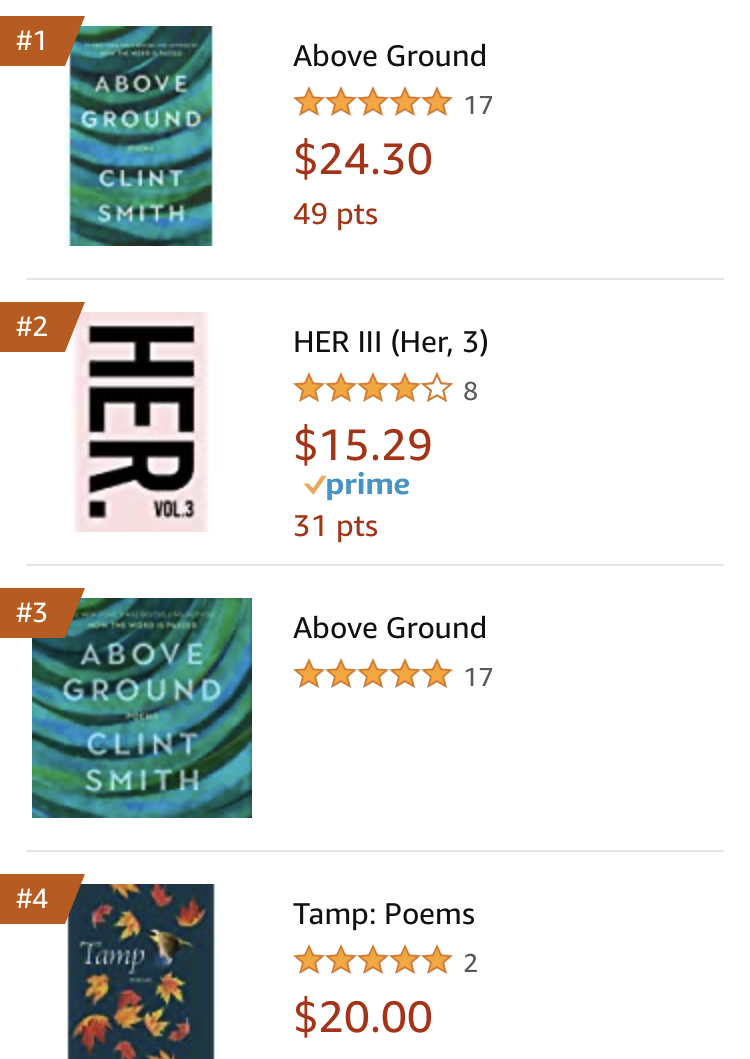
What was an even greater surprise was to see Tamp pop up in Amazon’s rankings. Over the weekend, the book went as high as #4 for new releases in American Poetry! It ranked as high as #27 in American Poetry overall! (See Tamp there at #27 just behind Maya Angelou and Amanda Gorman?)
If you’ve read or are reading Tamp, I’d be so grateful if you could leave a rating or review on Amazon: https://www.amazon.com/Tamp-Poems-Denton-Loving/dp/0881468738/. Everything to do with algorithms is a mystery to me, but Amazon reviews make a huge difference and will help keep Tamp in the eyes of new readers.
You can also help raise awareness of Tamp by posting on social media and tagging me. Send me photos of Tamp with your dogs and cats, with your adorable children and beautiful landscapes in the background.
And if you’d like to hear me read some poems from the book, please come hang out with me this week from the comfort of your living rooms. I’ll be speaking with Damian Dressick and Christina Fisanick on WANA Live!, the reading series for the Writers Association of Northern Appalachia. You can watch live on YouTube or Facebook on Thursday at 8:00 p.m. Eastern.
Again, thank you for all of the ways you’ve already shown support for me and Tamp!
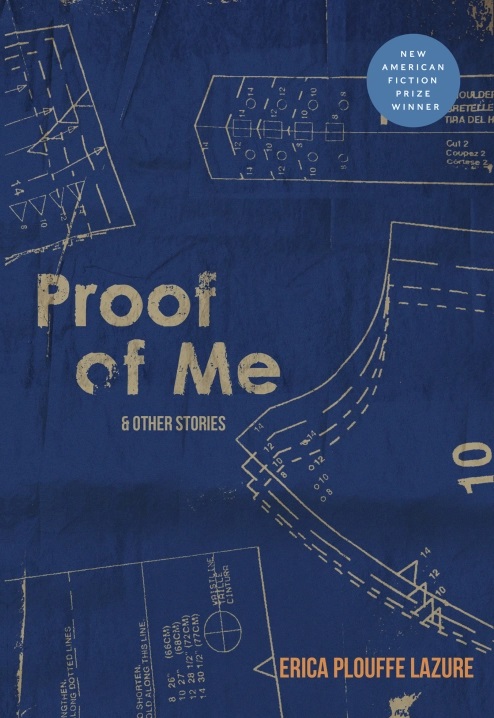
Erica Plouffe Lazure is quick to explain that she is not a Southerner nor a Southern writer. But what exactly is a Southerner or a Southern writer today? Are such distinctions based on the accident of birth? On the range of time and experience? How do perspective, talent and empathy work into the equations? I’ve heard every side of these arguments over the years. All I know for certain is that regardless of the way she self-identifies, the stories in Erica Plouffe Lazure’s linked-story collection Proof of Me authentically center on a small square of land called Mewborn, North Carolina, a place born out of Erica’s lived experience as much as from her imagination. Erica was kind enough to answer some of my questions about putting these stories together, about her submission process, and about winning the prestigious New American Press Fiction Prize.
DL: How long did it take you to write the stories in Proof of Me? Can you talk about how some of these stories link together and how those links impacted the shaping of the collection?
EPL: The stories in Proof of Me go back from when I first started pursuing creative writing—as early as 2005. Some were completed and published right away; others sat as drafts that I’d revisit and revise from time to time. I always keep a folder of stories that are “workable” but as of yet incomplete, and as I set out to help round out the stories and voices in this collection, they were integral.
I enjoy the editing process, and believe that, especially when you’re feeling stuck with a particular story, setting it aside for a while and returning to it can help shake loose its arc, and get it into publishable shape. Combing through each story one by one can help you to see how they might all fit together. Initially, I had not set out to link the stories (geographically or otherwise) in earlier configurations of the collection, but in the early days of the pandemic, I decided to dust off the collection, print it out, and see how I might more consciously connect each story to the other. I’d already written several pieces about some of the characters (like the Weaver sisters, or Cassidy Penelope), and so those stories became natural anchors for the larger collection. From there, I reworked some of the other pieces to connect more organically to other characters in the collection, or found ways to tie back stories that were set outside of Mewborn to the town itself. If I hadn’t allowed myself the flexibility to change certain aspects of the stories as I’d initially envisioned them, I’m not sure the collection would have been as strong.
DL: These stories are set in a range of locations such as Nashville and Boston and as far away as India, but each story is centered emotionally around Mewborn, North Carolina. Was it helpful in your writing process to create your own Yoknapatawpha County?
EPL: Mewborn the town is very much an imagined community, a bit of a hybrid of the small city of Greenville, in Pitt County (where I’d lived for about eight years), certain parts of Eastern Carolina, and my own hometown in Massachusetts. The name Mewborn is taken from a small crossing close to Kinston, but I chose it because I liked the sound of the name, and did not want (like Faulkner, I would guess) to have to adhere to the actual historical particulars of Pitt County while crafting a fictional work. And yet, a strong sense of place—about a small town, about how families and neighbors live and function alongside each other, about how even those who leave their hometown are still tethered to it—is what I hope surfaces in this collection. And as I mentioned earlier, I hadn’t intended the stories to be linked when I first set out to write them, but the revision process enabled me to see how I was, in fact, writing of, or about, the same place all along. And I should note that, for the record, I am not from the South, nor do I claim to be a Southerner, but I am very much a student of its literature, and I had never written a word of fiction until I moved to North Carolina.
DL: Can you describe the time between writing and publishing these stories? How did you connect with New American Press? Were there many rejections along the way?
EPL: Since about 2009, I had submitted various versions of Proof of Me to book prize contests offered by smaller presses. I like to joke how I almost renamed the collection The Bridesmaid, because it had been a finalist or runner-up in at least a half-dozen or so competitions (including New American Press, which eventually took it). But I think my effort to substantially rework the collection to make it more directly linked, geographically and thematically, worked in my favor. Rejection is part and parcel of the publishing game, and at some point, you understand that it’s not because the work isn’t any good; it’s more of what fits with the vision of the press, and the aesthetic tastes of the contest judge (or editor). I haven’t really gone the agent route—the agents I’ve had conversations with were always asking about my novel (! Don’t ask !) and were not interested in story collections. I’ve found there is certainly an interest and demand for short stories, but I guess we story writers have more work to do in making a convincing case to big publishers.
DL: Do you have advice for writers who hope to publish story collections?
EPL: This is rather technical advice, but something that helped me to envision my collection AS a collection was printing it all out (1.5 spacing, double-sided) and then read it aloud and edit with a pen in hand. I would make notes of key objects, characters or themes in a notebook, and then look for spots where those objects (sewing machines, dice, cars) might show up in another story. In some cases, I realized that, with a name change and a shift in a few key details, a story that might not have been part of the collection could be transformed into another piece of the Mewborn puzzle.
As far as submitting your work, I suggest that you research the publisher first to make sure it will be a good fit. Some publishers will want you to chip in for paying for a publicist (and there goes your advance), others might not do much in terms of promotion, or expect you to do much of that work yourself. I suggest researching a few past winners of story collections prizes of publishers that you’re interested in, and see how their books fared (via reviews, or press interest, or readings). Smaller presses tend not to have big budgets for book launches, so be aware of that.
DL: What are you working on now?
EPL: I’ve been working on a collection of flash stories under the thematic title Desire Path. It’s a term often used by city planners and landscapers to describe a “footpath made through foliage or grass by repeated traffic, rather than laid out by design.” I plan to take this literal definition in a metaphorical direction, where each of my characters will aspire for something guided by their desires, instincts and travels, and endeavor to carve a path of their own making to attain it. It is slow-going, but I’m enjoying discovering how each story might bend toward (or even challenge!) the established theme.
Huge thanks to Erica Plouffe Lazure for speaking to me about her new book. Don’t forget to order Proof of Me now. Stay tuned for my next post where I’ll share a writing exercise from Erica based on one of her short stories. Make sure you never miss a post by subscribing here:
About a year ago, I read a book that completely captured my attention. It was A.E. Hines’ Any Dumb Animal, published by Main Street Rag Publishing. Although Any Dumb Animal is a collection of poetry, it can also be likened to a memoir, moving through time to reveal moments of Hines’ personal life story. I was excited by the mixture of craft and accessibility in Hines’ writing. Many of his poems lean toward the narrative as well as the confessional. The result is that reading each poem feels like you’re being let in on a secret that has the potential to change your personal outlook of the world.
I’m far from alone in recognizing Hines’ talents. Any Dumb Animal received Honorable Mention in the North Carolina Poetry Society’s 2022 Brockman-Campbell Book contest and was a finalist for the Eric Hoffer Book award. His work has also appeared in some of the best journals of our time such as Alaska Quarterly Review, Southern Review, Rhino, American Poetry Review, Poet Lore, The Greensboro Review, Ninth Letter, The Missouri Review, I-70 Review, and Tar River Poetry, among other places.
He splits his time between Charlotte, North Carolina, and Medellín, Colombia. Last week, I reached out and asked if he would share one of his poems.
Waiting for the Diagnosis
Lying with the man I love, I muse about a farm high in the Colombian mountains where terraced slopes of coffee meander valley to peak and disappear into mist.
There’s still time, I tell him, to plant a thousand bamboo trees, watch them leap into the sky, to nail bat houses to the trunks and hear the flitter of webbed-wings, to hear the night monkeys winding their way in the dark, leaping branch to branch.
Let the shadows come and wrap us in their slippery shawls— there’s still time to dig our fingers into the black brooding earth, to taste the prickly fruit,
to believe we can grow old listening to the bats shriek, and night monkeys howl, to bamboo trunks rubbing together in the breeze, their insistent music like the luxury of creaking old bones.
I asked A.E. Hines if he would share the inspiration for writing Waiting for the Diagnosis, and here’s what he wrote:
“When Any Dumb Animal first came out, a couple of friends contacted me after reading this poem to inquire about my health. “What’s going on?” one asked. As I told my friend, I’m fine now. A few years ago, I did have one of those surprise health issues that stops you in your tracks, and leaves you worrying and waiting for the days and weeks it takes to get into doctor visits, to schedule and receive various test results. That gap in time was the genesis for this poem. I recall coming home after a particularly invasive test and wrote the title in my notebook. At the time, I was in a brand new relationship with the man who would later become my husband. We were still very new, and it was my first serious relationship after ending a twenty year marriage. Like all new couples, we were making plans for the future. But as middle-aged (and previously divorced) adults, we also understood time isn’t always on one’s side, and plans don’t always work out. Growing old (and doing it with someone you love) really is a luxury. This poem lives in the gap, that anxious moment of waiting. Of not knowing if plans will work out. But also in hope that they will. PS: As for me, so far, so good!”
In my next post, I’ll share a writing exercise based on Waiting for the Diagnosis. If you’re not already subscribed, you can make sure you never miss a post by subscribing here:
For many years before Tony Taddei was creating characters on the page, he was creating them on the stage as a trained actor. Born and raised in New Haven, Connecticut, Tony now lives in New Jersey. I first met Tony in 2014 when we both attended the Sewanee Writers’ Conference. A few years later, we reconnected through the Bennington College Writing Seminars. Though all of my interactions with Tony had been related to writing, I hadn’t had the pleasure to read his work for myself until the recent publication of his collection of linked short stories, The Sons of the Santorelli. What a joy it was to discover the craftsmanship and poignancy in these twelve stories about an immigrant family, particularly the men in the family who struggle with their desires and ambitions. Yes, this is a narrative about an immigrant family, but as David Gates said about the book, this is not “the conventional immigrant family saga.” Tony was kind enough to answer some of my questions about putting these stories together, about how he avoided convention, and how he infused a political slant into such personal, character-driven writing.
DL: How long did it take you to write these stories, and do you recall when you knew how individual stories would work together? Can you talk about your reasons for writing multiple, linked stories rather than a novel?
TT: I took my time writing these stories, so that the process from drafting the initial stories to finalizing the collection probably took five or six years. The collection wasn’t the only thing I was working on during the time, and, in any case, I didn’t want to rush the process of writing the collection. First, because I wanted to get the premise of each story right as well as to spend time considering what stories might need to be added, and second, because I was having a lot of fun writing about these people and I kind of wanted to savor it.
During the process of working on the stories I don’t think I really had a master plan for how they would all work together. That said, once I decided to write one story for each of the Santorelli sons and grandsons as well as at least one story about the patriarch, the linkages between stories started to become evident, and I was able to find ways in rewriting the stories and adding new ones to get them to work together as a piece. My goal was to have each story stand on its own but also for a reader to be able to sit back and think about them in their entirety after finishing the collection to realize that the parts of the book made up a whole.
As to why I wrote the saga of this family as linked stories rather than a novel, I did it because it gave me the ability to tell multiple, smaller stories that I would not have been able to tell in a novel (while still trying to make the novel a cohesive whole). It was also a lot easier for me to write about the individuals in this very complex and human family in separate stories than it would have been in a novel. By telling the story of the Santorellis a character at a time, I think I did more justice to each individual while still creating the personality and a legacy of a whole family.
DL: One of the recurring themes throughout these stories is the idea of the immigrant experience, often depicted here in connection with “immigrant shame” and the idea that America “breaks” the spirit of immigrants. This is the antithetical American story. How conscious were you of making this kind of political statement during the writing? Do you have advice for other writers about incorporating political ideas into fiction?
TT: As the work progressed, I was very conscious of it. Having come from an immigrant family and seen them fail more than succeed at the things they most wanted I can be somewhat cynical about the idea of an American Dream to begin with. I knew that cynicism would likely play a role in the situations I put my characters in.
That said, I didn’t I initially set out to tell stories that torpedoed the idea of what can be achieved in America. I set out to write human stories that were compelling to read as well as funny and tragic with as many twists and surprises as I could manage. In order tell the truth about the characters in this family as I saw them, I had to show the forces that were working upon them. The largest of those forces being that for most immigrants and, especially for the poor, this country very often only lets them get so far before it pushes them back down again. This comes in the form of economic imprisonment, and it comes in the form of racial imprisonment where one wave of immigrants who’d faced bigotry visits their own xenophobia and bigotry on the next wave of immigrants to reach America’s shores.
My advice for writers who want to incorporate political ideas into fiction is to first find an honest story that is personal and then begin writing it without focusing on the political or cultural connotations. If the story is honest and tracks with the world we live in, they won’t be able to help themselves from writing about the political forces that are acting upon their characters. Those forces come into play in our lives most of the time without us even realizing they are there. After that, when the writer looks back on what they’ve written, they can draw out the more political aspects of the story to any degree they choose. To put the above more succinctly, all politics are personal. I think any political writing should follow that guideline.
DL: Many of these stories are told through the male point of view which makes sense given the title of the collection. But that’s not to say that you don’t give voice to women within the Santorelli family. How did you settle on the balance between male and female characters and points-of-view? Were there any challenges in allowing the women to have their say in this male-dominated cast?
TT: Not at all, because I think if you look closely at each of the stories, you’ll see that the women in the backgrounds of these men’s lives are the real truth-tellers. The stories would not have found the ballast they needed for their conflict and reasoning if it weren’t for the women characters. A reader will likely see this most clearly in a story like “Commedia Dell’Arte” which has the matriarch of the family as the protagonist trying to make sense of and tell the truth about male dominance in her life. But it’s just below the surface of most of the other stories as well. From “Songs for Swingin’ Lovers” where a prostitute early on dominates a group of highly dysfunctional and misogynist men, to “Valiant” where the sisters and especially the mother in the family turn out to be stronger and more insightful then either the father or the son.
So, no, I did not find many challenges in allowing the women to have their say in my largely male-dominated cast. In fact, I’d say that the challenge was being able to hold off in letting the women have their say long enough so that the men could act out in the wrong-headed and solipsistic ways that I think make the stories interesting and recognizable to readers. Especially female readers.
DL: In an effort to demystify the process, I always ask writers about the process of submitting their manuscripts for publication. Can you describe the time between writing and publishing these stories? How did you connect with Bordighera Press?
TT: The time between writing and publishing was, to some extent, concurrent. I started to send the manuscript to publishers when I had most of the stories finished but was still revising the last two or three. At that point it was rejection, rejection, rejection until I found Bordighera Press.
Bordighera is a small independent press that is partially privately funded with a mission to publish writing about the culture of Italy and Italian Americans—essays, fiction, poetry, what have you. They publish a semiannual review of shorter work as well as a twice yearly run of new full-length work and are always looking for good writing that fits the themes of Italian life. About 2 years ago, I submitted the title story of my collection to Bordighera for consideration in their semiannual review, and it was accepted. Once I realized that they also published full length work, I sent the full and, by then, nearly completed manuscript, and I was thrilled when they said they wanted to publish it.
I’ve been telling people who ask how you find a publisher for your work that you have to persevere until you find a publisher that is the right fit. Most of the time that’s easier said than done. In my case I believe it was a bit easier because the work was a more-or-less exact match with the kind of work Bordighera is looking for.
DL: What are you working on now?
TT: I’m finishing up another collection of short stories that revolve around the melancholy, indignities, and occasional pleasures that men face as they age. Each of these stories also weaves in animals and their ability to live instinctually and unquestioningly as a humorous and (I think) affecting counterpoint to the men in the stories who are creating their own problems and then struggling to accept the circumstances they find themselves in. These two themes may not at first glance seem to go together, but I think the stories work better because of their juxtaposition. I’m hoping to have these stories published as a collection sometime soon and readers can judge for themselves. For now, if any of your readers want to take a look a couple of these stories, they a can go to Animal Literary Magazine and The Florida Review online. I’m also beginning a novel but it’s too early to say much about it, so I’ll have to get back to you on that.
DL: Are there any opportunities coming up for readers to hear you read from The Sons of the Santorelli either via Zoom or in person?
TT: Yes, I recently read an excerpt from a story in the collection – “We Now Conclude Our Broadcast Day” – online for the Prospect Street Reading series and readers can view that on Facebook Events at https://www.facebook.com/events/413658933932101/?ref=newsfeed (no Facebook account required to view).
Other readings are in the works, and I’ll post the particulars to my social media feeds when they’re set. (@tony_taddei/ Twitter; Tony Taddei / Facebook; tonytaddei / Instagram)
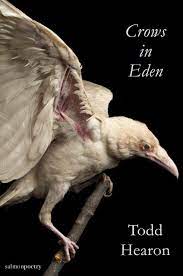
This week’s poem comes from the beautiful book, Crows in Eden, by Todd Hearon. Todd is a native of western North Carolina, and this collection of poems is placed in Eden, a small town in the Great Copper Basin of southeast Tennessee. A century ago, an African-American community was forced out of Eden after the lynching of three young Black men. Hearon’s poems are deeply-felt explorations of that particular time and place, and of the lives of both the victims and the perpetrators. This short poem essentially only 6 lines and an epigraph, is one of my favorite from the collection.
Epitaph
By his own hand to be engraved on copperplate and planted at The edge of town under the sign that reads EDEN POP. 353
When this grave has eaten us alive and slugs have blown the marrow from our souls think not Wildflower Pilgrim as you drive past this blot we were not particles of the scene you seek its promise and its poor mortal glory mirroring your own We were
The writing community lost a fine poet and friend last month when Ron Houchin passed away from a rare form of kidney cancer. I first met Ron when he attended the inaugural Mountain Heritage Literary Festival (MHLF), and our paths crossed many times in the years since then.
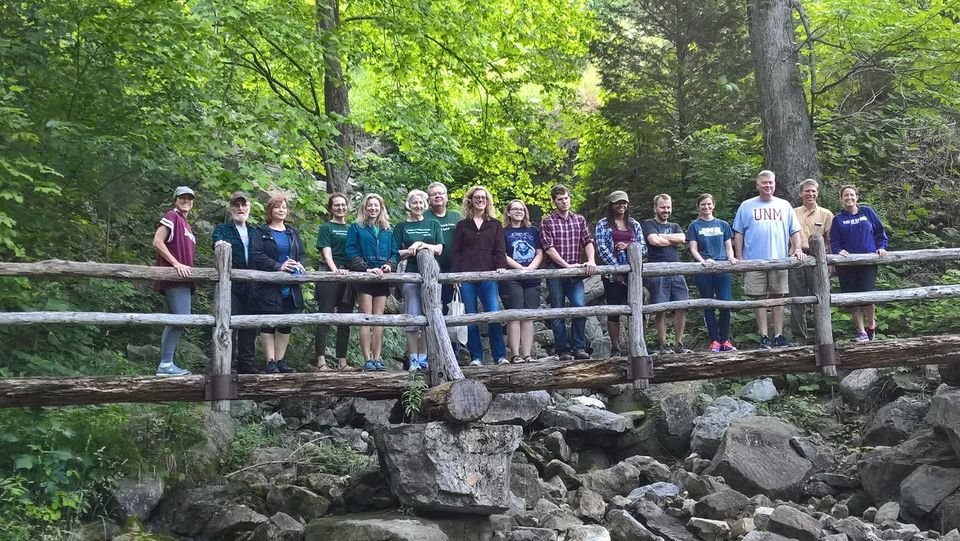
Ron was a consistent attendee at MHLF, and he never missed the Saturday morning hike led by my friend Tony Maxwell. Each year, Tony chose a walk that would eventually lead to the Pinnacle Overlook at the top of Cumberland Mountain, and Ron was always there. In the photo below, taken in 2017 and shared by Thomas Alan Holmes, you can see Ron standing second from the left, wearing his trademark baseball cap.
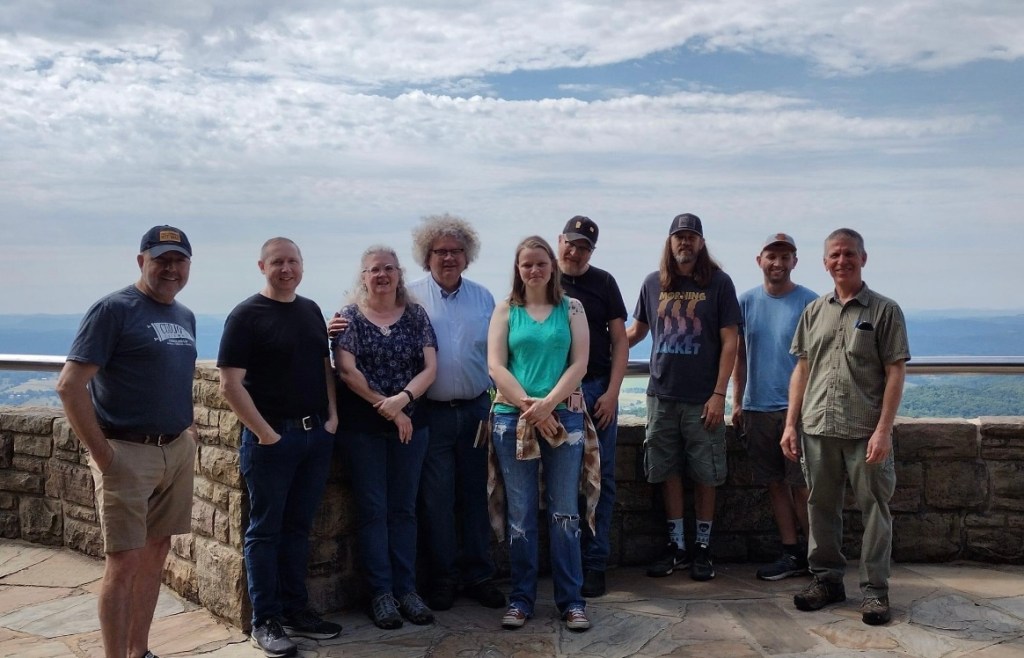
Thanks to Tony’s suggestion and Alan’s organization, a small group gathered at the Pinnacle Overlook on Sunday morning to remember Ron.
I wish I could share all of the wonderful stories that were told. Ron was often quiet, especially in group settings. He was one of the most thoughtful people I’ve ever met. Those factors combined with his obvious talent as a writer could feel intimidating. And yet he was incredibly kind and generous with his time and energy, and he often surprised us with his witty sense of humor and his always perfect delivery.
Ron published a remarkable body of work ranging from poetry to short fiction and a young adult novel—ten volumes that will keep him and his voice from ever completely dying. We read a few of his poems on Sunday when we gathered on top of the mountain. I didn’t read a poem, myself, although for weeks now, I’ve been carrying around my copy of his 2009 collection, Museum Crows, one of four titles published by Salmon Poetry. The first poem I opened to was, “When you are not there,” a perfect poem for a time of loss.
When you are not there
Five granules of pepper and three of salt lie on the table beside two clear shakers. On the floor a ray of sunlight lands beside the dog dish. It creeps over the bowl while the dog sleeps.
In his dream, he growls, but the sun beam does not hesitate. Its bright tongue licking over the edge of the dry food wets it with light. The dog blows out his breath, feet twitching.
Across the room, a tall glass, empty but for three ice cubes, clinks and settles its coldness. Behind the refrigerator, frail cobwebs, in the pattern of someone’s initials, wave in wind from the furnace vent.
Like the music of fear, the red light of the security system keeps time. When you are still not back, a full, pastel moon peers in the big window over the breakfast nook.
These things, and the bright planet Venus shining through the storm door, will not ask your whereabouts or why the car is not ticking toward coolness in the garage.
But the dog will wake soon and whine for you and fresh food. The philodendra will take a week to miss you. The tall water glass, still on the counter, whispers tragedy in strains of evaporation.
I can’t exactly remember the first time I met Patti Frye Meredith. I definitely have memories of her at one of the early Mountain Heritage Literary Festivals making people laugh and playing music late at night. One thing I know for certain is that Patti can make anyone laugh. That’s true whether you’re fortunate enough to sit down and share a meal with her, or whether you’re reading her beautiful new novel, South of Heaven, a multi-generation narrative set in Carthage, a small town in the Sandhills of North Carolina. At the center of the novel are two sisters, Fern and Leona. Both have secrets they are keeping from each other and from the world. There’s also Fern’s son Dean who, as Fern says, doesn’t have any secrets. South of Heaven is a meaningful exploration of how the things we try to keep bottled up complicate relationships. The novel is deeply Southern, completely universal and wonderfully fun to read.
DL: South of Heaven centers on the McQueen family, and it’s set in the late 1990’s, a time not so long ago but a time that feels infinitely different in hindsight. Do you have any advice for other writers writing about the recent past?
PM: When Dean first “talked to me in my head,” he told me his dad was MIA in Vietnam, and how as a child he pretended to find his daddy in the overgrown bamboo patch in his backyard.
I wrote the book from that one scene. I knew Dean was in his early 20’s, and that his father went missing at the very end of the war. That’s why I set the novel in 1998. After I got into it, other 1998 occurrences came into play like the Clinton/Lewinsky drama. There’s a lot in the book about the lengths we will go to avoid the truth, so that worked.
Early readers suggested that I move the story up in time, to make it more contemporary, to use the Iraq War instead of the Vietnam War and put it in present tense. I tried, but I couldn’t make it work. By that time, too, I felt like I knew Fern and Leona very well, and I realized they wouldn’t be the same people if they hadn’t grown up like they did in the sixties.
There are pitfalls. It’s not historic, and it’s not contemporary. The characters are just modern enough for readers to wonder, “Why would they think that?” or “Why would they do that?” It’s embarrassing, but I had to do research to remember if everyone had cell phones in 1998, or if fax machines were still a thing. We’ve seen a lot of change in twenty-four years, and it’s amazing how quickly we forget recent history.
DL: I loved reading the “Backstory” on your website about your job at University of North Carolina Public Television, and how you met so many writers there. The authors you mention (Lee Smith, Doris Betts, Reynolds Price, Fred Chappell) all come from the Southern tradition, and South of Heaven feels like a very Southern novel. How natural was it for you to write in that tradition?
PM: Like so many others, reading Eudora Welty, Elizabeth Spencer, Lee Smith, Jill McCorkle, Tim McLaurin, and so on and so on, showed me that stories set in small towns were okay to write.
I grew up in Galax, Virginia, population around 6,000. So, it was natural to stick to the world I knew. Thinking about it, I’ve now lived in Memphis and Chattanooga, Tennessee, Huntsville, Alabama, Durham and Charlotte, North Carolina, Columbia, South Carolina, and Baton Rouge, Louisiana. Cities large and small, but with the same southern sensibilities. (Or maybe I think all those places have the same southern sensibilities because “wherever you go, there you are”!)
DL: Did you feel any pressure to “live up” to the works of those writers you admired so much?
PM: If I thought I had to live up to their work, I’d never write another word! Back when I first started writing, I didn’t know what I didn’t know, however, it didn’t take long to realize I was never going to be in the same league with the writers I admired most. I’d give anything to see the world and put that world on the page like Fred Chappell, but I don’t have his complexity or depth. That doesn’t mean I don’t love reading his work. But, even when you study the craft and learn what makes great literature, even when you can recognize it, it’s still not possible to re-engineer your brain to create it. Thank heavens. There should be only one Lee Smith, one Jill McCorkle, one Darnell Arnoult.
That’s not to say I don’t spend a lot of time being discouraged! But you have to write what you write, be who you are, I mean, you can’t fake your subconscious! We all have our own perspectives and experiences, and we’ve all drawn our own conclusions.
I’m hooked on the joy of writing. The discoveries, the occasional good sentence, exploring the minds of my imaginary people. Writing helps me understand what matters and it’s my way of expressing what strikes me—good and bad—about being human.
And, since I love a cliché, I’ll say, “It’s the journey, not the destination.” Chasing after the “secret” to good writing has led me to friends who absolutely make my whole life better. Having the opportunity to be with other writers is the best reason to write! Sorry for getting off on a tangent, but maybe that’s the southern tradition!
DL: How long did it take you to write South of Heaven? How many drafts did you go through?
PM: There’s no telling how many drafts I have. Dean’s voice came to me at Hindman Settlement School in 2005. I wrote the original draft in first person present tense. Then changed it to third person present tense for my MFA thesis at the University of Memphis in 2012. Then I wrote a draft in third person past tense. I was always changing something, adding, taking away. Starting over. We moved seven times in twenty-eight years for my husband’s job, so I had a lot of distractions (excuses) through the years.
When my husband retired and we moved back to North Carolina, I set up my little office and joined a weekly writer’s group. Then the pandemic hit. Everyone is different. I know there are many great writers with extremely busy lives, but for me, the stillness of the pandemic quarantine made it possible to devote the time I needed to work. No travel, no socializing. I don’t think I understood what it meant to really work until the pandemic. I discovered the long stretches of uninterrupted time helped keep the story together in my head, helped me play out the scenes I needed to make the story more cohesive. I think of it as bandwidth. Writing South of Heaven took a lot of bandwidth!
DL: Your novel is published by Mint Hill Books, an imprint of Main Street Rag which published my poetry collection, Crimes Against Birds. What was your experience like in finding a publisher?
PM: I can’t remember if I saw Main Street Rag’s call for novel chapters on social media or in Poets & Writers, but I had one of those “What the heck” moments and sent chapters. Months later, I got an e-mail saying they were interested in publishing the novel, and Scott Douglass sent a contract and a detailed explanation of how the process would go.
I had sent out query letters to agents off and on for years. (One agent had almost taken it years ago, but that fell through when the third reader in her office didn’t think they could sell it.) I knew South of Heaven wasn’t the kind of book that was getting the attention of traditional publishing, or the independent presses I was familiar with. It wasn’t full-blown literary, and it wasn’t quirky enough to be chick-lit.
I didn’t think it was going to set the literary world on fire, but I wanted my imaginary people to live in a real book. So, I asked you, Sue Dunlap, and Darnell Arnoult to read it and tell me if I was about to embarrass myself, and you all said, “Do it.” So, I did. I fiddled with it after I got it back from you all, and I hired an editor to make sure I hadn’t added a lot more typos. Then I fiddled with it some more, and my niece, Becki Vasques, found my last snafus. We made it a family and friend affair! You and Darnell suggested I put an emu on the cover, and my husband, Lee, and I put it together (with Darnell on the phone). It’s been fun. Not “have lunch with your agent in New York City” fun, but better. A true labor of love. And I like that my North Carolina story is published by a North Carolina press. Scott Douglass does something very special with Main Street Rag. He publishes wonderful poetry and stories. I’ve gotten to know him and his wife and his dog, Harley, and I really appreciate the work he does.
DL: Do you have any advice for other writers ready to send their novel out?
PM: Don’t discount the small independent presses. We all appreciate independent bookstores. These presses deserve our appreciation, too.
Do ask yourself if you’re ready to be in the book marketing business, though, and the weird thing is part of that is selling not just the book but yourself. The great thing about the small press is, “You have a book to sell.” The scary thing about the small press is “YOU have a book to sell.” Just be honest with yourself about what you want to accomplish and why you’re doing it.
For me, the experience has been amazing because it has reminded me that I have the very best family and friends in the world. The support has been phenomenal. People I haven’t seen or talked to in ages bought my book after seeing my Facebook posts. Friends talk about my characters like they’re real people they care about. So, if I don’t sell another book, I’m very happy with the response South of Heaven has gotten.
CYNICAL ALERT!
The truth is, without Facebook, I wouldn’t have sold m(any) books. South of Heaven is in two bookstores, Chapters in Galax, my hometown, and McIntyre’s in Chapel Hill, where I live now. I’ve had one reading at McIntyre’s. I hired a publicist, and maybe there will be more readings, but maybe not. Even if I devote a lot of time to driving around, going to bookstores, taking them a book and a nice press kit, there’s no guarantee they’ll carry it. I have a couple of book club gatherings coming up. The bottom line is: It’s up to you to promote your book, to make yourself known. I believe even if you have an agent and a traditional press, they want you to have a “platform” meaning they want you to use your social media connections to publicize and sell your book.
DL: You’ve described South of Heaven as coming out “late in life.” We could argue about what that means, but I’m more interested in something else you said which is that having the novel out in the world helped clarify where and on what you want to focus your energies. Can you talk more about that?
PM: I know for sure I don’t want to be an author who dresses up and talks about writing. I want to be a writer who writes. I want to spend more time with my imaginary people and less time telling real people why they ought to like my book! Ha! I recently got together with a group of my writing friends, and afterwards I realized all we’d talked about was how close each of us were to having finished products to try to get published. Like there was some big door we were all clamoring to walk through to get to a different, more perfect life. I want to spend more time talking about ideas, or break-through moments, or what we’ve discovered about the craft. I don’t want my energy focused on end-products. I want to focus on better writing and storytelling.
DL: What are you working on now?
PM: Not much. I’m caught up doing what I think I ought to be doing to sell books. It’s uncomfortable and not much fun. I did have a little “conversation” with one of the characters in South of Heaven the other day. So, I wrote that down.
* * *
Find out more about Patti on her website, and don’t forget to order South of Heaven, now available from the Main Street Rag Bookstore. Coming soon, I’ll share my conversation with Tony Taddei about his debut story collection, The Sons of the Santorelli. Make sure you never miss a post by subscribing here:
Julia Wendell is a poet currently living in Aiken, South Carolina. She is also a three-day event rider, the experience of which considerably informs her newest collection of poetry, The Art of Falling, published by FutureCycle Press. Amanda Moore said this about The Art of Falling: “…knowing how to fall allows Wendell’s open-eyed work to acknowledge pain but not be weighed down by it, moving instead to consider what blossoms and grows each passing season. Love here is represented by and extended to plants and animals—reluctant gladiolas, bursting peonies, a menagerie of dogs and birds—but nothing so beloved as horses, an anchoring and comforting presence throughout.”
I found The Art of Falling to be a powerful book encompassing decades of Julia’s life, moving from childhood traumas to complexities of adulthood. In one poem, Julia describes the art of falling as a practice perfected through pain and intense self-awareness, visible in “the coat hook / of my separated shoulder, / my spine’s bumpy lane, / sunspots littering my back— / the parts of me / I can’t see without mirrors.” In other poems, the art of falling is also made known in far less visible ways. Julia was kind enough to speak to me about her new book, her writing process, ekphrastic poetry and what it’s like to be married to another poet.
DL: Many of the poems in “The Art of Falling” touch on a fall you suffered from a horse that caused significant physical pain. But these poems reveal other traumas as well. What’s your process like for transforming writing about trauma into a well-crafted poem?
JW: It wasn’t one fall from a horse, but many: actually, a lifetime of falls. The old directive is true for me—you fall off a horse, you get back on. You fall off a poem, you get back on. Some falls are worse than others. And the older you get, the worse they tend to be, and the harder it is to get back on. Several years ago, I broke my hip as well as my leg falling from one of my horses, and that fall transformed my life for a year, as well as the writing of The Art of Falling. I found ways to live through the pain and to see through it. I had to change my life pretty drastically during that time, and my poems became both a respite and a way to work through the ordeal. I couldn’t get on a horse, but I could go to my desk with the help of a cane or just steadying myself on furniture as I went across the room.
DL: I was thrilled to read your poem, “Horse in the Landscape” which is an ekphrastic work related to Franz Marc’s painting with the same name. This is also the image used for the book’s cover. I recently taught a workshop on ekphrastic writing. Can you talk about the relationship that can exist between visual art and written work? Are you also a visual artist?
JW: No, I’m not a visual artist, but the piano is my brush; has been all my life, and music often finds its way into my poems. In reference to the above question about writing through pain: while writing the poems in The Art of Falling, I re-visited Frida Kahlo’s life and work. Her example taught me how to keep making art while in terrible pain. I read everything I could get my hands on about her life and artistic process, and studied her strange, surreal self-portraits. I even went to Mexico City after I had partially healed and visited her house, Casa Azul. I was drawn to her for the obvious parallel between her life and mine at the time. Both of us had our hips gored by rods, except that hers was put there by a bus and mine was put there by a surgeon. Here was an artist who experienced a lifetime of pain, and yet she kept getting back on the horse of her art to create her organic, visceral, paintings. The poem “Portrait Chinois” came directly from my re-experience with Frida’s work.
Similarly, the figure of the broken girl in Wyeth’s Christina’s World reminded me of my own plight; and through her semi-reclined pull and yearning for the gray house on the hill, despite her infirmities and inability to walk, drew me to ponder what it would be like for her to crawl to the house, to go inside, to open up her world and reach her dream destination.
I have always loved Franz Marc’s work for its ebullience and movement, and of course for its subject matter. But what pulled me to Horse in the Landscape is also what struck me about Christina’s World—we see a still landscape through the girl’s and horse’s perspectives, as they turn their backs to us. It is a world of no movement, only thought and perspective, possibility and possible movement, which is what my life had become during the time I was so badly injured. I had to contemplate my life through quiet and stillness, and find my poems there.
I chose the cover for The Art of Falling before I had written Horse in the Landscape. The pdf’s of the interior of the book were almost ready for the printer. Suddenly, I had the urge to write the poem and spent last Christmas season writing and re-writing it, thinking I would save it for some other project. Then Diane Kistner, the editor at FutureCycle Press, contacted me. Did I have another poem that might fit into the book? The way the pages were laying out, she needed one. Uncanny coincidence.
DL: I always ask writers about the process of compiling, submitting and publishing their books, and I’m especially interested in asking you because this is, I believe, your eleventh book. How long did it take you to write and shape the poems in this collection? How did you find and form a relationship with FutureCycle Press?
JW: The poems in The Art of Falling span at least a decade. The last book, Take This Spoon, had a very specific theme of poems about family, and the relationship to food and eating and anorexia, and even incorporated old family recipes. I was already working on the poems in The Art of Falling when Take This Spoon came out in 2016. The manuscript has seen many, many revisions: different title, different order, new poems. It’s actually my sixth, full-length collection, having published a number of chapbooks in addition to the longer books. I submitted to FutureCycle at the suggestion of April Ossmann, with whom I worked on an earlier draft of The Art of Falling. Diane Kistner, editor at FutureCycle, was very good at managing the publication details of the book, though not so much involved with line edits or broader editorial suggestions. For those I relied on April, Jack Stephens, D.W. Fenza, and most especially my husband, Barrett Warner.
DL: I have to ask you about Barrett Warner who is also a writer. To what extent do you and he read and comment on each other’s work?
JW: Barrett reads and helps edit everything I write, as well as a tone of what other people are writing. When he likes reading something his hand twists up his hair, and if he comes back to me with really messy hair, I know he liked it. I am dependent upon him as my first reader. He is a bit more independent of me, perhaps because as an editor he has such rich connections with other writers. I am more of an artistic recluse, and I like it that way. But everyone needs a first reader, and Barrett’s mine. In sickness and in first drafts, as they say.
DL: In addition to being a writer, you’re a three-day event rider. It’s also clear in your poetry how much you love and respect horses. Are there lessons from the equestrian world that also apply to writing?
JW: Ride the rhythm, create the energy from behind, send it forward, don’t let the poem go against your hand. Talk to your poem. Give it confidence by having clear intentions. Give it treats. There must be a daily devotion to the art of riding, as there must be to writing. The development of a poem, as well as a horse, comes in the smallest of increments, and must be addressed day after day after day. Writing is re-writing; riding is re-riding. The daily devotional is how you get there.
DL: What are you working on now?
JW: The next poem. Then, the one after that.
Seriously, though: recently I’ve collected poems I’ve written about my daughter in her lifetime (and even before that), and have compiled a collection called “Daughter Days.” I have plans to get back to that manuscript to revise it and see if I still like it before I send it out into the world. Writing is re-writing, and submitting is re-submitting.
***
Find out more about Julia on her website, and don’t forget to order her newest publication, The Art of Falling. My next post will feature a writing exercise inspired by one of Julia Wendell’s poems. Make sure you never miss a post by subscribing here: