Earlier this month at the Kentucky Book Festival, I met Manny Grimaldi, who gifted me with a beautiful copy of Yearling: A Poetry Journal for Working Writers. Yearling is an annual publication that operates under the umbrella of Workhorse of Lexington, which in itself is a cool, wide-ranging operation that supports publishing and building community for writers. Manny is Yearling’s managing editor, and he agreed to answer a few questions about the journal that will be interesting and helpful for those of you looking for good publications where you can submit your writing.
DL: It was great to meet you at the Kentucky Book Festival, and to find out about Yearling. How long has Yearling been publishing? How long have you served as managing editor?
MG: It was a pleasure conversing with you, Denton. Yearling: A Poetry Journal for Working Writers is an offshoot of a poetry feedback program through Workhorse of Lexington. I approached our editor-in-chief for work, and he instructed I take helm of the feedback program where folks sent in work only for response. Soon after in 2021, we launched Yearling with that ethos.
DL: The fact that Yearling provides feedback to submitters really sets the journal apart from so many others. As an editor, I know that requires a lot of work, but it’s also such a benefit to submitters. As managing editor, do you still provide that feedback yourself?
MG: I do provide the feedback, and a resounding yes to what you are stating, this is difficult work. But I do this with the helpful impressions of team readers. Never in the community of artists, whether actors, poets, editors, musicians, or novelists do I claim to do and develop in a vacuum. We help each other. In the end, I re-read each poem, draw together our conversations, solidify my impressions, and compose meaningful feedback. I read much gratitude for the deep reads from our authors, and some encounters with poets create avenues to their outstanding revisions.
DL: Yearling is a journal dedicated strictly for poetry. Are there any specific forms or styles that you’re especially looking to publishing in Yearling?
MG: As managing editor, I focus upon this principle: Does the work move me to forget I am reading a poem? A sonnet can do that. A villanelle can transcend form. I also hold anyone can do that, Denton. Provided they are telling the truth, and telling it well! Short answer: any style, any length, any form, we can print—we enjoy a book format now. We take everything from single poem submissions, up to six poem. Currently, in this issue, I hope to cull the heart of Kentucky writers and our surrounds as much as possible. That said, everything is read, considered, and published if it sings.
DL: If I understand correctly, then Yearling publishes in December of every year, and acceptances for that issue are sent out by October 1st. Is Yearling currently accepting submissions for the 2026 issue?
MG: We process submissions all year. Yes. Yearling prints December of every year, once a year. In practice, we have closed a year’s volume with the requisite number of poets, which is 40, as soon as April. We respond generally, schedules permitting, as promptly as possible.
DL: In addition to being an editor, you have also published multiple books of your own writing. Where can readers find your work, and how can they connect with you?
Mothman and Finding are full length. ex libris is a satirical chapbook released by anonymus scriptus.Mothman connects people with a window into family and personal demons. Finding is about romance, reveling in poetic forms, from the historical persona poem, to the broken sonnet, to tanka.
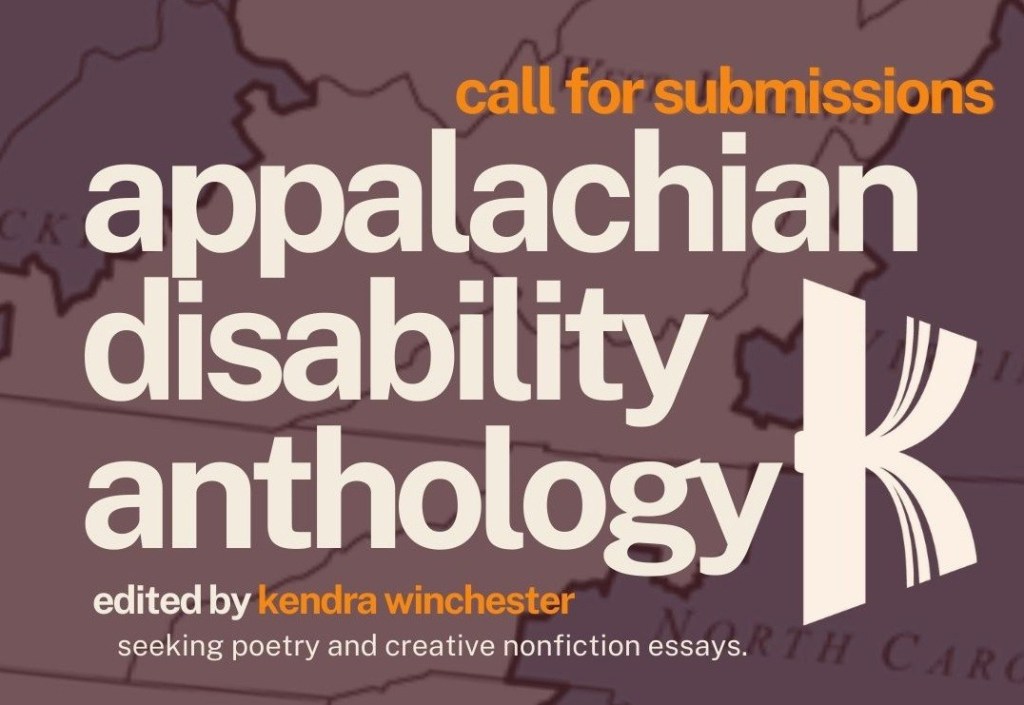
Many readers of this blog will be familiar with Kendra Winchester’s name from her work as the host of the popular Read Appalachia podcast, which celebrates Appalachian literature and writing. Kendra is also a Contributing Editor for Book Riot where she writes about audiobooks and disability literature. Kendra and I had a chance to spend some time together in person this past summer during the Appalachian Writers’ Workshop. One day while we were having lunch, Kendra started to tell me about her new project to compile and edit an anthology of work by disabled writers from Appalachia. The dining hall that day was so loud with conversation and laughter that we struggled to hear each other. So Kendra agreed to answer some questions over email about this anthology, which is actively accepting submissions.
DL: I was excited to learn that you will be editing an anthology of work by Appalachians writing about disability. How did the idea of this anthology form?
KW: Far too often, disabled people are treated like we’re invisible. When we are mentioned, we’re featured as inspirations, side characters, or burdens for the nondisabled people around us. Sometimes the very existence of our disability makes other people uncomfortable.
When I first read Disability Visibility, edited by Alice Wong, I didn’t realize how rarely I saw my disabled self in books. Reading stories about people like me was something I never knew I needed. This led me to seeking out as many books by disabled authors as I could get my hands on. Little did I know that there was a whole disability community waiting for me. We have our own culture and history. People just have to realize that it’s there.
In the vein of Disability Visibility, I wanted to bring together Appalachian writers to tell their own stories of what it’s like being disabled in Appalachia. With poetry being such a vibrant tradition in the region, I also wanted to include poets, and my goodness, so many Appalachian poets have shown up in such a big way. My hope is that this anthology will be the first of many anthologies of disabled writers from the region sharing their work with the world. The more voices, the better.
Sometimes people ask me if their disability “counts,” but we’re using the big umbrella for disability. So anyone who is disabled, chronically ill, deaf, or neurodivergent is most welcome to submit.
DL: Do people with disabilities in our region face challenges that are unusual or different from other regions?
KW: Appalachia has higher rates of disability than the national average. Some disabled people have had to completely leave the region to seek treatment. Some disabled people can still live in the region but have to travel back and forth to urban centers to see specialists. And others are disabled because they worked in major Appalachian industries, such as coal mines and paper mills. Whatever our experience, we all have stories to tell.
DL: What genres are you seeking for this anthology, and how long should submissions be?
KW: I’m looking for creative nonfiction essays—around 2,500 – 3,000 words—that center the writer’s experience with living with disability in Appalachia. I’m also looking for poetry—3-5 poems—informed by personal experiences with disability in the region. I also welcome previously published work.
DL: Are you only looking for work from published, experienced writers?
KW: I’m looking for writers of all experience levels! The anthology includes experienced, prize-winning writers and people who have never had a published piece before.
DL: How can writers submit to your anthology, or reach out to you if they have questions?
KW: To submit their work or if anyone has questions, they can reach me at Kendra (at) readappalachia.com. I’m happy to answer any questions that they may have.
DL: When we were at the Appalachian Writers Workshop this past summer, you read a wonderful piece about growing up with a disability. Where can readers find that essay or any of your other recent work?
KW: Owning It: Our Disabled Childhoods in Our Own Words just came out in the U.S. this past August. It includes dozens of essays by disabled adults who were also disabled as kids. I was so honored to be included with writers like Ilya Kaminsky, Imani Barbarin, Ashley Harris Whaley, Rebekah Taussig, and Carly Findlay. I also write for Book Riot and have an occasional newsletter called.
Many thanks to Kendra Winchester for this important work and for answering my questions. You can find out more about Kendra and all of her projects by following her on Instagram or Twitter, or by subscribing to her occasional newsletter called Winchester Ave.
Last year, submission posts like this one fell by the wayside, and I’m sorry. When I looked back at 2024, I saw that I did not submit enough of my own work, and I realized how building and sharing these lists and my own submissions go hand in hand. So I’m trying to start 2025 off the right way by sending some of my own work out into the world.
As we move forward, I want to give some extra energy to finding new journals and magazines to recommend to you. There are so many great outlets, and there are new journals emerging all the time. I often feel overwhelmed by all these magazines I’ve never heard of. So you’ll see on this list of ten submission opportunities a few names that are new to me. I hope they are new for you also.
How do we rank these new journals or compare them to some of the ones we’re more familiar with? I don’t know that yet. Please take a look at each one to determine if it feels like a good match for your work and your publication goals.
Today was a great day for me to think about all this, as I was somewhat snowed in. I’m guessing some of the rest of you in the South and East might stuck inside, too, if not by snow then probably by these Arctic temperatures. I hope the timing is right for you to receive this list.
For those of you in Southern California, especially those directly affected by the wildfires, please know that there are so many of us heartbroken by the extreme loss that you’re experiencing. I’m praying for your safety. To anyone and everyone reading this, I wish you all the best for the new year. Happy submitting.
The 2025 Yeats Poetry Prize is a public program since 1997 of the all-volunteer WB Yeats Society of NY. Our 2025 Judge is January O’Neil who also served as last year’s judge. Poets of any age from anywhere in the world may enter through February 1, 2025. There is no limit on entries, and they can be on any topic. They must also be in English, unpublished, and no more than 60 lines in length. First prize is $1,000, second prize is $500, and two or three honorable mentions are usually awarded at the judge’s discretion. The entry fees, which help to underwrite the competition, are $15 for the first poem and $12 for each additional poem. Winners are announced in early March, and awards are presented in New York City in April. https://yeats.submittable.com/submit
Deep South Magazine accepts original fiction, short stories and shorts, nonfiction and poetry during open reading periods. For fiction and nonfiction, we will do special themed calls. We will announce a new theme sometime in 2024. For poetry, our reading period will be open through February 14, 2025. We will mainly publish poetry in April during National Poetry Month, so around 30 selections will be chosen. All submissions must have a Southern connection, whether the author lives in the South, used to live in the South, has family in the South or was inspired by a visit to the region. Poetry submissions can be up to five poems of any length. Fiction, short stories and nonfiction are limited to one work at a time and may not be longer than 3,500 words. https://deepsouthmag.com/submission-guidelines/
Beaver Magazine publishes poetry, flash fiction and nonfiction, hybrid works, art and anything else you have to offer during our open reading periods. For poetry, send 3-5 poems of any format, each beginning on a new page. We love work that plays with traditional forms and modes. We want the lyric, the narrative, and everything in between. For prose, send up to 3 flash pieces of no more than 1,000 words each (though we do prefer brevity). Creative nonfiction can include personal, research, or lyric essays as well as memoirs. Fiction can be of any genre or style. Hybrid work can be whatever you want it to be! We celebrate and yearn for work from LGBTQIA2S+ and BIPOC. Submit through February 15, 2025, for the Spring Issue. https://beavermag.org/submit/
The Santa Clara Review is a student-edited literary magazine that publishes poetry, fiction, nonfiction, and visual art. The magazine is published biannually in February and May, drawing on submissions from Santa Clara University students, faculty, and staff, as well as from writers around the nation and globe. Please submit works of fiction or nonfiction prose under 6,000 words. Please submit no more than five poems or pieces of artwork at a time. Submissions for Volume 112.2 are currently open through February 15, 2025. https://santaclarareview.com/submit
Canary is published four times a year to welcome each new season on the solstices and equinoxes. We will be open from February 1- 28 for Spring-themed work for the Spring Equinox issue due out March 21, 2025. Please submit no more than 5 poems, or essays/short stories of not more than 1500 words. We look forward to reading your work on your experience of the losses to the natural world in your home environment and the joys of that natural world that we stand to lose. https://canarylitmag.org/submissions.php
Brevity publishes well-known and emerging writers working in the extremely brief (750 words or fewer) essay form. We have featured work from Pulitzer prize winners, NEA fellows, Pushcart winners, Best American authors, and writers from India, Egypt, The Netherlands, Ireland, Spain, Malaysia, Qatar, and Japan. We have also featured many previously-unpublished authors, and take a special joy in helping to launch a new literary career. While Brevity (the magazine) publishes the finest examples of flash nonfiction, the Brevity Blog offers a place to discuss issues related to the writing of creative nonfiction. https://brevitymag.com/submissions/
Pine Hills Review seeks submissions of previously unpublished fiction, nonfiction, poetry, and visual art. We are interested in quality work, no matter the genre, form, or style. Hybrid and experimental works are especially encouraged. Poetry submissions should include no more than six poems total. Nonfiction, fiction submissions, and hybrid or cross-genre work should be no more than 3,000 words total. Our regular reading period ends April 30, 2025. https://pinehillsreview.com/submit/
The Baffler is America’s leading voice of incisive and unconventional left-wing political criticism, cultural analysis, short stories, poems, and art. Founded in 1988 by Thomas Frank and Keith White as “the journal that blunts the cutting edge,” the magazine is currently edited by Matthew Shen Goodman. Nonfiction should be submitted in pitch form (no complete manuscripts, please), consisting of two paragraphs that describe your project. Poetry and fiction are welcome; our preferred length for prose is between 2,200 and 5,000 words. https://thebaffler.com/about/submissions
Forge Literary Magazine publishes one prose piece per week selected by a rotating cast of editors. Free submissions open on the 1st of each month. If there is no free link, we’ve hit our quota. We will reopen at the top of each month, except for September and December. We prefer stories under 3,000 words but will consider up to 5,000 words. We love flash and micro! We consider previously unpublished pieces only. We are open to all genres and voices, and stories with any background, race, ethnicity, gender, sexual or personal identity from all over the world. Literary excellence is our only criteria. https://forgelitmag.submittable.com/submit
Streetlight Magazine reads year-round and typically responds to submissions within three months. Send us 3-5 unpublished poems in a single document. Please send one story at a time, 2,000 words max. We currently seek creative essays/memoirs with an emphasis on the interaction of place and one’s personal relationship to it. We also welcome guest bloggers. We’re interested in topics about the literary and visual arts as well as personal perspectives on much more. Blogs should be between 300-700 words and may be edited to fit SL format. https://streetlightmag.com/submissions/
~
Thanks for reading. Please feel free to share these opportunities with other writers. If you’re not already receiving these posts directly to your inbox, please subscribe.
Perhaps it’s the heat, but I can’t quite fathom how we are already steaming in the July sun. July. How did it get here so soon? Not only is summer at least half over, so too is the whole year. That makes it a good time to re-evaluate your goals for your writing and submitting? Do you have any ongoing projects? Are you moving them forward or feeling stuck? Are you submitting your work to journals and magazines?
When I first began to send my stories and poems out to literary journals, my friend Darnell Arnoult encouraged me and my writing group to give ourselves a goal, not for acceptances, but for rejections. That first year, my goal was to receive 50 rejections. Making a kind of game out of it took the sting away every time an editor rejected my work. But the surprise was that I agonized less over trying bigger, higher-tiered journals. I was only aiming for a rejection, but I got some surprise acceptances along the way.
Even though the year is half over, it’s not too late to set some goals for your writing. To that end, here are ten submission opportunities for writers plus a bonus if you will go back and see my recent conversation with Andy Fogle who shared that Salvation South is also open for your submissions. Good luck!
Granum Foundation Prize&Granum Foundation Translation Prize The Granum Foundation Prize will be awarded annually to help U.S.-based writers complete substantive literary works—such as poetry books, essay or short story collections, novels, and memoirs—or to help launch newly published works. One winner will be awarded $5,000. Up to three finalists will be awarded $500 or more. Additionally, the Granum Foundation Translation Prize will be awarded to support the completion of a work translated into English by a U.S.-based writer. One winner will receive $1,500 or more. Funding from both prizes can be used to provide a writer with the tools, time, and freedom to help ensure their success. For example, resources may be used to cover basic needs, equipment purchases, mentorship, or editing services. Competitive applicants will be able to present a compelling project with a reasonable timeline for completion. They also should be able to demonstrate a record of commitment to the literary arts. There is no fee to apply. Applications close on August 1, 2024. https://www.granumfoundation.org/granum-prize
Fried Chicken & Coffee FCAC is an ezine/blog edited by Rusty Barnes, mostly interested in crime fiction, rural, working-class and Appalachian concerns. FCAC accepts short stories, poems and essays. Rusty says: “Send me rural, funky, dirty stories about churchgoing women who never sin. I would love to see more stories about women. Get to the grit, get to the love, show me the scars, and take Harry Crews to heart: ‘Blood, bone, and nerve, that’s fiction. Show me the stuff that cuts to the quick.’” There are no word limits. To submit, send an email to rusty (dot) barnes (at) gmail (dot) com with the words FCAC and SUBMISSION in the subject line. https://friedchickenandcoffee.com/manifesto/submissions/
Lanternfish Press We are seeking novella-length manuscripts between 20K and 40K words that fall in the mist-wreathed borderlands between literary and speculative fiction. In particular, we are interested in climate fiction; regional American Gothic fiction—Midwestern, in the vein of These Bones by Kayla Chenault; Southern, like The Salt Fields by Stacy D. Flood; or Alaskan Gothic, or Rust Belt Gothic—whatever kind of luxuriant and atmospheric decay floats your boat; well-researched historical fiction that breathes life into its material and cultural milieu; queer monsters for readers who enjoyed Carmilla or Elegy for the Undead; fiction that can claim as a comp title the novel Wednesday Addams was typing on her typewriter in the attic. Deadline to submit is July 31, 2023. https://lanternfishpress.com/submissions
Orion We’re excited to read your pitches for our upcoming Summer 2024 issue. This time we will specifically be looking to read pitches for essays and reporting about animals and floods. How is marine life impacted by water reaching the shore? What are the interesting ways you’ve observed land animals responding to water? We’re looking for pitches for stories that would be 3,000 to 4,000 words in length for an issue of Orion looking with fresh eyes at the floods around us. Please try to keep pitches to 500 words or so. https://orion.submittable.com/submit/267484/pitches-for-summer-2024-issue-on-floods
Necessary Fiction This October, we want to be scared. We want to feel unsettled. We want to go to sleep with dread knotted in our stomachs. Send us your spooky tales, your uncanny narratives, your haunted places, your tortured monsters, and your Gothic twists. We accept unpublished fiction up to 3,000 words only. Deadline to submit: July 31, 2023. https://necessaryfiction.submittable.com/submit/200451/special-call-october-stories
Galileo Press Galileo Press is open for submissions of full-length collections of poems, essays, stories, as well as novellas, novels, memoirs, or hybrids (with exception to 4-colour art / text hybrids). Please indicate in the title of your submission which genre you feel best describes it. Galileo hopes to publish 2-4 selections while also reserving a few manuscripts for development. A small stipend of $200-$500 is provided, along with copies and standard royalties. A few elements we consider are a confident, appealing voice; the thematic cohesiveness and the emotional range and maturity; vivid imagery and the balance of abstract to concrete imagery; deft handling of highly charged emotion; the capacity to surprise; use of wit, humor, and self-implication; the elastic syntax, pace, and music; and the choice and use of extended metaphor, skillfully juxtaposing the micro and the macro. There is an $18 submission fee. Submissions are open through August 1, 2023. https://freegalileo.com/submissions/
Short Story, Long We are accepting short stories, 2k-8k words long (with the 3,000-5,500 range being our real sweet spot). What are we looking for? Honestly, best indicator is to read a story or two we’ve already published. Second best indicator is to generally be familiar with Editor Aaron Burch’s taste and what he’s published on HAD, and Hobart before that. Every published story will be paired with original art, with both the writer and artist receiving $100. Submissions are open until August 1, 2023. https://ashortstorylong.submittable.com/submit
Kitchen Table Quarterly Kitchen Table Quarterly is a journal preoccupied with history- cultural, political, geographical, personal, and how each interacts with the other to mold our experience. Adolescent blunders, dental records, the archaic origins of long-held or long-lost traditions— we want to know all of it. We are looking for work that spills secrets and wipes the dust off of old memories. Submit no more than five poems (with a maximum of 10 pages). For creative nonfiction, submit a stand-alone piece of up to 3000 words. While we accept all forms of creative nonfiction, we typically prefer essays. Submissions are open until August 1, 2023. https://www.kitchentablequarterly.org/submit
Salt Hill Salt Hill publishes poetry, prose, translations, essays, interviews, and artwork. Please submit no more than five poems at a time. For prose, please do not submit works of more than 30 pages, double-spaced. We accept multiple flash pieces, so long as their combined length does not exceed 30 pages. We accept nonfiction and art submissions year-round. Deadline for all other submissions is September 13, 2023. https://salthill.submittable.com/submit
Potomac Review Rooted in the nation’s capital’s suburbs, Potomac Review is the antidote to the scripted republic that surrounds it. We seek literature from emerging as well as established writers around the globe to facilitate literary conversation. We accept submissions through October 15, 2023. We’ll read stories and essays of any size, though typically we find it difficult to make room for works that run longer than 7,500 words. Please submit up to five poems. http://mcblogs.montgomerycollege.edu/potomacreview/submission-guidelines/
~
Thanks for reading. Please feel free to share these opportunities with other writers.
~
In case you missed it… I had the opportunity earlier this month to celebrate place poems alongside P. Scott Cunningham and J.D. Isip, as part of Emerge Journal’s Be Well Reading Series. And earlier this summer, I had a wonderful conversation with Patricia Hudson about her novel Traces, which gives voice to Rebecca Boone and her daughters.
~
If you’re not already receiving these posts directly to your inbox, please subscribe.
In 2021, founding editor-in-chief of The Bitter Southerner Chuck Reece and his wife Stacy Reece began publishing Salvation South. In the publication’s opening salvo, Reece famously said, “I’m not bitter anymore. What I am is hopeful.” According to Salvation South’s guidelines, they accept stories, in all mediums, including journalism, essays, fiction, photography, filmmaking, and poetry. I saved poetry for the end of that list because Andy Fogle is Salvation South’s new poetry editor, and he’s looking to publish work by established, emerging and new poets. Andy agreed to share some insight into exactly what he’s looking for in terms of submissions. If you’re reading this, Andy (and I) hope you will consider sending Salvation South some of your own work.
DL: Congrats on your new role as poetry editor at Salvation South. I love the magazine’s origin story, and how Chuck and Stacy Reece have said to “think of Salvation South as a big old house party—filled with people who want to celebrate Southern culture and people who are searching for new reasons to be hopeful about the South.” Can you talk about how that ethos pertains to the kind of poetry you hope to curate for the magazine?
AF: Thank you much. I’ve been wanting to get back into doing something like this for a long time, and, among my various professional duties in this world, it’s really one of my favorite things to do.
To the house party metaphor and poetry: I want to cast as wide a net as I possibly can, so just come on in, at least for a cup of coffee. Ever since 10th grade when I realized I wanted to devote my life to the arts, I’ve found things to like all over the artistic map, both across and within genres, and they all swap around. In college and grad school, I ran kind of a punk literary zine called 5th Gear, and while I definitely made some mistakes, I also think I got an underground reputation for being seriously eclectic. You could read all kinds of crazy-different and interesting stuff in 5th Gear. I’m still proud of that, I still believe in that, and I still aim to act like that. I have an MFA; I’ve participated in (and won 2) poetry slams; I’ve taught in all kinds of schools; I’ve been into way-out experimental stuff, formal stuff, middle-of-the-road stuff, street stuff, uncategorizable stuff…I believe that the best poetry has an aesthetic energy and a social function. I believe in the beauty of both, the magic of many, the awe of all. If I can help present a consistent mosaic of diverse voices, I’m a happy dude.
DL: The first time that I became familiar with your work and your involvement at Salvation South was when I read your wonderful interview with the poet Annie Woodford. I loved this interview for a lot of reasons but in part because Woodford’s poetry and your interview with her takes a hard and honest look at her corner of the South. It shows that while Salvation South’s point of view is hopeful, it’s also very focused on narratives that seek to accurately depict the places where we live.
AF: Annie is my newest living poetry hero, for a bunch of reasons I tried to articulate in that piece. Part of it is what look you mention, which is hard, honest, and hopeful too, I think. Salvation South’s general guidelines say we’re looking for “stories, in all mediums, that reckon with the history and celebrate the culture of the American South.” We publish pieces that do one of those things, but I savor those that do both. Celebration should not be blind, and reckoning is kin to rapture. I think being able to face the hard things is a reason for hope, and I think we can even look for hope in the gut-wrenching stuff, not just despite it. Maybe struggling with history is a form of celebration; maybe celebration is predicated on some form of struggle. When we shine a light on what’s been tucked away in the corners of our consciousness, it’s uncomfortable, it’s uncertain, and it’s unpredictable—but remember it’s still light that is the tool.
DL: Let’s talk about the mechanics of the submission process. Are you looking for individual poems or groups of poems? Do you have preferences for style, length, etc.?
AF: First of all, it’s free to submit. I like to see 3-5 poems rather than a single poem. It gives me a broader idea of a poet’s style(s), concerns, and abilities, and it also gives me more stuff to try to build a fire with. Obviously with a single poem, that’s your only shot, and I’m getting a very restricted view of your work; with at least a trio, there’s a higher probability of me finding something to encourage, which is what I want to do. Here’s something unusual and, I hope, useful: I write individualized comments in my responses with some regularity, I guess because I’m a teacher and I’m glad to strike up conversations and correspondence with poets.
Any length and any style, but I should say that I think branches and roots are related. It’s only a good thing when people have an idea of what’s been going on in the last few decades of poetry. But aside from that, if you love language, you’re probably a poet, at some level. And if you also have something…not necessarily to “say,” but if you have something intellectual, emotional, and/or sensual for readers to witness through that love of language—if you’ve got something to wrestle with in the joy of language—then send it on. I read pretty much all the time, year-round, and often respond to folks within a week.
DL: Should submitted work speak explicitly about the South?
AF: We generally do need to see its relevance to the South, be that addressing its past (which is still present), celebrating its culture, or something else. There have been a couple of poems I’ve almost accepted, but then realized that at least geographically, culturally, or thematically, it could’ve been written by anyone from anywhere, and any kind of Southern relevance just wasn’t any part of the equation. Good poems, but not quite a good fit (I try to let people know that too, just to be clear).
I’ll also say that it feels like Salvation South has become sort of a refuge for Southern storytellers of all types, whether their stories come out as prose or verse. We still love reported journalism, but we also love beautifully written personal essays that address all things Southern—identity, politics, history, culture, whatever. It would be nice to see more fiction submissions—we don’t get very many short stories.
DL: Although you’re originally from Virginia, you now live in upstate New York. Has living outside of the region allowed you to view the South in a new light?
AF: If anything, it’s made me defensive. From what I’ve experienced in 18 years of upstate New York, there is, at best, a slowly-fading ignorance about the South. Too many people just blindly lean right into the stereotypes, some of which, to an extent, we’ve unfortunately earned. Living in the North has probably deepened some of my distaste for the stubborn isolationism that persists—although neither region is clean in that regard. Sometimes I do read news about something in the South and think, “What the hell is wrong with y’all?” And then the next day I’ll be calling out some of my high school students, asking why they snicker at the word “Alabama” when I mention my aunt lives there. Ignorance doesn’t use a map.
But look, then again, I recently came home—which is a complicated word for me—to visit my dad, and we took some stuff to the dump, and I very quickly wound up having a brief but detailed and familiar-feeling conversation with the attendant guy—about my compression sock, and how I’d pulled a calf muscle, and then they found two blood clots in there—and he’s friendly as can be, asking follow-up questions and everything. Guess what happens a few days later when my dad and I go to the dump with another load of stuff? Same thing with the same guy. We’re just talking. And it’s not at all weird. I love that. I feel like I’m home—at the dump, talking with the attendant about compression socks. My chest just swelled with love for that little convergence. I think I appreciate that kind of thing more at this point in my life, since I see that it happens way less often up where I live now.
DL: You’re a poet in your own right. Can you talk about some of your current or upcoming projects?
AF: I have my second full-length book of poems coming out in November with Main Street Rag Publishing out of Charlotte. It’s called Mother Countries. It’s mostly about my mom, divorce, death, Virginia, race, and a little grace. It’s not always pretty. A hard book for me, one I don’t expect to get comfortable with anytime soon. It took me way too long to address that particular knot of issues in my work, but I needed to. And I’m about 2/3 done with a long, multi-dimensional book of poems related to abolitionist John Brown, tentatively called Cutting Light. With a little luck, I’ll start sending that around sometime in the fall. I also, when time permits, co-translate an Egyptian poet named Farouk Goweda with my friend Walid Abdallah. We have a chapbook out last summer called Arc and Seam from Finishing Line in Georgetown, Kentucky, but we’re hoping to eventually develop a full-length of his work.
Many thanks to Salvation South and particularly to Andy Fogle for answering my questions.
~
If you missed it, I had the opportunity last week to read some poems about place alongside P. Scott Cunningham and J.D. Isip in Emerge Journal’s Be Well Reading Series. It was such a fund reading. You can watch it here. Check back next week when I plan to post a new list of summer submission opportunities.
While I was putting together today’s list of submission opportunities, I discovered that Catamaran Literary Reader is charging $8 for general submissions. That’s insane. My personal philosophy is to never pay this much to submit my work. I’ve been involved with numerous literary journals and organizations over the years, and I understand all of the reasons to charge reading fees and generate income. I’m not opposed to the idea. But $8 is obscene even in a time plagued with inflation. Back to my own philosophy on the matter: There are too many good journals who don’t charge at all or who only charge a nominal fee. Submitting work can be expensive, and I try to take that into account when I compile submission lists. You’ll notice that some of today’s opportunities do come along with application or submission fees. Again, I’m not opposed to the concept. The key, I believe, is to make sure the benefit is proportionate to the risk and/or reward. In that spirit, here are 10 opportunities I recommend. Good luck!
Cimarron Review We accept submissions year-round in poetry, fiction, nonfiction, and art. Please include a cover letter with your submission. Please send 3-6 poems, one piece of fiction, or one piece of nonfiction. Please only submit to one genre at a time. Address all work to the appropriate editor. https://cimarronreview.com/submit/
Southeast Review The Southeast Review publishes poetry, literary fiction, creative nonfiction, and art in each biannual issue as well as on SER Online, in addition to online book reviews and interviews. We pride ourselves on presenting emerging writers alongside well-established ones. Please submit one double-spaced short story of up to 7500 words. Please submit no more than 5 single-spaced poems at a time, with a maximum of 15 pages per total submission. Place all poems in one document. https://www.southeastreview.org/general-submissions
32 PoemsWe welcome unsolicited poetry year round and accept simultaneous submissions. As a rule we publish shorter poems that fit on a single page (about 32 lines), though we sometimes make exceptions to accommodate remarkable work that runs a little longer. $3 submission fee. http://www.32poems.com/submission-guidelines
Berkeley Fiction Review Berkeley Fiction Review accepts short fiction, sudden fiction, comics, and art submissions. We look for innovative and reflective short fiction from new and emerging writers across all genres that play with form and content, as well as traditionally constructed stories with fresh voices and original ideas that say something new or bring nuance and perspective to an ongoing cultural conversation. https://berkeleyfictionreview.org/submit/
Juked There are no limits on word count for online fiction or nonfiction—we like narratives and essays of all sizes, so long as the colors fit. For our print issue, we accept prose submissions of at least 2,500 words. For poetry, we are looking for long poems (four pages or longer) or sequences of two or more linked poems. Submit a maximum of five poems. We read year-round. http://www.juked.com/info/submit.asp
Key West Literary Seminar Emerging Writer Awards The Cecelia Joyce Johnson Award, Scotti Merrill Award, and Marianne Russo Award recognize and support writers who possess exceptional talent and demonstrate potential for lasting literary careers. Each award is tailored to a particular literary form. The Merrill Award recognizes a poet, while fiction writers may apply for either the Johnson Award (for a short story) or the Russo Award (for a novel-in-progress). Winners of the 2024 Emerging Writer Awards will receive full tuition support for our January 2024 Seminar and Writers’ Workshop Program, round-trip airfare, lodging, a $500 honorarium, and the opportunity to appear on stage during the Seminar. There is a $12 application fee. Deadline is June 30, 2023. https://www.kwls.org/awards/emerging-writer-awards/
Rhino PoetryRhino looks for the best-unpublished poems, translations, and flash fiction/nonfiction by local, national, and international writers. We welcome all styles of writing, particularly that which is well-crafted, uses language lovingly and surprisingly, and feels daring or quietly powerful. General submissions are open through June 30, 2023. https://rhinopoetry.org/general-submissions
Muzzle Magazine Muzzle publishes poetry, interviews, and book reviews. We are actively seeking submissions in poetry and are also open to queries about reviews and interviews. Please send 3-5 poems at a time. Include all poems in one DOC or PDF file. Make sure that your name does not appear anywhere in the document or submission title; our editors like to view submissions blindly. We are open from June 15 through July 15, 2023. http://www.muzzlemagazine.com/submissions.html
Sundress Publications Call for Full-Length Poetry Manuscripts Sundress Publications is open for submissions of full-length poetry manuscripts. All authors are welcome to submit qualifying manuscripts through August 31, 2023, but we especially welcome authors from marginalized and underrepresented communities. We’re looking for manuscripts of forty-eight to eighty (48-80) single-spaced pages; front matter is excluded from page count. Individual pieces or selections may have been previously published in anthologies, chapbooks, print journals, online journals, etc., but cannot have appeared in any full-length collection, including self-published collections. Single-author and collaborative author manuscripts will be considered. There is a $15 reading fee per manuscript, but the fee will be waived for entrants who purchase or pre-order any Sundress title or broadside. http://www.sundresspublications.com/fulllength/2023/06/sundress-opens-for-full-length-poetry-manuscripts/
Ploughshares We accept fiction and nonfiction that is less than 7,500 words. Excerpts of longer works are welcome if self-contained. Submit 1-5 pages of poetry at a time with each poem beginning on a new page. We accept submissions to the journal from June 1, 2023, to January 15, 2024. There is a $3 submission fee. https://www.pshares.org/submit/journal/guidelines
Thanks for reading. Please feel free to share these opportunities with other writers.
~
In case you missed it… I had a wonderful conversation with Patricia Hudson about her novel Traces, which gives voice to Rebecca Boone and her daughters.
~
If you’re not already receiving these posts directly to your inbox, please subscribe.
I’ve had a lot of fun this last month as my new collection, Tamp, has found its way into readers’ hands. Thanks to all of you who have ordered the book, and extra thanks to those of you who’ve reached out to let me know what you think about the poems. Just as the days are growing warmer and longer, I’m very aware of how much I hope to accomplish this summer. I have several writing projects that I want to move forward in at least some way. And there also has to be time set aside to submitting our work. To that purpose, I offer this list of one dozen submission opportunities. It’s tempting to pretend most journals are taking the summer off, and maybe we should take it off, too. But neither is exactly true. A lot of great journals, like these 12, are open right now, and would love to read whatever you’ve been writing. Good luck!
Exacting ClamExacting Clam is an online and in print quarterly journal from Sagging Meniscus Press, publishing short fiction, poetry, book, art and music reviews, essays, interviews, and visual art/illustrations. https://www.exactingclam.com/submit/
Florida Review & Aquifer: The Florida Review Online We are looking for innovative, luxuriant, insightful human stories—and for things that might surprise us. Please submit no more than one piece of fiction, nonfiction, graphic narrative, review, or digital story at a time. Poets and visual artists may submit up to (but no more than) five poems or artworks as a single submission. We charge a $2 or $3 submission fee depending on category. https://floridareview.submittable.com/submit
Pithead ChapelPithead Chapel electronically publishes art, literary fiction, nonfiction, and prose poetry monthly. At present, we only accept submissions under 4,000 words. https://pitheadchapel.com/submission-guidelines/
Tipton Poetry Journal The Tipton Poetry Journal is published quarterly both in print and an online archive. The Tipton Poetry Journal publishes about 35 poems each. Poems with the best chance for acceptance are quality free verse which evokes a shared sense of common humanity. The Tipton Poetry Journal is published in Indiana, so themes with a regional focus are encouraged. Submissions are read year-round. http://tiptonpoetryjournal.com/submission.html
Waxwing We read submissions of poetry, short fiction, and literary essays Sept 1 to May 1; translations of poetry and literary prose are read year-round. Each issue features approximately thirteen poets, six prose writers, and six authors in translation. Poets should send one to five poems, and prose writers one story, essay, novella, or novel chapter (or up to three short-short stories or micro-essays). https://waxwing.submittable.com/submit
Qu Qu is a literary journal, published by the MFA program at Queens University of Charlotte. The Qu editorial staff is comprised of current students. We publish fiction, poetry, essays and script excerpts of outstanding quality. Payment upon publication is $100 per prose piece and $50 per poem. Next reading period opens May 15th, 2023. http://www.qulitmag.com/submit/
The Stinging Fly We publish new, previously unpublished work by Irish and international writers. Each issue of The Stinging Fly includes a mix of poetry, fiction, and non-fiction, alongside our Featured Poets and Comhchealg sections, occasional author interviews and novel extracts. We have a particular interest in promoting new writers, and in promoting the short story form. We plan on being open again for submissions from May 16 until May 31 2023, for Issue 49 Volume Two (November 2023). http://www.stingingfly.org/about-us/submission-guidelines
Baltimore Review Summer The Baltimore Review is a quarterly, online literary journal. Submit one short story or creative nonfiction piece, no more than 5,000 words. Submit three poems. Our current submission period runs through May 31, 2023. www.baltimorereview.org
2023 New American Fiction Prize The New American Fiction Prize is awarded each year to a full-length fiction manuscript, such as a story collection, novel, novella(s), or something that blends forms, like a novel in verse. The winner receives $1,500 and a book contract, as well as 25 author’s copies and promotional support. Deadline is June 15, 2023. There is a $25 submission fee. https://newamericanpress.submittable.com/submit
The Fairy Tale Review Founding Editor Kate Bernheimer will edit the twentieth annual issue of Fairy Tale Review. Vol. 20 will not have a theme. We are looking for your best new work. Writers may submit a single prose piece up to 6,000 words or up to three prose pieces under 1,000 words each. We welcome short fiction, essays, lyric nonfiction, and creative scholarship. Submit up to four poems totaling no more than ten pages. Submissions will be accepted through July 15, 2023. http://fairytalereview.com/submit/
Poetry South Poetry South is a national journal that considers all kinds of poetry. Though we pay particular attention to writers from the South — born, raised, or living here — all poetry within our covers has a claim to the South because it is published here. The magazine has a tradition of including poets from other regions in the US and other countries. We are looking for a great mix of styles and voices that will appeal to our audience and breathe new life into the poetry of the South. Send 1-4 unpublished poems in Word or RTF format. Our annual submission deadline is July 15. https://www.muw.edu/poetrysouth/submit
Masque & Spectacle Masque & Spectacle is a bi-annual arts and literary journal.We publish short fiction of all genres, up to 7,500 words. We are looking for unpublished nonfiction essays, literary analysis pieces, and personal essay/memoirs of up to 7,500 words. We are looking for all forms of poetry, including formal and experimental work. Submit work to be included in our next issue between May 1 and July 31, 2023. http://masqueandspectacle.com/submission-guidelines/
Thanks for reading. Please feel free to share these opportunities with other writers. If you’re not already receiving these posts directly to your inbox, please subscribe.
Coming up… Join me Tuesday, May 16, at 7:00 p.m., as I speak with Erica Nichols-Frazer about her book, Feed Me, in Birch Bark Editing’s InConversation series. The event is free but registration is required. I hope to see you there.
Since it’s still January, it feels acceptable to still wish you a happy new year. In yet another attempt to get the year off to a good start, I spent much of yesterday sorting through these calls and submitting my own work. I was reminded both of how much time and effort it takes, and how important it is. Submitting is vastly different than the work of writing. We can be steadfast writers, dedicated to our craft, but the act of submitting our work forces us to evaluate our words in new ways. Which of my poems work together? Which of my essays is the most ready for others to read? Which of my stories is a good fit for this journal? Sometimes we’re lucky and our work is accepted. But even rejection can prompt us to see our pieces under new eyes. If we’re very fortunate, a kind editor takes time to offer a word of encouragement or advice. So yeah, I believe submitting is an important part of our job as a writer. Toward that end, I offer this list of one dozen submission opportunities. Good luck!
Glass: A Journal of Poetry Glass is back and now actively accepting submissions. We’ll be publishing weekly, a single poem every Wednesday, starting in July and we’d love to see your work. We’ll never charge reading fees and we’ll read year-round (except in March when we’ll be reading chapbook submissions). Past contributors have included Rane Arroyo, Saeed Jones, Lisa Fay Coutley, Adam Tavel, Sandy Longhorn, and Xochitl-Julisa Bermejo, among many many others. Past work has been included in Sundress Publication’s Best of the Net and on Verse Daily. Submit 3-5 poems, any style, any length. http://www.glass-poetry.com/journal/submit.html
Café Review Submit up to three unpublished poems in one file. The Café Review welcomes both new and established voices and has no limitations or preferences as to form or style. We publish the most exciting, impressive, and affecting poems that come to us. https://www.thecafereview.com/submissions/poetry/
Prelude Prelude is a journal of poetry and criticism based in New York. We publish online quarterly. Send us up to 8 pages of poetry. Send us a draft or a description of an essay. It could be a critical essay, an experimental essay, a personal essay relating to poetry, etc. https://preludemag.com/about/
Hawai`i Pacific Review HPC is Hawai`i Pacific University’s award-winning online literary magazine. While we often publish work about Hawai`i and the Pacific, we accept great work from all regions and on all subjects. Submit no more than 3 poems at a time. Fiction and Creative Nonfiction submissions should be less than 4000 words. We also accept flash fiction and flash nonfiction up to 750 words. Deadline: February 4, 2023. https://hawaiipacificreview.org/submissions/
Orange Blossom Review OBR publishes innovative poetry, short fiction, creative nonfiction, and visual art. Submit short fiction and creative nonfiction up to 5,000 words. Submit up to three poems. We accept unsolicited general submissions through February 15, 2023. https://orangeblossomreview.org/
Swing Swing is home for the emerging writer to the renowned, the discovered to the too-long neglected. We are creating a magazine with the energy and verve of its home city, Nashville, a town of vagabonds and roots, where new influences course through the old. Swing wants the poetry, fiction (auto-, hybrid, very short, or regular but extraordinary), nonfiction (creative, travel, personal, hybrid, surely there are other variations), and comics that could only have been written by you. Submit up to 5 poems or up to 8,000 words of prose. Deadline: February 16, 2023. https://www.porchtn.org/swing
Dunes Review The Dunes Review is published in northern lower Michigan, a place of exquisite natural beauty and hardy local culture. Place is really important to us. Not only physical place, but the place created in a piece of writing. The feeling of being rooted in any somewhere grounds our work. If your work expresses or includes a significant tie to a significant somewhere, we are bound to love it. You and your work do not necessarily need a tie to a Michigan location, but we do appreciate work that fits Michigan-like themes or motifs. We consider short fiction or creative nonfiction up to 3,000 words, or up to 4 poems. Deadline: March 1, 2023, or when we have received 300 submissions, whichever comes first. www.michwriters.org/dunesreview/dunes-review-submission-guidelines/
Gulf Coast Stories and essays should be no more than 7,000 words. Send up to 5 poems per submission. Gulf Coast typically commissions book reviews, but unsolicited reviews are accepted and occasionally published. We are particularly interested in reviews of first or second books. Interviews should not exceed twelve pages. Deadline: March 1, 2023. http://gulfcoastmag.org/submit/
Barrow Street BS is a nonprofit literary arts organization that was started in Greenwich Village, NYC in 1994. Submit up to five manuscript pages. Response time is one week to four months. Deadline: March 31, 2023. http://barrowstreet.org/press/submit/
Raleigh Review General submissions are open from January through March for Poetry. Send up to 5 poems. Deadline: March 31, 2023. https://www.raleighreview.org/submit.html
Salamander Published biannually, Salamander features poetry, fiction, and nonfiction. Submit no more than five poems at a time, OR one story or memoir at a time, OR up to three flash pieces in either fiction or nonfiction. Deadline: April 1, 2023. https://salamandermag.org/how-to-submit/
Asheville Poetry Review APR is an annual literary journal that publishes 180–220 pages of poems, interviews, translations, essays, historical perspectives, and book reviews. Send 3–6 poems of any length or style. We are open for regular submissions from January 15 through July 15, 2023. http://www.ashevillepoetryreview.com/submissions
Thanks for reading. To receive posts like these directly in your inbox, subscribe here:
A lot of journals and magazines are opening up now that schools are also starting back. This month, I’ve compiled a list of a dozen opportunities for writers in every genre. So take advantage of the timing and send them some work.
* * *
Anomaly CALL FOR BLOG & FEATURE WRITERSWe’re looking for writers who are interested in contributing in an ongoing manner to the Anomaly Blog, either by proposing a column or series, or by joining a team of staff writers who both pitch and take on assigned pieces for the blog. We are particularly interested in writers to focus on reviews, interviews, and profiles of artists and writers; and in getting pitches for columns or series that focus specifically on a particular artistic or writing community within the purview of our expanded mission. If you are interested, please send an email to Features & Reviews Editor Sarah Clark [sarah (at) anomalouspress (dot) org] with a paragraph about what you’re interested in writing about and your CV attached. https://anmly.org/calls/
Bodega Bodega releases digital issues on the first Monday of every month, featuring poetry, prose, and occasional interviews by established and emerging writers. Submit up to 3 poems or up to 3000 words of fiction or nonfiction. http://www.bodegamag.com/about
Lime Hawk Lime Hawk, a quarterly independent online journal of culture, environment, and sustainability, seeks new, unpublished submissions of short fiction, creative nonfiction, poetry, and visual art. No deadline to submit. No reading fees. www.limehawk.org/journal
Four Way Review FWR accepts poetry and fiction from both established and emerging authors. We look for work that demonstrates fine attention to craft while retaining a powerful and compelling voice. We want writing that showcases the imagination’s unique ability to refine the raw materials of human experience. Unsolicited submissions are considered year round. Submit 3-5 poems or up to 6,000 words of fiction in a single document. http://fourwayreview.com/submit-3/
CRAFT Our creative categories are open year-round to any emerging or established author. For flash fiction and flash creative nonfiction, send work up to 1,000 words. For short fiction or creative nonfiction, send work up to 6,000 words. We will also consider previously published creative work. We pay our authors $100 for original flash and $200 for original short fiction and creative nonfiction. https://www.craftliterary.com/submit/
BULL We are dedicated to examining and discussing modern masculinity: what works, what doesn’t, what needs to change and what needs to go. We’re in quickly shifting times and more than ever this conversation is crucial. We want fiction and essays that engage that conversation from every angle from men and women, gay and straight, Americans and citizens of the world. Everybody has a stake in making men better and, by proxy, culture as a whole. We want stories of exemplary masculinity, cautionary tales, accounts from every possible perspective and persuasion. https://mrbullbull.com/newbull/submit/
2022 University of New Orleans Press Publishing Lab Prize We are looking for the best unpublished novel or short story collection. The Publishing Laboratory at the University of New Orleans seeks to bring innovative publicity and broad distribution to authors. We collect submissions through August 31, 2022, deciding on 15-20 finalists. The finalists are read by students from The Publishing Laboratory in the fall, and one is chosen for publication. The work does not have to be regionally focused. There is no word limit. There is no limit on subjects covered. https://unopress.submittable.com/submit
Another Chicago Magazine We’re open through August 31, 2022, for poetry, fiction, nonfiction, reviews, and translations on the theme of Trans/formation. (Trans/formation: shifting, fluidity, change, and rediscovery in all forms, big and small. Consider how trans/formation raises the ideas of both a continuing process of becoming, and of some kind of coalescence. What does trans/formation mean to you?) We have no restrictions on length or style. https://anotherchicagomagazine.net/submissions/
Apple Valley Review Apple Valley Review is currently reading submissions of poetry, personal essays, and short fiction. Several pieces from the journal have later appeared as selections, finalists, and/or notable stories in Best American Essays, Best of the Net, Best of the Web, and storySouth Million Writers Award. We accept poetry, short fiction, flash fiction, and essays. Submissions are read year-round, but the deadline for the fall issue is September 15. http://www.applevalleyreview.com/
Cream City Review We devote ourselves to publishing memorable and energetic fiction, nonfiction, poetry, and artwork which represent a broad range of creators with diverse, unique backgrounds. Both beginning and well-known writers are welcome. We are currently reading for our Fall/Winter Issue from now through November 1, 2022. For Fiction and Nonfiction, send fewer than twenty double-spaced pages. We are interested in dynamic, well-crafted nonfiction, including creative journalism, personal essays, travelogues, flash, and polemics. We seek book reviews of any CCR-published genre and relevant author interviews. Please submit no more than five poems at a time. https://uwm.edu/creamcityreview/general/
Scholarships & Fellowships Available for the 2023 Eckerd College Writers’ Conference: Writers in Paradise Located on the coast of the picturesque Boca Ciega Bay in St. Petersburg, Florida, Eckerd College Writers’ Conference: Writers in Paradise offers an intimate experience of workshop classes in Crime & Suspense, Memoir, Non-fiction, Novel, Poetry, Structure, Short Story and Historical Fiction, along with craft talks, panel discussions, Q&As, readings, book signings, and receptions with our award-winning faculty and lecturers. The workshop is scheduled for January 14 – 21, 2023. Deadline is November 1, 2022. www.writersinparadise.com
Outlook Springs Send us stories we can’t put down. Our emphasis is literary fiction, but we aren’t biased against genre. Send poems that ooze with sonic pleasure and stagger from line-to-line with an animated corpse’s lingering bravado. As for nonfiction, send us your travel narratives, your lyrical essays, your personal essays, and everything in between. If it’s real, if it’s interesting, if it’s well-written and gives us a new and exciting way to see the world (or – even better—inside your head), then we’ll publish it. Our current reading period ends December 14, 2022. http://outlooksprings.com/
* * *
Thanks for reading. Please feel free to share these opportunities with other writers. If you’re not already receiving these posts directly to your inbox, please visit my wordpress site and subscribe.
It’s been nice this month to have heard from a few different blog readers. I still owe responses to a few of you. Please know they’re coming. It’s always great to hear from anyone following the blog. Please know how happy I am if you find the content here useful to you and your writing.
It’s easy to forget about submitting in the summer. Many university journals close during the summer break, but many are still open. In this post, I’m sharing a list of 10 opportunities that range from journal to book publication. There should be something here for everyone.
* * *
The Peauxdunque Review Whether your podunk is a small town in Alabama, middle-of-nowhere-Indiana, a working-class block of slab-houses in New Orleans East, piney-wooded East Texas, a Tennessee hill or holler, or an Atlanta apartment house, send us your expression to the world. Fiction and nonfiction should be no longer than 7500 words. Flash fiction should be no longer than 750 words. Please send no more than 3 poems per submission. https://peauxdunquereview.com/
Image We welcome unsolicited submissions and consider all submissions carefully. We produce two publications: Image, a quarterly journal, and Good Letters, a daily blog. All the work we publish reflects what we see as a sustained engagement with one of the western faiths—Judaism, Christianity, or Islam. That engagement can include unease, grappling, or ambivalence as well as orthodoxy; the approach can be indirect or allusive, but for a piece to be a fit for Image or Good Letters, some connection to faith must be there. Please submit no more than five poems or ten pages total. For fiction and nonfiction, we have an upper limit of approximately 6,000 words. We rarely publish stories or essays under 3,000 words. https://imagejournal.org/journal/submit/
New Orleans Review For web features, New Orleans Review seeks fiction, nonfiction, poetry, and book reviews. Submit fiction and nonfiction pieces up to 5,000 words. Flash pieces welcome. Submit up to five pages of poems. We are looking for reviews of books (all genres) forthcoming or published in the last year. Query us if you’d like to submit or propose an interview. http://www.neworleansreview.org/submit/
Virginia Quarterly Review Submissions are open through July 31, 2022. Submit poetry of all types and length, short fiction between 2,500–8,000 words, and nonfiction between 3,000–7,000 words. We are generally not interested in genre fiction (such as romance, science fiction, or fantasy). We publish literary, art, and cultural criticism; reportage; historical and political analysis; and travel essays. We publish few author interviews or memoirs. In general, we are looking for nonfiction that looks out on the world, rather than within the self. Submissions are limited to one prose piece and four poems per reading period. https://www.vqronline.org/about-vqr/submissions
2023 Howling Bird Press Nonfiction Prize Howling Bird Press, the publishing house of Augsburg College’s MFA in Creative Writing, seeks submissions for its 2023 Book Prize in Nonfiction. The press welcomes innovative, original work from established and emerging authors. Recommended length is between 20,000 and 60,000 words long although exceptions are permissible. The competition is open to all writers in English, whether published or unpublished. Author of the winning manuscript receives a cash award of $2,500, which serves as an advance, with book subsequently published by Howling Bird Press under a standard book contract. There is a $25 entry fee. Submit through July 31, 2022. https://augsburghowlingbirdpress.submittable.com/submit
The Boiler The Boiler began in 2011 by a group of writers at Sarah Lawrence College. We publish poetry, fiction, and nonfiction on a quarterly basis. We like work that turns up the heat, whistles, and stands up to pressure. Our writers include authors such as Thomas Lux, Bruce Bond, Joseph Millar, Cynthia Cruz, Emma Bolden, Marina Rubin, Paul Lisicky, Raena Shirali, and others. Our current reading period extends through August 15, 2022. http://theboilerjournal.com/guidelines/
Gold Line Press & Ricochet Editions Gold Line Press and Ricochet Editions are sibling presses run by students of the University of Southern California’s PhD Program in Creative Writing. Ricochet will be open to hybrid manuscript submissions through July 31 2022. Gold Line will be open to chapbook submissions in fiction, nonfiction, and poetry from August 1 to September 30, 2022. https://goldlinepress.submittable.com/submit
Bat City ReviewBCR is published annually. Submissions are open through September 15, 2022, with responses typically sent within two months of receiving a submission. We are interested in poetry, fiction, creative non-fiction, art, and cross-genre pieces that experiment with language, form, and unconventional subject matter. We also welcome traditional styles as well as translations. Send us writing that plays, that strikes out, that enjoys itself, that makes its own rules. http://www.batcityreview.org/submit
Ponder Review Ponder Review is a student-run publication of the MFA program at Mississippi University for Women. We welcome fiction, flash fiction, creative nonfiction, poetry, short plays, new media & visual art. Our current reading period runs through September 15, 2022. https://www.muw.edu/ponderreview/submit
I-70 Review The I-70 Review welcomes submissions of poetry and fiction through December 31, 2022. For poetry, submit 3-5 poems of 40 or fewer lines. Fiction and flash fiction should not exceed 1500 words. Publication of I-70 Review is annually in the fall. http://i70review.fieldinfoserv.com/submissions.html
* * *
Thanks for reading. Next week, I’ll share my recent conversation about writing and publishing with Tony Taddei, author of The Sons of the Santorelli. To receive posts like these directly in your inbox, subscribe here:



 Denton Loving