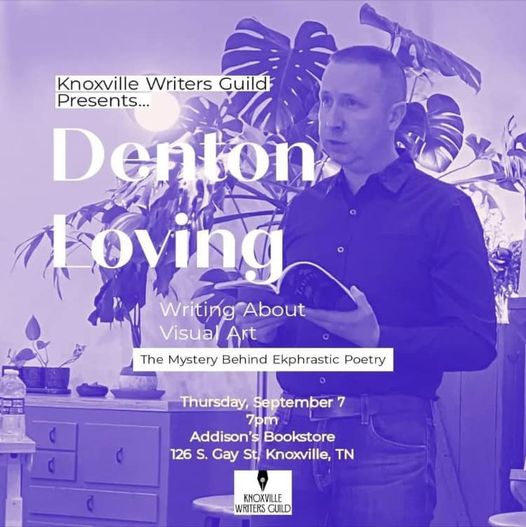
If you’re in the greater Knoxville area on Thursday, September 7th, I hope you’ll join me at the monthly meeting of the Knoxville Writers Guild at Addison’s Bookstore, located at 126 S. Gay St., in Knoxville. The meeting begins at 7:00 p.m.
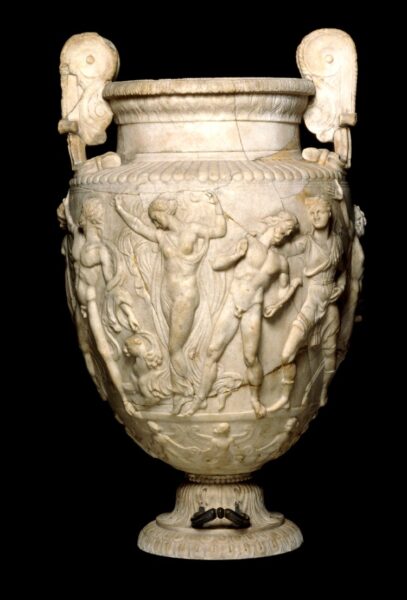
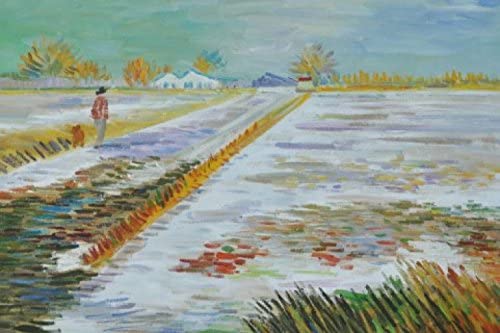
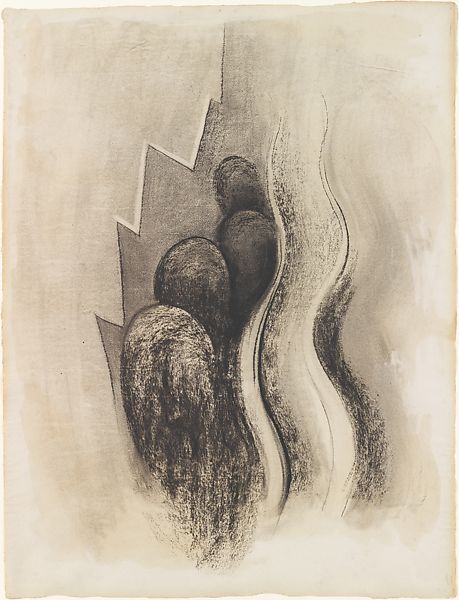
I’ll be talking about ekphrastic writing or ekphrasis. The word “ekphrasis” comes to us from the Greek where it means “description.” If you still aren’t sure what ekphrastic writing is, then I’ll briefly define it as writing that vividly describes a pre-existing work of art. I’ll share some of my favorite examples of ekphrasis, and we’ll even generate new work using some of the fantastic art on display at Addison’s.
Here are some of the images I’ll be talking about in this session.
.
.
.
.
.
.
.
.
If you live too far away to be in Knoxville on Thursday, I hope you’ll use one of these images or an image of your own in your writing practice this week. If you come up with something you especially like, please send it to me. If you need more guidance, check out my conversation with Julia Wendell about her ekphrastic poem “Horse in the Landscape.”
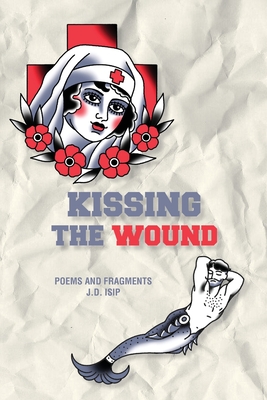
In my previous post, I had a wonderful conversation with J.D. Isipabout his new collection Kissing the Wound. One of the threads in these poems explores the way we are connected to place. One of the places J.D. writes about is The Carmelitos Public Housing Development where he grew up. While reading Kissing the Wound, I admired the way he was able to write about that place and others from multiple views such as from the present and the past, from the inside and the outside. I mentioned to J.D. how place-based writing is always on interest to me, and I asked if he had any advice for writing about place. I’ll share J.D.’s response here:
J.D. Isip: Yes, after reading Tamp, I can definitely see how important place is to you. My time in Carmelitos was from my childhood, over forty years ago. I think that distance in time helped me to be more objective. I like a lot of the ideas of psychogeography, the idea that there is a spiritual imprint on a place that never goes away, that there are times that keep playing over and over just beyond our vision. One might say that I write about Carmelitos from a place of disdain, but I don’t think that’s entirely true. It was a difficult place to exist in, but, going back to the idea of trauma, I think any place can be difficult to exist in depending on what you might be going through. Yes, I lived in the hood at the height of the Crips and the Bloods, but how does that compare to a middle-class woman in a seemingly loving relationship who just can’t find the will to get out of bed, the depression is so bad? So, for me, I try to think back to whatever I was holding onto – maybe it was my mom or my brother, maybe it was the beautiful neighbor boy who was kind to me, maybe it was my white-hot hatred for being poor or hungry. Whatever it was, I think you have to excavate it like an anthropologist (or whatever Indiana Jones was). You have to be willing to look at a past where you weren’t always right, where you made mistakes, where things weren’t always black and white.
My best advice here, and again, after reading your work, I think you might agree, is you have to talk to everyone you can who existed where you existed. Get their stories. See what they verify or contradict. If you can, use their voices. I like having other characters speak in my work. Yes, I am giving them those words, but I feel like there’s a little more ethos there. It’s like, “Oh, I believe everything about Spoon River, cause all these dead folks told me so!” Also, one of my mentors, Frank Gaspar, told me that the more specific you get in the details, the more universal your message can be. So, it’s not just this tree or that flower, it’s the specific kind, the color, the stage they are in growth, etc. For Camelitos, in “Carmelitos Ever After,” I wanted to take the reader through that psychogeographic journey – this is what was, what is, what ever shall be.
DL: One of my favorite poems in Kissing the Wound is “Leaving Krypton”. I quickly knew that I’d love to share this poem on my blog because the conceit is so interesting and makes for a wonderful prompt. Thanks to J.D. for allowing me to share the poem here.
Leaving Krypton for Anne
It is better you had not stayed long enough to know what alchemy binds us to a place, how extracting yourself begins a dissolution, the cloud-capped towers, the cracked cement slab you’d jump every day on your way to school, the band you worshipped, a dog you pet in your sleep, friends, parents, all
melt away before you think to look back, you think turning around, just a glance, will be too much for you and you are right, some ancient knowledge forces your stare forward, drowns out the chain-reacting atoms, the splitting crust of a world where once you were essential as its gravity, its rotation, its sun—
But, O! What crests into view? A light you never felt pulls you closer, a strength you’ve never had takes over, and you are flying this foreign galaxy, feeling yourself for the first time yourself, arms outstretched, open to embrace a brand-new atmosphere, the sweet air, a woman you kiss to sleep, adopted parents, friends, all
will need your new powers to survive this new adventure: x-ray vision to see the imposters; piercing heat to bore deep into layers of tradition, stubbornness, scars; a cold breath for those who call you a false god; and the wisdom to keep that shrunken city from this place as a reminder we never fully lose the past, but what we knew is gone
the instant that we leave it.
DL: One reason I love “Leaving Krypton” is because it is infused with all of the qualities of place-based writing. Even though a specific place isn’t named, the reader gains a sense of the place based on the place’s specific imagery. The sense of that place is expanded by ideas of what will be left behind as well as what will be gained, as well as the strengths that were gained (and will be exported) as we leave the place we’re from. The title allows us to connect the place with the fictional Krypton even though we retain the sense that a more-realistic setting is being described. I asked J.D. if he could relay the inspiration for this poem, and how he came up with the idea to write it from the angle of what I assumed was Superman.
JI: Thank you for asking about this poem, means a lot. One of my best friends, Anne, whom the poem is dedicated to, had hit a real crossroads in her life. I talk a little about it in Kissing the Wound, specifically the prose piece, “A Wedding at Cana.” She’d been in this long, emotionally abusive relationship, her work situation was getting pretty bad, and she had just, pretty late in life, accepted that she was a lesbian. I mean damn, one of those would put me under! After a lot of me and other friends telling her to leave this place, she finally did. She did it for her and for her son. And it was one of the bravest, scariest things I’d ever seen a person do.
I wanted to write something to say goodbye. Superman is one of my favorite characters, so of course I thought of him. But I actually thought of Kara, Supergirl. But Anne and Kal shared more, so I just followed Kal’s story. And I threw in a couple of nods to things she’d know were me saying goodbye – the “O” for Walt Whitman and the “cloud capped towers” for Shakespeare. I wrote it in one night, and I read it to her as she was driving away. We both cried. My hope was that she would see her move as so much bigger than it was, and that she wasn’t only running away from her past but running toward her future. I’m a cheesy person. It took everything in me not to say somewhere, “The S stands for hope” – but it’s implied.
Prompt: If you’d like to use “Leaving Krypton” as a prompt for your own poem, then you probably need to begin with the title by which I also mean you begin with a fictional place. This should be informed by your own interests and likes. J.D. Isip loves to call himself a nerd because he likes, among other things, comic books and superheroes. Krypton is immediately recognizable to most readers. So begin by selecting a fictional place to draw on that will also be fairly recognizable: Gotham, Neverland, The Emerald City, Mansfield Park, Yoknapatawpha County.
Begin your poem, not with this fictional place but with details from the real place that you are writing about. Or from your life if you’re writing about yourself. Think about J.D.’s “cracked cement slab you’d jump every / day on your way to school.” That could be from anywhere, but it feels meaningful because the reader understands it’s from personal experience.
The important factor about the fictional place you pick is that you must know some strengths about the character related to that place. Because you will want to draw on those strengths as your work through your own poem.
I think this is an exercise that can be applied, not only to poetry, but to creative nonfiction and fiction. Give it a try. And if you are able to write something from this prompt, send it to me. I’d love to see it.
In my previous post, I had a wonderful conversation with Erica Plouffe Lazure about her new linked-story collection Proof of Me. Today, Erica is sharing a very short story from her collection. Originally published in Swink, Erica’s story, “Re: Division Unification,” is a mere six paragraph structured in the form of an inter-office memo. I appreciate interesting narrative structures such as in this one. Another story in Proof of Me, “Azimuth and Altitude,” is told through a series of phone messages. These kinds of structure lend towards a monological confession. In other words, it’s a great way to let a character loose to better reveal their voice and their particular narrative. Read Erica’s story below, and afterwards, I’ll share Erica’s advice about how to use interesting structures in your own work regardless of genre.
RE: Division Unification
Golden Poultry Processing Plant MEMO To: All Golden Poultry Division Employees From: Kitty Ingram Lanford RE: Division Unification
As you know, Boss Karpinski likes to say that we here at Golden Poultry should all aim for division unification. Better workers, he says, produce better teams; better teams make for better projects; better projects create a better office atmosphere, which brings better leadership, all of which contributes to a better, more unified division, which, in turn, makes our company succeed. The company is considered successful when it makes more money. And it is the division’s office’s leader’s team’s project’s members—each of us—who are charged with making that happen.
To motivate us into further unifying our division, Karpinski tells us to get our “ducks in a row,” to “think outside the box,” and to always leave “room on our plate.” Achieving these three goals, he says, will no doubt put “a feather in our cap.”
More than once, he has noted that members of our division’s team must “wear many hats” in order to succeed. This in particular caught my attention because I have yet to see anyone in our division, save for myself, wear a single hat, let alone several. I did a good stretch of knitting a few years back, after my father died and before my daughter joined the Marching Tigers, and those of you who work on my team in our division’s office know that I actually own and wear an extensive collection of woolen hats—although not at the same time. I’d like to know why Boss Karpinski suggests that we all wear hats, then, when in fact I am the division’s sole multiple hat wearer. I can imagine he’ll read this memo and say, “there’s no ‘I’ in ‘team,’ Kitty Ingram.” But there’s no ‘we” in team, either. Only “me,” mixed up. And wearing all the hats. And while I see boxes of chocolates and boxed pens doled to my colleagues as quarterly rewards, I—the lone multi-hat wearer of our division—have yet to see a reward, let alone a single feather, for my cap—or caps, as it were—come my way.
Perhaps the source of these elusive feathers is the ducks which Mr. Karpinski is so fond of aligning. Every time he urges us to get our “ducks in a row,” I can’t help but think we are getting bad advice. My father was a prize duck hunter out at Mattamuskeet each year, Mallard Class, and I know that, unless they are stuffed and mounted on your mantle, ducks do not readily get in rows, nor do they like to. As everyone knows, ducks in flight make v-shaped formations, which is not a row but rather an elegant, egalitarian arc. And anyone who’s ever watched ducks in a marsh could tell you they aren’t about to line up for you when they’re sitting in the water. That’s why they make buckshot. Yet Mr. Karpinski seems to believe that there is some relationship between row-friendly ducks and our mission of division unification. But to put them in rows is contrary not only to the natural tendencies of ducks, but also to the true aim of the statement, by which I assume he means: get organized.
But in order to get organized, he wants us to think outside the very object that would help us, logistically, to achieve it. It has been nearly three decades since I have been able to maneuver my body to fit inside a box, let alone think inside of one. And, unless you are compelled to place a box over your head as inspiration to get the neurons firing, thinking outside of a box is a natural, if not logical, thing to do. It begs the question why a box would even need to be present in order for thought to occur. My experience suggests that thinking happens—and should happen—when no box is present. So it makes one wonder: why the emphasis on the box? If, perhaps, the word “box” is meant to suggest my rather boxlike “cubicle,” then I heartily agree. And, since boxes tend to stay where you put them—except if that box happens to be in the supply room closet filled with staples and designer pushpins and the four-dollars-a-pop fountain pens and deluxe desk calendar—it seems a far simpler and more logical task to put your boxes in a row, and to let the ducks outside where they belong.
By solving the dilemmas of box placement and duck-alignment, it frees us, then, to consider Mr. Karpinski’s third piece of advice to achieve division unification. When I first heard him say, “don’t tell me your plate is full; always leave a little room,” I thought he was talking about the holiday all-you-can-eat chicken buffet the division pays for down in the break room. It’s advice I get from my dietician, too. And my therapist. But I always want to know, and no one ever tells me: what are we leaving room on our plates for? Ducks? In boxes? But then I realized that leaving room on a plate simply means that there is more to life than ducks and boxes and Golden Poultry, for that matter, and that you need to be ready for it. Leaving room on your plate is, in essence, making room for change, something that would mix up and rehash stale leftovers, be it food or phrase. Maybe it’s something that might inspire you to leave the division’s office for a while, even for just an hour, to take a walk in the woods to experience box-free thinking. And maybe you’d find in the woods a lake, where, if you are lucky enough, you may come across a family of ducks and observe them. You would know how unwilling they’d be to get in rows for you, how easily they spook if you rush at them, scare them a little into taking flight. I used to do this when I was a girl, on those Saturday mornings duck hunting with my dad. I’d rush at the ducks and when they flew away, a feather sometimes would fall from their fold, and land, miraculously, at my feet.
~~~
Erica Plouffe Lazure: When I wrote RE: Division Unification, I was working in an office at a university, and often had to edit the somewhat formalized and (at times abstruse) language of professional communication. And my brain is always looking for something to be entertained by—I’m a terrible punster—and so I thought it would be fun to see what would happen if one of my characters were to co-opt some of the hackneyed phrases we always hear in corporate settings, and use them to address a topic that is personal in nature while maintaining a somewhat formal tone.
I think stories that steal from other formats (with essays they’re called “hermit crabs”) can work, due to the sense of urgency (that “confessional” feel) and the familiarity of the format itself. Something that I always think about when I compose stories (no matter what format they take) is what circumstance would motivate, or even force, my character to ACT? What would push them into divulging something that they might not otherwise? Something I would caution against is using unusual forms gratuitously—there’s a fine line between coopting an unusual format to bring the writer (and character) closer to the truth of a situation, and using it as a gimmick.
As far as Kitty Ingram Lanford, we are introduced to her in the story “Marchers,” but we don’t know precisely what motivates her until she has a chance to speak on her own behalf via the memo in “RE: Division Unification.” Here we see a woman who is probably unseen and ignored at work, who dedicates a lot of time to causes she cares for, who is likely still grieving the death of her father, and who is sick of having people steal office supplies from the closet. To refer back to our earlier conversation about how I shaped my story collection, “RE: Division Unification” is a good example of how I’d reworked the names and some of the minor points of the original story (published in the now-defunct Swink journal) and found a space and voice for her in Proof of Me as Kitty Ingram Lanford.
Prompt: Start by making a list of unique structures along the lines of an office memo/email, or a voicemail. Pick one that allows a character to tell their story. Be sure to allow your character to confess something to their audience. Include a memory from the character’s past.
If you are writing nonfiction, try to recall a job you once held, and write about a time when you wanted to express something to a co-worker or boss, but didn’t. Use a memo, email, or voicemail format to recall that moment to your former colleague, and why it still stays with you.
If you are writing poetry, make a list of the objects of a workspace that is familiar to you. Then make a list of words you associate with that profession (feel free to look them up). Mix and match the words to see what story or throughline surfaces. Or, find a format within the workspace (an admission ticket or order form, for example) that you might borrow to “contain” the poem.
A.E. Hines: “Think and write of an example from your life of a time you were forced to wait. This doesn’t have to be a dramatic waiting—it could be as simple as idling impatiently at a traffic light, or waiting for an apology from an angry spouse that you are uncertain will come, or for a potential new love interest to call for that first date. The point is to pick a period of waiting, where the duration feels uncertain, and the outcome is unclear, and you can’t easily escape. What does this feel like? Waiting is not typically considered pleasant—but are there pleasant or helpful aspects to this waiting? Let your waiting be a trigger, and then see what you discover by lingering there.”
As you write your own poem (or scene, story or essay), consider that Hines’s poem embraces the natural world outside of the physical space from which he writes. In this case, the poem’s speaker states that he’s lying with his lover, but many of the images in the poem delve into the wildness of the Colombian mountains which is where the speaker’s hopes for the future reside.
There’s also a celebration of the wild through the depictions of the bats and the monkeys and even in the language used to describe the earth. This prompt gives the same opportunity to embrace the far reaches of our own experience, and encourages us to step into the wider realms of possibility.
By this point, I hope your mind is racing with ideas for writing. If not, I’d offer these concrete steps to include in your first draft. One, don’t forget to tell the reader where the speaker is in the physical world. In Waiting for the Diagnosis, Hines says he is lying with the man he loves. Two, include the actions of at least two animals.
If this prompt helps you, I’d love to see the final product. In the meantime, please check out A.E. Hines’ website, and don’t forget to buy his collection, Any Dumb Animal, available from Main Street Rag Publishing, online retailers, and your local bookstore.
* * *
Make sure you never miss writing prompts like this one by subscribing here:
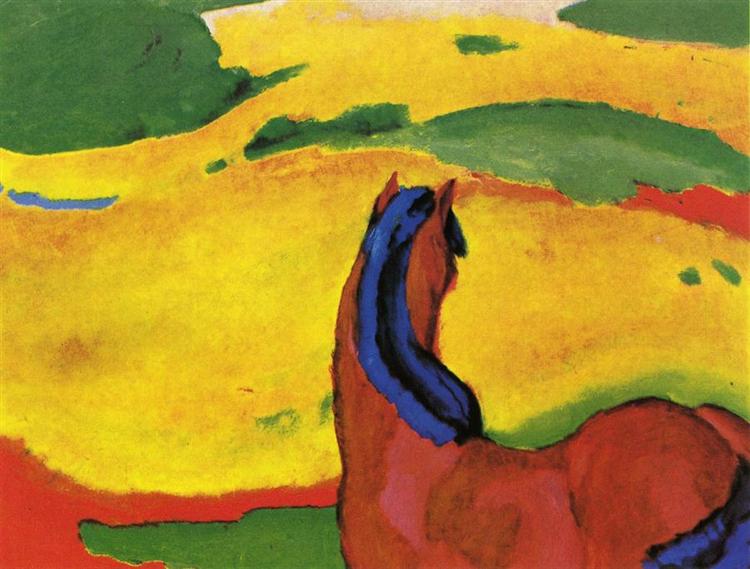
In my previous post, I had a wonderful conversation with Julia Wendell about her new poetry collection, The Art of Falling. One of the subjects we discussed was ekphrastic writing, and particularly her poem, Horse in the Landscape, which works in dialogue with a 1910 painting with the same name (sometimes titled Horse in a Landscape) by Franz Marc.
Born in Germany in 1880, Franz Marc was an Expressionist painter who died in 1916 during a battle in France. Many of his paintings feature animals whom Marc believed had a spirituality that had been lost in humans. This article from wikiart.org mentions that in works such as Horse in the Landscape Marc “tried to emulate the animal’s point of view and experience of the world.” This is meaningful because Julia Wendell makes the same gesture in her poem, shared here with Wendell’s permission:
Horse in the Landscape
I was given the power to gaze and ears pricked to hear across the mustard-yellow distance. I wait and listen.
I was created before Franz Marc ever marched into a trench, created because he yearned for the opposite of movement.
I gaze out to a slice of water, to the stillness of the future, its impenetrable line. Think of all the other horses he never painted during the years he never had.
Surely beauty, for young Franz, lived only in the present tense, in the twitch of an ear, color splashed on canvas, confirming the impulse to be.
I sport a bold red coat and blue mane, more than a century of perception behind me. My heart taps out on its old chest a staccato that just might make the landscape tremble.
For this writing exercise, I ask you to focus on the way Wendell identifies or writes from the perspective of the horse. One of the most important elements to consider in an ekphrastic work is the angle or the specific point of view that the writer/narrator chooses. One way to write about a piece of art is from a more-literal angle, meaning from your own perspective as a person viewing the art work. Sometimes, a writer using this more-literal angle will then enter the image, usually as themselves.
What Wendell does in Horse in the Landscape is to give voice to the horse inside the painting from the very first sentence: “I was given the power to gaze / and ears pricked to hear / across the mustard-yellow distance.”
It’s entirely up to you as the writer to judge which mode is better for the image you’re working with and for the poem (or story or essay) that you’re attempting to write. But for this exercise, do try to capture the voice of one of the subjects within the art work. As I’ve written about in the past, taking on the voice of a non-human form sometimes allows us to better express our very human emotions.
There are other important elements to Wendell’s poem such as the nod she gives to Marc’s tragically short life. You could interpret this poem as speaking in some ways to the waste of war, and there is also a great deal of simple but beautiful description. Your own work can move in similar directions or branch off in a new way. But begin from the perspective of the subject within the work.
Ekphrastic writing is not limited to poetry. I’ve read wonderful ekphrastic prose in addition to ekphrastic poems. For examples of ekphrasis in every genre, have a look at The Ekphrastic Review which might be a great place to send the finished draft of this writing exercise.
You can try this exercise with any painting or any other piece of art. But why not start with one of Franz Marc’s many paintings which you can see by returning to the wikiart.org page. Horse in the Landscape is one of Marc’s best known works. It’s not his only painting that features horses, but he also depicts animals like weasels, cattle, foxes, goats, etc. I’ll leave you with one of my favorites, The Steer, from 1911.
Huge thanks to Julia Wendell for speaking to me about her new book and for inspiring this writing exercise. Make sure you never miss writing exercises like this one by subscribing here:
Writing Exercise 22.4: Everyone has experiences in a waiting room, whether a physical room at the doctor’s office or a virtual room before a Zoom call. Many stories start or end in a waiting room: Flannery O’Connor’s Mrs. Turpin waits in a doctor’s office filled with people she disapproves so openly that one of them disapproves of her right back by smacking her with a textbook, and Anthony Perkins hopes to impress the police that he is harmless at the end of Psycho, saying, “I’m not even gonna swat that fly.”
Describe a waiting room, real or imagined, in as much detail as necessary to create the beginning or end of a story.
Walter’s writing prompt triggered the memory of Elizabeth Bishop’s famous poem, In the Waiting Room, and when I searched for it online, I came across a poem by Thomas Hardy that I’d never read before but that uses a similar title, In A Waiting-room.
I love this prompt because waiting rooms, although they can be incredibly unique from each other, have a universal quality that readers can immediately connect with. I’m so grateful to Walter for taking the time to talk about his writing and for offering this exercise. I’m anxious to try it myself.
Please buy Walter’s new book, What Cannot Be Undone—True Stories of a Life in Medicine, available from University of New Mexico Press, online retailers, and your local bookstore.
If you missed my previous post, please check out my conversation with Lauren Davis about her new poetry collection, Home Beneath the Church. Lauren talked about how difficult it was her to write deeply personal poems about her body and health. The poems in Home Beneath the Church also explore holy spaces. Those holy spaces begin and end with the body, but there are also churches, French basilicas, and other spaces reserved for traditional religious figures. And there is also the outside world. Lauren’s poems are never far from nature. It’s clear that she is a gifted student of observation, although I must assume there’s some amount of research that supports her knowledge of the natural world.
Two of my favorite poems in this collection are “If I Were a Resurrection Fern” and “I am a New Caledonian Owlet-Nightjar.”
If I Were a Resurrection Fern
And you were the wind-shipped rain, I’d draw you up. My fronds bright soaked
without shame. Imagine my grief this past drought. I shivered in my little
plot of lack. Come my mineral nip, my sky-dropped lake.
Nothing can keep us apart, not even climate nor gods.
You come down and down and never stop coming down,
and I revive, baptized.
I am a New Caledonian Owlet-Nightjar
Unseen since 1998, I am nearly a lost breed.
No one has heard my voice but you— a different genus of bird who sought and discovered me.
I beat my wings against yours unable to mate, but look
how groomed my semiplumes. I pluck them into dead air.
Now I am ready to be collected beneath your breast.
Let scientists say I dared to survive— that you came down from your perch
to quiver against me, my last known touch.
They will find me in the brushweed, virgin. But a song in my throat.
In both poems, the narrator takes on the identity of non-human forms in order to express very human yearning. One poem is qualified with the word “if.” The second poem is more declaratory: “I am.” But in both poems, the narrator embodies another form.
For this writing exercise, start with a quick online search for vulnerable species in the region where you live or within a geographic area that has significance for you.
Reading these poems prompted me to think about what animal or plant I would choose to speak through in a poem. So I started with a quick online search for “endangered birds of Appalachia.” The first link expanded my original idea by taking me to a website that listed vulnerable species beyond birds. I chose to search for species in Appalachia because that’s where I live, and it felt more appropriate for my writing.
I love that a minimal amount of research can keep me from feeling that I don’t know what to write. So once you’ve selected your species, see what you can find about their behaviors. This will help you embody that species for yourself by borrowing where they are and what they do.
Notice that in both poems, the narrator speaks directly to a beloved by addressing that person as “you.” Do the same in your poem by speaking directly to someone.
Speaking from a non-human voice is not limited to poetry. A New Caledonian Owlet-Nightjar likely would have just as much to say in a short story as she does in a poem. The same is true in an essay, and in an essay, there’s even more room for research. Whatever form you’re writing in, you may find it wonderfully freeing to speak through this other voice.
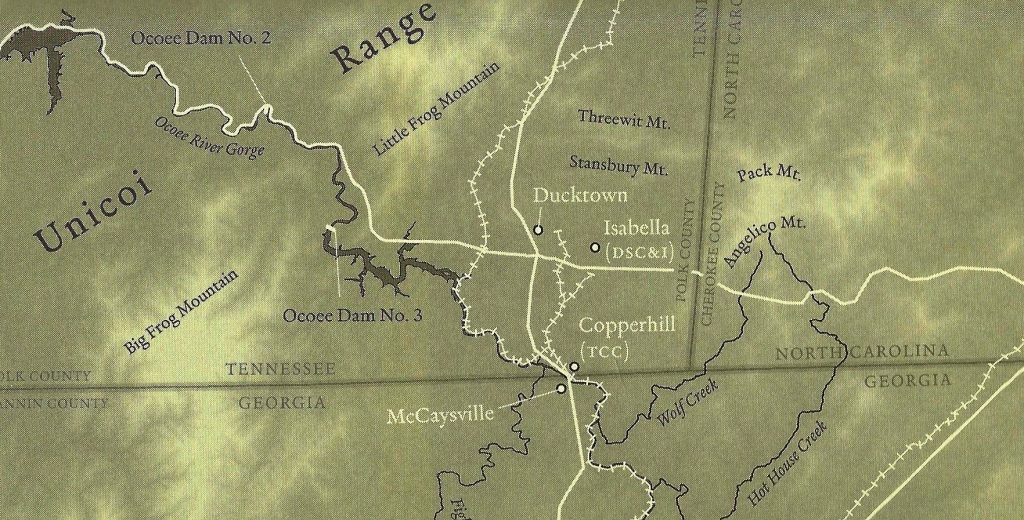
Reading “Place Names” prompted me to think about some of the wonderful place names near where I live. For this writing exercise, begin by making a list of location names near you. Or if not near you, consider making a list of location names that are important to you for one reason or another. You might even consider looking at some historical maps in case some more-interesting names have been replaced over the years.
Historic map of the Copper Basin region of Tennessee, referenced in yesterday’s post.
“Place Names” should probably be considered a narrative poem because the story of the bear hunt leads the reader through the locations. But because the names of the locations are so musical and interesting, the place names tend to rise above the narrative, and for this reason, “Place Names” feels a bit like a list poem.
Caki Wilkinson’s poem “Flyover Country” is an actual list poem. There’s no narrative structure in this poem although the epigraph “Between Memphis and Bristol” does a lot of work. I love this poem in part because Wilkinson includes my home town, Speedwell, but also because of the sound and culminating meaning of the poem.
Once you have created your list of location names that are meaningful or relevant to you, you can think about how they might work as a poem. I love a well-designed list poem like “Flyover Country,” but use Sue Weaver Dunlap’s poem as an example for how to give your own poem a narrative structure.
There’s a writing exercise to be found here for prose writers too. Think of the narrative that holds the place names together in “Place Names.” Think also of the original essay by Horace Kephart. And there’s always the question of how these place names originated. Who bestowed these names. A little research might go a far way.
If you missed my previous post, please check out my conversation with Rosemary Royston where Rosemary talked about the process that inspired the poems in her poetry collection, Second Sight. She also talked about how writers should think about writing about traumatic events, and some revision tricks to make poetry sound and feel less prosaic. The poems in Second Sight combine folk traditions, superstitions, sixth sense, and the powers of suggestion and intention. Now, I’m sharing a writing exercise that Rosemary shared with me. Before you start, read Rosemary’s “Appalachian Ghazal” online at the museum of americana, and “Rumex acetosella” online at Split Rock Review.
Writing Exercise 22.1: I challenge readers to do some quick research on a superstition, belief, colloquialism, or a nagging question they’ve had, and to take what they find and turn it into a poem (or an essay or a scene for a short story or a novel chapter). It can be a narrative or list poem or even a lyric! Whatever comes out, but be sure to pay close attention to sound, imagery, and diction.
I love prompts like this one that involve a little research. For this one, I suggest writing into any superstition or belief that you already hold, but if you need more help to get started, check out ScaryMommy.com’s list of common superstitions, or Good Housekeeping’s list of 55 of the Strangest Superstitions From Around the World.
Rosemary Royston, author of Second Sight
I’m so grateful for the time and energy Rosemary took to talk about her writing and to offer this prompt. Please buy Rosemary’s book, Second Sight, available through Kelsay Press and Amazon), and give her a follow for regular updates at her blog “The Luxury of Trees.”
Rosemary is also teaching at two upcoming events, both of which I highly recommend:
February 5, 2022 — Poetry Workshop, Mildred Haun Conference, Walters State Community College. Rosemary says, “In this poetry workshop, I’m addressing the overall theme of the conference: Coming or Staying Home: the Appalachian Dilemma, by focusing on places/emotions/relationships/etc. that we wrestle leaving or staying with. So the workshop will be both place-based and universal.”
May 8-14, 2022 —Creative Writing across the Genres, John C. Campbell Folk School. Rosemary says, “In this week-long class at the wonderful John C. Campbell Folk School in North Carolina, participants will read, write, and discuss poetry, creative nonfiction, and fiction. It is always lovely to be at the Folk School.”









 Denton Loving