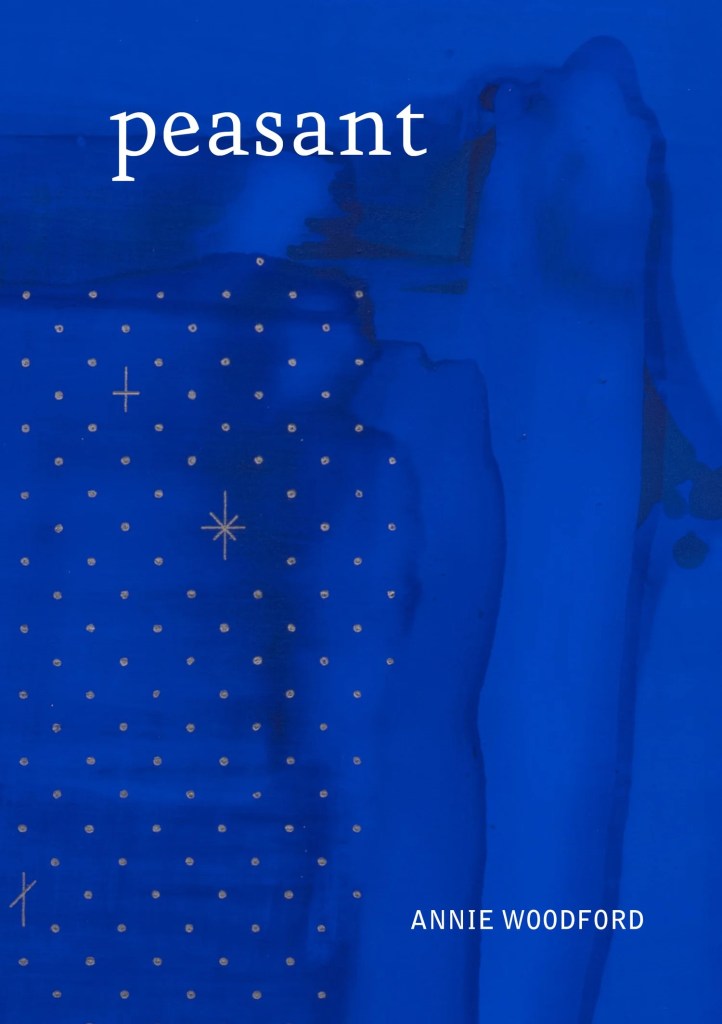
The first full week of January came in with a roar and a mountain of work. I already feel a bit behind in my goal to read more in 2026. But one title I can add to my reading list is Annie Woodford’snewest collection, Peasant. Peasant is a beautiful collection of work. But that’s not a surprise. Every poem I’ve ever read by Annie has been written with tenderness and a genuine love of the people and places she writes about, especially the natural spaces of our region, the fields and forests and everything that exists there. That is the kingdom that Annie writes about, and I’m always here for it.
Peasant is published by Pulley Press. I met Pulley Press founder and editor, Frances McCue, a few years ago when we were stationed in the same neighborhood on the AWP convention floor. I remember learning about Pulley Press then and their dedication to publishing writers and writing from rural places. And if you’re a writer from a rural place or just love to read about rural people and their spaces, you should definitely check them out.
Here is one of my favorite poems from Peasant.
A Song for the Daughters of Europa Annie Woodford
Every time we pass that pasture I point out the bull to my daughter, who was never taught to know a bull
and therefore to spot one, when needed, in a field of cows. But once you’ve seen one, they will always stand out—
the massive neck, the muscled shoulders more dangerous than any female Angus. I name the bull for Granny, who named them
for me and believed in the red myth and in getting over the nearest fence fast as you can. I know now
this was her only way, the lesson pressed in by the little stones of her eyes. I see the girl she must have been,
her hay-straw hair fine, like mine. and barely holding a rag curl, her canvas sneakers well-washed
but still stained by farmwork. She is out in the dawn, an hour before school, where she is the fastest
at math. She’s calling down the milk cow, the copper penny leaves of the locust tree, her footprints left in frost.
Once she grabbed my hand just as she grabbed the electric fence and, when the shock passed through her and into me, she laughed.
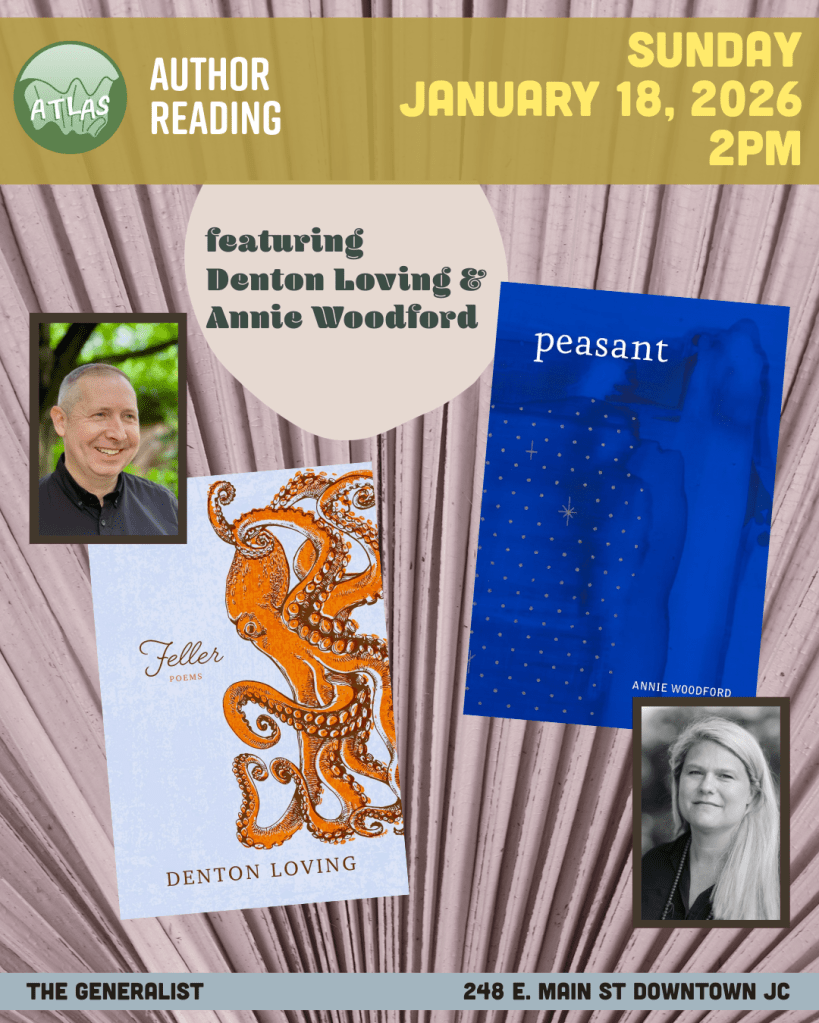
I feel so fortunate to be able to read with Annie next week at Atlas Books inside The Generalist. If you live in or near Johnson City, Tennessee, I invite you to come out on Sunday afternoon, January 18th. Our reading will start at 2:00 p.m. Huge thanks to Davis Shoulders for making this reading happen! I’m really looking forward to getting back to Johnson City, which has an amazing literary community, and it will be so much fun to read with Annie.
In 2021, founding editor-in-chief of The Bitter Southerner Chuck Reece and his wife Stacy Reece began publishing Salvation South. In the publication’s opening salvo, Reece famously said, “I’m not bitter anymore. What I am is hopeful.” According to Salvation South’s guidelines, they accept stories, in all mediums, including journalism, essays, fiction, photography, filmmaking, and poetry. I saved poetry for the end of that list because Andy Fogle is Salvation South’s new poetry editor, and he’s looking to publish work by established, emerging and new poets. Andy agreed to share some insight into exactly what he’s looking for in terms of submissions. If you’re reading this, Andy (and I) hope you will consider sending Salvation South some of your own work.
DL: Congrats on your new role as poetry editor at Salvation South. I love the magazine’s origin story, and how Chuck and Stacy Reece have said to “think of Salvation South as a big old house party—filled with people who want to celebrate Southern culture and people who are searching for new reasons to be hopeful about the South.” Can you talk about how that ethos pertains to the kind of poetry you hope to curate for the magazine?
AF: Thank you much. I’ve been wanting to get back into doing something like this for a long time, and, among my various professional duties in this world, it’s really one of my favorite things to do.
To the house party metaphor and poetry: I want to cast as wide a net as I possibly can, so just come on in, at least for a cup of coffee. Ever since 10th grade when I realized I wanted to devote my life to the arts, I’ve found things to like all over the artistic map, both across and within genres, and they all swap around. In college and grad school, I ran kind of a punk literary zine called 5th Gear, and while I definitely made some mistakes, I also think I got an underground reputation for being seriously eclectic. You could read all kinds of crazy-different and interesting stuff in 5th Gear. I’m still proud of that, I still believe in that, and I still aim to act like that. I have an MFA; I’ve participated in (and won 2) poetry slams; I’ve taught in all kinds of schools; I’ve been into way-out experimental stuff, formal stuff, middle-of-the-road stuff, street stuff, uncategorizable stuff…I believe that the best poetry has an aesthetic energy and a social function. I believe in the beauty of both, the magic of many, the awe of all. If I can help present a consistent mosaic of diverse voices, I’m a happy dude.
DL: The first time that I became familiar with your work and your involvement at Salvation South was when I read your wonderful interview with the poet Annie Woodford. I loved this interview for a lot of reasons but in part because Woodford’s poetry and your interview with her takes a hard and honest look at her corner of the South. It shows that while Salvation South’s point of view is hopeful, it’s also very focused on narratives that seek to accurately depict the places where we live.
AF: Annie is my newest living poetry hero, for a bunch of reasons I tried to articulate in that piece. Part of it is what look you mention, which is hard, honest, and hopeful too, I think. Salvation South’s general guidelines say we’re looking for “stories, in all mediums, that reckon with the history and celebrate the culture of the American South.” We publish pieces that do one of those things, but I savor those that do both. Celebration should not be blind, and reckoning is kin to rapture. I think being able to face the hard things is a reason for hope, and I think we can even look for hope in the gut-wrenching stuff, not just despite it. Maybe struggling with history is a form of celebration; maybe celebration is predicated on some form of struggle. When we shine a light on what’s been tucked away in the corners of our consciousness, it’s uncomfortable, it’s uncertain, and it’s unpredictable—but remember it’s still light that is the tool.
DL: Let’s talk about the mechanics of the submission process. Are you looking for individual poems or groups of poems? Do you have preferences for style, length, etc.?
AF: First of all, it’s free to submit. I like to see 3-5 poems rather than a single poem. It gives me a broader idea of a poet’s style(s), concerns, and abilities, and it also gives me more stuff to try to build a fire with. Obviously with a single poem, that’s your only shot, and I’m getting a very restricted view of your work; with at least a trio, there’s a higher probability of me finding something to encourage, which is what I want to do. Here’s something unusual and, I hope, useful: I write individualized comments in my responses with some regularity, I guess because I’m a teacher and I’m glad to strike up conversations and correspondence with poets.
Any length and any style, but I should say that I think branches and roots are related. It’s only a good thing when people have an idea of what’s been going on in the last few decades of poetry. But aside from that, if you love language, you’re probably a poet, at some level. And if you also have something…not necessarily to “say,” but if you have something intellectual, emotional, and/or sensual for readers to witness through that love of language—if you’ve got something to wrestle with in the joy of language—then send it on. I read pretty much all the time, year-round, and often respond to folks within a week.
DL: Should submitted work speak explicitly about the South?
AF: We generally do need to see its relevance to the South, be that addressing its past (which is still present), celebrating its culture, or something else. There have been a couple of poems I’ve almost accepted, but then realized that at least geographically, culturally, or thematically, it could’ve been written by anyone from anywhere, and any kind of Southern relevance just wasn’t any part of the equation. Good poems, but not quite a good fit (I try to let people know that too, just to be clear).
I’ll also say that it feels like Salvation South has become sort of a refuge for Southern storytellers of all types, whether their stories come out as prose or verse. We still love reported journalism, but we also love beautifully written personal essays that address all things Southern—identity, politics, history, culture, whatever. It would be nice to see more fiction submissions—we don’t get very many short stories.
DL: Although you’re originally from Virginia, you now live in upstate New York. Has living outside of the region allowed you to view the South in a new light?
AF: If anything, it’s made me defensive. From what I’ve experienced in 18 years of upstate New York, there is, at best, a slowly-fading ignorance about the South. Too many people just blindly lean right into the stereotypes, some of which, to an extent, we’ve unfortunately earned. Living in the North has probably deepened some of my distaste for the stubborn isolationism that persists—although neither region is clean in that regard. Sometimes I do read news about something in the South and think, “What the hell is wrong with y’all?” And then the next day I’ll be calling out some of my high school students, asking why they snicker at the word “Alabama” when I mention my aunt lives there. Ignorance doesn’t use a map.
But look, then again, I recently came home—which is a complicated word for me—to visit my dad, and we took some stuff to the dump, and I very quickly wound up having a brief but detailed and familiar-feeling conversation with the attendant guy—about my compression sock, and how I’d pulled a calf muscle, and then they found two blood clots in there—and he’s friendly as can be, asking follow-up questions and everything. Guess what happens a few days later when my dad and I go to the dump with another load of stuff? Same thing with the same guy. We’re just talking. And it’s not at all weird. I love that. I feel like I’m home—at the dump, talking with the attendant about compression socks. My chest just swelled with love for that little convergence. I think I appreciate that kind of thing more at this point in my life, since I see that it happens way less often up where I live now.
DL: You’re a poet in your own right. Can you talk about some of your current or upcoming projects?
AF: I have my second full-length book of poems coming out in November with Main Street Rag Publishing out of Charlotte. It’s called Mother Countries. It’s mostly about my mom, divorce, death, Virginia, race, and a little grace. It’s not always pretty. A hard book for me, one I don’t expect to get comfortable with anytime soon. It took me way too long to address that particular knot of issues in my work, but I needed to. And I’m about 2/3 done with a long, multi-dimensional book of poems related to abolitionist John Brown, tentatively called Cutting Light. With a little luck, I’ll start sending that around sometime in the fall. I also, when time permits, co-translate an Egyptian poet named Farouk Goweda with my friend Walid Abdallah. We have a chapbook out last summer called Arc and Seam from Finishing Line in Georgetown, Kentucky, but we’re hoping to eventually develop a full-length of his work.
Many thanks to Salvation South and particularly to Andy Fogle for answering my questions.
~
If you missed it, I had the opportunity last week to read some poems about place alongside P. Scott Cunningham and J.D. Isip in Emerge Journal’s Be Well Reading Series. It was such a fund reading. You can watch it here. Check back next week when I plan to post a new list of summer submission opportunities.

 Denton Loving