About a year ago, I read a book that completely captured my attention. It was A.E. Hines’ Any Dumb Animal, published by Main Street Rag Publishing. Although Any Dumb Animal is a collection of poetry, it can also be likened to a memoir, moving through time to reveal moments of Hines’ personal life story. I was excited by the mixture of craft and accessibility in Hines’ writing. Many of his poems lean toward the narrative as well as the confessional. The result is that reading each poem feels like you’re being let in on a secret that has the potential to change your personal outlook of the world.
I’m far from alone in recognizing Hines’ talents. Any Dumb Animal received Honorable Mention in the North Carolina Poetry Society’s 2022 Brockman-Campbell Book contest and was a finalist for the Eric Hoffer Book award. His work has also appeared in some of the best journals of our time such as Alaska Quarterly Review, Southern Review, Rhino, American Poetry Review, Poet Lore, The Greensboro Review, Ninth Letter, The Missouri Review, I-70 Review, and Tar River Poetry, among other places.
He splits his time between Charlotte, North Carolina, and Medellín, Colombia. Last week, I reached out and asked if he would share one of his poems.
Waiting for the Diagnosis
Lying with the man I love, I muse about a farm high in the Colombian mountains where terraced slopes of coffee meander valley to peak and disappear into mist.
There’s still time, I tell him, to plant a thousand bamboo trees, watch them leap into the sky, to nail bat houses to the trunks and hear the flitter of webbed-wings, to hear the night monkeys winding their way in the dark, leaping branch to branch.
Let the shadows come and wrap us in their slippery shawls— there’s still time to dig our fingers into the black brooding earth, to taste the prickly fruit,
to believe we can grow old listening to the bats shriek, and night monkeys howl, to bamboo trunks rubbing together in the breeze, their insistent music like the luxury of creaking old bones.
I asked A.E. Hines if he would share the inspiration for writing Waiting for the Diagnosis, and here’s what he wrote:
“When Any Dumb Animal first came out, a couple of friends contacted me after reading this poem to inquire about my health. “What’s going on?” one asked. As I told my friend, I’m fine now. A few years ago, I did have one of those surprise health issues that stops you in your tracks, and leaves you worrying and waiting for the days and weeks it takes to get into doctor visits, to schedule and receive various test results. That gap in time was the genesis for this poem. I recall coming home after a particularly invasive test and wrote the title in my notebook. At the time, I was in a brand new relationship with the man who would later become my husband. We were still very new, and it was my first serious relationship after ending a twenty year marriage. Like all new couples, we were making plans for the future. But as middle-aged (and previously divorced) adults, we also understood time isn’t always on one’s side, and plans don’t always work out. Growing old (and doing it with someone you love) really is a luxury. This poem lives in the gap, that anxious moment of waiting. Of not knowing if plans will work out. But also in hope that they will. PS: As for me, so far, so good!”
In my next post, I’ll share a writing exercise based on Waiting for the Diagnosis. If you’re not already subscribed, you can make sure you never miss a post by subscribing here:
It’s been nice this month to have heard from a few different blog readers. I still owe responses to a few of you. Please know they’re coming. It’s always great to hear from anyone following the blog. Please know how happy I am if you find the content here useful to you and your writing.
It’s easy to forget about submitting in the summer. Many university journals close during the summer break, but many are still open. In this post, I’m sharing a list of 10 opportunities that range from journal to book publication. There should be something here for everyone.
* * *
The Peauxdunque Review Whether your podunk is a small town in Alabama, middle-of-nowhere-Indiana, a working-class block of slab-houses in New Orleans East, piney-wooded East Texas, a Tennessee hill or holler, or an Atlanta apartment house, send us your expression to the world. Fiction and nonfiction should be no longer than 7500 words. Flash fiction should be no longer than 750 words. Please send no more than 3 poems per submission. https://peauxdunquereview.com/
Image We welcome unsolicited submissions and consider all submissions carefully. We produce two publications: Image, a quarterly journal, and Good Letters, a daily blog. All the work we publish reflects what we see as a sustained engagement with one of the western faiths—Judaism, Christianity, or Islam. That engagement can include unease, grappling, or ambivalence as well as orthodoxy; the approach can be indirect or allusive, but for a piece to be a fit for Image or Good Letters, some connection to faith must be there. Please submit no more than five poems or ten pages total. For fiction and nonfiction, we have an upper limit of approximately 6,000 words. We rarely publish stories or essays under 3,000 words. https://imagejournal.org/journal/submit/
New Orleans Review For web features, New Orleans Review seeks fiction, nonfiction, poetry, and book reviews. Submit fiction and nonfiction pieces up to 5,000 words. Flash pieces welcome. Submit up to five pages of poems. We are looking for reviews of books (all genres) forthcoming or published in the last year. Query us if you’d like to submit or propose an interview. http://www.neworleansreview.org/submit/
Virginia Quarterly Review Submissions are open through July 31, 2022. Submit poetry of all types and length, short fiction between 2,500–8,000 words, and nonfiction between 3,000–7,000 words. We are generally not interested in genre fiction (such as romance, science fiction, or fantasy). We publish literary, art, and cultural criticism; reportage; historical and political analysis; and travel essays. We publish few author interviews or memoirs. In general, we are looking for nonfiction that looks out on the world, rather than within the self. Submissions are limited to one prose piece and four poems per reading period. https://www.vqronline.org/about-vqr/submissions
2023 Howling Bird Press Nonfiction Prize Howling Bird Press, the publishing house of Augsburg College’s MFA in Creative Writing, seeks submissions for its 2023 Book Prize in Nonfiction. The press welcomes innovative, original work from established and emerging authors. Recommended length is between 20,000 and 60,000 words long although exceptions are permissible. The competition is open to all writers in English, whether published or unpublished. Author of the winning manuscript receives a cash award of $2,500, which serves as an advance, with book subsequently published by Howling Bird Press under a standard book contract. There is a $25 entry fee. Submit through July 31, 2022. https://augsburghowlingbirdpress.submittable.com/submit
The Boiler The Boiler began in 2011 by a group of writers at Sarah Lawrence College. We publish poetry, fiction, and nonfiction on a quarterly basis. We like work that turns up the heat, whistles, and stands up to pressure. Our writers include authors such as Thomas Lux, Bruce Bond, Joseph Millar, Cynthia Cruz, Emma Bolden, Marina Rubin, Paul Lisicky, Raena Shirali, and others. Our current reading period extends through August 15, 2022. http://theboilerjournal.com/guidelines/
Gold Line Press & Ricochet Editions Gold Line Press and Ricochet Editions are sibling presses run by students of the University of Southern California’s PhD Program in Creative Writing. Ricochet will be open to hybrid manuscript submissions through July 31 2022. Gold Line will be open to chapbook submissions in fiction, nonfiction, and poetry from August 1 to September 30, 2022. https://goldlinepress.submittable.com/submit
Bat City ReviewBCR is published annually. Submissions are open through September 15, 2022, with responses typically sent within two months of receiving a submission. We are interested in poetry, fiction, creative non-fiction, art, and cross-genre pieces that experiment with language, form, and unconventional subject matter. We also welcome traditional styles as well as translations. Send us writing that plays, that strikes out, that enjoys itself, that makes its own rules. http://www.batcityreview.org/submit
Ponder Review Ponder Review is a student-run publication of the MFA program at Mississippi University for Women. We welcome fiction, flash fiction, creative nonfiction, poetry, short plays, new media & visual art. Our current reading period runs through September 15, 2022. https://www.muw.edu/ponderreview/submit
I-70 Review The I-70 Review welcomes submissions of poetry and fiction through December 31, 2022. For poetry, submit 3-5 poems of 40 or fewer lines. Fiction and flash fiction should not exceed 1500 words. Publication of I-70 Review is annually in the fall. http://i70review.fieldinfoserv.com/submissions.html
* * *
Thanks for reading. Next week, I’ll share my recent conversation about writing and publishing with Tony Taddei, author of The Sons of the Santorelli. To receive posts like these directly in your inbox, subscribe here:
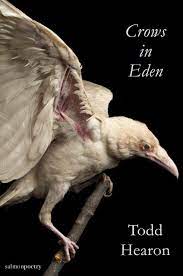
This week’s poem comes from the beautiful book, Crows in Eden, by Todd Hearon. Todd is a native of western North Carolina, and this collection of poems is placed in Eden, a small town in the Great Copper Basin of southeast Tennessee. A century ago, an African-American community was forced out of Eden after the lynching of three young Black men. Hearon’s poems are deeply-felt explorations of that particular time and place, and of the lives of both the victims and the perpetrators. This short poem essentially only 6 lines and an epigraph, is one of my favorite from the collection.
Epitaph
By his own hand to be engraved on copperplate and planted at The edge of town under the sign that reads EDEN POP. 353
When this grave has eaten us alive and slugs have blown the marrow from our souls think not Wildflower Pilgrim as you drive past this blot we were not particles of the scene you seek its promise and its poor mortal glory mirroring your own We were
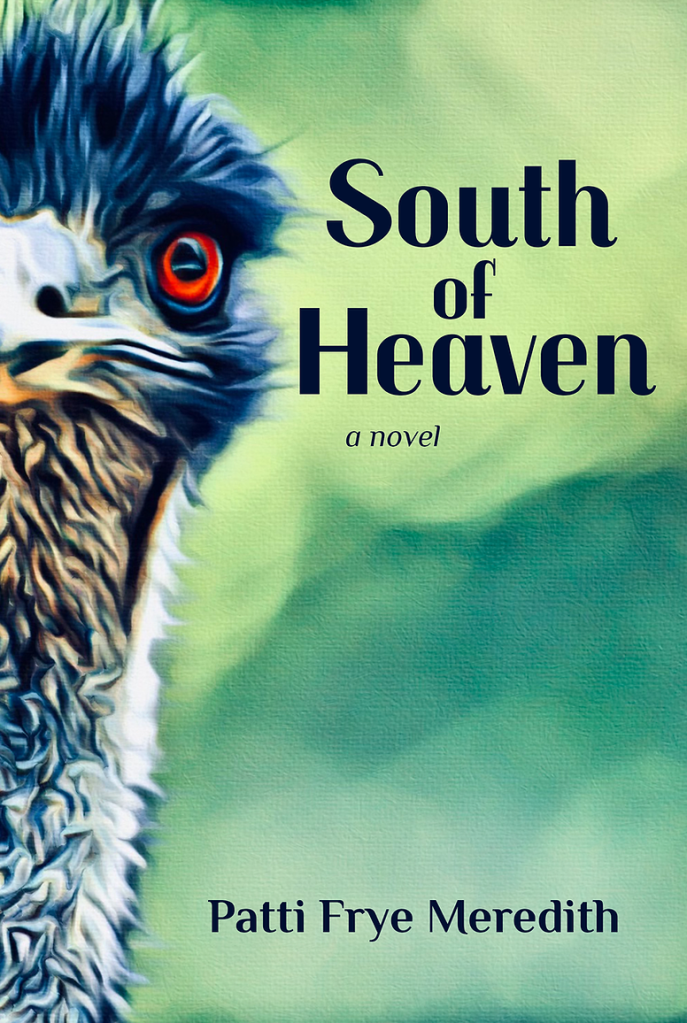
I can’t exactly remember the first time I met Patti Frye Meredith. I definitely have memories of her at one of the early Mountain Heritage Literary Festivals making people laugh and playing music late at night. One thing I know for certain is that Patti can make anyone laugh. That’s true whether you’re fortunate enough to sit down and share a meal with her, or whether you’re reading her beautiful new novel, South of Heaven, a multi-generation narrative set in Carthage, a small town in the Sandhills of North Carolina. At the center of the novel are two sisters, Fern and Leona. Both have secrets they are keeping from each other and from the world. There’s also Fern’s son Dean who, as Fern says, doesn’t have any secrets. South of Heaven is a meaningful exploration of how the things we try to keep bottled up complicate relationships. The novel is deeply Southern, completely universal and wonderfully fun to read.
DL: South of Heaven centers on the McQueen family, and it’s set in the late 1990’s, a time not so long ago but a time that feels infinitely different in hindsight. Do you have any advice for other writers writing about the recent past?
PM: When Dean first “talked to me in my head,” he told me his dad was MIA in Vietnam, and how as a child he pretended to find his daddy in the overgrown bamboo patch in his backyard.
I wrote the book from that one scene. I knew Dean was in his early 20’s, and that his father went missing at the very end of the war. That’s why I set the novel in 1998. After I got into it, other 1998 occurrences came into play like the Clinton/Lewinsky drama. There’s a lot in the book about the lengths we will go to avoid the truth, so that worked.
Early readers suggested that I move the story up in time, to make it more contemporary, to use the Iraq War instead of the Vietnam War and put it in present tense. I tried, but I couldn’t make it work. By that time, too, I felt like I knew Fern and Leona very well, and I realized they wouldn’t be the same people if they hadn’t grown up like they did in the sixties.
There are pitfalls. It’s not historic, and it’s not contemporary. The characters are just modern enough for readers to wonder, “Why would they think that?” or “Why would they do that?” It’s embarrassing, but I had to do research to remember if everyone had cell phones in 1998, or if fax machines were still a thing. We’ve seen a lot of change in twenty-four years, and it’s amazing how quickly we forget recent history.
DL: I loved reading the “Backstory” on your website about your job at University of North Carolina Public Television, and how you met so many writers there. The authors you mention (Lee Smith, Doris Betts, Reynolds Price, Fred Chappell) all come from the Southern tradition, and South of Heaven feels like a very Southern novel. How natural was it for you to write in that tradition?
PM: Like so many others, reading Eudora Welty, Elizabeth Spencer, Lee Smith, Jill McCorkle, Tim McLaurin, and so on and so on, showed me that stories set in small towns were okay to write.
I grew up in Galax, Virginia, population around 6,000. So, it was natural to stick to the world I knew. Thinking about it, I’ve now lived in Memphis and Chattanooga, Tennessee, Huntsville, Alabama, Durham and Charlotte, North Carolina, Columbia, South Carolina, and Baton Rouge, Louisiana. Cities large and small, but with the same southern sensibilities. (Or maybe I think all those places have the same southern sensibilities because “wherever you go, there you are”!)
DL: Did you feel any pressure to “live up” to the works of those writers you admired so much?
PM: If I thought I had to live up to their work, I’d never write another word! Back when I first started writing, I didn’t know what I didn’t know, however, it didn’t take long to realize I was never going to be in the same league with the writers I admired most. I’d give anything to see the world and put that world on the page like Fred Chappell, but I don’t have his complexity or depth. That doesn’t mean I don’t love reading his work. But, even when you study the craft and learn what makes great literature, even when you can recognize it, it’s still not possible to re-engineer your brain to create it. Thank heavens. There should be only one Lee Smith, one Jill McCorkle, one Darnell Arnoult.
That’s not to say I don’t spend a lot of time being discouraged! But you have to write what you write, be who you are, I mean, you can’t fake your subconscious! We all have our own perspectives and experiences, and we’ve all drawn our own conclusions.
I’m hooked on the joy of writing. The discoveries, the occasional good sentence, exploring the minds of my imaginary people. Writing helps me understand what matters and it’s my way of expressing what strikes me—good and bad—about being human.
And, since I love a cliché, I’ll say, “It’s the journey, not the destination.” Chasing after the “secret” to good writing has led me to friends who absolutely make my whole life better. Having the opportunity to be with other writers is the best reason to write! Sorry for getting off on a tangent, but maybe that’s the southern tradition!
DL: How long did it take you to write South of Heaven? How many drafts did you go through?
PM: There’s no telling how many drafts I have. Dean’s voice came to me at Hindman Settlement School in 2005. I wrote the original draft in first person present tense. Then changed it to third person present tense for my MFA thesis at the University of Memphis in 2012. Then I wrote a draft in third person past tense. I was always changing something, adding, taking away. Starting over. We moved seven times in twenty-eight years for my husband’s job, so I had a lot of distractions (excuses) through the years.
When my husband retired and we moved back to North Carolina, I set up my little office and joined a weekly writer’s group. Then the pandemic hit. Everyone is different. I know there are many great writers with extremely busy lives, but for me, the stillness of the pandemic quarantine made it possible to devote the time I needed to work. No travel, no socializing. I don’t think I understood what it meant to really work until the pandemic. I discovered the long stretches of uninterrupted time helped keep the story together in my head, helped me play out the scenes I needed to make the story more cohesive. I think of it as bandwidth. Writing South of Heaven took a lot of bandwidth!
DL: Your novel is published by Mint Hill Books, an imprint of Main Street Rag which published my poetry collection, Crimes Against Birds. What was your experience like in finding a publisher?
PM: I can’t remember if I saw Main Street Rag’s call for novel chapters on social media or in Poets & Writers, but I had one of those “What the heck” moments and sent chapters. Months later, I got an e-mail saying they were interested in publishing the novel, and Scott Douglass sent a contract and a detailed explanation of how the process would go.
I had sent out query letters to agents off and on for years. (One agent had almost taken it years ago, but that fell through when the third reader in her office didn’t think they could sell it.) I knew South of Heaven wasn’t the kind of book that was getting the attention of traditional publishing, or the independent presses I was familiar with. It wasn’t full-blown literary, and it wasn’t quirky enough to be chick-lit.
I didn’t think it was going to set the literary world on fire, but I wanted my imaginary people to live in a real book. So, I asked you, Sue Dunlap, and Darnell Arnoult to read it and tell me if I was about to embarrass myself, and you all said, “Do it.” So, I did. I fiddled with it after I got it back from you all, and I hired an editor to make sure I hadn’t added a lot more typos. Then I fiddled with it some more, and my niece, Becki Vasques, found my last snafus. We made it a family and friend affair! You and Darnell suggested I put an emu on the cover, and my husband, Lee, and I put it together (with Darnell on the phone). It’s been fun. Not “have lunch with your agent in New York City” fun, but better. A true labor of love. And I like that my North Carolina story is published by a North Carolina press. Scott Douglass does something very special with Main Street Rag. He publishes wonderful poetry and stories. I’ve gotten to know him and his wife and his dog, Harley, and I really appreciate the work he does.
DL: Do you have any advice for other writers ready to send their novel out?
PM: Don’t discount the small independent presses. We all appreciate independent bookstores. These presses deserve our appreciation, too.
Do ask yourself if you’re ready to be in the book marketing business, though, and the weird thing is part of that is selling not just the book but yourself. The great thing about the small press is, “You have a book to sell.” The scary thing about the small press is “YOU have a book to sell.” Just be honest with yourself about what you want to accomplish and why you’re doing it.
For me, the experience has been amazing because it has reminded me that I have the very best family and friends in the world. The support has been phenomenal. People I haven’t seen or talked to in ages bought my book after seeing my Facebook posts. Friends talk about my characters like they’re real people they care about. So, if I don’t sell another book, I’m very happy with the response South of Heaven has gotten.
CYNICAL ALERT!
The truth is, without Facebook, I wouldn’t have sold m(any) books. South of Heaven is in two bookstores, Chapters in Galax, my hometown, and McIntyre’s in Chapel Hill, where I live now. I’ve had one reading at McIntyre’s. I hired a publicist, and maybe there will be more readings, but maybe not. Even if I devote a lot of time to driving around, going to bookstores, taking them a book and a nice press kit, there’s no guarantee they’ll carry it. I have a couple of book club gatherings coming up. The bottom line is: It’s up to you to promote your book, to make yourself known. I believe even if you have an agent and a traditional press, they want you to have a “platform” meaning they want you to use your social media connections to publicize and sell your book.
DL: You’ve described South of Heaven as coming out “late in life.” We could argue about what that means, but I’m more interested in something else you said which is that having the novel out in the world helped clarify where and on what you want to focus your energies. Can you talk more about that?
PM: I know for sure I don’t want to be an author who dresses up and talks about writing. I want to be a writer who writes. I want to spend more time with my imaginary people and less time telling real people why they ought to like my book! Ha! I recently got together with a group of my writing friends, and afterwards I realized all we’d talked about was how close each of us were to having finished products to try to get published. Like there was some big door we were all clamoring to walk through to get to a different, more perfect life. I want to spend more time talking about ideas, or break-through moments, or what we’ve discovered about the craft. I don’t want my energy focused on end-products. I want to focus on better writing and storytelling.
DL: What are you working on now?
PM: Not much. I’m caught up doing what I think I ought to be doing to sell books. It’s uncomfortable and not much fun. I did have a little “conversation” with one of the characters in South of Heaven the other day. So, I wrote that down.
* * *
Find out more about Patti on her website, and don’t forget to order South of Heaven, now available from the Main Street Rag Bookstore. Coming soon, I’ll share my conversation with Tony Taddei about his debut story collection, The Sons of the Santorelli. Make sure you never miss a post by subscribing here:
One of my top priorities for the month of May was to compile a list of submission calls to share here. If you have followed my posts for a while (and if you’ve only recently subscribed, thank you and welcome), then you may be aware that there was no list last month. I build these lists in part to share with writers, but I also depend on the process to ensure that I’m submitting my own work. Anytime that I haven’t shared a list, it’s a safe bet that I probably haven’t been submitting either. Such is life, I suppose. But I like to be intentional about these kind of priorities. So here, finally, is a list of journals, presses and contests open this month. Good luck submitting!
Carolina Quarterly The Carolina Quarterly welcomes unsolicited submissions of poetry, fiction, nonfiction, and visual art. Submissions are accepted year round. As of Winter 2020, we pay contributors to our print volumes $50 upon publication, plus a free copy of the issue in which the work appears. Submit no more than 6 poems at a time. Submit no more than one prose piece, per genre, at a time. We charge a $2.50 submission fee. https://thecarolinaquarterly.submittable.com/submit
Kestrel Kestrel is now accepting submissions year-round. Kestrel publishes fiction, poetry, and creative nonfiction by established and emerging writers. We are especially happy to publish work by West Virginia and Appalachian writers. Kestrel features reviews and visual art in each issue. All accepted work is for the print publication; select work may be featured on our website. Kestrel submits each issue to Verse Daily, Poetry Daily, and Vox Populi, and, therefore, work published in Kestrel may be chosen for reprint in those venues. https://www.fairmontstate.edu/kestrel/submission-guidelines
Monologging For Monologging’s Autumn 2022 edition we are seeking stories and artwork that explore the theme of Influence. Who influences us? What compels a person to urge another to follow their lead, and when we follow? What questions of morality arise from these relationships? Our 2022 edition will be an exploration of the realms of influence, a profound meditation on evolving online ethics and etiquette as well as a quest to celebrate the lives of friends, neighbors, loved ones and mentors who have been our most devoted anchors, advocates, muses and guides. http://monologging.org/submit/
32 Poems We welcome unsolicited poetry year round and accept simultaneous submissions. As a rule we publish shorter poems that fit on a single page (about 32 lines), though we sometimes make exceptions to accommodate remarkable work that runs a little longer. We charge a $3 reading and processing fee. http://www.32poems.com/submission-guidelines
Florida Review & Aquifer: The Florida Review Online We are looking for innovative, luxuriant, insightful human stories—and for things that might surprise us. Please submit no more than one piece of fiction, nonfiction, graphic narrative, review, or digital story at a time. Poets and visual artists may submit up to (but no more than) five poems or artworks as a single submission. We charge a $2 or $3 submission fee depending on category. https://floridareview.submittable.com/submit
2022 New American Fiction Prize The New American Fiction Prize is awarded each year to a full-length fiction manuscript, such as a story collection, novel, novella(s), or something that blends forms, like a novel in verse. The winner receives $1,500 and a book contract, as well as 25 author’s copies and promotional support. Final judge is Weike Wang, the author of Joan Is Okay (Random House 2022) and Chemistry (Knopf 2017). Deadline is June 15, 2022. There is a $25 submission fee. https://newamericanpress.com/category/new-american-fiction-prize/
Los Angeles Review The Los Angeles Review is open for general submissions year-round. (Submissions for the Los Angeles Review Awards are open through June 30, 2022.) Send fiction, flash fiction, poetry, creative nonfiction, translations and book reviews. We charge a $3 submission fee. http://losangelesreview.org/submission/
Cheap Pop Cheap Pop is open for submissions during the month of June. We’re looking for your best work in 500 words or less—please, nothing greater than that. We don’t differentiate between Fiction, Creative Nonfiction, and anything in-between, nor do we have restrictions on genre—if it pops, it pops! What we want to see is good writing, your best writing, and that’s it. Please note: CHEAP POP does not publish poetry, so please do not send it. Deadline: June 30, 2022. http://www.cheappoplit.com/submit
Black Lawrence Press Through our annual contests and open reading periods, we seek innovative, electrifying, and thoroughly intoxicating manuscripts that ensnare themselves in our hearts and minds and won’t let go. During our June open reading period, we accept submissions in the following categories: novel, novella, short story collection (full-length and chapbook), poetry (full-length and chapbook), biography & cultural studies, translation (from the German), and creative nonfiction. We also enthusiastically accept hybrid submissions. https://blacklawrencepress.submittable.com/submit
Alien Magazine Alien Magazine is currently open for all types of fiction, nonfiction, poetry, and visual art submissions. We are nice people; don’t be afraid to send us anything. We are not a science fiction magazine, though we are open to SF work. By “Alien” we mean “outsider” or anything that exists outside the societal norm. Deadline for Fiction and Poetry: July 1, 2022. https://alienmagazine.submittable.com/submit
The Orison Chapbook Prize We are accepting submissions through July 1, 2022, of chapbook manuscripts (20 – 45 pp.) in any genre (poetry, fiction, nonfiction, drama, or hybrid) for The Orison Chapbook Prize, judged by Orison Books founder and editor, Luke Hankins. The winner will be awarded publication, a $300 cash prize, a 2-year Duotrope membership ($100 value), and 20 copies of the chapbook, in addition to a standard royalties contract. We plan to announce the winner and finalists by October 15, 2022. Submission fee is $12.00. https://duotrope.com/duosuma/submit/orison-chapbook-prize-6T0fK
Thanks for reading. In the coming weeks, I’ll share my conversations about writing and publishing with Patti Frye Meredith and Tony Taddei. To receive posts like these directly in your inbox, subscribe here:
In my previous post, I had a wonderful conversation with Julia Wendell about her new poetry collection, The Art of Falling. One of the subjects we discussed was ekphrastic writing, and particularly her poem, Horse in the Landscape, which works in dialogue with a 1910 painting with the same name (sometimes titled Horse in a Landscape) by Franz Marc.
Born in Germany in 1880, Franz Marc was an Expressionist painter who died in 1916 during a battle in France. Many of his paintings feature animals whom Marc believed had a spirituality that had been lost in humans. This article from wikiart.org mentions that in works such as Horse in the Landscape Marc “tried to emulate the animal’s point of view and experience of the world.” This is meaningful because Julia Wendell makes the same gesture in her poem, shared here with Wendell’s permission:
Horse in the Landscape
I was given the power to gaze and ears pricked to hear across the mustard-yellow distance. I wait and listen.
I was created before Franz Marc ever marched into a trench, created because he yearned for the opposite of movement.
I gaze out to a slice of water, to the stillness of the future, its impenetrable line. Think of all the other horses he never painted during the years he never had.
Surely beauty, for young Franz, lived only in the present tense, in the twitch of an ear, color splashed on canvas, confirming the impulse to be.
I sport a bold red coat and blue mane, more than a century of perception behind me. My heart taps out on its old chest a staccato that just might make the landscape tremble.
For this writing exercise, I ask you to focus on the way Wendell identifies or writes from the perspective of the horse. One of the most important elements to consider in an ekphrastic work is the angle or the specific point of view that the writer/narrator chooses. One way to write about a piece of art is from a more-literal angle, meaning from your own perspective as a person viewing the art work. Sometimes, a writer using this more-literal angle will then enter the image, usually as themselves.
What Wendell does in Horse in the Landscape is to give voice to the horse inside the painting from the very first sentence: “I was given the power to gaze / and ears pricked to hear / across the mustard-yellow distance.”
It’s entirely up to you as the writer to judge which mode is better for the image you’re working with and for the poem (or story or essay) that you’re attempting to write. But for this exercise, do try to capture the voice of one of the subjects within the art work. As I’ve written about in the past, taking on the voice of a non-human form sometimes allows us to better express our very human emotions.
There are other important elements to Wendell’s poem such as the nod she gives to Marc’s tragically short life. You could interpret this poem as speaking in some ways to the waste of war, and there is also a great deal of simple but beautiful description. Your own work can move in similar directions or branch off in a new way. But begin from the perspective of the subject within the work.
Ekphrastic writing is not limited to poetry. I’ve read wonderful ekphrastic prose in addition to ekphrastic poems. For examples of ekphrasis in every genre, have a look at The Ekphrastic Review which might be a great place to send the finished draft of this writing exercise.
You can try this exercise with any painting or any other piece of art. But why not start with one of Franz Marc’s many paintings which you can see by returning to the wikiart.org page. Horse in the Landscape is one of Marc’s best known works. It’s not his only painting that features horses, but he also depicts animals like weasels, cattle, foxes, goats, etc. I’ll leave you with one of my favorites, The Steer, from 1911.
Huge thanks to Julia Wendell for speaking to me about her new book and for inspiring this writing exercise. Make sure you never miss writing exercises like this one by subscribing here:
Julia Wendell is a poet currently living in Aiken, South Carolina. She is also a three-day event rider, the experience of which considerably informs her newest collection of poetry, The Art of Falling, published by FutureCycle Press. Amanda Moore said this about The Art of Falling: “…knowing how to fall allows Wendell’s open-eyed work to acknowledge pain but not be weighed down by it, moving instead to consider what blossoms and grows each passing season. Love here is represented by and extended to plants and animals—reluctant gladiolas, bursting peonies, a menagerie of dogs and birds—but nothing so beloved as horses, an anchoring and comforting presence throughout.”
I found The Art of Falling to be a powerful book encompassing decades of Julia’s life, moving from childhood traumas to complexities of adulthood. In one poem, Julia describes the art of falling as a practice perfected through pain and intense self-awareness, visible in “the coat hook / of my separated shoulder, / my spine’s bumpy lane, / sunspots littering my back— / the parts of me / I can’t see without mirrors.” In other poems, the art of falling is also made known in far less visible ways. Julia was kind enough to speak to me about her new book, her writing process, ekphrastic poetry and what it’s like to be married to another poet.
DL: Many of the poems in “The Art of Falling” touch on a fall you suffered from a horse that caused significant physical pain. But these poems reveal other traumas as well. What’s your process like for transforming writing about trauma into a well-crafted poem?
JW: It wasn’t one fall from a horse, but many: actually, a lifetime of falls. The old directive is true for me—you fall off a horse, you get back on. You fall off a poem, you get back on. Some falls are worse than others. And the older you get, the worse they tend to be, and the harder it is to get back on. Several years ago, I broke my hip as well as my leg falling from one of my horses, and that fall transformed my life for a year, as well as the writing of The Art of Falling. I found ways to live through the pain and to see through it. I had to change my life pretty drastically during that time, and my poems became both a respite and a way to work through the ordeal. I couldn’t get on a horse, but I could go to my desk with the help of a cane or just steadying myself on furniture as I went across the room.
DL: I was thrilled to read your poem, “Horse in the Landscape” which is an ekphrastic work related to Franz Marc’s painting with the same name. This is also the image used for the book’s cover. I recently taught a workshop on ekphrastic writing. Can you talk about the relationship that can exist between visual art and written work? Are you also a visual artist?
JW: No, I’m not a visual artist, but the piano is my brush; has been all my life, and music often finds its way into my poems. In reference to the above question about writing through pain: while writing the poems in The Art of Falling, I re-visited Frida Kahlo’s life and work. Her example taught me how to keep making art while in terrible pain. I read everything I could get my hands on about her life and artistic process, and studied her strange, surreal self-portraits. I even went to Mexico City after I had partially healed and visited her house, Casa Azul. I was drawn to her for the obvious parallel between her life and mine at the time. Both of us had our hips gored by rods, except that hers was put there by a bus and mine was put there by a surgeon. Here was an artist who experienced a lifetime of pain, and yet she kept getting back on the horse of her art to create her organic, visceral, paintings. The poem “Portrait Chinois” came directly from my re-experience with Frida’s work.
Similarly, the figure of the broken girl in Wyeth’s Christina’s World reminded me of my own plight; and through her semi-reclined pull and yearning for the gray house on the hill, despite her infirmities and inability to walk, drew me to ponder what it would be like for her to crawl to the house, to go inside, to open up her world and reach her dream destination.
I have always loved Franz Marc’s work for its ebullience and movement, and of course for its subject matter. But what pulled me to Horse in the Landscape is also what struck me about Christina’s World—we see a still landscape through the girl’s and horse’s perspectives, as they turn their backs to us. It is a world of no movement, only thought and perspective, possibility and possible movement, which is what my life had become during the time I was so badly injured. I had to contemplate my life through quiet and stillness, and find my poems there.
I chose the cover for The Art of Falling before I had written Horse in the Landscape. The pdf’s of the interior of the book were almost ready for the printer. Suddenly, I had the urge to write the poem and spent last Christmas season writing and re-writing it, thinking I would save it for some other project. Then Diane Kistner, the editor at FutureCycle Press, contacted me. Did I have another poem that might fit into the book? The way the pages were laying out, she needed one. Uncanny coincidence.
DL: I always ask writers about the process of compiling, submitting and publishing their books, and I’m especially interested in asking you because this is, I believe, your eleventh book. How long did it take you to write and shape the poems in this collection? How did you find and form a relationship with FutureCycle Press?
JW: The poems in The Art of Falling span at least a decade. The last book, Take This Spoon, had a very specific theme of poems about family, and the relationship to food and eating and anorexia, and even incorporated old family recipes. I was already working on the poems in The Art of Falling when Take This Spoon came out in 2016. The manuscript has seen many, many revisions: different title, different order, new poems. It’s actually my sixth, full-length collection, having published a number of chapbooks in addition to the longer books. I submitted to FutureCycle at the suggestion of April Ossmann, with whom I worked on an earlier draft of The Art of Falling. Diane Kistner, editor at FutureCycle, was very good at managing the publication details of the book, though not so much involved with line edits or broader editorial suggestions. For those I relied on April, Jack Stephens, D.W. Fenza, and most especially my husband, Barrett Warner.
DL: I have to ask you about Barrett Warner who is also a writer. To what extent do you and he read and comment on each other’s work?
JW: Barrett reads and helps edit everything I write, as well as a tone of what other people are writing. When he likes reading something his hand twists up his hair, and if he comes back to me with really messy hair, I know he liked it. I am dependent upon him as my first reader. He is a bit more independent of me, perhaps because as an editor he has such rich connections with other writers. I am more of an artistic recluse, and I like it that way. But everyone needs a first reader, and Barrett’s mine. In sickness and in first drafts, as they say.
DL: In addition to being a writer, you’re a three-day event rider. It’s also clear in your poetry how much you love and respect horses. Are there lessons from the equestrian world that also apply to writing?
JW: Ride the rhythm, create the energy from behind, send it forward, don’t let the poem go against your hand. Talk to your poem. Give it confidence by having clear intentions. Give it treats. There must be a daily devotion to the art of riding, as there must be to writing. The development of a poem, as well as a horse, comes in the smallest of increments, and must be addressed day after day after day. Writing is re-writing; riding is re-riding. The daily devotional is how you get there.
DL: What are you working on now?
JW: The next poem. Then, the one after that.
Seriously, though: recently I’ve collected poems I’ve written about my daughter in her lifetime (and even before that), and have compiled a collection called “Daughter Days.” I have plans to get back to that manuscript to revise it and see if I still like it before I send it out into the world. Writing is re-writing, and submitting is re-submitting.
***
Find out more about Julia on her website, and don’t forget to order her newest publication, The Art of Falling. My next post will feature a writing exercise inspired by one of Julia Wendell’s poems. Make sure you never miss a post by subscribing here:
I first met Christopher Linforth in 2014 at Sewanee Writers’ Conference. Our paths crossed again in 2019 at Writers in Paradise – Eckerd College Writers Conference. Christopher is a graduate of Virginia Tech’s MFA program, and recently, he was appointed Editor-in-Chief of Atticus Review. Christopher’s first two books are When You Find Us We Will Be Gone (Lamar University Press, 2014) and Directory (Otis Books/Seismicity Editions, 2020).
His third collection of short fiction, The Distortions, was named winner of the 2020 Orison Books Fiction Prize and has just been released by Orison Press. The Distortions is a beautiful collection of stories, thematically linked by the Croatian-Serbian War, particularly its aftermath. In each story, the weight of the past continues to press against the present. For many of these characters, historical events have had generational effects. These are not war stories although the war is a villainous character, always looming in the background. More than war stories, these stories are often about love–all kinds of love including the kinds that are sadly insufficient as well as the kinds that keep trying.
Christopher is a gifted writer. His own experience living in Zagreb was surely useful in writing these stories, but each story is subtly elevated by detailed knowledge that must have required significant research. In the same way that these are not war stories, this is also not a book about Croatia, Bosnia, Serbia, etc. as much as it’s a book about displacement and identity and the universal ways we humans struggle to put the past behind us. Christopher agreed to answer some questions about The Distortions as well as about his writing and publishing.
DL: Your new collection of short stories, The Distortions, centers on the aftermath of the Yugoslav Wars, mostly focusing though on the Croatian-Serbian conflict. Although you lived in Zagreb for some time, you come from a very different background. Did you find your outside perspective to be helpful or more challenging as you wrote these stories? Can you talk about how the kinds of research that were required for these stories?
CL: In some ways, my position as an outsider helped me to broach the aftermath of the war in new and different ways. Josip Novakovich talks in the afterword to Infidelities about the reluctance of people in the former Yugoslavia to talk or write about the war. Though this has changed in recent years and has led many writers from those countries to write compelling novels about the war, I still felt I had something to say. Over the years, to aid my poor memory, I read dozens of history books on the subject and watched documentaries, and delved into tranches of original documents and news reports, and I talked with people from that area. Much of that information, though, never appears in the book. Instead, I focused more on the characters and the stories while hewing—as much as one can—to the historical, political, and cultural realities of the time.
DL: So much of the tension in your stories comes from the weight of the past pressing into a character’s present. Moving back and forth through time can be tricky, but it can also enrich a narrative as it clearly does in your stories.
CL: Whenever possible, I try to eschew as much backstory as possible and instead focus the story on the present action. With the stories being set in former Yugoslavia and revolving around a major but little-known war, I tried to strike a balance of including information (in non-expository ways) that would help an American audience understand the ramifications of the war for the characters while also keeping the pacing tight and the stories interesting.
DL: Two of my favorite stories in The Distortions are epistolary. I’m thinking about “brb” (seemingly told through a long Instant Message) and “Sojourn”(told through a more traditional letter). What I appreciate about both stories are their gestures toward the confessional. Do you have advice for writers who want to explore the epistolary form? Does a story told through a letter have special considerations?
CL: It’s funny. For me, “Sojourn,” is an imagined letter, not an actual one. The story reads and feels like a letter and perhaps contains a vestigial element of that form. The story, to me at least, has an uncertain form: part letter, part monological confession, part a story being told. The hybrid nature perhaps also reflects the vacillating nature and identity of the narrator. Similarly, “brb” uses misdirection about the narrator’s identity to say something about the stylized IM form. The intersection of the confession and the letter form, or variants thereof, often work well together. They allow a “natural” unfolding of thought on the page addressed to someone off it. For me, that is where the intimacy and magic of the epistolary form lie.
DL: I’ve been working on a collection of short stories for several years, and through that time, the manuscript keeps shifting. How long did it take you to write and shape these stories? What was the submission and publication process like for The Distortions?
CL: The earliest stories were drafted around 2014 and the latest around 2019. It was a long process of revision and then discarding the lesser stories (perhaps another six or seven). Some stories, like “brb,” emerged fully formed, with only minor edits later. Others, like “The Little Girls,” I rewrote several times over the years. I entered the manuscript into a handful of contests in late 2019 and early 2020, perhaps only five or six altogether, while constantly fine-tuning it the whole time. The collection won the Orison Fiction Book Prize in July 2020 and then underwent another year of refinement.
DL: What are you working on now?
CL: I’m working on two books. One is a sister project to The Distortions. Tentatively titled The Homeland War, it’s centered on two young men in Zagreb just before the outbreak of war. The novel explores toxic masculinity and social class and the football hooliganism endemic in the 1990s. The other book, currently untitled, examines the intersections of internet culture and the New York art scene. Stories from this collection are forthcoming in Cutleaf and in the Irish magazine, Banshee.
DL: Are there any opportunities coming up for readers to meet you or study with you via Zoom or in person?
CL: Yes, I teach online creative writing classes for The Writer’s Center in DC, and I take on private editing clients now and again. I’m also available for workshops and readings and so forth. I also have some more on the origins of the book over at Necessary Fiction.
Thanks for reading. To receive posts like this one directly in your inbox, subscribe here:
For those of you who aren’t in submission mode but are rather needing some inspiration for generating work, I hope you will refer to some of my recent blog posts. Since my last list of submission opportunities, I’ve posted conversations with Lauren Davis and Walter Robinson about their new books. I’ve also posted generative writing exercises (Exercise 22.3 and Exercise 22.4) from both writers. And I’m looking forward to speaking with additional writers in the next few weeks.
As I’ve been collecting and organizing this list of opportunities today, I’ve been thinking a lot about the AWP Conference that is coming up in Philadelphia at the end of the month. I’m planning to be there along with the other EastOver Press editors. If you’re going to be at AWP, I hope you will let me know or at least stop by our small corner of the bookfair to say hello.
Until then, here are a dozen submission opportunities for writers. There’s something here for you regardless of what genre you’re writing in. So happy submitting, and good luck!
The Madison Review The Madison Review accepts poetry, fiction, and art submissions during our reading period. We publish two issues, one online in fall and one physical in the spring. Fiction submissions should be no longer than 30 pages. Send up to 5 poems. https://madisonreview.submittable.com/submit
Sepia Journal Sepia is committed to showcasing the work of both emerging and established artists. We are open to submissions all year, and we aim to reply to all submissions within three months. We welcome submissions of both fiction and creative nonfiction. We prefer work that is below 8,000 words long. Submit up to five poems at a time. https://thesepia.org/submission-guidelines
Real Karen Fiction Contest Got a great original story that includes a well-written character named Karen? We welcome flash fiction, multiple submissions, simultaneous submissions, and work that has been published elsewhere for which you hold the copyright. We prefer not to publish work from authors who use and or have used the word “Karen” as a slur in their other writing. Stories should be less than 8,000 words in length. https://www.therealkaren.com/inspired-fiction/submit-your-fiction
Berkeley Fiction Review The Berkeley Fiction Review is a forum for short fiction, published annually. We invite submissions of previously unpublished short stories from around the country and the world year-round. There is no minimum required page count, but submissions should not exceed 30 pages in length. https://berkeleyfictionreview.org/submit/short-fiction/
Movable Type: 1455’s E-Magazine 1455’s Movable Type publishes every other month. Each issue provides a forum for a diverse array of poets, masters of prose, essayists, educators and anyone with passion for written expression. Each issue revolves around a theme. Please see the themes for 2022 and send your original work. https://1455litarts.org/movable-type/
Cortland Review TCR considers poetry, translations, book reviews. We accept simultaneous submissions, but kindly ask that you notify us as soon as possible when you have placed submitted work elsewhere. Submit up to 5 poems at a time. https://www.cortlandreview.com/submissions/
Salvation South Salvation South accepts submissions in two broad categories: stories that address critical issues facing the South and stories that celebrate the culture of the South. In our submission form, you will find several more specific options. Please choose the one that best applies to your submission. We also accept Southern short fiction and poetry. https://salvationsouth.submittable.com/submit
Rust and Moth We are accepting submissions for the Summer 2022 issue. At this time, we publish only poetry. Submit up to three poems in any style. Deadline: March 31, 2022. https://rustandmoth.com/submissions/
Split Lip Review Split Lip Review is a literary journal of voice-driven writing with a pop culture twist. We publish online monthly and in print yearly. We accept fiction between 1,000 and 5,000 words, flash fiction under 1,000 words, and memoir up to 2,000 words. We accept only one (yes, just one) poem at a time. Please do not send us more than one poem. Send your best poem, but only one. We mean it. Submissions are free through the month of March. https://splitlipthemag.com/submit
Passages North Passages North is open to submissions of poetry, short-shorts, nonfiction, and hybrid work from through April 15, 2022. Please submit a packet of 1-5 poems. Send up to three short-shorts or five mircos (fiction, nonfiction, prose poems, hybrids). We’re looking for all manner of well-written, innovative creative nonfiction (up to 8000 words) including, but not limited to, lyric essays, personal essays, memoir, and literary journalism. https://www.passagesnorth.com/submit
Posit Journal Posit is currently considering submissions for 2023. Send 1-3 pieces of prose, including fiction and hybrids, but no nonfiction please, 1000 words or less each. However, if you are submitting very short pieces, please send us at least three to choose from. Please include a minimum of five and a maximum of six poems for us to consider. Deadline: June 15, 2022. https://posit.submittable.com/submit
Rhino Our diverse group of editors looks for the best-unpublished poems, translations, and flash fiction/nonfiction by local, national, and international writers. We welcome all styles of writing, particularly that which is well-crafted, uses language lovingly and surprisingly, and feels daring or quietly powerful. Send 3-5 poems or flash fiction/nonfiction pieces (500 words or fewer), totaling no more than 5 pages. Submissions are open until monthly caps are reached through June 30, 2022. https://rhinopoetry.org/submit-1
Writing Exercise 22.4: Everyone has experiences in a waiting room, whether a physical room at the doctor’s office or a virtual room before a Zoom call. Many stories start or end in a waiting room: Flannery O’Connor’s Mrs. Turpin waits in a doctor’s office filled with people she disapproves so openly that one of them disapproves of her right back by smacking her with a textbook, and Anthony Perkins hopes to impress the police that he is harmless at the end of Psycho, saying, “I’m not even gonna swat that fly.”
Describe a waiting room, real or imagined, in as much detail as necessary to create the beginning or end of a story.
Walter’s writing prompt triggered the memory of Elizabeth Bishop’s famous poem, In the Waiting Room, and when I searched for it online, I came across a poem by Thomas Hardy that I’d never read before but that uses a similar title, In A Waiting-room.
I love this prompt because waiting rooms, although they can be incredibly unique from each other, have a universal quality that readers can immediately connect with. I’m so grateful to Walter for taking the time to talk about his writing and for offering this exercise. I’m anxious to try it myself.
Please buy Walter’s new book, What Cannot Be Undone—True Stories of a Life in Medicine, available from University of New Mexico Press, online retailers, and your local bookstore.




 Denton Loving