A Poem by Stephanie Niu

Happy New Year, friends!

Last week, as I was taking stock of the past year, I was disappointed to realize how few books I had read in 2025. I could only count 17 total books, far fewer than usual. I won’t go into the excuses for why I read less than usual. But I know that reading helps me process information, and it inspires me to be a better writer, editor and teacher. It’s also still one of the few things in life that I find purely enjoyable. So one of my goals for 2026 is simply to read more. I shy away from setting new year resolutions, but I do like to articulate some goals for where to place my energy in the coming year. And so far, so good. In the last week, I’ve dedicated time to reading some of the books I collected along my 2025 travels.
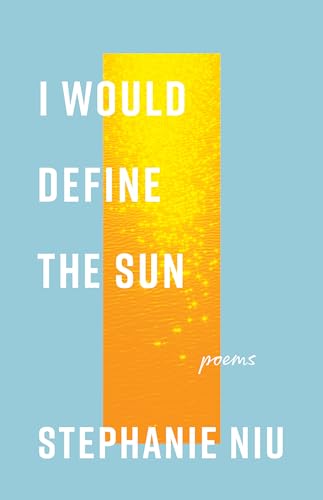
The first book I read in 2026 was Stephanie Niu’s I Would Define the Sun, which received the Vanderbilt University Literary Prize. In the book’s foreword, Major Jackson writes, “Occasionally, one encounters a voice so attuned to the groundswell of their being that their poems arrive like luxuriant explorations of language and feeling. Such is the work of Stephanie Niu and her debut collection of poetry.” I agree.

I met Stephanie briefly last October when we were both readers at the Decatur Book Festival. You can watch Stephanie’s reading from that day on YouTube. Stephanie’s poems about her family are some of my favorite from the multiple threads that she weaves together in I Would Define the Sun. So it was especially lovely to meet Stephanie’s parents at her reading, and to see how proud they are of her and her work. One of my favorite poems from the book, “Information Worker at the End of the World,” was originally published in Ecotone.

Information Worker at the End of the World
Stephanie Niu

When the ship to Mars has already departed,
and my wealthiest friends have plots in New Zealand
for their children, or have no children, what box
do I put my treasure in? I have one waterproof bag
that clips at the top. Every month, money drips
into my retirement account. You think the world
will still be around when you’re sixty-five? I don’t know
what it means to survive. I’ve learned all I can
about the Svalbard seed vault. I used to spend time
on the names of birds until the warblers disappeared.
The earth is more burned out than my coworkers.
The mantle is deathly dry. My doctor tells me
I ought to moisturize. Weekly, my milk expires.
I panic when I flip to a new month on my free
Audubon calendar. There is too much time
and not enough of it. I’m a bad steward caught
red-eyed. I board flights, order takeout high,
forget to recycle. Some days I wake and resolve
to arm myself for a righteous fight. I will make
coffee grounds into face scrub, eat kombucha
bacteria raw. Other days I wake already late
to my first meeting, say hello brightly
though the laptop screen is all my gunked-up
eyes can see. A blue glow sized to a day, an hour,
an act of speech. Everything else beyond me.

~

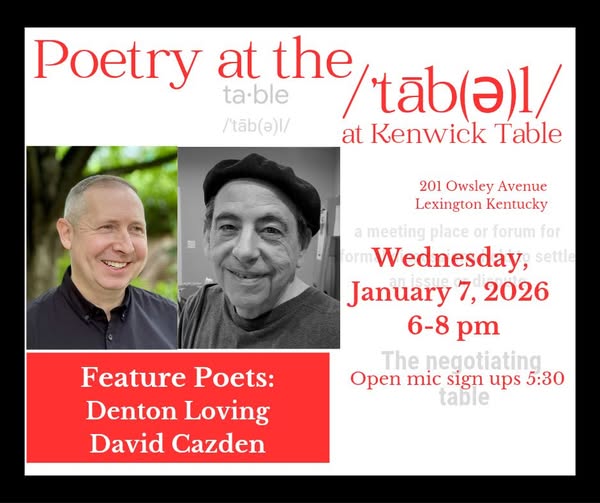
If you live in or around Lexington, Kentucky, I invite you to come out to Poetry at the Table on Wednesday, January 7th. I’ll be reading with the very talented David Cazden, and I’m looking forward to hearing others read during the open mic portion of the evening. This is a hugely popular event, held monthly at Kenwick Table in Lexington and hosted by B. Elizabeth Beck, and I’m so glad to have the chance to read some poems from Feller to this audience.
In case you missed it…

In case you missed it… I recently shared a guest post featuring a conversation between Ruth Mukwana and Lynne Sharon Schwartz, and Emily Choate’s review of Feller appeared recently in The Chattanooga Times Free Press.

If you’re not already receiving these posts directly to your inbox, please subscribe.

A Conversation with Yearling Editor Manny Grimaldi

Earlier this month at the Kentucky Book Festival, I met Manny Grimaldi, who gifted me with a beautiful copy of Yearling: A Poetry Journal for Working Writers. Yearling is an annual publication that operates under the umbrella of Workhorse of Lexington, which in itself is a cool, wide-ranging operation that supports publishing and building community for writers. Manny is Yearling’s managing editor, and he agreed to answer a few questions about the journal that will be interesting and helpful for those of you looking for good publications where you can submit your writing.

DL: It was great to meet you at the Kentucky Book Festival, and to find out about Yearling. How long has Yearling been publishing? How long have you served as managing editor?

MG:  It was a pleasure conversing with you, Denton. Yearling: A Poetry Journal for Working Writers is an offshoot of a poetry feedback program through Workhorse of Lexington. I approached our editor-in-chief for work, and he instructed I take helm of the feedback program where folks sent in work only for response. Soon after in 2021, we launched Yearling with that ethos.

DL: The fact that Yearling provides feedback to submitters really sets the journal apart from so many others. As an editor, I know that requires a lot of work, but it’s also such a benefit to submitters. As managing editor, do you still provide that feedback yourself?

MG: I do provide the feedback, and a resounding yes to what you are stating, this is difficult work. But I do this with the helpful impressions of team readers. Never in the community of artists, whether actors, poets, editors, musicians, or novelists do I claim to do and develop in a vacuum. We help each other. In the end, I re-read each poem, draw together our conversations, solidify my impressions, and compose meaningful feedback. I read much gratitude for the deep reads from our authors, and some encounters with poets create avenues to their outstanding revisions.

DL: Yearling is a journal dedicated strictly for poetry. Are there any specific forms or styles that you’re especially looking to publishing in Yearling?

MG: As managing editor, I focus upon this principle: Does the work move me to forget I am reading a poem? A sonnet can do that. A villanelle can transcend form. I also hold anyone can do that, Denton. Provided they are telling the truth, and telling it well! Short answer: any style, any length, any form, we can print—we enjoy a book format now. We take everything from single poem submissions, up to six poem. Currently, in this issue, I hope to cull the heart of Kentucky writers and our surrounds as much as possible. That said, everything is read, considered, and published if it sings.

DL: If I understand correctly, then Yearling publishes in December of every year, and acceptances for that issue are sent out by October 1st. Is Yearling currently accepting submissions for the 2026 issue?

MG: We process submissions all year. Yes. Yearling prints December of every year, once a year. In practice, we have closed a year’s volume with the requisite number of poets, which is 40, as soon as April. We respond generally, schedules permitting, as promptly as possible.

DL: In addition to being an editor, you have also published multiple books of your own writing. Where can readers find your work, and how can they connect with you?

MG: Three books! Two are self-published—Riding Shotgun with the Mothman (2024) and ex libris Ioannes Cerva (2024), and the latest was published by Whiskey City Press, entitled Finding a Word to Describe You.

Mothman and Finding are full length. ex libris is a satirical chapbook released by anonymus scriptus. Mothman connects people with a window into family and personal demons. Finding is about romance, reveling in poetic forms, from the historical persona poem, to the broken sonnet, to tanka.

My work pops up on internet and print in everything from Club Plum, Rye Whiskey Review, Moss Puppy Magazine, and Jerry Jazz Musician. I appeared on Katerina Stoykova’s ACCENTS Nov. 5, 2025, podcast on WUKY, also available on Apple and NPR. I am easily reached by email: m.grimaldi2019 (at) gmail.com.

~

Thanks to Manny Grimaldi for taking the time to speak to me. Be sure to take a look at Yearling’s full submission guidelines and to follow on Patreon.

In case you missed it… check out some of my past conversations about writing and publishing with Kendra Winchester, Melanie K. Hutsell and Georgann Eubanks. Also, I hope you’ll have a look at Bill Griffin’s wonderful site, Verse and Image, where he recently shared some poems from my newest collection, Feller.

If you’re not already receiving these posts directly to your inbox, please subscribe.