A Poem by Stephanie Niu

Happy New Year, friends!

Last week, as I was taking stock of the past year, I was disappointed to realize how few books I had read in 2025. I could only count 17 total books, far fewer than usual. I won’t go into the excuses for why I read less than usual. But I know that reading helps me process information, and it inspires me to be a better writer, editor and teacher. It’s also still one of the few things in life that I find purely enjoyable. So one of my goals for 2026 is simply to read more. I shy away from setting new year resolutions, but I do like to articulate some goals for where to place my energy in the coming year. And so far, so good. In the last week, I’ve dedicated time to reading some of the books I collected along my 2025 travels.

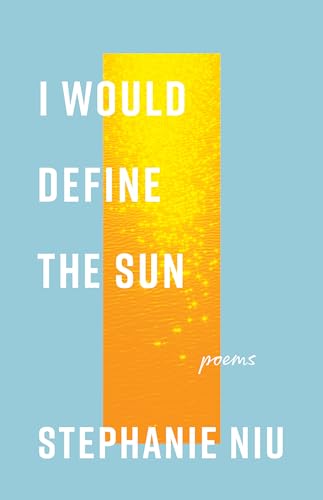
The first book I read in 2026 was Stephanie Niu’s I Would Define the Sun, which received the Vanderbilt University Literary Prize. In the book’s foreword, Major Jackson writes, “Occasionally, one encounters a voice so attuned to the groundswell of their being that their poems arrive like luxuriant explorations of language and feeling. Such is the work of Stephanie Niu and her debut collection of poetry.” I agree.

I met Stephanie briefly last October when we were both readers at the Decatur Book Festival. You can watch Stephanie’s reading from that day on YouTube. Stephanie’s poems about her family are some of my favorite from the multiple threads that she weaves together in I Would Define the Sun. So it was especially lovely to meet Stephanie’s parents at her reading, and to see how proud they are of her and her work. One of my favorite poems from the book, “Information Worker at the End of the World,” was originally published in Ecotone.

Information Worker at the End of the World
Stephanie Niu

When the ship to Mars has already departed,
and my wealthiest friends have plots in New Zealand
for their children, or have no children, what box
do I put my treasure in? I have one waterproof bag
that clips at the top. Every month, money drips
into my retirement account. You think the world
will still be around when you’re sixty-five? I don’t know
what it means to survive. I’ve learned all I can
about the Svalbard seed vault. I used to spend time
on the names of birds until the warblers disappeared.
The earth is more burned out than my coworkers.
The mantle is deathly dry. My doctor tells me
I ought to moisturize. Weekly, my milk expires.
I panic when I flip to a new month on my free
Audubon calendar. There is too much time
and not enough of it. I’m a bad steward caught
red-eyed. I board flights, order takeout high,
forget to recycle. Some days I wake and resolve
to arm myself for a righteous fight. I will make
coffee grounds into face scrub, eat kombucha
bacteria raw. Other days I wake already late
to my first meeting, say hello brightly
though the laptop screen is all my gunked-up
eyes can see. A blue glow sized to a day, an hour,
an act of speech. Everything else beyond me.

~

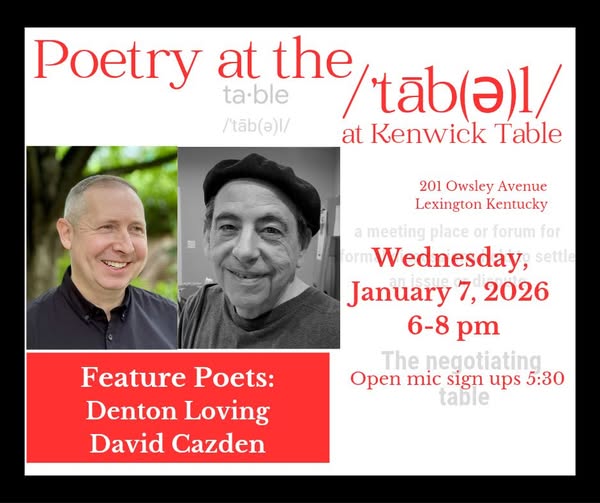
If you live in or around Lexington, Kentucky, I invite you to come out to Poetry at the Table on Wednesday, January 7th. I’ll be reading with the very talented David Cazden, and I’m looking forward to hearing others read during the open mic portion of the evening. This is a hugely popular event, held monthly at Kenwick Table in Lexington and hosted by B. Elizabeth Beck, and I’m so glad to have the chance to read some poems from Feller to this audience.

In case you missed it…

In case you missed it… I recently shared a guest post featuring a conversation between Ruth Mukwana and Lynne Sharon Schwartz, and Emily Choate’s review of Feller appeared recently in The Chattanooga Times Free Press.

If you’re not already receiving these posts directly to your inbox, please subscribe.

A Conversation with Yearling Editor Manny Grimaldi

Earlier this month at the Kentucky Book Festival, I met Manny Grimaldi, who gifted me with a beautiful copy of Yearling: A Poetry Journal for Working Writers. Yearling is an annual publication that operates under the umbrella of Workhorse of Lexington, which in itself is a cool, wide-ranging operation that supports publishing and building community for writers. Manny is Yearling’s managing editor, and he agreed to answer a few questions about the journal that will be interesting and helpful for those of you looking for good publications where you can submit your writing.

DL: It was great to meet you at the Kentucky Book Festival, and to find out about Yearling. How long has Yearling been publishing? How long have you served as managing editor?

MG:  It was a pleasure conversing with you, Denton. Yearling: A Poetry Journal for Working Writers is an offshoot of a poetry feedback program through Workhorse of Lexington. I approached our editor-in-chief for work, and he instructed I take helm of the feedback program where folks sent in work only for response. Soon after in 2021, we launched Yearling with that ethos.

DL: The fact that Yearling provides feedback to submitters really sets the journal apart from so many others. As an editor, I know that requires a lot of work, but it’s also such a benefit to submitters. As managing editor, do you still provide that feedback yourself?

MG: I do provide the feedback, and a resounding yes to what you are stating, this is difficult work. But I do this with the helpful impressions of team readers. Never in the community of artists, whether actors, poets, editors, musicians, or novelists do I claim to do and develop in a vacuum. We help each other. In the end, I re-read each poem, draw together our conversations, solidify my impressions, and compose meaningful feedback. I read much gratitude for the deep reads from our authors, and some encounters with poets create avenues to their outstanding revisions.

DL: Yearling is a journal dedicated strictly for poetry. Are there any specific forms or styles that you’re especially looking to publishing in Yearling?

MG: As managing editor, I focus upon this principle: Does the work move me to forget I am reading a poem? A sonnet can do that. A villanelle can transcend form. I also hold anyone can do that, Denton. Provided they are telling the truth, and telling it well! Short answer: any style, any length, any form, we can print—we enjoy a book format now. We take everything from single poem submissions, up to six poem. Currently, in this issue, I hope to cull the heart of Kentucky writers and our surrounds as much as possible. That said, everything is read, considered, and published if it sings.

DL: If I understand correctly, then Yearling publishes in December of every year, and acceptances for that issue are sent out by October 1st. Is Yearling currently accepting submissions for the 2026 issue?

MG: We process submissions all year. Yes. Yearling prints December of every year, once a year. In practice, we have closed a year’s volume with the requisite number of poets, which is 40, as soon as April. We respond generally, schedules permitting, as promptly as possible.

DL: In addition to being an editor, you have also published multiple books of your own writing. Where can readers find your work, and how can they connect with you?

MG: Three books! Two are self-published—Riding Shotgun with the Mothman (2024) and ex libris Ioannes Cerva (2024), and the latest was published by Whiskey City Press, entitled Finding a Word to Describe You.

Mothman and Finding are full length. ex libris is a satirical chapbook released by anonymus scriptus. Mothman connects people with a window into family and personal demons. Finding is about romance, reveling in poetic forms, from the historical persona poem, to the broken sonnet, to tanka.

My work pops up on internet and print in everything from Club Plum, Rye Whiskey Review, Moss Puppy Magazine, and Jerry Jazz Musician. I appeared on Katerina Stoykova’s ACCENTS Nov. 5, 2025, podcast on WUKY, also available on Apple and NPR. I am easily reached by email: m.grimaldi2019 (at) gmail.com.

~

Thanks to Manny Grimaldi for taking the time to speak to me. Be sure to take a look at Yearling’s full submission guidelines and to follow on Patreon.

In case you missed it… check out some of my past conversations about writing and publishing with Kendra Winchester, Melanie K. Hutsell and Georgann Eubanks. Also, I hope you’ll have a look at Bill Griffin’s wonderful site, Verse and Image, where he recently shared some poems from my newest collection, Feller.

If you’re not already receiving these posts directly to your inbox, please subscribe.

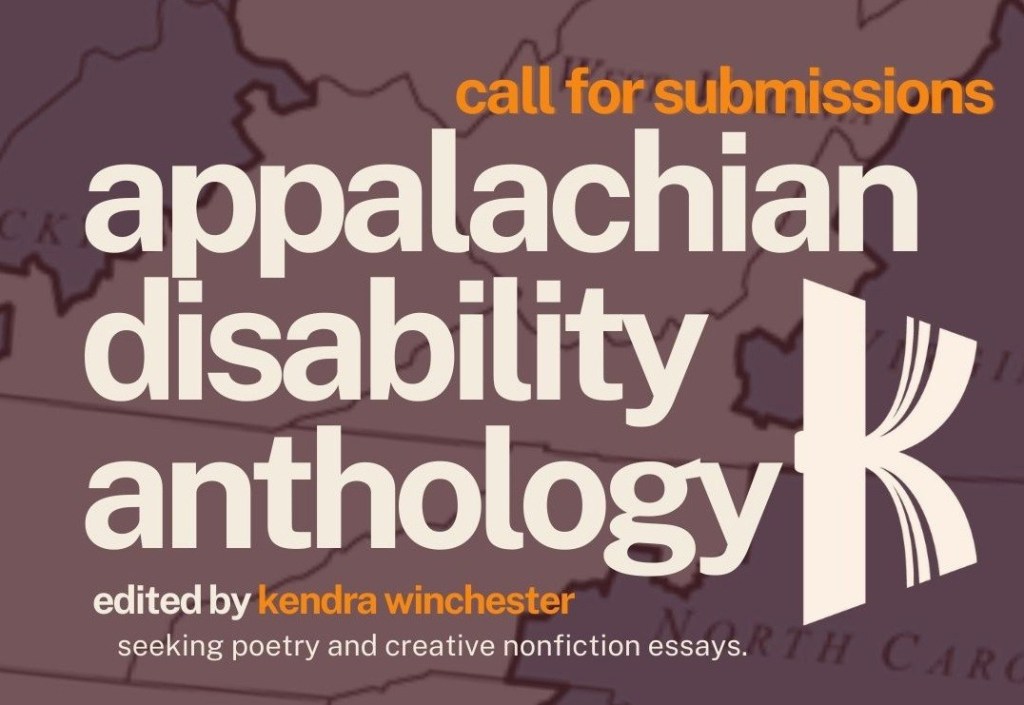
Submission Call for Disabled Writers from Appalachia: An Anthology Edited by Kendra Winchester

Many readers of this blog will be familiar with Kendra Winchester’s name from her work as the host of the popular Read Appalachia podcast, which celebrates Appalachian literature and writing. Kendra is also a Contributing Editor for Book Riot where she writes about audiobooks and disability literature. Kendra and I had a chance to spend some time together in person this past summer during the Appalachian Writers’ Workshop. One day while we were having lunch, Kendra started to tell me about her new project to compile and edit an anthology of work by disabled writers from Appalachia. The dining hall that day was so loud with conversation and laughter that we struggled to hear each other. So Kendra agreed to answer some questions over email about this anthology, which is actively accepting submissions.

DL: I was excited to learn that you will be editing an anthology of work by Appalachians writing about disability. How did the idea of this anthology form?

KW: Far too often, disabled people are treated like we’re invisible. When we are mentioned, we’re featured as inspirations, side characters, or burdens for the nondisabled people around us. Sometimes the very existence of our disability makes other people uncomfortable.

When I first read Disability Visibility, edited by Alice Wong, I didn’t realize how rarely I saw my disabled self in books. Reading stories about people like me was something I never knew I needed. This led me to seeking out as many books by disabled authors as I could get my hands on. Little did I know that there was a whole disability community waiting for me. We have our own culture and history. People just have to realize that it’s there.

In the vein of Disability Visibility, I wanted to bring together Appalachian writers to tell their own stories of what it’s like being disabled in Appalachia. With poetry being such a vibrant tradition in the region, I also wanted to include poets, and my goodness, so many Appalachian poets have shown up in such a big way. My hope is that this anthology will be the first of many anthologies of disabled writers from the region sharing their work with the world. The more voices, the better.

Sometimes people ask me if their disability “counts,” but we’re using the big umbrella for disability. So anyone who is disabled, chronically ill, deaf, or neurodivergent is most welcome to submit.

DL: Do people with disabilities in our region face challenges that are unusual or different from other regions?

KW: Appalachia has higher rates of disability than the national average. Some disabled people have had to completely leave the region to seek treatment. Some disabled people can still live in the region but have to travel back and forth to urban centers to see specialists. And others are disabled because they worked in major Appalachian industries, such as coal mines and paper mills. Whatever our experience, we all have stories to tell. 

DL: What genres are you seeking for this anthology, and how long should submissions be?

KW: I’m looking for creative nonfiction essays—around 2,500 – 3,000 words—that center the writer’s experience with living with disability in Appalachia. I’m also looking for poetry—3-5 poems—informed by personal experiences with disability in the region. I also welcome previously published work.

DL: Are you only looking for work from published, experienced writers?

KW:  I’m looking for writers of all experience levels! The anthology includes experienced, prize-winning writers and people who have never had a published piece before. 

DL: How can writers submit to your anthology, or reach out to you if they have questions?

KW: To submit their work or if anyone has questions, they can reach me at Kendra (at) readappalachia.com. I’m happy to answer any questions that they may have.

DL: When we were at the Appalachian Writers Workshop this past summer, you read a wonderful piece about growing up with a disability. Where can readers find that essay or any of your other recent work?

KW: Owning It: Our Disabled Childhoods in Our Own Words just came out in the U.S. this past August. It includes dozens of essays by disabled adults who were also disabled as kids. I was so honored to be included with writers like Ilya Kaminsky, Imani Barbarin, Ashley Harris Whaley, Rebekah Taussig, and Carly Findlay. I also write for Book Riot and have an occasional newsletter called.

Many thanks to Kendra Winchester for this important work and for answering my questions. You can find out more about Kendra and all of her projects by following her on Instagram or Twitter, or by subscribing to her occasional newsletter called Winchester Ave.

In case you missed it…Check out past conversations about writing and publishing with Melanie K. Hutsell, Zackary Vernon, and David Wesley Williams, whose new novel, Come Again No More, is out this week.

If you’re not already receiving these posts directly to your inbox, please subscribe.

Official Publication Day for Feller

Hello Friends,

Today, August 5th, is the official publication day for Feller, my new book of poems from Mercer University Press that explores themes of connection, longing, and the pursuit of a fully lived life. I’ve been writing these poems for about 12 years, so I’m really excited to finally be able to send this book out into the world, and to share it with you.

There’s a short window of time surrounding a book’s release where every action is amplified. If you’re inclined to help me help Feller reach more readers, here are a few things you can do.

1) Please buy the book. You can order Feller directly from Mercer University Press or from online retailers like AmazonBarnes & Noble and Bookshop.orgTertulia is offering a 25% discount if you order through their site by August 7th. You don’t even have to create an account. Just enter the code FELLER at checkout.

Feller is also available at great independent bookstores, such as City Lights, Parnassus Books, Novel Memphis, and others. If your local bookstore doesn’t already have copies of Feller in stock, please ask them to order it.

2) Please rate and review Feller or add it to your “Want to Read” shelf on Goodreads or any similar platforms such as StoryGraph, BookWyrm, or LibraryThing.

Remember that you don’t have to purchase a book from Amazon in order to rate and review it there. There are legitimate reasons not to support Amazon, but reviews there do make a difference. Reviews don’t need to be lengthy. Any short, simple message to recommend the book is appreciated.

3) Post about the book on social media and tag me. Photos of the book (with your pet or your baby, on a beach or a park bench, etc.) are especially great to share! You can find me on Facebook, Instagram and LinkedIn.

4) Come to events and invite me to read. I’ll be traveling a lot this fall. Check out my calendar of events to see if I’ll be near you. More dates are in the works and will be added soon. But I’m also still looking for opportunities to connect with more readers. If you host a book club or reading series, I’d love the opportunity to come talk about Feller. Let’s talk about getting something scheduled.

5) Teach it: If you’re a teacher and would like to teach from Feller, let me know. I’d love to connect with you and your students by visiting your classroom either in person or virtually.

PHOTO COURTESY OF KARI GUNTER-SEYMOUR.

In the days leading to publication, Feller has ranked as high as #9 on Amazon’s new releases chart for poetry, which feels remarkable! And look at these excepts from longer blurbs from three writers I deeply admire.

“Loving makes lyric sense of complex issues in poem after poem in Feller, with his special blend of eco-poetics and earthly reason.” — Elaine Sexton, Site Specific          “At once timely and timeless, Feller is a superbly striking and essential book.” — Matt W. Miller, Tender the River          “Reading Feller is a transformative, joyful, loneliness-alleviating experience.” — Annie Woodford, Where You Come From Is Gone

I feel incredibly blessed for Feller to receive some early attention, beginning with the exclusive cover reveal in Electric Literature! I gave my first official reading from Feller at the 48th Annual Appalachian Writers Workshop in Hindman, Kentucky. I spoke to Greg Lehman on his Moonbeams podcast. I answered some questions about poetry and shared a poem on Deborah Zenha-Adams’ wonderful blog. I spoke to Emily Mohn-Slate for one of her great Beginner’s Mind interviews. A poem from Feller was recently featured at Verse Daily. Two poems from the book were published this week at Salvation South.

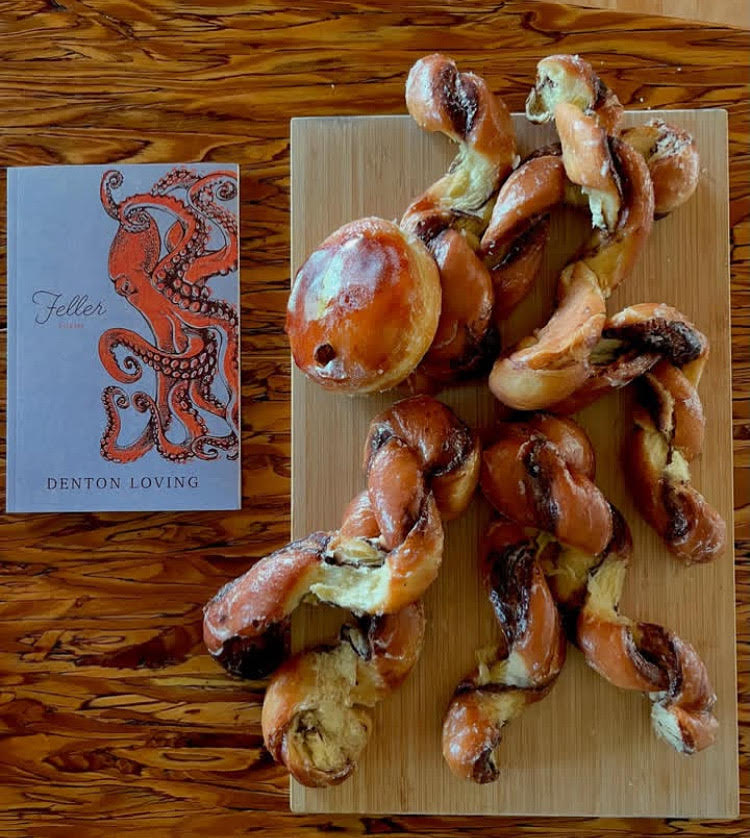
And my friend Davin Malasarn—who is a one of the most artistic and imaginative people I know—created one of his famous book-and-donut pairings to celebrate the launch.

One of the most exciting things about publishing a book is to see it interpreted and reflected through the eyes of readers. The other exciting thing is to connect with all of you. I can’t wait. Thanks for all you’ve done and what you still might do!

If you’re not already receiving these posts directly to your inbox, please subscribe. And in case you missed it… check out my recent conversation with Zackary Vernon about his YA novel, Our Bodies Electric.

Permission To Be Ourselves: Conversation with Zackary Vernon

I was in Asheville back in April for the North Carolina Writers Network Spring Conference. Zackary Vernon was there teaching a workshop on writing young adult literature. I had met Zack only once before in person, about a month earlier in the Los Angeles International Airport following AWP. But the world is small, especially the world of writers, and I used to work with Zack’s wife, Jessica Martell, when she taught about a decade ago at Lincoln Memorial University. It was fun to spend some time with both of them between conference sessions, and just before I headed home, Zack slipped me with a copy of his novel, Our Bodies Electric.

Our Bodies Electric is a coming-of-age story set on Pawley’s Island, South Carolina. We meet the main character, Josh, when he’s in the sixth grade and follow him into high school and his sexual awakening. Despite the very conservative and religious shadows cast by his parents and community, Josh finds surprising refuge in the words of Walt Whitman’s Song of Myself, which gives him the strength to love his body and his desires in all their forms.

Zachary is an Associate Professor and Director of Graduate Studies at Appalachian State University. He is a co-editor of Summoning the Dead: Essays on Ron Rash, and he is the editor of Ecocriticism and the Future of Southern Studies. His scholarly research and creative nonfiction and short fiction have been published widely. Zack agreed to answer a few questions about his writing, the need to accept differences in people, and his relationship with Walt Whitman.

DL: I think you and I are not too far apart in age, which is based partly on the fact that there was a lot I recognized from my own youth in Our Bodies Electric. How much of your own life and experience factored into setting the time and place for this novel?

ZV: Our Bodies Electric is set in my hometown of Pawleys Island, South Carolina, during the early to mid 1990s. It’s a southern coming-of-age story about a teenager named Josh who struggles against the pressure to conform to social conventions placed on him by his religious family and community, particularly as he enters his teenage years and tries to understand his body and sexuality. Josh hangs out with a bunch of outcast teenagers who get up to all kinds of hijinks, but more importantly they help each other through this period of rapid change and development. They need each other because they don’t get much help from their families or school or church. Those institutions fail them, because they constantly tell young adults that the things they think and do are evil. Some teens end up conforming to conservative conventions, and some decide to break the mold.

I am Josh, or at least Josh is some version of me. All of those details come from my own life and the lives of my friends between the sixth and nineth grades. I think that period might be the one in which we change the most rapidly; there is a fluidity during these years. We go from being kids to being hormonal teenagers who all the sudden possess very adult ideas and desires.

Throughout the novel, Josh sets off on an adventure of experimentation and self-discovery, which is of course natural and healthy. But the puritans surrounding him want nothing more than to police his behavior and stamp out any curiosity they believe is abnormal and thus dangerous. His journey is strange and uncomfortable at times, but hopefully he’s a better and more authentic person at the end of it.

DL: Walt Whitman and Song of Myself play a fairly pivotal role in this novel, and your students report that you really enjoy teaching Whitman. Did you know from the beginning of Our Bodies Electric that Whitman and Song would be part of Josh’s narrative? Or did that come later in the writing process?

ZV: Walt Whitman was a huge inspiration both for the form and the content of the novel. Regarding content, I’ve been a massive fan of Whitman since I first read him in high school. So his ideas have been rattling around in my head for decades. The year that I started earnestly working on Our Bodies Electric was the year I turned 37. And Whitman in “Song of Myself”—or the Whitman-esque persona that narrates the poem—is also 37. The first section contains these lines:

I, now thirty-seven years old in perfect health begin,
Hoping to cease not till death.

So I decided that during my 37th year of life, I would read Whitman every single day. And I didn’t miss a single one. I read various portions of Leaves of Grass for 365 consecutive days. Some days I’d only read a few lines, and some days I’d really dig in. So this year steeped me in Whitman’s language and ideas more than ever, and that happened to also be the time that I was seriously writing the novel.

For the protagonist Josh, Whitman becomes a sort of life coach and an inspiration. Josh reads Whitman and his ideas help him understand and accept himself.

In terms of form, I divided the novel into 52 sections, which are in dialogue with the 52 sections of “Song of Myself.” That’s not to say that there is a one-to-one mirroring going one—i.e. Section 1 of “Song of Myself” is in dialogue with Chapter 1 of my novel. It’s not that similar. But I did borrow the 52-section structure, and I tried to add a Whitman easter egg into every chapter. These are mostly subtle. There are only a handful of passages that actually allude to Whitman directly. But I’d say in a more general sense, Whitman pervades the entire novel.

DL: Besides the fact that the scenes throughout your novel sing all the way through, the thing I love best is how empathetic this book is. Josh is a compassionate character—to others and usually to himself—but you as the author give so much compassion to characters who aren’t compassionate to others. I’m thinking in particular about Josh’s fire and brimstone minister. Is there a person or situation that instilled so much empathy in you as a person and a writer?

ZV: My hope is that the novel has a message about the necessity of accepting difference. I think one could read it as being a harsh critique of Pawleys Island. But it’s not. It’s a critique of the stultifying impulse to conform that is often thrust onto kids and teenagers in conservative, religious communities. This exists everywhere. It’s not unique to Pawleys or even to the South. I taught for a year at a catholic college just north of Boston. The students there felt conflicted about themselves just as much as anyone I’ve ever seen in the South.

My novel is set in Pawleys simply because I happened to be from there; I lived there during those formative years that seem to make us who we are for life.

So I want to be clear too that I’m not making fun of Pawleys Island in any way. The novel is not mean-spirited or tragic. It’s humorous, and if anything it makes a plea to celebrate life. Also, the heroes of the novel come from Pawleys. Yes, the protagonist feels tortured by the conservative community here. But it is also locals who show him that there are different ways of being in the world. In other words, that place, like all places, contains good and bad. Josh doesn’t have to flee to find himself. He does that there, with the help of the many small-town eccentrics he meets along the way.

I was always fascinated by the black sheep I encountered in Pawleys Island. Some of them you could spot easily, but others didn’t look like punks or drifters. Take, for example, my high school English teacher Mary Ginny DuBose.

Miss DuBose was the most transformational teacher I’ve ever had. I’m talking about ever—more than any teacher I had through college or grad school.

She taught us to be independent thinkers. She cued us in to the fact that there was a great big world out there. And in it people thought in ways that were very different from our parents and our church leaders and members of our communities. That’s not to say that local folks were wrong all or even some of the time. But our world was limited in certain ways, and then Miss DuBose came along and started opening doors.

It’s cliché perhaps—very Dead Poets Society—but Miss DuBose expanded our minds. She was a tough teacher, but also very kind. I don’t know how she pulled that off. I’ve been teaching now for nearly two decades, and I’ve never been able to get that balance right—tough enough to prompt and prod even those most reluctant of souls, but kind enough to empathize and inspire.

And crucially it was Miss DuBose who first introduced me to Walt Whitman. Along with Miss DuBose, Whitman gave us permission to be ourselves; or perhaps both of them made us realize that we didn’t need permission in the first place.

DL: I understand you wrote a lot of nonfiction before you turned to fiction. Can you talk about your path to publication, both in general and specifically this novel? How did you come to work with Regal House/Fitzroy Books?

ZV: I’ve wanted to be a writer since high school. I don’t know why exactly. It’s not like I knew any writers personally. Maybe I’d seen writers romanticized in films, or maybe it was my Whitman obsession. But somehow I viewed writers as being subversive, and that’s what I wanted to be.

I was really into music in high school. And I think I was a decent musician, but that never felt like a good fit. Plus I could never write songs. I tried and tried, but it just never came, so at best if I had continued in music, I’d be in some kind of cover band, or playing backup in someone else’s band.

Writing stories and novels, though, was a different matter. When I got to college, I had no problem writing. In fact, I couldn’t stop. I wrote obsessively. That’s not to say the stories I was writing were good. They weren’t. They were terrible. But they flowed out of me. Something was there, some inclination. But I had to read a lot and study for a long time before the stories became halfway decent.

Samuel Johnson said, “The greatest part of a writer’s time is spent in reading, in order to write: a man will turn over half a library to make one book.”

I read voraciously and wrote about a million stories and two novels in college. Again, these were terrible and will never see the light of day. But I was very disciplined, and I produced a lot.

Then after undergrad I desperately wanted to get an MFA, but instead I got a PhD. I foolishly thought that this was the practical way of going about things. I had no idea at that point how bad the academic job market was.

What ended up happening was that for my MA and PhD and then when I got my first two teaching positions, I only wrote scholarship and nothing creative. It was a creative dry spell that lasted for close to a decade and a half. I wrote and published a lot of scholarship during that period, and I love that kind of writing, but it wasn’t what I was most passionate about.

When I got tenure, I decided that I was going to write fiction again. I dropped all my scholarly projects and dove into what would become Our Bodies Electric. The writing came as effortlessly as it did in college, except this time I think it was decent, or at least it was genuinely me. I was no longer trying to be someone I’m not—to write like Faulkner or Flannery O’Connor. I was no longer trying to be pretentious, writing serious historical southern gothic tales. Instead, I wrote humorous stories, and most of them were true in some way—things I’d experienced, things I’d heard about during my childhood and adolescence in Pawleys.

I wrote the novel is a strange roundabout way. I drafted the chapters more like short stories than chapters in a novel. And then I tried to weave together the best ones. And since they were mostly autobiographical, it wasn’t hard to create a coherent overarching narrative.

I got involved with Fitzroy Books, the YA imprint of Regal House Publishing, through my friend and colleague Mark Powell. Mark had read my book and helped me revise it, and he also had a book accepted at Regal House around this time. He recommended the press, saying it was the up-and-coming new indie in the South. So I sent them the book, and they seemed to like it right away.

DL: When we saw each other last, you were teaching a workshop on writing young adult fiction. What’s one of the most important lessons or advice you try to pass on to writers interested in YA fiction?

ZV: I came to YA accidentally. I didn’t write Our Bodies Electric as a YA novel. The main characters were adolescents, but I was imagining it being akin to books like Truman Capote’s Other Voices, Other Rooms, Carson McCullers’s The Heart Is a Lonely Hunter, or Lewis Nordan’s Music of the Swamp. In other words, I thought of the book in this lineage of coming-of-age adult literary fiction. And I hope my novel is that. But I also don’t want it to be merely read by adults.

It was my editor Jaynie Royal who had the idea of marketing the novel as YA. I was resistant at first, but Jaynie ultimately convinced me when she asked who I thought needed to read this book: other middle-aged liberals like me or young adults who might be struggling in the same ways that I struggled. I found and still find that idea very compelling.

In terms of advice for YA writers, I would just say that it’s important to be authentic. Teenagers can smell a phony from a mile away. You can tell about your own experiences or you dream up stories, but make sure they have an emotional or ideological truth to them. We desperately need to be reminded right now of the better angels of our nature—to be understanding and kind, even when people in power aren’t doing so.

I hope that’s what comes across in my book. In it, a small group of teenagers try like hell to discover who they are, even if their real identities go against the established community they live in. They rebel nonetheless, and as a result they learn to live more authentically, to celebrate and sing themselves.

I’m so grateful to Zackary Vernon for answering these questions. If you haven’t already read Our Bodies Electric, be sure to order your copy, available at bookshop.org or wherever books are sold.

In case you missed it… I have a new book of poems called Feller that will be published on August 5th. I’ve been making the rounds to talk about the book and the general state of poetry. See my recent conversations with Emily Mohn-Slate in her “Beginner’s Mind” Series and with Greg Lehman in Episode 4 of Moon Beams. And for a limited time, pre-order Feller and get a 25% discount through Tertulia. Just enter the code FELLER at checkout.

If you’re not already receiving these posts directly to your inbox, please subscribe.

Official Cover Reveal for Feller

Friends, I’ve been really excited for today to come! After what feels like a long wait, I can finally share the cover for my new collection of poems, Feller. But first, here’s one last teaser:

To view the entire image, head over to Electric Literature who very graciously is hosting the official cover reveal. I’m incredibly grateful for Electric Lit’s support and help in launching this new book.

I’m also grateful to Mary-Frances and Jim Burt of Burt & Burt who designed this cover image. It’s really striking and hits the exact right emotional key. I’m always grateful to Mercer University Press, especially my editor Marc Jolley, for believing in my work in general and Feller in particular. And huge thanks to Kelly March for coordinating this cover reveal in the first place. She’s amazing!

Feller is a book that has been a long time in the making. Some of these pieces took over ten years to transform from first draft to finished poem. There will be more opportunities later to talk about the individual poems and what the collection is about. And as always, I’m more excited to hear what the poems and the book mean to you. So I hope you’ll read Feller. The official pub date is August 5th, 2025, but if you want to hear a few of the new poems, you can listen to this episode of The Beat, a poetry podcast hosted by Alan May.

And don’t forget to take a look at the whole image over at Electric Literature. I hope you like it as much as I do.

Book Launch for Claudia Stanek’s Beneath Occluded Shine

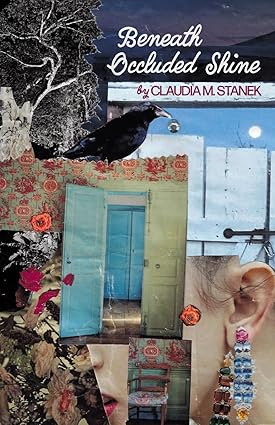
Last week, I was invited to be part of the launch of Claudia Stanek’s poetry chapbook, Beneath Occluded Shine. This is a short collection of 16 powerful poems all written in response to poems from Pablo Neruda’s Book of Questions. Neruda’s questions are essentially unanswerable. Claudia doesn’t attempt to answer Neruda although responding to a question with a question is sometimes its own answer. But I prefer to read these poems as wrestling with all of the deepest parts of our shared humanity.

You can read one of Claudia’s poems, Sunday Morning in Broken November, originally published here in Bitterzoet Magazine.

The book launch took place virtually as part of Jules’ Poetry Playhouse, hosted by Jules Nyquist and John Roche, who are based out of New Mexico. In one of the most unique reading events I’ve ever been part of, Claudia invited Jules and John, as well as poets Catherine Faurot, Gail Hosking and me to alternate reading all of the poems in Beneath Occluded Shine. The result was something that felt meditative if not downright spiritual.

You can watch and listen to our reading of Claudia’s work on YouTube.

And don’t forget to order Beneath Occluded Shine from Finishing Line Press.

Thanks for reading. If you’re not already receiving these posts directly to your inbox, please subscribe.
And in case you missed it, I celebrated National Poetry Month by reading new poems from my forthcoming collection, Feller, forthcoming in August 2025. You can listen to the reading by following the links here.

Wrapping Up National Poetry Month

I don’t ever remember a past April where I could visibly see poetry celebrated so often and in so many ways. Maybe one of the things we couldn’t predict about living in a dystopian world is how people would turn to poetry. Regardless, it was beautiful.

For my part, I had the privilege of reading poems to the monthly book discussion group, All Over the Page, at Lawson McGhee Library in Knoxville, Tennessee. I read poems from Tamp, as well as some new poems from a new book that will coming out in August.

Yeah, I sort of just buried the lede there, didn’t I? But that’s right. I have a new collection of poems coming out in August from Mercer University Press. It’s called Feller. I just saw the cover for the first time this week, and I love it so much. I can’t wait to share it with you all very soon.

In the meantime, that reading at Lawson McGhee Library was recorded as an episode of their podcast The Beat. You can listen to the episode here: https://the-beat.captivate.fm/episode/denton-loving-joins-us-live-for-all-over-the-page.

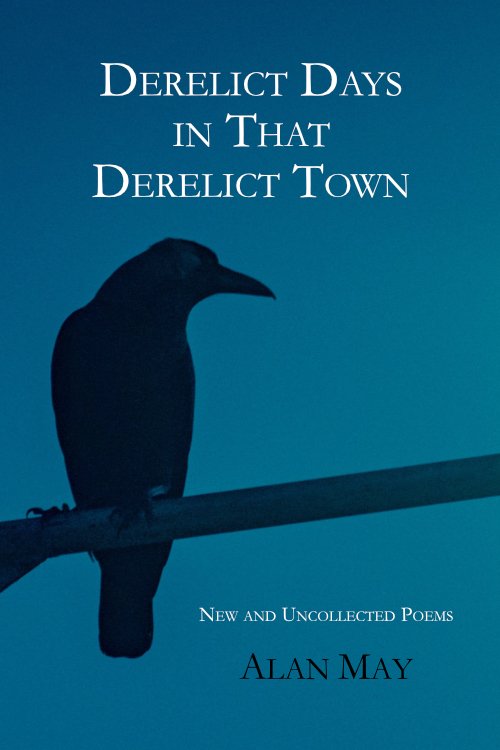
Special thanks to Alan May, Lawson McGhee librarian and host of The Beat, who invited me. Alan has a great book of poems out himself: Derelict Days in That Derelict Town: New and Uncollected Poems, published through BlazeVOX Books. I hope you’ll check it out.

There’s another lovely book recently out that you should know about, and that’s Beneath Occluded Shine by Claudia Stanek, published by Finishing Line Press. Claudia will be celebrating an online book launch on Wednesday, April 30, 2025, at Jules’ Poetry Playhouse. I’ll also be there reading a couple of poems along with poets Gail Hosking and Catherine Faurot. The reading is at 6:00 p.m. Pacific / 9:00 p.m. Eastern. It would be so nice to see you there.

Thanks for reading. If you’re not already receiving these posts directly to your inbox, please subscribe.
Submission Calls for Writers 1/11/2025

It’s been a while, friends.

Last year, submission posts like this one fell by the wayside, and I’m sorry. When I looked back at 2024, I saw that I did not submit enough of my own work, and I realized how building and sharing these lists and my own submissions go hand in hand. So I’m trying to start 2025 off the right way by sending some of my own work out into the world.

As we move forward, I want to give some extra energy to finding new journals and magazines to recommend to you. There are so many great outlets, and there are new journals emerging all the time. I often feel overwhelmed by all these magazines I’ve never heard of. So you’ll see on this list of ten submission opportunities a few names that are new to me. I hope they are new for you also.

How do we rank these new journals or compare them to some of the ones we’re more familiar with? I don’t know that yet. Please take a look at each one to determine if it feels like a good match for your work and your publication goals.

Today was a great day for me to think about all this, as I was somewhat snowed in. I’m guessing some of the rest of you in the South and East might stuck inside, too, if not by snow then probably by these Arctic temperatures. I hope the timing is right for you to receive this list.

For those of you in Southern California, especially those directly affected by the wildfires, please know that there are so many of us heartbroken by the extreme loss that you’re experiencing. I’m praying for your safety. To anyone and everyone reading this, I wish you all the best for the new year. Happy submitting.

The 2025 Yeats Poetry Prize is a public program since 1997 of the all-volunteer WB Yeats Society of NY. Our 2025 Judge is January O’Neil who also served as last year’s judge. Poets of any age from anywhere in the world may enter through February 1, 2025. There is no limit on entries, and they can be on any topic. They must also be in English, unpublished, and no more than 60 lines in length. First prize is $1,000, second prize is $500, and two or three honorable mentions are usually awarded at the judge’s discretion. The entry fees, which help to underwrite the competition, are $15 for the first poem and $12 for each additional poem. Winners are announced in early March, and awards are presented in New York City in April. https://yeats.submittable.com/submit

Deep South Magazine accepts original fiction, short stories and shorts, nonfiction and poetry during open reading periods. For fiction and nonfiction, we will do special themed calls. We will announce a new theme sometime in 2024. For poetry, our reading period will be open through February 14, 2025. We will mainly publish poetry in April during National Poetry Month, so around 30 selections will be chosen. All submissions must have a Southern connection, whether the author lives in the South, used to live in the South, has family in the South or was inspired by a visit to the region. Poetry submissions can be up to five poems of any length. Fiction, short stories and nonfiction are limited to one work at a time and may not be longer than 3,500 words. https://deepsouthmag.com/submission-guidelines/

Beaver Magazine publishes poetry, flash fiction and nonfiction, hybrid works, art and anything else you have to offer during our open reading periods. For poetry, send 3-5 poems of any format, each beginning on a new page. We love work that plays with traditional forms and modes. We want the lyric, the narrative, and everything in between. For prose, send up to 3 flash pieces of no more than 1,000 words each (though we do prefer brevity). Creative nonfiction can include personal, research, or lyric essays as well as memoirs. Fiction can be of any genre or style. Hybrid work can be whatever you want it to be! We celebrate and yearn for work from LGBTQIA2S+ and BIPOC. Submit through February 15, 2025, for the Spring Issue. https://beavermag.org/submit/

The Santa Clara Review is a student-edited literary magazine that publishes poetry, fiction, nonfiction, and visual art. The magazine is published biannually in February and May, drawing on submissions from Santa Clara University students, faculty, and staff, as well as from writers around the nation and globe. Please submit works of fiction or nonfiction prose under 6,000 words. Please submit no more than five poems or pieces of artwork at a time. Submissions for Volume 112.2 are currently open through February 15, 2025. https://santaclarareview.com/submit

Canary is published four times a year to welcome each new season on the solstices and equinoxes. We will be open from February 1- 28 for Spring-themed work for the Spring Equinox issue due out March 21, 2025. Please submit no more than 5 poems, or essays/short stories of not more than 1500 words. We look forward to reading your work on your experience of the losses to the natural world in your home environment and the joys of that natural world that we stand to lose. https://canarylitmag.org/submissions.php

Brevity publishes well-known and emerging writers working in the extremely brief (750 words or fewer) essay form. We have featured work from Pulitzer prize winners, NEA fellows, Pushcart winners, Best American authors, and writers from India, Egypt, The Netherlands, Ireland, Spain, Malaysia, Qatar, and Japan. We have also featured many previously-unpublished authors, and take a special joy in helping to launch a new literary career. While Brevity (the magazine) publishes the finest examples of flash nonfiction, the Brevity Blog offers a place to discuss issues related to the writing of creative nonfiction. https://brevitymag.com/submissions/

Pine Hills Review seeks submissions of previously unpublished fiction, nonfiction, poetry, and visual art. We are interested in quality work, no matter the genre, form, or style. Hybrid and experimental works are especially encouraged. Poetry submissions should include no more than six poems total. Nonfiction, fiction submissions, and hybrid or cross-genre work should be no more than 3,000 words total. Our regular reading period ends April 30, 2025. https://pinehillsreview.com/submit/

The Baffler is America’s leading voice of incisive and unconventional left-wing political criticism, cultural analysis, short stories, poems, and art. Founded in 1988 by Thomas Frank and Keith White as “the journal that blunts the cutting edge,” the magazine is currently edited by Matthew Shen Goodman. Nonfiction should be submitted in pitch form (no complete manuscripts, please), consisting of two paragraphs that describe your project. Poetry and fiction are welcome; our preferred length for prose is between 2,200 and 5,000 words. https://thebaffler.com/about/submissions

Forge Literary Magazine publishes one prose piece per week selected by a rotating cast of editors. Free submissions open on the 1st of each month. If there is no free link, we’ve hit our quota. We will reopen at the top of each month, except for September and December. We prefer stories under 3,000 words but will consider up to 5,000 words. We love flash and micro! We consider previously unpublished pieces only. We are open to all genres and voices, and stories with any background, race, ethnicity, gender, sexual or personal identity from all over the world. Literary excellence is our only criteria. https://forgelitmag.submittable.com/submit

Streetlight Magazine reads year-round and typically responds to submissions within three months. Send us 3-5 unpublished poems in a single document. Please send one story at a time, 2,000 words max. We currently seek creative essays/memoirs with an emphasis on the interaction of place and one’s personal relationship to it. We also welcome guest bloggers. We’re interested in topics about the literary and visual arts as well as personal perspectives on much more. Blogs should be between 300-700 words and may be edited to fit SL format. https://streetlightmag.com/submissions/

~

Thanks for reading. Please feel free to share these opportunities with other writers. If you’re not already receiving these posts directly to your inbox, please subscribe.
~

Book Launch for Darnell Arnoult’s Incantations

Last week, I had the privilege to be part of the book launch for Darnell Arnoult’s new collection of poems, Incantations. This collection is a mesmerizing group of poems that celebrates language in unique but powerful ways. Many of the poems came out of a period of grief, but the poems are also celebratory and full of hope. They speak simultaneously to the personal and the political, addressing some of the most significant challenges of our times.

The launch took place in Hillsborough, North Carolina, at St. Matthew’s Episcopal Church as part of their Faith and Arts Series. Darnell gave a beautiful reading of her new work. The church was filled, and Purple Crow Books sold all of their copies after the reading. Alison Weiner accompanied her on the piano. And I had double duty that night, first introducing Darnell and then following up with an on-stage discussion about her work. The on-stage discussion was especially fun, and I hope an audio recording of it will be available at a later time. Until then, I want to share my introduction. It was such an honor to be part of welcoming this new book into the world, as well as to celebrate my good friend. I may have also added a little good-natured ribbing.

Welcome, and thank you all for coming out tonight to celebrate our friend Darnell Arnoult and her newest collection of poems, Incantations!

If you are here tonight, there is a good chance that you already know Darnell. Before I get too personal, allow me to properly impress you with a few of Darnell’s professional accomplishments.

Darnell is the author of the novel Sufficient Grace, and two previous collections of poems: Galaxie Wagon and What Travels With Us, and she has published stories, poems and essays in a variety of journals and anthologies.

She is the recipient of the Southern Indie Booksellers Alliance Poetry Book of the Year Award, the Weatherford Award for Appalachian Literature, the Thomas and Lillie D. Chaffin Award, and the Mary Frances Hobson Medal for Arts and Letters. In 2007 she was named Tennessee Writer of the Year by the Tennessee Writers Alliance. She holds degrees from The University of Memphis, North Carolina State University, and The University of North Carolina at Chapel Hill.

If you know Darnell, it’s likely because you have studied with Darnell, perhaps at the Table Rock Writers Workshop, the John C. Campbell Folk School, the Appalachian Writers Workshop, the Tennessee Mountain Writers annual conference, through Learning Events, the Mountain Heritage Literary Festival, or perhaps even as an undergraduate student from Lincoln Memorial University where Darnell served as Writer-in-Residence from 2010 to 2020.

Lincoln Memorial University is the place where Darnell’s and my lives began to intertwine. We co-directed the Mountain Heritage Literary Festival. And we also created and shared editing responsibilities for the literary journal drafthorse, a journal dedicated to writing about labor and occupation. Darnell and I worked together, often getting each other in and out of trouble, and we became wonderful friends in the process.

I cannot list all of the pieces of good fortune that have come to me because of Darnell, mostly because Darnell told me to do something—often something I didn’t want to do or didn’t have faith that I could do. There are too many of these instances to list, but I will tell you that when I decided to apply to MFA programs, Darnell decided I would go to Bennington College’s low residency program in Vermont. I, on the other hand, lacked the ability to imagine being accepted in that program. I didn’t even have any intention of trying. But if you know Darnell, you know that once she’s made up her mind, you might as well agree or get out of the way. It is no exaggeration to tell you that the only reason I applied to Bennington was to shut Darnell up. As she seemed to know in advance, my life changed in innumerable ways because of that program, all for the better.

Darnell is the person who has encouraged me the most as a writer and certainly as a poet. Darnell probably knows my poetry better than anyone, and she has probably influenced my poetry more than anyone. A lot of my early poems originated in workshops Darnell taught. She was the first person who thought I had enough poetry to form my first book, and she largely arranged the order of that book, which in itself was another incredible lesson in learning how to shape individual pieces into a larger narrative. She has seen so many first and early drafts that it’s a wonder she still opens my emails.

In the 10 years that Darnell taught at LMU and lived in Cumberland Gap, Tennessee, my life was richer, and a lot more exciting. In her absence, there are fewer people asking me if I have seen Darnell, if I have any idea where Darnell is, if I can find her, please, help, she’s not answering her phone, she never answers her phone! Why doesn’t she ever answer her phone? There are fewer reasons to rush to the emergency room. There are fewer visits from the fire department. In short, there is much less excitement, and my life is poorer for her absence.

To answer the question as to why Darnell rarely ever answers her phone, I can report that she may have turned the ringer off two days earlier and can’t find the phone, she may have left her phone at home or at someone else’s home, or any number of other places along the way, the battery may be dead, or more likely, she is just already on the other line with someone else who needs to talk to her just as badly as you may need to talk to her. The number of people who rely on Darnell is uncountable. The number of people whose lives have been enriched by Darnell is legion.

I would be remiss to not acknowledge that the 10 years in which Darnell lived in Cumberland Gap were not completely happy. For Darnell, I know that time period is framed by her husband William’s recurring illnesses, his battle with cancer, and his passing in 2020. The poems in Incantations were born from that grief. The deepest kinds of grief. Grief that comes, as she would describe, from worlds burning, from death that dances and glides, from widowhood with its slaughtered and emptied heart.

And yet, within these poems, Darnell also rejoices in the curative properties of language, how it can bewitch and rescue us from despair. When you look at the beautiful cover of Darnell’s new book, you will see an image of fire and light bursting into the darkness. As that image suggests, these poems tell us that there is salvation in the darkness. There is salvation in these poems that are also charms for remembrance, charms for protection and rebirth, and always charms for love, no matter how it may shift its shape.

Join me in welcoming Darnell to the stage as we celebrate her new collection of poems, Incantations.

~

You can read a sample of poems from Incantations online at Cutleaf. Or you can order a copy through Purple Crow Books, directly from Madville Publishing, from your own local bookstore or anywhere books are sold. (Photos courtesy of Donna Campbell and Kelly March.)

~

In case you missed it… check out my conversation with David Wesley Williams about his novel Everybody Knows.

~

If you’re not already receiving these posts directly to your inbox, please subscribe.