Book Launch for Darnell Arnoult’s Incantations

Last week, I had the privilege to be part of the book launch for Darnell Arnoult’s new collection of poems, Incantations. This collection is a mesmerizing group of poems that celebrates language in unique but powerful ways. Many of the poems came out of a period of grief, but the poems are also celebratory and full of hope. They speak simultaneously to the personal and the political, addressing some of the most significant challenges of our times.

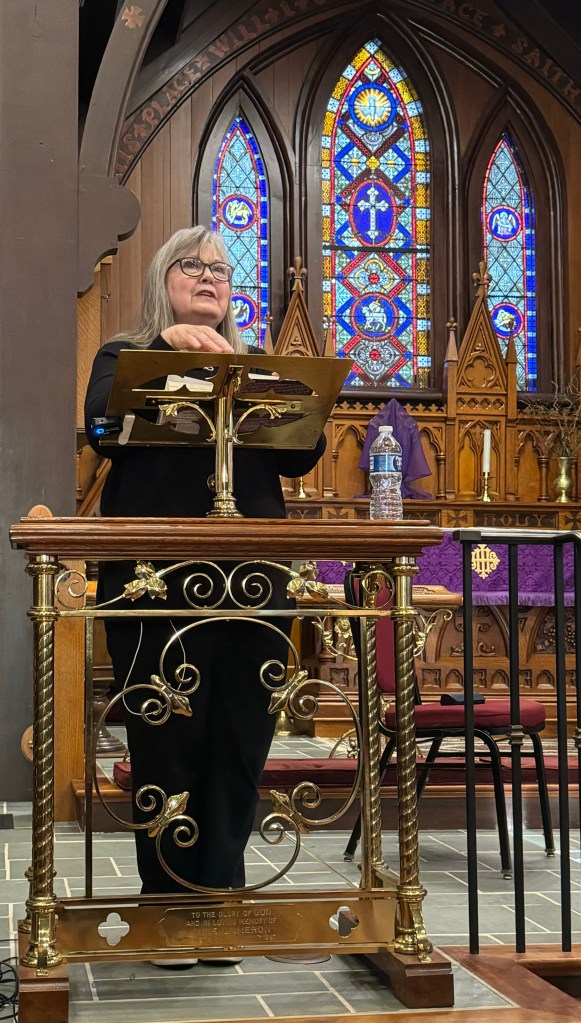
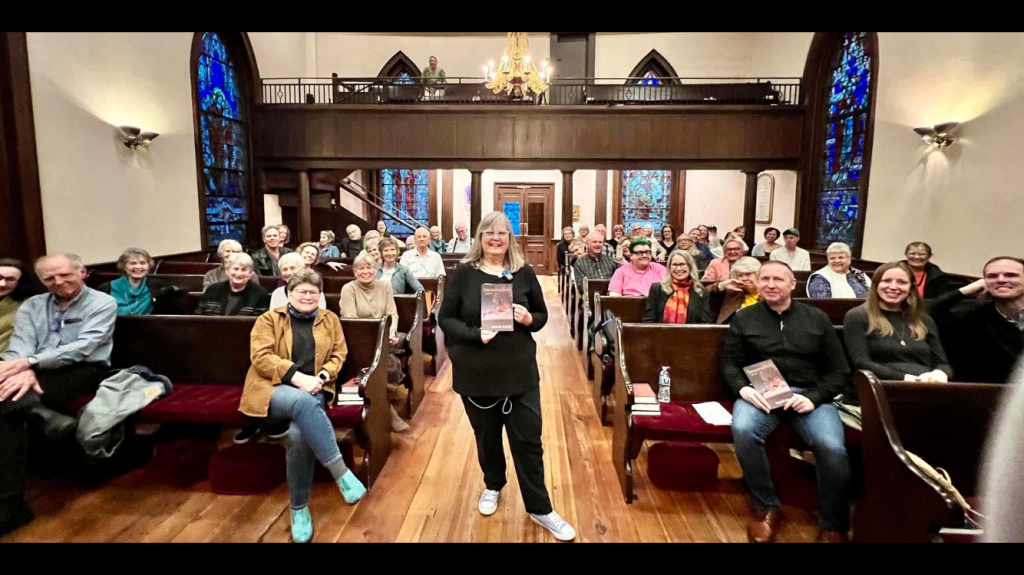
The launch took place in Hillsborough, North Carolina, at St. Matthew’s Episcopal Church as part of their Faith and Arts Series. Darnell gave a beautiful reading of her new work. The church was filled, and Purple Crow Books sold all of their copies after the reading. Alison Weiner accompanied her on the piano. And I had double duty that night, first introducing Darnell and then following up with an on-stage discussion about her work. The on-stage discussion was especially fun, and I hope an audio recording of it will be available at a later time. Until then, I want to share my introduction. It was such an honor to be part of welcoming this new book into the world, as well as to celebrate my good friend. I may have also added a little good-natured ribbing.

Welcome, and thank you all for coming out tonight to celebrate our friend Darnell Arnoult and her newest collection of poems, Incantations!

If you are here tonight, there is a good chance that you already know Darnell. Before I get too personal, allow me to properly impress you with a few of Darnell’s professional accomplishments.

Darnell is the author of the novel Sufficient Grace, and two previous collections of poems: Galaxie Wagon and What Travels With Us, and she has published stories, poems and essays in a variety of journals and anthologies.

She is the recipient of the Southern Indie Booksellers Alliance Poetry Book of the Year Award, the Weatherford Award for Appalachian Literature, the Thomas and Lillie D. Chaffin Award, and the Mary Frances Hobson Medal for Arts and Letters. In 2007 she was named Tennessee Writer of the Year by the Tennessee Writers Alliance. She holds degrees from The University of Memphis, North Carolina State University, and The University of North Carolina at Chapel Hill.

If you know Darnell, it’s likely because you have studied with Darnell, perhaps at the Table Rock Writers Workshop, the John C. Campbell Folk School, the Appalachian Writers Workshop, the Tennessee Mountain Writers annual conference, through Learning Events, the Mountain Heritage Literary Festival, or perhaps even as an undergraduate student from Lincoln Memorial University where Darnell served as Writer-in-Residence from 2010 to 2020.

Lincoln Memorial University is the place where Darnell’s and my lives began to intertwine. We co-directed the Mountain Heritage Literary Festival. And we also created and shared editing responsibilities for the literary journal drafthorse, a journal dedicated to writing about labor and occupation. Darnell and I worked together, often getting each other in and out of trouble, and we became wonderful friends in the process.

I cannot list all of the pieces of good fortune that have come to me because of Darnell, mostly because Darnell told me to do something—often something I didn’t want to do or didn’t have faith that I could do. There are too many of these instances to list, but I will tell you that when I decided to apply to MFA programs, Darnell decided I would go to Bennington College’s low residency program in Vermont. I, on the other hand, lacked the ability to imagine being accepted in that program. I didn’t even have any intention of trying. But if you know Darnell, you know that once she’s made up her mind, you might as well agree or get out of the way. It is no exaggeration to tell you that the only reason I applied to Bennington was to shut Darnell up. As she seemed to know in advance, my life changed in innumerable ways because of that program, all for the better.

Darnell is the person who has encouraged me the most as a writer and certainly as a poet. Darnell probably knows my poetry better than anyone, and she has probably influenced my poetry more than anyone. A lot of my early poems originated in workshops Darnell taught. She was the first person who thought I had enough poetry to form my first book, and she largely arranged the order of that book, which in itself was another incredible lesson in learning how to shape individual pieces into a larger narrative. She has seen so many first and early drafts that it’s a wonder she still opens my emails.

In the 10 years that Darnell taught at LMU and lived in Cumberland Gap, Tennessee, my life was richer, and a lot more exciting. In her absence, there are fewer people asking me if I have seen Darnell, if I have any idea where Darnell is, if I can find her, please, help, she’s not answering her phone, she never answers her phone! Why doesn’t she ever answer her phone? There are fewer reasons to rush to the emergency room. There are fewer visits from the fire department. In short, there is much less excitement, and my life is poorer for her absence.

To answer the question as to why Darnell rarely ever answers her phone, I can report that she may have turned the ringer off two days earlier and can’t find the phone, she may have left her phone at home or at someone else’s home, or any number of other places along the way, the battery may be dead, or more likely, she is just already on the other line with someone else who needs to talk to her just as badly as you may need to talk to her. The number of people who rely on Darnell is uncountable. The number of people whose lives have been enriched by Darnell is legion.

I would be remiss to not acknowledge that the 10 years in which Darnell lived in Cumberland Gap were not completely happy. For Darnell, I know that time period is framed by her husband William’s recurring illnesses, his battle with cancer, and his passing in 2020. The poems in Incantations were born from that grief. The deepest kinds of grief. Grief that comes, as she would describe, from worlds burning, from death that dances and glides, from widowhood with its slaughtered and emptied heart.

And yet, within these poems, Darnell also rejoices in the curative properties of language, how it can bewitch and rescue us from despair. When you look at the beautiful cover of Darnell’s new book, you will see an image of fire and light bursting into the darkness. As that image suggests, these poems tell us that there is salvation in the darkness. There is salvation in these poems that are also charms for remembrance, charms for protection and rebirth, and always charms for love, no matter how it may shift its shape.

Join me in welcoming Darnell to the stage as we celebrate her new collection of poems, Incantations.
~

You can read a sample of poems from Incantations online at Cutleaf. Or you can order a copy through Purple Crow Books, directly from Madville Publishing, from your own local bookstore or anywhere books are sold. (Photos courtesy of Donna Campbell and Kelly March.)

~

In case you missed it… check out my conversation with David Wesley Williams about his novel Everybody Knows.

~

If you’re not already receiving these posts directly to your inbox, please subscribe.

Conversation with Lauren Davis

Lauren Davis is a writer who lives on the Olympic Peninsula. I first met Lauren when we were both MFA students at Bennington College. Since that time, Lauren has published two chapbooks of poetry, and, most recently, a full-length collection, Home Beneath the Church. “Lauren Davis is the poet you need to be reading,” says Kelli Russell Agodon, and I couldn’t agree more.

Home Beneath the Church includes deeply personal poems about the body and then moves into writing about religious spaces. Clearly, the body is one such religious space, perhaps even the holiest. But there are also churches, French basilicas, grottoes reserved for anchoresses and saints. And there is also the outside world: the forest, the bay, the moon, and everything that lives and endures in that outside world. Davis finds the holiness in it all.

Lauren agreed to answer some questions about Home Beneath the Church as well as about the writing and publishing process. Come back tomorrow for a writing exercise inspired by Lauren’s new collection.

DL: So many of the poems in Home Beneath the Church explore deeply personal material about your body and particularly your health. I often feel that we poets are inherently confessional, but can you talk about the process of writing these poems?

LD: I sometimes wept while putting pen to paper. One thing that kept me going was my absolute rage at the shame that surrounds women’s bodies. There was nothing for me to be ashamed of in these poems, and yet, I struggled. I found this struggle infuriating, so I pressed forward.

DL: Do you have advice for writers who are attempting to write about the body? Were there other poets or specific poems you referred to for guidance?

LD: Read, read, read. That’s my advice. Somewhere someone has taken the plunge, or they’ve taken a similar risk. I turned many times to Sharon Olds and Jason Shinder. I also made use of therapy. There’s so much to unravel when we talk about bodies.

DL: One of the questions I’m asked the most, especially by poets early in their career, is how to not sound overly prosaic. What kind of craft elements do you employ to identify and modify those prosaic turns of phrase?

LD: We’re not supposed to be overly prosaic? That’s news to me! I often find the opposite situation in new writers. They’re writing in such a complicated or elevated manner that the music, imagery, and meaning gets lost. But my advice, whether the new writer is dealing with either side of the spectrum, is to read, read, read. There is no substitute. And read living poets. Give the Greats a rest for a moment. Come back to them in a couple of years. For now, find those writers that are winning awards and branch out from there.

DL: In my conversation with Rosemary Royston last month, she said that it took her about six years of reorganizing, resending, and hoping before she found a publisher for her most recent collection of poems. How long did it take you to write and shape this collection? What was the submission and publication process like for Home Beneath the Church?

LD: Oh, Lord. Who really knows how long this took? Five years? And forty-eight rejections, I think. Each rejection helped shape the book in its own way. The publication process was a little rocky. We entered the pandemic shutdown, and I just took my hands off of it. Full surrender. And I could not be happier with the final product that Fernwood Press delivered.

DL: I know you have another collection of poems already in the works. If it’s not too early, can you tell us when that will be available? And what are you working on now?

LD: When I Drowned will be available in Winter 2023 through Aldrich Press. At the moment, I’m working on a novel titled The Sleeping Cure, and I’m seeking a publisher for my short-story collection The Milk of Dead Mothers.

* * *

My next post will feature a writing exercise inspired by one of Lauren Davis’s poems in Home Beneath the Church, as well as more information about where you can hear Lauren read this spring.

Cathey Smith Bowers’ “Paleolithic”

While waiting for the snow that still hasn’t truly arrived, I finished reading Cathy Smith Bowers’ debut collection The Love That Ended Yesterday in Texas. This book was first published by Texas Tech University Press in 1992 and later reprinted by Iris Press. There are so many memorable and beautiful poems in this book, but I thought I’d share the very first one from the collection. First poems in collections have a heavy burden to speak to the overall theme of the book while also drawing the reader in. This first poem, “Paleolithic,” does all of that and more.

PALEOLITHIC

We love these old caves—Lascaux,
Altamira—and walk carefully
the way we always enter the past,
our hands bearing
the artificial light of this world.

We imagine those first hunters
crouched, conjuring luck,
carving into rock-swell
their simple art—whole herds of bison,
the haunches, the powerful heads, floating
orderless along the walls.
And some are climbing sky
as if they were stars, planets
orbiting something they cannot see.
Centuries will pass before they
right themselves, their hooves
coming down on to the deep
wet floor of leaf-fall.
Remembering where it was
they were headed.

My 2021 Reading List

It’s been almost 8 months since my last blog post here. I’m afraid a lot of my plans for this space escaped me as the year rushed by. Probably the biggest reason for this is because of the role I accepted as an editor for EastOver Press and EOP’s literary journal Cutleaf. In our first year, we published 23 bi-weekly issues of the journal. We also published 4 wonderful books of poetry that I’m really proud of. (See the links below to purchase EOP books and others!) This new position as an editor requires a lot of reading, and so my list of published books I read last year (2021) isn’t quite as robust as I’d like. But I love seeing other people’s what-I’ve-read lists, so here’s mine.

  1. Julia Cameron – Finding Water
  2. Haruki Murakami – What I Talk About When I Talk About Running
  3. Wesley Browne – Spoon (manuscript)
  4. Jennifer Stewart Miller – Thief
  5. Haruki Murakami – After Dark
  6. Jay McCoy – The Occupation
  7. Britton Shurley – Spinning the Vast Fantastic
  8. Matthew Landrum – Berlin Poems
  9. Katrin Ottarsdóttir – Are There Copper Pipes in Heaven
  10. Chaelee Dalton – Mother Tongue
  11. Frank Jamison – Marginal Notes
  12. Daniel Corrie – For the Future
  13. Jesse Donaldson – On Homesickness
  14. Matt Urmy – The Rain in the Bell
  15. Liz Ahl – Beginning Ballroom Dance
  16. Cathryn Hankla – Galaxies
  17. Erica Anderson-Senter – Midwestern Poet’s Incomplete Guide to Symbolism
  18. Ralph Sneeden – Surface Fugue
  19. Rosemary Royston – Second Sight
  20. John Davis, Jr. – The Places That Hold
  21. Marie Parsons – An Echo in the Wind
  22. Katherine Hauswirth – The Book of Noticing
  23. Larry Pike – Even in the Slums of Providence
  24. A.E. Hines – Any Dumb Animal
  25. Tarn Wilson – In Praise of Inadequate Gifts
  26. Ross Gay – The Book of Delights
  27. Virginia Woolf – To the Lighthouse
  28. Megan Culhane Galbraith – The Guild of the Infant Saviour: An Adopted Child’s Memory Book
  29. Sylvia Woods – What We Take With Us
  30. Lauren Davis – The Missing Ones
  31. Ralph Sneeden – Evidence of the Journey
  32. Shawna Kay Rodenberg – Kin: A Memoir

I’d like to think that my list for next year will be at least twice this long. And maybe it will be. But it really doesn’t matter. These days, I’m trying to be more comfortable with the idea of slowing down the process. What this means to me is sometimes reading fewer books, but giving more time to think about and engage with each one.

If you’ve posted your own 2021 list or have recommendations for what to read in 2022, please post links and ideas in the comments section. I’d love to hear from you. Happy New Year!