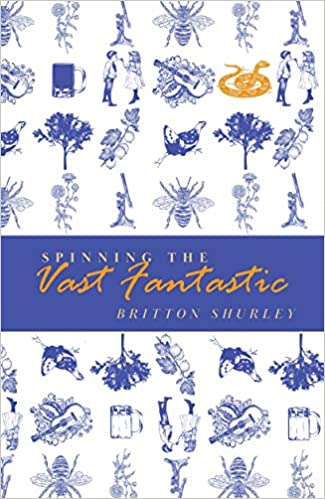
Britton Shurley’s new collection, Spinning the Vast Fantastic, is a beautiful guide for spiritual sustainment in a complicated and down-heartening world. The first poem in the collection, “When I Think I’m Through with Beauty,” refers to the world as one that “gnaws us to gristle, if we / don’t work free from its teeth.”
 Many of Shurley’s other poems make similar references. Shurley is not speaking specifically the restrictions and hardships suffered under a pandemic. He’s talking mostly about how hard life can be in general, and yet, these poems feel especially appropriate for our time. This isn’t because of the way Shurley sees how life can beat us down. It’s more so because of the ways Shurley finds solace. In so many of the poems, that solace is found by taking a breath and paying attention to our surroundings.
In “When I Think I’m Through with Beauty,” the beauty that surprises and pleases is a “boy who’s built / like a thick brick shit-house / spinning a whip of forsythia // just bursting with bright / yellow blossoms, while his // boom box floods the street / with velvet organ chords / of old-time Baptist gospel.” As evidenced in this passage, one of the other ways Shurley finds delight and gives delight to the reader is through sound. The language here and in every poem in the collection is stunning, filled with assonance and internal rhyme, all of which help bring alive these amazing images like this boy with his forsythia.
A recurring theme in these poems is the joy that children bring, as well as the promise for their ability to better the future, as seen in “The Red-Winged Blackbird.”
THE RED-WINGED BLACKBIRD
Its name is a strut for the tongue.
A song that can crack the heart
like mine did when that bird lit down
on a purpled redbud’s branch
in Ron and Kelli’s field. This handful
of acres saved from an inland flood
of McMansions drowning half of Indiana.
This field where chickens roam—
Orpingtons, Wynadottes, and Rhode
Island Reds—all hunting for bugs at dusk
by a garden of onions and melons.
And as if that’s not enough, a child’s
on his way in fall. Now I know
I know nothing for certain, but this boy
will be born amidst magic, in a home
where cabbage, apple, and ginger
turn to jars of kraut so crisp
my mouth wants to shout and dance.
I hope his name holds such a tune,
that it sings like the sound of the red-
winged blackbird and can bare
a hyphen’s weight. Maybe Banjo-
Nectarine or Cannonball-Daffodil Abdon.
Either way, his life will be music;
he’ll make this cold world swoon.
One of the immense strengths of these poems is in Shurley’s ability to juxtapose the bucolic and familial against the material and trivial. With similar hope and promise, he references his own daughters, notably in “To the Harvey Weinsteins et al.” Shurley begins the poem, “Know my daughters believe in their power.” He then describes the girls performing a “spell” to bring snow and a snow day from school. “And damn, if it didn’t work,” he writes, “so that we could wake in a world / slowed and stilled for a day.” Shurley brings the end of the poem back to Weinstein—not only Weinstein but all the men he represents—warning such abusers to be careful, and to see what powers these young women have.
Spinning the Vast Fantastic is overwhelmingly an optimistic view of life. We see this in the view of young women like his daughters but also in the hope for young men like the aforementioned Banjo-Nectarine. But Shurley’s optimism is seen also by the wonders found in the world. One example is in the poem “Headless Wonder” that examines a 1945 report of a chicken who lived for 18 months without its head. Another example in the book’s title poem re-imagines an 1876 report of fresh meat falling from the sky. In “Parthenogenesis” Shurley writes, “If the ankle of the horse is holy, then so is the cow’s / cracked hoof, the sheep’s bleating tongue…” What I take away from these poems is that the world is always miraculous, even during dangerous and frightening times.

 Denton Loving