Conversation with Lauren Davis

Lauren Davis is a writer who lives on the Olympic Peninsula. I first met Lauren when we were both MFA students at Bennington College. Since that time, Lauren has published two chapbooks of poetry, and, most recently, a full-length collection, Home Beneath the Church. “Lauren Davis is the poet you need to be reading,” says Kelli Russell Agodon, and I couldn’t agree more.

Home Beneath the Church includes deeply personal poems about the body and then moves into writing about religious spaces. Clearly, the body is one such religious space, perhaps even the holiest. But there are also churches, French basilicas, grottoes reserved for anchoresses and saints. And there is also the outside world: the forest, the bay, the moon, and everything that lives and endures in that outside world. Davis finds the holiness in it all.

Lauren agreed to answer some questions about Home Beneath the Church as well as about the writing and publishing process. Come back tomorrow for a writing exercise inspired by Lauren’s new collection.

DL: So many of the poems in Home Beneath the Church explore deeply personal material about your body and particularly your health. I often feel that we poets are inherently confessional, but can you talk about the process of writing these poems?

LD: I sometimes wept while putting pen to paper. One thing that kept me going was my absolute rage at the shame that surrounds women’s bodies. There was nothing for me to be ashamed of in these poems, and yet, I struggled. I found this struggle infuriating, so I pressed forward.

DL: Do you have advice for writers who are attempting to write about the body? Were there other poets or specific poems you referred to for guidance?

LD: Read, read, read. That’s my advice. Somewhere someone has taken the plunge, or they’ve taken a similar risk. I turned many times to Sharon Olds and Jason Shinder. I also made use of therapy. There’s so much to unravel when we talk about bodies.

DL: One of the questions I’m asked the most, especially by poets early in their career, is how to not sound overly prosaic. What kind of craft elements do you employ to identify and modify those prosaic turns of phrase?

LD: We’re not supposed to be overly prosaic? That’s news to me! I often find the opposite situation in new writers. They’re writing in such a complicated or elevated manner that the music, imagery, and meaning gets lost. But my advice, whether the new writer is dealing with either side of the spectrum, is to read, read, read. There is no substitute. And read living poets. Give the Greats a rest for a moment. Come back to them in a couple of years. For now, find those writers that are winning awards and branch out from there.

DL: In my conversation with Rosemary Royston last month, she said that it took her about six years of reorganizing, resending, and hoping before she found a publisher for her most recent collection of poems. How long did it take you to write and shape this collection? What was the submission and publication process like for Home Beneath the Church?

LD: Oh, Lord. Who really knows how long this took? Five years? And forty-eight rejections, I think. Each rejection helped shape the book in its own way. The publication process was a little rocky. We entered the pandemic shutdown, and I just took my hands off of it. Full surrender. And I could not be happier with the final product that Fernwood Press delivered.

DL: I know you have another collection of poems already in the works. If it’s not too early, can you tell us when that will be available? And what are you working on now?

LD: When I Drowned will be available in Winter 2023 through Aldrich Press. At the moment, I’m working on a novel titled The Sleeping Cure, and I’m seeking a publisher for my short-story collection The Milk of Dead Mothers.

* * *

My next post will feature a writing exercise inspired by one of Lauren Davis’s poems in Home Beneath the Church, as well as more information about where you can hear Lauren read this spring.
Britton Shurley’s Spinning the Vast Fantastic

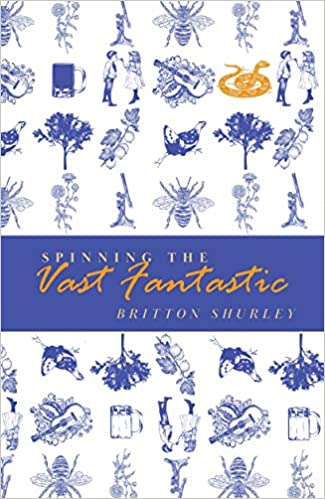
Britton Shurley’s new collection, Spinning the Vast Fantastic, is a beautiful guide for spiritual sustainment in a complicated and down-heartening world. The first poem in the collection, “When I Think I’m Through with Beauty,” refers to the world as one that “gnaws us to gristle, if we / don’t work free from its teeth.”

Britton Shurley - Spinning the Vast FantasticMany of Shurley’s other poems make similar references. Shurley is not speaking specifically the restrictions and hardships suffered under a pandemic. He’s talking mostly about how hard life can be in general, and yet, these poems feel especially appropriate for our time. This isn’t because of the way Shurley sees how life can beat us down. It’s more so because of the ways Shurley finds solace. In so many of the poems, that solace is found by taking a breath and paying attention to our surroundings.
In “When I Think I’m Through with Beauty,” the beauty that surprises and pleases is a “boy who’s built / like a thick brick shit-house / spinning a whip of forsythia // just bursting with bright / yellow blossoms, while his // boom box floods the street / with velvet organ chords / of old-time Baptist gospel.” As evidenced in this passage, one of the other ways Shurley finds delight and gives delight to the reader is through sound. The language here and in every poem in the collection is stunning, filled with assonance and internal rhyme, all of which help bring alive these amazing images like this boy with his forsythia.

A recurring theme in these poems is the joy that children bring, as well as the promise for their ability to better the future, as seen in “The Red-Winged Blackbird.”

THE RED-WINGED BLACKBIRD

     Its name is a strut for the tongue.
A song that can crack the heart
     like mine did when that bird lit down

on a purpled redbud’s branch
     in Ron and Kelli’s field. This handful

of acres saved from an inland flood
     of McMansions drowning half of Indiana.
This field where chickens roam—

     Orpingtons, Wynadottes, and Rhode
Island Reds—all hunting for bugs at dusk

     by a garden of onions and melons.
And as if that’s not enough, a child’s
     on his way in fall. Now I know

I know nothing for certain, but this boy
     will be born amidst magic, in a home

where cabbage, apple, and ginger
     turn to jars of kraut so crisp
my mouth wants to shout and dance.

     I hope his name holds such a tune,
that it sings like the sound of the red-

     winged blackbird and can bare
a hyphen’s weight. Maybe Banjo-
     Nectarine or Cannonball-Daffodil Abdon.

Either way, his life will be music;
     he’ll make this cold world swoon.

One of the immense strengths of these poems is in Shurley’s ability to juxtapose the bucolic and familial against the material and trivial. With similar hope and promise, he references his own daughters, notably in “To the Harvey Weinsteins et al.” Shurley begins the poem, “Know my daughters believe in their power.” He then describes the girls performing a “spell” to bring snow and a snow day from school. “And damn, if it didn’t work,” he writes, “so that we could wake in a world / slowed and stilled for a day.” Shurley brings the end of the poem back to Weinstein—not only Weinstein but all the men he represents—warning such abusers to be careful, and to see what powers these young women have.

Spinning the Vast Fantastic is overwhelmingly an optimistic view of life. We see this in the view of young women like his daughters but also in the hope for young men like the aforementioned Banjo-Nectarine. But Shurley’s optimism is seen also by the wonders found in the world. One example is in the poem “Headless Wonder” that examines a 1945 report of a chicken who lived for 18 months without its head. Another example in the book’s title poem re-imagines an 1876 report of fresh meat falling from the sky. In “Parthenogenesis” Shurley writes, “If the ankle of the horse is holy, then so is the cow’s / cracked hoof, the sheep’s bleating tongue…” What I take away from these poems is that the world is always miraculous, even during dangerous and frightening times.

Buy Spinning the Vast Fantastic from Bull City Press.

Jennifer Stewart Miller’s Thief

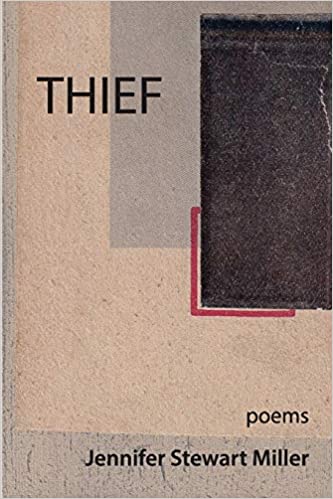
Jennifer Stewart Miller’s new collection, Thief, (Grayson Press 2021) begins with the poem, “My Dead,” wherein she says, “Maybe your dead / are kinder. But mine— / they won’t look you / in the eye. Won’t / say sorry or / bare their hearts.” Such are the privileges of death, one might argue. But not Miller. Instead, Thief is a collection of poems that gives voice to the deceased. They seldom say they’re sorry, but their hearts are revealed all the same.

Miller’s poems have a history of this sort of exploration. Her chapbook, The Strangers Burial Ground, recreates the lives of historical people found in New England cemeteries. But Thief hits far closer to home. These poems are more personal. In Thief, Miller explores many different forms of her own personal grief. There is the grief that follows the deaths of her father and her stepfather. But there is also the grief of a sister lost to addiction and ongoing mental health crises. In these poems are also incredible depictions of the ways that the living manage (or are forced) to endure, often because of everyday necessity. This is perhaps best explored in her poem, “The End,” where Miller writes:

I keep coming back to how my mother
left my stepfather

at Rutland Regional Medical Center
to hurry off to the bank in Granville—

thinking she could still add her name
to some account or other by

bringing in a few shaky words he’d
scribbled on a scrap of paper.

And that was that.
After all the grand passion—

just an old married couple
trying to sort things out.

One of Miller’s many strengths is the slantwise framework of her poetry as seen in “Poems I Probably Won’t Write About My Stepfather” that hints some parts of the past are better left unexplored no matter how much they haunt us. In “This poem has a highway in it” the poem takes on geographical qualities that reveal history, and yet, like the aforementioned highway, the poem and the narrative inside it move ever forward. It’s impossible to read this poem without feeling such forward momentum that you feel part of the narrative.

Another of Miller’s strengths is her knowledge of the natural world and a gift for mixing biological details with current events and elements of her own life, as in this poem:

To the Dead Striped Bass Swimming in Sunset

Swim on, beached beauty, agog
in the chilly marsh, aglow without
scales or skin. May the jut
of your jaw, your eyeless eyes,
guide you back to the sea. May
your body—filleted of flesh—
follow so lightly. Long, supple,
golden spine. Ribs vaulted with
air and light. Moony-white tail.
Even the waves lap you a prayer—
undulate, undulate. Striped bass—
gather up my newly dead, school
with them, show them the way
out of the still-dead April grass.

And the title poem, “Thief” celebrates the masked banditry of a raccoon even though its life is fleeting. “Tonight, I’ll raise a glass to what moon there is,” Miller says in this poem, “and lick up every last tongue-full of grief.” And really, this entire collection is like a celebration of that sweet taste that comes alongside grief. How would we go on without it?

Emily Mohn-Slate’s The Falls

The Falls

Emily Mohn-Slate is one of the greatest emerging poets I know, and THE FALLS is a beautiful, often breathtaking, portrait of a woman’s life in our times. These poems range from a painful first marriage and its lingering scars to finding new love and becoming a mother.

Mohn-Slate’s motherhood poems are some of the most revealing of her work and perspective. In “I’m Trying to Write a Joyful Poem” she asks, “why does joy always slide / into darkness?” All along, she juxtaposes the joy of tickling her son with “the collapse of long / love, how even the brightest / glint in the eye / becomes shadow eventually.”

Possibly a better example is in the poem “Girl on the Street” where she overlays her daughter just learning to walk with overly-sexualized, objectifying comments from men. In the mix are a series of poems written to the obscure poet, Charlotte Mew. In these poems, Mohn-Slate resurrects Mew and her work for a new generation of readers while simultaneously using Mew’s life to make revelations about our current time.

The title poem for the collection originally appeared in the April / May 2016 issue of Rogue Agent Journal (http://www.rogueagentjournal.com/issue13-14), but I’m pasting the entire poem here:

The Falls

White noise like galloping
horses, water twisting over

rock edge, a green-grey pour.
Long-fingered voices

lure me down. Heavy creatures,
we were not made to rise.

The mist packs a shape
like a hand reaching.

I want to be inside it.

A woman on her honeymoon
climbed down to the falls alone.

She picked her way over
slippery rocks, and disappeared.

Barely alive in her hospital bed,
she told reporters, I wanted

to touch beauty. It was like
a tornado pulled me in.

Mohn-Slate is such accomplished poet. Some of her newer work deals with the ways our lives merge with technology. One such poem, “People at Yellow Lights Scrolling,” appears online at AGNI. Please go and read it!

You can find links to more of her work on her author page: https://emilymohnslate.com/poems/.

THE FALLS is engaging and accessible while also working at the highest levels of craft. You will read these poems and only wish there were more. Please buy a copy of this book and see for yourself. A great place to purchase is from White Whale Books, Mohn-Slate’s home book store in Pittsburg, Pennsylvania. They are also hosting a virtual reading on November 20, 2020, featuring Mohn-Slate, and it would be awesome to see you there.