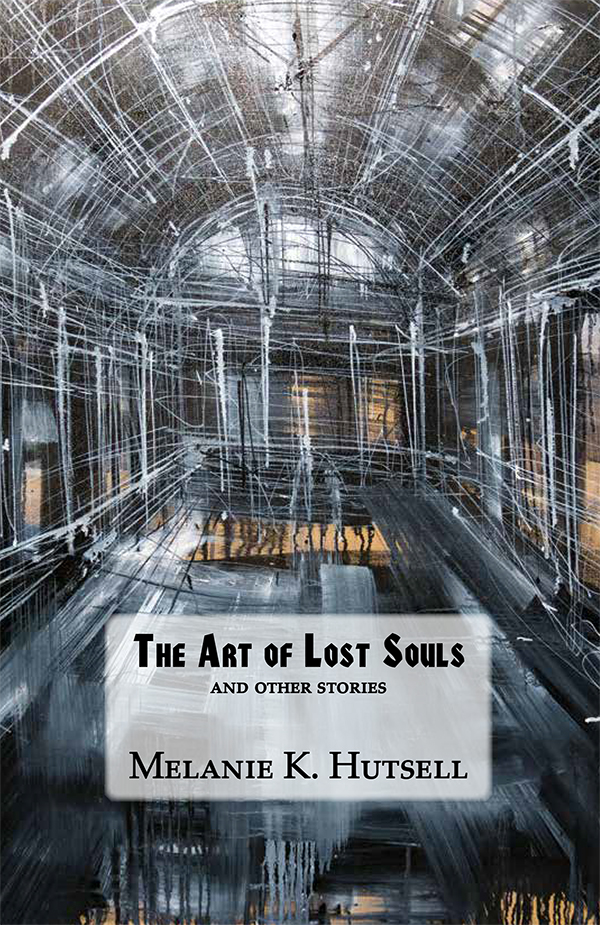
Where the Story Demands to Go: A Conversation with Melanie K. Hutsell

I’ve lost track of how long I’ve known Melanie K. Hutsell, but it’s been a few years. She’s a native of East Tennessee, and we share a mentor and many writer friends from this region. In the time we’ve known each other, she has published two novels, The Dead Shall Rise: A Tale of the Mountains, and The Book of Susan, which received the Award of Merit in the fiction category of the 2023 Christianity Today Book Awards. About a year ago, I ran into Melanie at a writers conference, and she told me about her new collection of short stories, The Art of Lost Souls, which she was in the process of sending out to publishers.

The Art of Lost Souls and Other Stories quickly found a home with Main Street Rag (MSR), and is currently available for pre-order. MSR and Editor Scott Douglass have a long history of publishing beautiful books. MSR is the press that published my first poetry collection, Crimes Against Birds. I’m forever grateful to MSR and Scott for taking a chance with my book, and I’m always excited to see MSR continue to publish good work like Melanie’s collection of short fiction.

In The Art of Lost Souls Melanie has created a cast of characters that are both achingly strange and sad. They are misunderstood dreamers, people on the verge of big transitions, wonderers asking what life would look like if all the pieces fit together. But as Hutsell’s characters face loss and uncertain futures, they reveal themselves to be creative souls with imaginations that help them survive. Melanie agreed to answer a few questions about writing, publishing, and not giving up on old projects.
DL: The title of this collection sets up how so many of your characters are some kind of artists, and usually, it’s their creativity that provides a sense of salvation to their stories. You’ve written in the past about having bipolar disorder. How does your background and your own experience of being a creative inform the characters you want to write about?

MH: This is interesting for me to consider. I’ve been aware that I do tend to write characters who are creatives—but until you asked this, I’d never really considered how seldom I write about writers. Because I do tend to think of my background as being fairly focused on words and pages, from an early age. And my fictional creatives tend toward other pursuits, like music or cooking or visual art. Maybe I tend to think, fictionally, of creativity as a way of expressing a character’s superpower, and of course, not everybody writes. I guess I tend to subscribe to the notion that all humans are here to create. I’m drawn towards the philosophy/theology in books like Divine Beauty by John O’Donohue or Art + Faith by Makoto Fujimura, which suggest humans are here to do and experience beauty and that creativity can be expressed in doing anything with love, and by love I mean with intention and giving, in the direction of God and humans.

DL: Some of the stories in The Art of Lost Souls are set in towns and locations that are real places, meaning you didn’t create them out of thin air. The first story is even titled Still Life in Townsend, referencing the town of Townsend, Tennessee. When you’re writing a story, how much do you draw on what you know about the place where it’s set?

MH: For someone who grew up reading a lot of fantasy, my adult work is pretty grounded in the Appalachia of East Tennessee. And I grew up in upper East Tennessee, and that is where most of my work is set, and Appalachian identity almost always is an important facet of my characters. Most of my settings are fictional, with strong underpinnings of reality to them. My two novels, The Dead Shall Rise and The Book of Susan, share some fictional towns with the short stories. Creating a fictional geography allows me to create needed settings or maybe to transport real-life places and set them down in new locations. But, yes, I do sometimes use real settings. In The Art of Lost Souls and Other Stories, both “Celestial Images” and “Still Life in Townsend” are set in real places, and the settings there really define the kind of stories they are. “Celestial Images” is about a homesick Appalachian living in Bloomington, Indiana, and “Still Life in Townsend” is about a motel family who specifically runs a business in the quiet—as opposed to the more tourist-deluged—side of the Smokies, and that’s pretty central to the story. The title story in the collection is set in Knoxville, though it’s a rather magical Knoxville. I was going there for a sense of urban history in that setting, something about time and distance. And sometimes I will invoke real places to make my fictional ones seem more real.

DL: One of the things I admire with the stories in The Art of Lost Souls is that you’re not afraid to go into some pretty dark spaces. But you usually bring some relief to the reader, too. Do good stories require pushing into that darkness?

MH: I do think the best writing is that which costs the author something to make and also requires great honesty. Often when something’s false in what I’m working on, it’s because I haven’t pushed myself enough in that spot, really faced what’s trying to be said there. I haven’t gone to where the story is demanding to go. And I think all of this is true whether one is writing realistic fiction or not, literary fiction or not. Because art is about being human. And there is a lot of darkness there. I consider myself to be generally wired up as someone who believes, but it’s dishonest not to acknowledge the dark.

DL: The Art of Lost Souls is your third book publication. But you’ve also been working for a long time on a magical realism novel. How do you balance multiple projects at the same time? And what keeps you returning to this unfinished novel?

MH: Well, the short answer is, I really don’t balance multiple projects at once. I actually become very absorbed in my writing projects, which is one reason—among many—that the unfinished novel remains unfinished. It’s a work that I’ve been wrestling with in many different variations since college. It began life as a fantasy novel and is a magic realism novel now. The Dead Shall Rise actually started, when I was in graduate school twenty-five or so years ago, as a manuscript written around a misbehaving character carved from the other work. After many years plagued by mental illness (though I didn’t know at the time that was what ailed me) and then devoted to recovery, the unfinished novel came back to me. But I set it aside to focus on writing and publishing short fiction to hone my craft and get a publication history. And then I opted to revise The Dead Shall Rise and seek publication with it, being a more complete manuscript, than to finish the messy, half-done one. And then The Book of Susan got written because of an agent’s interest engendered by reading one of my published short stories. (The agent ultimately passed on Susan.)  And I’ve long wanted to have a collection of my short work appear all in one place, and Main Street Rag publishing The Art of Lost Souls is a realization of that dream. Meanwhile, in between these projects, I’m writing along on the poor, longsuffering, untitled novel, because I can only do one thing at once. I suppose I find the protagonist compelling. Possibly he is my alter ego, more so than any other character I’ve written.

DL: I think you know that I have so much respect for small and independent publishers. Now that you’ve published three books with different small presses, do you have advice for writers about how to get published?

MH: You don’t need an MFA, and you don’t need an agent. Not that those are not good, helpful, and desirable things. But I have neither. I say: write and be a student of writing. I was fortunate to have a mentor when I was in high school, poet Jane Hicks, who was my guidance counselor and who taught me to approach writing professionally. Back then, it was the Writer’s Market and SASEs. Now it’s Submittable and Substack and unknown frontiers. Stay abreast of the ever-evolving business. Always read the guidelines. Don’t be afraid to submit. Don’t let rejection define you – learn from it. And definitely consider small presses as options for submitting your work. I’ve loved working with each press I’ve worked with. Each has devoted such care to seeing my manuscript through the process, helped me better realize the vision I’ve had for that particular work. I’ll pass along advice once given to me—you’re looking for the press that loves your manuscript as much as you do. There’s a lot to be said for sending your work to an indie press.

Many thanks to Melanie K. Hutsell for answering these questions. Find out more about Melanie here, and be sure to pre-order The Art of Lost Souls from Main Street Rag Publishers.

In case you missed it… I recently read with Georgann Eubanks for the Spoken & Heard series. And I’m so grateful that Feller has had some great reviews from Jake Lawson in MicroLit: a Tiny Journal of Prose & Poetry, Noah Soltau in Red Branch Review, and from Meredith Sue Willis in Books for Readers. I hope you’ll take a look.

If you’re not already receiving these posts directly to your inbox, please subscribe.

Martin Amis’s “Oktober”

You may have seen that the writer Martin Amis died last week. I’ve never read any of Amis’s novels, but on hearing the news, I immediately recalled Amis’s short story ”Oktober,” a story that has lingered in my memory because of how much I have admired it ever since the first time I read it 7 or 8 years ago.

I’ve seen this story criticized as “non-fiction-ish” and “lightly fictionalized.” It doesn’t matter to me how much Amis heavily drew from his own experience and observations, as if there’s only a certain amount that’s okay. Rather, this story should be held up as an example of how we can fictionalize our own experiences to find deeper, emotional meaning on the page. Perhaps one reason this story speaks to me is because it’s archetypal in that it portrays a character on a journey, and, as Amis said:

“Even the dullest journey resembles a short story: beginning, middle, end, with the traveler displaced and, we hope, alerted.”

I admire this story for many reasons, most notably because it’s such a well-executed political story. It addresses world events on both the largest and smallest scales. In this case, the story centers on an Englishman in Munich during Oktoberfest, and more importantly, during an influx of Middle Eastern refugee movement. What the narrator witnesses is framed both by literature (Vladimir Nabokov & Thomas Wolfe) and history (Russian refugees in 1917 & German refugees following World War II).

The story’s refugee thread holds continued relevance in light of the migrations being politicized in the United States, centered around the expiration of Title 42.

One of the characters in “Oktober,” Bernhardt, is Iranian-German. He says about the migrants: “You know, they won’t stop coming. They pay large sums of money to risk their lives crossing the sea and then they walk across Europe. They walk across Europe. A few policemen and a stretch of barbed wire can’t keep them out. And there are millions more where they came from. This is going to go on for years. And they won’t stop coming.”

There are also mothers of various types appearing on virtually every page of “Oktober.” And in regard to the mothers that Amis portrays here, I would mention that one thing I admire about this story is how tightly he weaves all the threads of the story. It may not always seem so because the language is conversational, but everything seems to serve a purpose. Everything is connected. Meanwhile, the story is not so economical that it feels austere or lacking. It feels rather sprawling instead.

Amis received criticism during the last several years for some sloppy comments he made about terrorism and extremism. Some of these comments are not so far from those of Geoffrey, a British businessman in “Oktober” who has a less than welcoming attitude towards migrants. Geoffrey is also the character who brings the most shock value to the story. So while he is not a likeable character, he’s incredibly dramatic to follow.

I don’t know if I’ll ever get around to reading any of Amis’s better known works, but it was a pleasure to revisit this story and to remember all of the reasons I admired it in the first place. You can read Martin Amis’s short story, “Oktober,” online at The New Yorker: https://www.newyorker.com/magazine/2015/12/07/oktober. And I hope you will.

~

Thanks for reading. If you’re not already receiving these posts directly to your inbox, please subscribe.

~

In case you missed it… check out this month’s list of Submission Calls for Writers, and my conversation with Erika Nichols-Frazer, where we discussed my poetry collection Tamp and her memoir Feed Me, hosted by Birch Bark Editing.

Conversation with Tony Taddei

For many years before Tony Taddei was creating characters on the page, he was creating them on the stage as a trained actor.  Born and raised in New Haven, Connecticut, Tony now lives in New Jersey. I first met Tony in 2014 when we both attended the Sewanee Writers’ Conference. A few years later, we reconnected through the Bennington College Writing Seminars. Though all of my interactions with Tony had been related to writing, I hadn’t had the pleasure to read his work for myself until the recent publication of his collection of linked short stories, The Sons of the Santorelli. What a joy it was to discover the craftsmanship and poignancy in these twelve stories about an immigrant family, particularly the men in the family who struggle with their desires and ambitions. Yes, this is a narrative about an immigrant family, but as David Gates said about the book, this is not “the conventional immigrant family saga.” Tony was kind enough to answer some of my questions about putting these stories together, about how he avoided convention, and how he infused a political slant into such personal, character-driven writing.

DL: How long did it take you to write these stories, and do you recall when you knew how individual stories would work together? Can you talk about your reasons for writing multiple, linked stories rather than a novel?

TT: I took my time writing these stories, so that the process from drafting the initial stories to finalizing the collection probably took five or six years.  The collection wasn’t the only thing I was working on during the time, and, in any case, I didn’t want to rush the process of writing the collection.  First, because I wanted to get the premise of each story right as well as to spend time considering what stories might need to be added, and second, because I was having a lot of fun writing about these people and I kind of wanted to savor it. 

During the process of working on the stories I don’t think I really had a master plan for how they would all work together.  That said, once I decided to write one story for each of the Santorelli sons and grandsons as well as at least one story about the patriarch, the linkages between stories started to become evident, and I was able to find ways in rewriting the stories and adding new ones to get them to work together as a piece.  My goal was to have each story stand on its own but also for a reader to be able to sit back and think about them in their entirety after finishing the collection to realize that the parts of the book made up a whole.

As to why I wrote the saga of this family as linked stories rather than a novel, I did it because it gave me the ability to tell multiple, smaller stories that I would not have been able to tell in a novel (while still trying to make the novel a cohesive whole).  It was also a lot easier for me to write about the individuals in this very complex and human family in separate stories than it would have been in a novel.  By telling the story of the Santorellis a character at a time, I think I did more justice to each individual while still creating the personality and a legacy of a whole family.

DL: One of the recurring themes throughout these stories is the idea of the immigrant experience, often depicted here in connection with “immigrant shame” and the idea that America “breaks” the spirit of immigrants. This is the antithetical American story. How conscious were you of making this kind of political statement during the writing? Do you have advice for other writers about incorporating political ideas into fiction?

TT: As the work progressed, I was very conscious of it.  Having come from an immigrant family and seen them fail more than succeed at the things they most wanted I can be somewhat cynical about the idea of an American Dream to begin with. I knew that cynicism would likely play a role in the situations I put my characters in.

That said, I didn’t I initially set out to tell stories that torpedoed the idea of what can be achieved in America.  I set out to write human stories that were compelling to read as well as funny and tragic with as many twists and surprises as I could manage.  In order tell the truth about the characters in this family as I saw them, I had to show the forces that were working upon them. The largest of those forces being that for most immigrants and, especially for the poor, this country very often only lets them get so far before it pushes them back down again.  This comes in the form of economic imprisonment, and it comes in the form of racial imprisonment where one wave of immigrants who’d faced bigotry visits their own xenophobia and bigotry on the next wave of immigrants to reach America’s shores.   

My advice for writers who want to incorporate political ideas into fiction is to first find an honest story that is personal and then begin writing it without focusing on the political or cultural connotations. If the story is honest and tracks with the world we live in, they won’t be able to help themselves from writing about the political forces that are acting upon their characters. Those forces come into play in our lives most of the time without us even realizing they are there.  After that, when the writer looks back on what they’ve written, they can draw out the more political aspects of the story to any degree they choose. To put the above more succinctly, all politics are personal. I think any political writing should follow that guideline.

DL: Many of these stories are told through the male point of view which makes sense given the title of the collection. But that’s not to say that you don’t give voice to women within the Santorelli family. How did you settle on the balance between male and female characters and points-of-view? Were there any challenges in allowing the women to have their say in this male-dominated cast?

TT:  Not at all, because I think if you look closely at each of the stories, you’ll see that the women in the backgrounds of these men’s lives are the real truth-tellers.  The stories would not have found the ballast they needed for their conflict and reasoning if it weren’t for the women characters. A reader will likely see this most clearly in a story like “Commedia Dell’Arte” which has the matriarch of the family as the protagonist trying to make sense of and tell the truth about male dominance in her life.  But it’s just below the surface of most of the other stories as well. From “Songs for Swingin’ Lovers” where a prostitute early on dominates a group of highly dysfunctional and misogynist men, to “Valiant” where the sisters and especially the mother in the family turn out to be stronger and more insightful then either the father or the son.

So, no, I did not find many challenges in allowing the women to have their say in my largely male-dominated cast.  In fact, I’d say that the challenge was being able to hold off in letting the women have their say long enough so that the men could act out in the wrong-headed and solipsistic ways that I think make the stories interesting and recognizable to readers.  Especially female readers.

DL: In an effort to demystify the process, I always ask writers about the process of submitting their manuscripts for publication. Can you describe the time between writing and publishing these stories? How did you connect with Bordighera Press?

TT:  The time between writing and publishing was, to some extent, concurrent.  I started to send the manuscript to publishers when I had most of the stories finished but was still revising the last two or three.  At that point it was rejection, rejection, rejection until I found Bordighera Press.

Bordighera is a small independent press that is partially privately funded with a mission to publish writing about the culture of Italy and Italian Americans—essays, fiction, poetry, what have you.  They publish a semiannual review of shorter work as well as a twice yearly run of new full-length work and are always looking for good writing that fits the themes of Italian life.   About 2 years ago, I submitted the title story of my collection to Bordighera for consideration in their semiannual review, and it was accepted.  Once I realized that they also published full length work, I sent the full and, by then, nearly completed manuscript, and I was thrilled when they said they wanted to publish it. 

I’ve been telling people who ask how you find a publisher for your work that you have to persevere until you find a publisher that is the right fit.  Most of the time that’s easier said than done.  In my case I believe it was a bit easier because the work was a more-or-less exact match with the kind of work Bordighera is looking for.

DL: What are you working on now?

TT: I’m finishing up another collection of short stories that revolve around the melancholy, indignities, and occasional pleasures that men face as they age.  Each of these stories also weaves in animals and their ability to live instinctually and unquestioningly as a humorous and (I think) affecting counterpoint to the men in the stories who are creating their own problems and then struggling to accept the circumstances they find themselves in.  These two themes may not at first glance seem to go together, but I think the stories work better because of their juxtaposition. I’m hoping to have these stories published as a collection sometime soon and readers can judge for themselves. For now, if any of your readers want to take a look a couple of these stories, they a can go to Animal Literary Magazine and The Florida Review online.  I’m also beginning a novel but it’s too early to say much about it, so I’ll have to get back to you on that.

DL: Are there any opportunities coming up for readers to hear you read from The Sons of the Santorelli either via Zoom or in person?

TT: Yes, I recently read an excerpt from a story in the collection – “We Now Conclude Our Broadcast Day” – online for the Prospect Street Reading series and readers can view that on Facebook Events at  https://www.facebook.com/events/413658933932101/?ref=newsfeed (no Facebook account required to view).

Folks can also go to the Selected Audio section of my website and listen to me read the first two stories from the collection.

Other readings are in the works, and I’ll post the particulars to my social media feeds when they’re set.  (@tony_taddei / Twitter; Tony Taddei / Facebook; tonytaddei / Instagram)

* * *

Huge thanks to Tony for speaking to me about his new book. Don’t forget to order The Sons of the Santorelli now from Bordighera Press. Make sure you never miss a post by subscribing here:

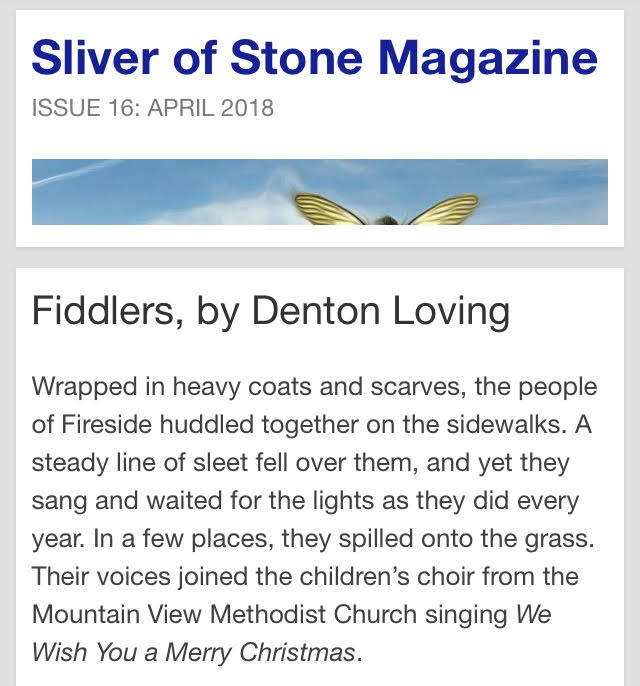
New Short Story: Fiddlers

Thanks to Sliver of Stone Magazine for publishing my short story, Fiddlers, in their 16th issue. Fiddlers is sort of a dark Christmas story, so it might feel a little strange to read in this July heat wave. Or else, it might remind you what snow and cold feel like.

Sliver of Stone

The entire story can be read online at https://sliverofstonemagazine.com/fiddlers-by-denton-loving/.

One of my favorite writers, John Lane, also has an experimental essay in this issue: https://sliverofstonemagazine.com/the-father-box-by-john-lane/. It’s called The Father Box, and you should give it a read. It’s an honor to have my work anywhere in the vicinity of his!

There’s also some info about Darren Demaree’s new poetry book, Two Towns Overhttps://sliverofstonemagazine.com/2018/03/31/new-publications/.

Recommended Reading 2/2/2018 – Short Stories

The best part about January being so long and cold was that it was a great time to read.  It was literally too cold to do anything else. February is starting off the same way. If you’re stuck inside this weekend and not sure what to read, here are some of the short stories I read last month. Try one or two or more.

“No Good” by Hala Alyan

“Freezer Burn” by Ron Austin

“Shine” by Ron Austin

“August 2026: There Will Come Soft Rains” by Ray Bradbury

“The Ceiling” by Kevin Brockmeier

demonman-1-768x461

“Demonman” by Julialicia Case is an amazing story that appeared online this month at The Master’s Review. Here’s how it begins:

“I am eleven the spring Demonman comes, first to the alley behind the Kroger, where the dumpsters reek like fermented orange juice, then to the train tracks by the boarded-up video store, then to the Harding mansion, still for sale, then to a snot-colored van with flattened tires. He comes to our nightmares, our whispered worries, to newspapers and televisions and notices in the post office. He’s called something else, a different name, although, of course, he is still Demonman. Since the shootings upstate, the police struggle with the race riots, but they claim to be searching for him, following the leads.”

“Expensive Lessons” by Anton Chekhov

“These Certain Young People” by Dave Eggers

First Night

“First Night” by Kevin Fitton appeared online this month at Storgy. I loved reading this story that covers a large emotional range but still manages to impart some humor. Here’s how it begins:

“It was the morning of New Year’s Eve, and a dull light confessed the start of another winter day. In Vermont this time of year, the days were short. It was dark when Brian woke in the morning for work and dark when he drove home from the office. It was the time of year Vermonters did their best to survive by taking vacations to the Caribbean, talking to their therapist, and drinking. The night before it was snowing when he went to sleep, and Brian dreamt that the roof was covered with two feet of heavy snow. In his dream, he could feel the house sweating as it tried to hold the weight, could hear the rafters cracking under their burden—pop, pop, pop, like the last kernels of corn on the stove.”

“The Miniature Wife” by Manuel Gonzalez

“Mermaid in the Jar” by Sheila Heti

“Plan B” by Michele Johnson

 “The Things They Carried” by Tim O’Brien

“My Name is Jean-Pierre and I am Still an End Table” by Dana Schwartz

“Saying Goodbye to Yang” by Alexander Weinstein


If you’ve read a great short story lately, please tell me about it in the comments.