Book Launch for Darnell Arnoult’s Incantations

Last week, I had the privilege to be part of the book launch for Darnell Arnoult’s new collection of poems, Incantations. This collection is a mesmerizing group of poems that celebrates language in unique but powerful ways. Many of the poems came out of a period of grief, but the poems are also celebratory and full of hope. They speak simultaneously to the personal and the political, addressing some of the most significant challenges of our times.

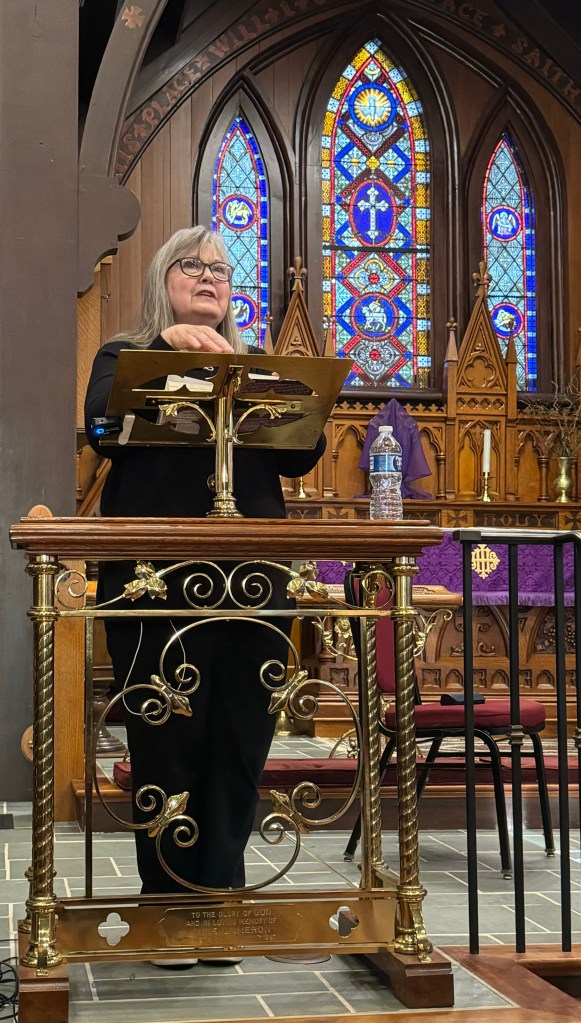
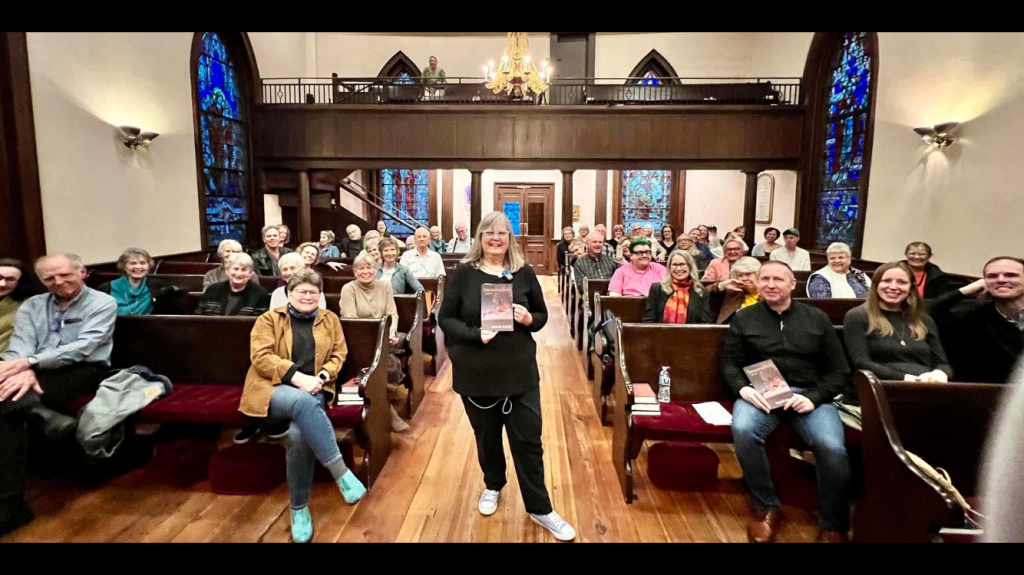
The launch took place in Hillsborough, North Carolina, at St. Matthew’s Episcopal Church as part of their Faith and Arts Series. Darnell gave a beautiful reading of her new work. The church was filled, and Purple Crow Books sold all of their copies after the reading. Alison Weiner accompanied her on the piano. And I had double duty that night, first introducing Darnell and then following up with an on-stage discussion about her work. The on-stage discussion was especially fun, and I hope an audio recording of it will be available at a later time. Until then, I want to share my introduction. It was such an honor to be part of welcoming this new book into the world, as well as to celebrate my good friend. I may have also added a little good-natured ribbing.

Welcome, and thank you all for coming out tonight to celebrate our friend Darnell Arnoult and her newest collection of poems, Incantations!

If you are here tonight, there is a good chance that you already know Darnell. Before I get too personal, allow me to properly impress you with a few of Darnell’s professional accomplishments.

Darnell is the author of the novel Sufficient Grace, and two previous collections of poems: Galaxie Wagon and What Travels With Us, and she has published stories, poems and essays in a variety of journals and anthologies.

She is the recipient of the Southern Indie Booksellers Alliance Poetry Book of the Year Award, the Weatherford Award for Appalachian Literature, the Thomas and Lillie D. Chaffin Award, and the Mary Frances Hobson Medal for Arts and Letters. In 2007 she was named Tennessee Writer of the Year by the Tennessee Writers Alliance. She holds degrees from The University of Memphis, North Carolina State University, and The University of North Carolina at Chapel Hill.

If you know Darnell, it’s likely because you have studied with Darnell, perhaps at the Table Rock Writers Workshop, the John C. Campbell Folk School, the Appalachian Writers Workshop, the Tennessee Mountain Writers annual conference, through Learning Events, the Mountain Heritage Literary Festival, or perhaps even as an undergraduate student from Lincoln Memorial University where Darnell served as Writer-in-Residence from 2010 to 2020.

Lincoln Memorial University is the place where Darnell’s and my lives began to intertwine. We co-directed the Mountain Heritage Literary Festival. And we also created and shared editing responsibilities for the literary journal drafthorse, a journal dedicated to writing about labor and occupation. Darnell and I worked together, often getting each other in and out of trouble, and we became wonderful friends in the process.

I cannot list all of the pieces of good fortune that have come to me because of Darnell, mostly because Darnell told me to do something—often something I didn’t want to do or didn’t have faith that I could do. There are too many of these instances to list, but I will tell you that when I decided to apply to MFA programs, Darnell decided I would go to Bennington College’s low residency program in Vermont. I, on the other hand, lacked the ability to imagine being accepted in that program. I didn’t even have any intention of trying. But if you know Darnell, you know that once she’s made up her mind, you might as well agree or get out of the way. It is no exaggeration to tell you that the only reason I applied to Bennington was to shut Darnell up. As she seemed to know in advance, my life changed in innumerable ways because of that program, all for the better.

Darnell is the person who has encouraged me the most as a writer and certainly as a poet. Darnell probably knows my poetry better than anyone, and she has probably influenced my poetry more than anyone. A lot of my early poems originated in workshops Darnell taught. She was the first person who thought I had enough poetry to form my first book, and she largely arranged the order of that book, which in itself was another incredible lesson in learning how to shape individual pieces into a larger narrative. She has seen so many first and early drafts that it’s a wonder she still opens my emails.

In the 10 years that Darnell taught at LMU and lived in Cumberland Gap, Tennessee, my life was richer, and a lot more exciting. In her absence, there are fewer people asking me if I have seen Darnell, if I have any idea where Darnell is, if I can find her, please, help, she’s not answering her phone, she never answers her phone! Why doesn’t she ever answer her phone? There are fewer reasons to rush to the emergency room. There are fewer visits from the fire department. In short, there is much less excitement, and my life is poorer for her absence.

To answer the question as to why Darnell rarely ever answers her phone, I can report that she may have turned the ringer off two days earlier and can’t find the phone, she may have left her phone at home or at someone else’s home, or any number of other places along the way, the battery may be dead, or more likely, she is just already on the other line with someone else who needs to talk to her just as badly as you may need to talk to her. The number of people who rely on Darnell is uncountable. The number of people whose lives have been enriched by Darnell is legion.

I would be remiss to not acknowledge that the 10 years in which Darnell lived in Cumberland Gap were not completely happy. For Darnell, I know that time period is framed by her husband William’s recurring illnesses, his battle with cancer, and his passing in 2020. The poems in Incantations were born from that grief. The deepest kinds of grief. Grief that comes, as she would describe, from worlds burning, from death that dances and glides, from widowhood with its slaughtered and emptied heart.

And yet, within these poems, Darnell also rejoices in the curative properties of language, how it can bewitch and rescue us from despair. When you look at the beautiful cover of Darnell’s new book, you will see an image of fire and light bursting into the darkness. As that image suggests, these poems tell us that there is salvation in the darkness. There is salvation in these poems that are also charms for remembrance, charms for protection and rebirth, and always charms for love, no matter how it may shift its shape.

Join me in welcoming Darnell to the stage as we celebrate her new collection of poems, Incantations.
~

You can read a sample of poems from Incantations online at Cutleaf. Or you can order a copy through Purple Crow Books, directly from Madville Publishing, from your own local bookstore or anywhere books are sold. (Photos courtesy of Donna Campbell and Kelly March.)

~

In case you missed it… check out my conversation with David Wesley Williams about his novel Everybody Knows.

~

If you’re not already receiving these posts directly to your inbox, please subscribe.
Conversation with Andy Fogle

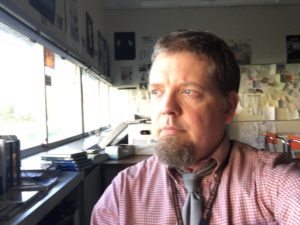
In 2021, founding editor-in-chief of The Bitter Southerner Chuck Reece and his wife Stacy Reece began publishing Salvation South. In the publication’s opening salvo, Reece famously said, “I’m not bitter anymore. What I am is hopeful.”  According to Salvation South’s guidelines, they accept stories, in all mediums, including journalism, essays, fiction, photography, filmmaking, and poetry. I saved poetry for the end of that list because Andy Fogle is Salvation South’s new poetry editor, and he’s looking to publish work by established, emerging and new poets. Andy agreed to share some insight into exactly what he’s looking for in terms of submissions. If you’re reading this, Andy (and I) hope you will consider sending Salvation South some of your own work.

DL: Congrats on your new role as poetry editor at Salvation South. I love the magazine’s origin story, and how Chuck and Stacy Reece have said to “think of Salvation South as a big old house party—filled with people who want to celebrate Southern culture and people who are searching for new reasons to be hopeful about the South.” Can you talk about how that ethos pertains to the kind of poetry you hope to curate for the magazine?

AF: Thank you much. I’ve been wanting to get back into doing something like this for a long time, and, among my various professional duties in this world, it’s really one of my favorite things to do.

To the house party metaphor and poetry: I want to cast as wide a net as I possibly can, so just come on in, at least for a cup of coffee. Ever since 10th grade when I realized I wanted to devote my life to the arts, I’ve found things to like all over the artistic map, both across and within genres, and they all swap around. In college and grad school, I ran kind of a punk literary zine called 5th Gear, and while I definitely made some mistakes, I also think I got an underground reputation for being seriously eclectic. You could read all kinds of crazy-different and interesting stuff in 5th Gear. I’m still proud of that, I still believe in that, and I still aim to act like that. I have an MFA; I’ve participated in (and won 2) poetry slams; I’ve taught in all kinds of schools; I’ve been into way-out experimental stuff, formal stuff, middle-of-the-road stuff, street stuff, uncategorizable stuff…I believe that the best poetry has an aesthetic energy and a social function. I believe in the beauty of both, the magic of many, the awe of all. If I can help present a consistent mosaic of diverse voices, I’m a happy dude.

DL: The first time that I became familiar with your work and your involvement at Salvation South was when I read your wonderful interview with the poet Annie Woodford. I loved this interview for a lot of reasons but in part because Woodford’s poetry and your interview with her takes a hard and honest look at her corner of the South. It shows that while Salvation South’s point of view is hopeful, it’s also very focused on narratives that seek to accurately depict the places where we live.

AF: Annie is my newest living poetry hero, for a bunch of reasons I tried to articulate in that piece. Part of it is what look you mention, which is hard, honest, and hopeful too, I think. Salvation South’s general guidelines say we’re looking for “stories, in all mediums, that reckon with the history and celebrate the culture of the American South.” We publish pieces that do one of those things, but I savor those that do both. Celebration should not be blind, and reckoning is kin to rapture. I think being able to face the hard things is a reason for hope, and I think we can even look for hope in the gut-wrenching stuff, not just despite it. Maybe struggling with history is a form of celebration; maybe celebration is predicated on some form of struggle. When we shine a light on what’s been tucked away in the corners of our consciousness, it’s uncomfortable, it’s uncertain, and it’s unpredictable—but remember it’s still light that is the tool.

DL: Let’s talk about the mechanics of the submission process. Are you looking for individual poems or groups of poems? Do you have preferences for style, length, etc.? 

AF: First of all, it’s free to submit. I like to see 3-5 poems rather than a single poem. It gives me a broader idea of a poet’s style(s), concerns, and abilities, and it also gives me more stuff to try to build a fire with. Obviously with a single poem, that’s your only shot, and I’m getting a very restricted view of your work; with at least a trio, there’s a higher probability of me finding something to encourage, which is what I want to do. Here’s something unusual and, I hope, useful: I write individualized comments in my responses with some regularity, I guess because I’m a teacher and I’m glad to strike up conversations and correspondence with poets.

Any length and any style, but I should say that I think branches and roots are related. It’s only a good thing when people have an idea of what’s been going on in the last few decades of poetry. But aside from that, if you love language, you’re probably a poet, at some level. And if you also have something…not necessarily to “say,” but if you have something intellectual, emotional, and/or sensual for readers to witness through that love of language—if you’ve got something to wrestle with in the joy of language—then send it on. I read pretty much all the time, year-round, and often respond to folks within a week.

DL: Should submitted work speak explicitly about the South?  

AF: We generally do need to see its relevance to the South, be that addressing its past (which is still present), celebrating its culture, or something else. There have been a couple of poems I’ve almost accepted, but then realized that at least geographically, culturally, or thematically, it could’ve been written by anyone from anywhere, and any kind of Southern relevance just wasn’t any part of the equation. Good poems, but not quite a good fit (I try to let people know that too, just to be clear).  

I’ll also say that it feels like Salvation South has become sort of a refuge for Southern storytellers of all types, whether their stories come out as prose or verse. We still love reported journalism, but we also love beautifully written personal essays that address all things Southern—identity, politics, history, culture, whatever. It would be nice to see more fiction submissions—we don’t get very many short stories.

(Read Patti Meredith’s short story Sand Dollar in Salvation South here.)

DL: Although you’re originally from Virginia, you now live in upstate New York. Has living outside of the region allowed you to view the South in a new light?

AF: If anything, it’s made me defensive. From what I’ve experienced in 18 years of upstate New York, there is, at best, a slowly-fading ignorance about the South. Too many people just blindly lean right into the stereotypes, some of which, to an extent, we’ve unfortunately earned. Living in the North has probably deepened some of my distaste for the stubborn isolationism that persists—although neither region is clean in that regard. Sometimes I do read news about something in the South and think, “What the hell is wrong with y’all?” And then the next day I’ll be calling out some of my high school students, asking why they snicker at the word “Alabama” when I mention my aunt lives there. Ignorance doesn’t use a map.

But look, then again, I recently came home—which is a complicated word for me—to visit my dad, and we took some stuff to the dump, and I very quickly wound up having a brief but detailed and familiar-feeling conversation with the attendant guy—about my compression sock, and how I’d pulled a calf muscle, and then they found two blood clots in there—and he’s friendly as can be, asking follow-up questions and everything. Guess what happens a few days later when my dad and I go to the dump with another load of stuff? Same thing with the same guy. We’re just talking. And it’s not at all weird. I love that. I feel like I’m home—at the dump, talking with the attendant about compression socks. My chest just swelled with love for that little convergence. I think I appreciate that kind of thing more at this point in my life, since I see that it happens way less often up where I live now.

DL: You’re a poet in your own right. Can you talk about some of your current or upcoming projects?

AF: I have my second full-length book of poems coming out in November with Main Street Rag Publishing out of Charlotte. It’s called Mother Countries. It’s mostly about my mom, divorce, death, Virginia, race, and a little grace. It’s not always pretty. A hard book for me, one I don’t expect to get comfortable with anytime soon. It took me way too long to address that particular knot of issues in my work, but I needed to. And I’m about 2/3 done with a long, multi-dimensional book of poems related to abolitionist John Brown, tentatively called Cutting Light. With a little luck, I’ll start sending that around sometime in the fall. I also, when time permits, co-translate an Egyptian poet named Farouk Goweda with my friend Walid Abdallah. We have a chapbook out last summer called Arc and Seam from Finishing Line in Georgetown, Kentucky, but we’re hoping to eventually develop a full-length of his work.

Many thanks to Salvation South and particularly to Andy Fogle for answering my questions.

~

If you missed it, I had the opportunity last week to read some poems about place alongside P. Scott Cunningham and J.D. Isip in Emerge Journal’s Be Well Reading Series. It was such a fund reading. You can watch it here. Check back next week when I plan to post a new list of summer submission opportunities.

Conversation with Patti Frye Meredith

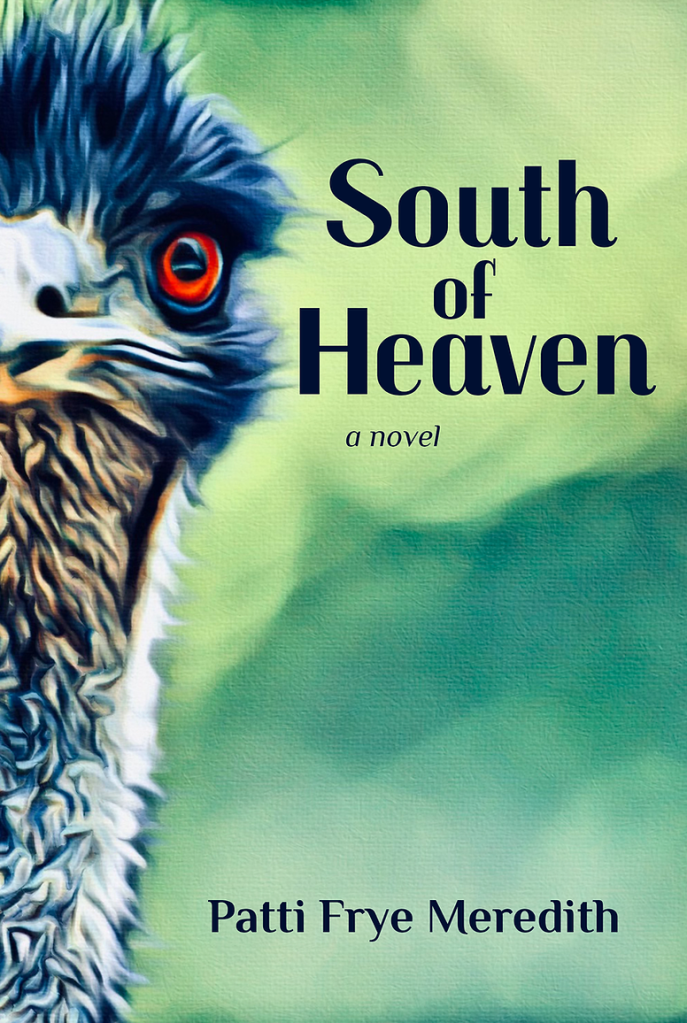
I can’t exactly remember the first time I met Patti Frye Meredith. I definitely have memories of her at one of the early Mountain Heritage Literary Festivals making people laugh and playing music late at night. One thing I know for certain is that Patti can make anyone laugh. That’s true whether you’re fortunate enough to sit down and share a meal with her, or whether you’re reading her beautiful new novel, South of Heaven, a multi-generation narrative set in Carthage, a small town in the Sandhills of North Carolina. At the center of the novel are two sisters, Fern and Leona. Both have secrets they are keeping from each other and from the world. There’s also Fern’s son Dean who, as Fern says, doesn’t have any secrets. South of Heaven is a meaningful exploration of how the things we try to keep bottled up complicate relationships. The novel is deeply Southern, completely universal and wonderfully fun to read.

DL: South of Heaven centers on the McQueen family, and it’s set in the late 1990’s, a time not so long ago but a time that feels infinitely different in hindsight. Do you have any advice for other writers writing about the recent past?

PM: When Dean first “talked to me in my head,” he told me his dad was MIA in Vietnam, and how as a child he pretended to find his daddy in the overgrown bamboo patch in his backyard.

I wrote the book from that one scene. I knew Dean was in his early 20’s, and that his father went missing at the very end of the war. That’s why I set the novel in 1998. After I got into it, other 1998 occurrences came into play like the Clinton/Lewinsky drama. There’s a lot in the book about the lengths we will go to avoid the truth, so that worked.

Early readers suggested that I move the story up in time, to make it more contemporary, to use the Iraq War instead of the Vietnam War and put it in present tense. I tried, but I couldn’t make it work. By that time, too, I felt like I knew Fern and Leona very well, and I realized they wouldn’t be the same people if they hadn’t grown up like they did in the sixties.

There are pitfalls. It’s not historic, and it’s not contemporary. The characters are just modern enough for readers to wonder, “Why would they think that?” or “Why would they do that?” It’s embarrassing, but I had to do research to remember if everyone had cell phones in 1998, or if fax machines were still a thing. We’ve seen a lot of change in twenty-four years, and it’s amazing how quickly we forget recent history.

DL: I loved reading the “Backstory” on your website about your job at University of North Carolina Public Television, and how you met so many writers there. The authors you mention (Lee Smith, Doris Betts, Reynolds Price, Fred Chappell) all come from the Southern tradition, and South of Heaven feels like a very Southern novel. How natural was it for you to write in that tradition?

PM: Like so many others, reading Eudora Welty, Elizabeth Spencer, Lee Smith, Jill McCorkle, Tim McLaurin, and so on and so on, showed me that stories set in small towns were okay to write.

I grew up in Galax, Virginia, population around 6,000. So, it was natural to stick to the world I knew. Thinking about it, I’ve now lived in Memphis and Chattanooga, Tennessee, Huntsville, Alabama, Durham and Charlotte, North Carolina, Columbia, South Carolina, and Baton Rouge, Louisiana. Cities large and small, but with the same southern sensibilities. (Or maybe I think all those places have the same southern sensibilities because “wherever you go, there you are”!)

DL: Did you feel any pressure to “live up” to the works of those writers you admired so much?

PM: If I thought I had to live up to their work, I’d never write another word! Back when I first started writing, I didn’t know what I didn’t know, however, it didn’t take long to realize I was never going to be in the same league with the writers I admired most. I’d give anything to see the world and put that world on the page like Fred Chappell, but I don’t have his complexity or depth. That doesn’t mean I don’t love reading his work. But, even when you study the craft and learn what makes great literature, even when you can recognize it, it’s still not possible to re-engineer your brain to create it. Thank heavens. There should be only one Lee Smith, one Jill McCorkle, one Darnell Arnoult.

That’s not to say I don’t spend a lot of time being discouraged! But you have to write what you write, be who you are, I mean, you can’t fake your subconscious! We all have our own perspectives and experiences, and we’ve all drawn our own conclusions.

I’m hooked on the joy of writing. The discoveries, the occasional good sentence, exploring the minds of my imaginary people. Writing helps me understand what matters and it’s my way of expressing what strikes me—good and bad—about being human.

And, since I love a cliché, I’ll say, “It’s the journey, not the destination.” Chasing after the “secret” to good writing has led me to friends who absolutely make my whole life better. Having the opportunity to be with other writers is the best reason to write!  Sorry for getting off on a tangent, but maybe that’s the southern tradition!

DL: How long did it take you to write South of Heaven? How many drafts did you go through?

PM: There’s no telling how many drafts I have. Dean’s voice came to me at Hindman Settlement School in 2005. I wrote the original draft in first person present tense. Then changed it to third person present tense for my MFA thesis at the University of Memphis in 2012. Then I wrote a draft in third person past tense. I was always changing something, adding, taking away. Starting over. We moved seven times in twenty-eight years for my husband’s job, so I had a lot of distractions (excuses) through the years.

When my husband retired and we moved back to North Carolina, I set up my little office and joined a weekly writer’s group. Then the pandemic hit. Everyone is different. I know there are many great writers with extremely busy lives, but for me, the stillness of the pandemic quarantine made it possible to devote the time I needed to work. No travel, no socializing. I don’t think I understood what it meant to really work until the pandemic. I discovered the long stretches of uninterrupted time helped keep the story together in my head, helped me play out the scenes I needed to make the story more cohesive. I think of it as bandwidth. Writing South of Heaven took a lot of bandwidth!

DL: Your novel is published by Mint Hill Books, an imprint of Main Street Rag which published my poetry collection, Crimes Against Birds. What was your experience like in finding a publisher?

PM: I can’t remember if I saw Main Street Rag’s call for novel chapters on social media or in Poets & Writers, but I had one of those “What the heck” moments and sent chapters. Months later, I got an e-mail saying they were interested in publishing the novel, and Scott Douglass sent a contract and a detailed explanation of how the process would go.

I had sent out query letters to agents off and on for years. (One agent had almost taken it years ago, but that fell through when the third reader in her office didn’t think they could sell it.) I knew South of Heaven wasn’t the kind of book that was getting the attention of traditional publishing, or the independent presses I was familiar with. It wasn’t full-blown literary, and it wasn’t quirky enough to be chick-lit.

I didn’t think it was going to set the literary world on fire, but I wanted my imaginary people to live in a real book. So, I asked you, Sue Dunlap, and Darnell Arnoult to read it and tell me if I was about to embarrass myself, and you all said, “Do it.” So, I did. I fiddled with it after I got it back from you all, and I hired an editor to make sure I hadn’t added a lot more typos. Then I fiddled with it some more, and my niece, Becki Vasques, found my last snafus. We made it a family and friend affair! You and Darnell suggested I put an emu on the cover, and my husband, Lee, and I put it together (with Darnell on the phone). It’s been fun. Not “have lunch with your agent in New York City” fun, but better. A true labor of love. And I like that my North Carolina story is published by a North Carolina press. Scott Douglass does something very special with Main Street Rag. He publishes wonderful poetry and stories. I’ve gotten to know him and his wife and his dog, Harley, and I really appreciate the work he does.

DL: Do you have any advice for other writers ready to send their novel out?

PM: Don’t discount the small independent presses. We all appreciate independent bookstores. These presses deserve our appreciation, too.

Do ask yourself if you’re ready to be in the book marketing business, though, and the weird thing is part of that is selling not just the book but yourself. The great thing about the small press is, “You have a book to sell.” The scary thing about the small press is “YOU have a book to sell.” Just be honest with yourself about what you want to accomplish and why you’re doing it.

For me, the experience has been amazing because it has reminded me that I have the very best family and friends in the world. The support has been phenomenal. People I haven’t seen or talked to in ages bought my book after seeing my Facebook posts. Friends talk about my characters like they’re real people they care about. So, if I don’t sell another book, I’m very happy with the response South of Heaven has gotten.

CYNICAL ALERT!

The truth is, without Facebook, I wouldn’t have sold m(any) books. South of Heaven is in two bookstores, Chapters in Galax, my hometown, and McIntyre’s in Chapel Hill, where I live now. I’ve had one reading at McIntyre’s. I hired a publicist, and maybe there will be more readings, but maybe not. Even if I devote a lot of time to driving around, going to bookstores, taking them a book and a nice press kit, there’s no guarantee they’ll carry it. I have a couple of book club gatherings coming up. The bottom line is: It’s up to you to promote your book, to make yourself known. I believe even if you have an agent and a traditional press, they want you to have a “platform” meaning they want you to use your social media connections to publicize and sell your book.

DL: You’ve described South of Heaven as coming out “late in life.” We could argue about what that means, but I’m more interested in something else you said which is that having the novel out in the world helped clarify where and on what you want to focus your energies. Can you talk more about that?

PM: I know for sure I don’t want to be an author who dresses up and talks about writing. I want to be a writer who writes. I want to spend more time with my imaginary people and less time telling real people why they ought to like my book! Ha! I recently got together with a group of my writing friends, and afterwards I realized all we’d talked about was how close each of us were to having finished products to try to get published. Like there was some big door we were all clamoring to walk through to get to a different, more perfect life. I want to spend more time talking about ideas, or break-through moments, or what we’ve discovered about the craft. I don’t want my energy focused on end-products. I want to focus on better writing and storytelling.

DL: What are you working on now?

PM: Not much. I’m caught up doing what I think I ought to be doing to sell books. It’s uncomfortable and not much fun. I did have a little “conversation” with one of the characters in South of Heaven the other day. So, I wrote that down.

* * *

Find out more about Patti on her website, and don’t forget to order South of Heaven, now available from the Main Street Rag Bookstore. Coming soon, I’ll share my conversation with Tony Taddei about his debut story collection, The Sons of the Santorelli. Make sure you never miss a post by subscribing here: