Submission Calls for Writers 2/8/2022

This has been a hard winter, in large part because we’ve all been enduring a difficult two years. When the weather is as cold as it’s been, I especially want to do nothing but hibernate. But yesterday and today, the sun has felt a little stronger, and I’m finding just enough energy to think about the future. That includes finding the courage to submit new work. In that vein, here are a dozen submission opportunities for writers. There’s something here for you regardless of what genre you’re writing in. So happy submitting, and good luck!

The Barcelona Review     The Barcelona Review is presently accepting submissions for previously unpublished short fiction, articles and essays. We do not accept poetry submissions. Submit one story at a time for consideration to the editor. Word length: 4,500 words max. Articles/Essays should be related in some way to the world of books and writing; creative non-fiction (e.g., personal essays) that fits with the review is welcome. Word length: preferably under 3,000 words. https://barcelonareview.com/mis/subguide.htm

The Manifest-Station     We are looking for honest writing that has heart. We want to be moved. Nonfiction submissions should be no longer than 3,000 words. Fiction submissions should be no longer than 5000 words. http://themanifeststation.net/submissions/

Regal House Publishing     We are currently seeking manuscripts within the genres of literary fiction, contemporary fiction, historical fiction, and memoirs. For submissions, please send us: A query letter, a one-page synopsis of your story, and the first three chapters of your novel or the first fifty pages, whichever is more. https://www.regalhousepublishing.com/submissions/

Barrow Street     We are currently open for poetry submissions. There is a $3 charge per submission. Submit up to five manuscript pages. http://barrowstreet.org/press/submit/

Western Humanities Review     Western Humanities Review accepts unsolicited submissions of original poetry, fiction, nonfiction, hybrid work, audio/visual work, essays, and reviews year round. Because of the volume of submissions we receive, we are only able to publish about 2% of them—so please send us your best work. We’re looking for dynamic writing that engages, surprises, and moves us, work that is, in fact, out to get us. http://www.westernhumanitiesreview.com/submissions/

Valparaiso Fiction Review     Publishing since 2011, Valparaiso Fiction Review is a biannual publication of Valparaiso University and its Department of English. Valparaiso Fiction Review is seeking submissions of short stories for its upcoming 2019 issues (Summer & Winter). Submissions to VFR should be original, unpublished works that range from 1,000 to 9,000 words. There is no set deadline, and submissions are considered on a rolling basis. Current and archived issues of the journal can be found online. https://scholar.valpo.edu/vfr/guidelines.html

Orange Blossom Review     We are excited to announce the open call period for submissions to Orange Blossom Review, the peer-reviewed, digital-format literary journal of the Florida College English Association. OBR publishes innovative poetry, short fiction, creative nonfiction, and visual art. Submit short fiction and creative nonfiction up to 5,000 words. Submit up to five poems. Deadline: February 15, 2022. https://orangeblossomreview.org/

Echolocation     For the very special 20th (!) volume of Echolocation, the theme is Everything Is Free – an aptly contradictory idea for this year (2021-2022). Our theme calls for writing that explores the costs of being alive, in whatever way you may interpret this; let the theme serve as a springboard to loosely guide your submission. We want you to send us your writing, no matter how subtle, explicit or tenuous the connection may appear.  Please submit 1 or 2 pieces of prose, or 1-4 poems, or 1 piece of prose and 1-2 poems. Submissions close March 1, 2022. https://www.echolocationmagazine.com/submit

Embark     Embark is a literary journal designed for novelists, and features the openings of unpublished novels. The opening of your novel should be a minimum 2,500 words and a maximum 4,000 words. The novel in question must be unpublished at the time of submission. Submissions received by March 1, 2022, will be considered for our sixteenth issue, which will be released in April 2022. https://embarkliteraryjournal.com/submissions/

Orange Blossom Review     We are excited to announce the open call period for submissions to Orange Blossom Review, the peer-reviewed, digital-format literary journal of the Florida College English Association. OBR publishes innovative poetry, short fiction, creative nonfiction, and visual art. Submit short fiction and creative nonfiction up to 5,000 words. Submit up to five poems. Deadline: February 15, 2022. https://orangeblossomreview.org/

Salamander     Salamander, which is published biannually, features poetry, fiction, and nonfiction. Submit no more than five poems at a time. Submit one story or memoir at a time, or up to three flash pieces in either fiction or nonfiction at a time. Our current reading period closes April 1, 2022. http://salamandermag.org/how-to-submit/

Bennington Review     Bennington Review is published twice a year in print form, Summer and Winter. For poetry, please send no fewer than three and no more than five poems per submission. For fiction and creative nonfiction, please send no more than thirty pages per submission; any excerpts from a longer project must work as self-contained essays or stories. Our current reading period will end on May 8, 2022. http://www.benningtonreview.org/submit/

Writing Exercise 22.2

If you missed my previous post, please go back and read Sue Weaver Dunlap’s poem, “Place Names” from her new collection, A Walk to the Spring House.

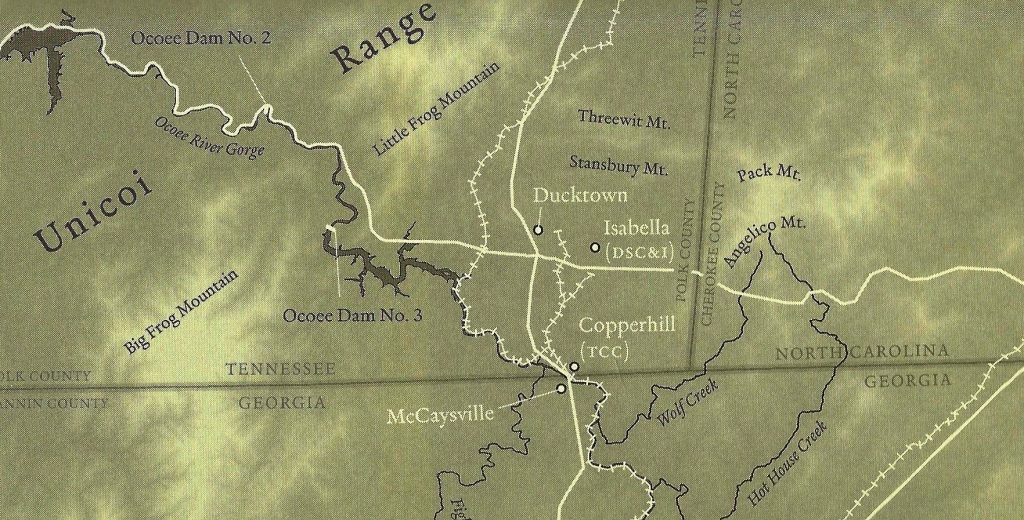
Reading “Place Names” prompted me to think about some of the wonderful place names near where I live.  For this writing exercise, begin by making a list of location names near you. Or if not near you, consider making a list of location names that are important to you for one reason or another. You might even consider looking at some historical maps in case some more-interesting names have been replaced over the years.

Historic map of the Copper Basin region of Tennessee, referenced in yesterday’s post.

“Place Names” should probably be considered a narrative poem because the story of the bear hunt leads the reader through the locations. But because the names of the locations are so musical and interesting, the place names tend to rise above the narrative, and for this reason, “Place Names” feels a bit like a list poem.

Caki Wilkinson’s poem “Flyover Country” is an actual list poem. There’s no narrative structure in this poem although the epigraph “Between Memphis and Bristol” does a lot of work. I love this poem in part because Wilkinson includes my home town, Speedwell, but also because of the sound and culminating meaning of the poem.

Once you have created your list of location names that are meaningful or relevant to you, you can think about how they might work as a poem. I love a well-designed list poem like “Flyover Country,” but use Sue Weaver Dunlap’s poem as an example for how to give your own poem a narrative structure.

There’s a writing exercise to be found here for prose writers too. Think of the narrative that holds the place names together in “Place Names.” Think also of the original essay by Horace Kephart. And there’s always the question of how these place names originated. Who bestowed these names. A little research might go a far way.

Sue Weaver Dunlap’s “Place Names”

A Walk to the Spring House, Iris Press

I received a wonderful surprise in the mail last week in the form of Sue Weaver Dunlap’s newest collection of poems, A Walk to the Spring House, published by Iris Press. Sue Weaver Dunlap is a retired teacher who lives deep in the Southern Appalachian Mountains near Walland, Tennessee, where she and her husband Raymond live and work a mountain farm. She has published poems in venues such as Appalachian Journal, Anthology of Appalachian Writers, Pine Mountain Sand and Gravel, and Southern Poetry Anthology, and elsewhere. “A Walk to the Spring House” includes many beautiful poems, but one that especially caught my attention is “Place Names” which I’m sharing here.

Place Names

from “A Bear Hunt in the Smokies”
Our Southern Highlanders by Horace Kephart

Mountain men slide through place names, their bear dogs ready.
They rest at Siler’s Meadow, slap cold water on stubbled faces
at Fortney’s Creek, camp at Rip Shin Thicket near Gunstick Laurel,
head out at day’s first break, think to find meat at Clingman Dome.
They don’t cross Sugarland Mountains, follow sign from Little River
near Thunderhead and Briar Knobb, track an old fellow around
Devil’s Court House, Block House, and Wooly Ridge near Bear Pen.
Dogs take chase between Briar Knob and Laurel Top, end him near
Saddle-back. Two shots. His parts shared among highlander hunters.

After reading this poem several times, I wrote Sue to ask her if she’d share the background of this poem. Here is what Sue was kind enough to write back to me:

“My first memory is of me standing between my parents in our Chevrolet truck, Dad driving us back from visiting my maternal grandparents. It’s December, 1956. A Sunday. We’ve left Ducktown through the Boyd Gap and across the White Bridge, and then along the Ocoee River Road, flanked on either side by the Big and Little Frog Mountains. I know this because Mama wrapped my memory in place names, places my people rooted long before I was born. The complexity and beauty of mountain language hypnotized me then and now. My mama grew up in places like Turtletown, Ducktown, Isabella, and Farner. The train depot was at Postelle. My Poppy worked mines in the Copper Basin, mines with names like Burra Burra and Mary. Place names like these girded me. In college, I listened to my older brother talk about his hikes in the Southern Appalachian Mountains, his love of places like Siler’s Bald, Gunstick Laurel, and Clingman’s Dome. All those place names rolled off his tongue like the language of our people. I also encountered the writings of Horace Kephart for the first time, especially his Our Southern Highlanders, his comprehensive accounting of his time spent with the people and places of our region. Over the last fifty or so years, I continue to visit Kephart’s book, a beautiful written reminder of what threads through my DNA. It was one of those “pick up the book and open to a random essay” entitled “A Bear Hunt in the Smokies” that I was inspired to write my poem “Place Names.” I could see those mountain men on their hunt for bear and hear the dogs tracking the scent. The catalogue of places they passed through became part of my own catalogue of place names. And then the poem was born, basically as it appears on the page.”

Many thanks to Sue Weaver Dunlap for sharing the history and inspiration of her poem “Place Names.” In my next post, I’ll share a writing exercise based on “Place Names.”

Writing Exercise 22.1

If you missed my previous post, please check out my conversation with Rosemary Royston where Rosemary talked about the process that inspired the poems in her poetry collection, Second Sight. She also talked about how writers should think about writing about traumatic events, and some revision tricks to make poetry sound and feel less prosaic. The poems in Second Sight combine folk traditions, superstitions, sixth sense, and the powers of suggestion and intention. Now, I’m sharing a writing exercise that Rosemary shared with me. Before you start, read Rosemary’s “Appalachian Ghazal” online at the museum of americana, and “Rumex acetosella” online at Split Rock Review.

Writing Exercise 22.1: I challenge readers to do some quick research on a superstition, belief, colloquialism, or a nagging question they’ve had, and to take what they find and turn it into a poem (or an essay or a scene for a short story or a novel chapter). It can be a narrative or list poem or even a lyric! Whatever comes out, but be sure to pay close attention to sound, imagery, and diction.

I love prompts like this one that involve a little research. For this one, I suggest writing into any superstition or belief that you already hold, but if you need more help to get started, check out ScaryMommy.com’s list of common superstitions, or Good Housekeeping’s list of 55 of the Strangest Superstitions From Around the World.

Rosemary Royston, author of Second Sight

I’m so grateful for the time and energy Rosemary took to talk about her writing and to offer this prompt. Please buy Rosemary’s book, Second Sight, available through Kelsay Press and Amazon), and give her a follow for regular updates at her blog “The Luxury of Trees.”

Rosemary is also teaching at two upcoming events, both of which I highly recommend:

February 5, 2022Poetry Workshop, Mildred Haun Conference, Walters State Community College. Rosemary says, “In this poetry workshop, I’m addressing the overall theme of the conference: Coming or Staying Home: the Appalachian Dilemma, by focusing on places/emotions/relationships/etc. that we wrestle leaving or staying with. So the workshop will be both place-based and universal.”

May 8-14, 2022 Creative Writing across the Genres, John C. Campbell Folk School. Rosemary says, “In this week-long class at the wonderful John C. Campbell Folk School in North Carolina, participants will read, write, and discuss poetry, creative nonfiction, and fiction. It is always lovely to be at the Folk School.”

Conversation with Rosemary Royston

According to Rosemary Royston’s own description, she is a poet, writer, re-imaginer of things. I couldn’t agree more, especially with that last part. Her most recent publication—a full-length collection of poetry, Second Sight, available through Kelsay Press and Amazonis all about reimagining things. Reading the poems in Second Sight causes me as a reader to want to reimagine things too.

Rosemary agreed to answer some questions about Second Sight as well as about the writing and publishing process. Come back tomorrow for a writing prompt from Rosemary, inspired by her new collection.

* * *

DL: The poems in Second Sight are often about intuition and premonition. A number of poems such as “Mountain Hoodoo” explore rich traditions of superstition. How did you first become interested in these traditions, and why/how did it occur to you that they were ripe for poetry?

RR: Having lived in many places in northeast Georgia, I found Appalachia, where I’ve spent the last 30 years, to be full of wonderful traditions and superstitions that intrigued me greatly. Always one open to the sixth sense and the power of suggestion or intention, I wanted to know more. Where did these “spells” come from? Why did some contain scripture from the Bible (something I stumbled upon), and why were others different? These questions led me in two directions: one, asking my friends and acquaintances in Southern Appalachia for their stories, and two, doing research that ranged from academic to collections based totally on experience or wisdom passed down. There were two sources that were very rich with history and on both ends of the spectrum: Anthony Cavander’s Folk Medicine in Appalachia, and Edain McCoy’s Mountain Magick: Folk Wisdom from the Heart of Appalachia. Cavender’s text is based on significant research, and identifies the “magic” or superstitions that have a level of legitimacy (such as medical magic that uses herbs of the region), along with identifying folk” treatments” that can be confounding and not based on scientific evidence. One of the examples Cavender shared that stayed with me is the act of “passing” a colicky baby around table legs nine times to end the colic. On the other hand, Edain McCoy (an actual relative of the famous McCoy’s) recorded a substantial amount of wisdom that had been passed down from her family. So before I began crafting the poems, I did a good bit of research as I wanted to honor the traditions and be as accurate as possible. Nothing in the poems with “Mountain Hoodoo” are totally made-up by me: they are references to the texts listed in the end of the book, or based on oral traditions shared with me by those who have lived in Appalachia for the majority of their lives.

As for their ripeness for poetry, I know that the traditions of any culture begin to slip away as society changes. I do not want the heritage of Southern Appalachia to evaporate. To capture them in poems allowed me to not only practice my well-loved craft of poetry, but also pass on some of the practices that I found most intriguing.

Second Sight, available through Kelsay Press and Amazon


DL: The third section of Second Sight begins with your son’s at-first undiagnosed illness, but the section includes poems about other traumatic experiences from your life. Can you talk about the benefits of writing about trauma? What’s your process like for transforming that kind of therapeutic writing into a well-crafted poem?

RR: Early in my writing career, I had the luxury of working with Heather McHugh. I had written a poem about my (favorite) dog passing away. She read the poem and put it down and said in the kindest way, “this is too close.” What she meant was that not enough time had not passed. I needed time to grieve. To reflect. She was 100% correct. So my thoughts on trauma are to definitely journal the pain and spiraling that trauma throws us in. But then let it sit. Because if a writer does not, the writing can be too painful to process, or come out in a way that is too sentimental. Even today, when I read “Type 1” or “Sudden Awareness of Embodying the Dialectical” I may tear up. It took years for me to be able to write poetically and with somewhat of a psychic distance about our son’s near-death experience, and my own experiences in this miraculous but aging body. I’m glad I did, but processing and grieving take time, and the writer must honor that. I’d also posit that turning therapeutic writing into poetry is not unlike writing creative nonfiction. The writer must decide what details are necessary, and they must be comfortable editing details or events in order to support the essence of the poem—this includes language, chronology, and the actual event in order to convey the emotions that the writer wishes the poem to convey to its audience.


DL: One of the questions I’m asked the most, especially by poets early in their career, is how to not sound overly prosaic. What kind of craft elements do you employ to identify and modify those prosaic turns of phrase?

RR: Oh, this is a great question and extremely relevant. In the first drafts of many of these poems, I would go back and read them and see that I’d just made more or less a list of my research findings. Making the language poetic was a big factor in taking research and shaping or conjuring it into poetic form. To do this, I had multiple drafts, with specific attention to diction, sound, line breaks, and form. I think that those of us who have grown up in the South have an innate ear for sound, and we often incorporate it without even thinking about it, but I made a concerted effort to take advantage of sound. I turned some of the research I’d gathered into narrative poems. Also, I used the ghazal form, which is a Persian form that allows for repetition. Since spells often involve repetition, I found this to be an applicable form. I intentionally steered away from ballads because not only was I not good at doing them, I felt they were a form already done well by my Appalachian literary aunts and uncles. Finally, I went for the scientific—Latinate titles for some of the poems with the intent that the reader be both aware of sound and craft, but also intellectually engaged—having to read further or deduce exactly what is being described.


DL: My first book took two years to find the right publisher, and that time while you’re searching can be really disheartening. What was the submission and publication process like for Second Sight?

RR: Just as hard as the first process! However, I’m grateful for both opportunities, which took about six years of reorganizing, resending, and hoping. I was proud of myself for being more assertive this go around, though. Initially, Kelsay Books accepted a chapbook submission. But I felt that the submission was too thin for the work I’d done; it did not feature everything I wanted. I asked if they would consider my full-length, and they did! It was very rewarding.


DL: What are you working on now?

RR: Of all the questions, this one (which should be easy) was the most challenging to answer! I will always write poetry. It’s in my bones. However, I’ve found that I’m branching out and experimenting with all types of art, from mixed media, needle felting, and playing barbies! LOL. Yesbarbies. But not only in the sense of play, but also of conveying a message, which is often based on issues such as gender, feminism, and sexism. Often, I’ll “enact” the essence of a poem in one of these forms (for readers who want to see this, follow midge_and_midge on Instagram). I’ve also done some collaborative work with the painter and artist Larry Caveney through ekphrastic poems based on his paintings. For the most part, I feel like I’m in that necessary lull between poetic projects, and I’m enjoying it (as opposed to berating myself!).

* * *

My next post will feature a writing prompt supplied by Rosemary Royston, as well as more information for opportunities to study with Rosemary this spring.
Cathey Smith Bowers’ “Paleolithic”

While waiting for the snow that still hasn’t truly arrived, I finished reading Cathy Smith Bowers’ debut collection The Love That Ended Yesterday in Texas. This book was first published by Texas Tech University Press in 1992 and later reprinted by Iris Press. There are so many memorable and beautiful poems in this book, but I thought I’d share the very first one from the collection. First poems in collections have a heavy burden to speak to the overall theme of the book while also drawing the reader in. This first poem, “Paleolithic,” does all of that and more.

PALEOLITHIC

We love these old caves—Lascaux,
Altamira—and walk carefully
the way we always enter the past,
our hands bearing
the artificial light of this world.

We imagine those first hunters
crouched, conjuring luck,
carving into rock-swell
their simple art—whole herds of bison,
the haunches, the powerful heads, floating
orderless along the walls.
And some are climbing sky
as if they were stars, planets
orbiting something they cannot see.
Centuries will pass before they
right themselves, their hooves
coming down on to the deep
wet floor of leaf-fall.
Remembering where it was
they were headed.

Jeff Hardin’s “Seed Heads Bursting Gold Light”

The first book I read this month was Jeff Hardin‘s collection, Notes for a Praise Book, published by Jacar Press. Jeff Hardin’s poems are always thoughtful and beautiful, and here’s one I wanted to share:

SEEDS HEADS BURSTING GOLD LIGHT

We need to busy ourselves with memorizing autumn
in the puddles down the drive. A single
forgotten reflection
makes all the others tremble.

I didn’t think twice as a boy, lying prostrate
to watch a dandelion bend with the breeze.
Amazing!
I knew already what to do with my life.

I’d wager Solomon, had he lived nearby,
would have taken long walks in the sage grass field,
just to watch how seed heads
burst with gold light.

I’m an advocate of letting things lean as they must.
When one tree rests its dying toward another,
I go among them
to listen in and take my place.

No big difference, I say, between years that lean that way
and a shared gaze between me and some friend’s eyes.
Some weakness unspoken
may be the strongest voice we have.

My 2021 Reading List

It’s been almost 8 months since my last blog post here. I’m afraid a lot of my plans for this space escaped me as the year rushed by. Probably the biggest reason for this is because of the role I accepted as an editor for EastOver Press and EOP’s literary journal Cutleaf. In our first year, we published 23 bi-weekly issues of the journal. We also published 4 wonderful books of poetry that I’m really proud of. (See the links below to purchase EOP books and others!) This new position as an editor requires a lot of reading, and so my list of published books I read last year (2021) isn’t quite as robust as I’d like. But I love seeing other people’s what-I’ve-read lists, so here’s mine.

  1. Julia Cameron – Finding Water
  2. Haruki Murakami – What I Talk About When I Talk About Running
  3. Wesley Browne – Spoon (manuscript)
  4. Jennifer Stewart Miller – Thief
  5. Haruki Murakami – After Dark
  6. Jay McCoy – The Occupation
  7. Britton Shurley – Spinning the Vast Fantastic
  8. Matthew Landrum – Berlin Poems
  9. Katrin Ottarsdóttir – Are There Copper Pipes in Heaven
  10. Chaelee Dalton – Mother Tongue
  11. Frank Jamison – Marginal Notes
  12. Daniel Corrie – For the Future
  13. Jesse Donaldson – On Homesickness
  14. Matt Urmy – The Rain in the Bell
  15. Liz Ahl – Beginning Ballroom Dance
  16. Cathryn Hankla – Galaxies
  17. Erica Anderson-Senter – Midwestern Poet’s Incomplete Guide to Symbolism
  18. Ralph Sneeden – Surface Fugue
  19. Rosemary Royston – Second Sight
  20. John Davis, Jr. – The Places That Hold
  21. Marie Parsons – An Echo in the Wind
  22. Katherine Hauswirth – The Book of Noticing
  23. Larry Pike – Even in the Slums of Providence
  24. A.E. Hines – Any Dumb Animal
  25. Tarn Wilson – In Praise of Inadequate Gifts
  26. Ross Gay – The Book of Delights
  27. Virginia Woolf – To the Lighthouse
  28. Megan Culhane Galbraith – The Guild of the Infant Saviour: An Adopted Child’s Memory Book
  29. Sylvia Woods – What We Take With Us
  30. Lauren Davis – The Missing Ones
  31. Ralph Sneeden – Evidence of the Journey
  32. Shawna Kay Rodenberg – Kin: A Memoir

I’d like to think that my list for next year will be at least twice this long. And maybe it will be. But it really doesn’t matter. These days, I’m trying to be more comfortable with the idea of slowing down the process. What this means to me is sometimes reading fewer books, but giving more time to think about and engage with each one.

If you’ve posted your own 2021 list or have recommendations for what to read in 2022, please post links and ideas in the comments section. I’d love to hear from you. Happy New Year!

Lauren Davis’s The Missing Ones

Lauren Davis’s The Missing Ones is a slim but engrossing collection that reimagines disappearance of Russell and Blanch Warren. In 1929, the couple were driving home to reunite with their two young sons and to celebrate theLauren Davis - The Missing Ones 4th of July. Their route took them on Route 101 along Lake Crescent where they presumably drowned. What makes these poems work so well is that Davis doesn’t waste time recreating the ways the Warrens may have ended up driving into the lake. Instead, these poems give voice to the dead as in the very short poem that introduces the collection:

Blanch Says

There are dangers
in deep waters no one

speaks of. Like dark
that climbs the spine.

There’s a stain on the rock
Unfolding. I drink the lake,

all of it. I make it mine.

Many of the poems are in Blanch’s voice. In some, she gives advice, such as in “I’ll Tell You What Happened,” where she says: “Your husband has something to tell you— / you can sense it in the cold. Wait until you are both done / drowning. The build a new home.”

The idea of the lake as a home is one of my favorite aspects of these poems. A grave is a home of a kind, but the lake is a living ecosystem. Some poems reference the lake’s “population” which sometimes mean the fish in the water, or the birds outside, and sometimes it refers to others who have perished in the lake’s waters. In some poems, the idea of the lake as a home is expressed through its “rooms,” all of which suggests that the Warrens are still there, unable to die or be truly forgotten because they were never found. The idea is haunting in numerous ways, especially when the reader is reminded of the couple’s two young sons. This is expressed in Blanch’s voice again in the poem, “Have You Seen,” where she says,

My love haunts good as
any ghost. It is more
than lake deep. Boys—

I am never so buried,
gloated, hemorrhaged with blue
That I forget you.

My only criticism of this lovely book is that it’s too short. I wanted it to go on and on. I guess I could say that I, too, am now haunted by this story.

Britton Shurley’s Spinning the Vast Fantastic

Britton Shurley’s new collection, Spinning the Vast Fantastic, is a beautiful guide for spiritual sustainment in a complicated and down-heartening world. The first poem in the collection, “When I Think I’m Through with Beauty,” refers to the world as one that “gnaws us to gristle, if we / don’t work free from its teeth.”

Britton Shurley - Spinning the Vast FantasticMany of Shurley’s other poems make similar references. Shurley is not speaking specifically the restrictions and hardships suffered under a pandemic. He’s talking mostly about how hard life can be in general, and yet, these poems feel especially appropriate for our time. This isn’t because of the way Shurley sees how life can beat us down. It’s more so because of the ways Shurley finds solace. In so many of the poems, that solace is found by taking a breath and paying attention to our surroundings.

In “When I Think I’m Through with Beauty,” the beauty that surprises and pleases is a “boy who’s built / like a thick brick shit-house / spinning a whip of forsythia // just bursting with bright / yellow blossoms, while his // boom box floods the street / with velvet organ chords / of old-time Baptist gospel.” As evidenced in this passage, one of the other ways Shurley finds delight and gives delight to the reader is through sound. The language here and in every poem in the collection is stunning, filled with assonance and internal rhyme, all of which help bring alive these amazing images like this boy with his forsythia.

A recurring theme in these poems is the joy that children bring, as well as the promise for their ability to better the future, as seen in “The Red-Winged Blackbird.”

THE RED-WINGED BLACKBIRD

     Its name is a strut for the tongue.
A song that can crack the heart
     like mine did when that bird lit down

on a purpled redbud’s branch
     in Ron and Kelli’s field. This handful

of acres saved from an inland flood
     of McMansions drowning half of Indiana.
This field where chickens roam—

     Orpingtons, Wynadottes, and Rhode
Island Reds—all hunting for bugs at dusk

     by a garden of onions and melons.
And as if that’s not enough, a child’s
     on his way in fall. Now I know

I know nothing for certain, but this boy
     will be born amidst magic, in a home

where cabbage, apple, and ginger
     turn to jars of kraut so crisp
my mouth wants to shout and dance.

     I hope his name holds such a tune,
that it sings like the sound of the red-

     winged blackbird and can bare
a hyphen’s weight. Maybe Banjo-
     Nectarine or Cannonball-Daffodil Abdon.

Either way, his life will be music;
     he’ll make this cold world swoon.

One of the immense strengths of these poems is in Shurley’s ability to juxtapose the bucolic and familial against the material and trivial. With similar hope and promise, he references his own daughters, notably in “To the Harvey Weinsteins et al.” Shurley begins the poem, “Know my daughters believe in their power.” He then describes the girls performing a “spell” to bring snow and a snow day from school. “And damn, if it didn’t work,” he writes, “so that we could wake in a world / slowed and stilled for a day.” Shurley brings the end of the poem back to Weinstein—not only Weinstein but all the men he represents—warning such abusers to be careful, and to see what powers these young women have.

Spinning the Vast Fantastic is overwhelmingly an optimistic view of life. We see this in the view of young women like his daughters but also in the hope for young men like the aforementioned Banjo-Nectarine. But Shurley’s optimism is seen also by the wonders found in the world. One example is in the poem “Headless Wonder” that examines a 1945 report of a chicken who lived for 18 months without its head. Another example in the book’s title poem re-imagines an 1876 report of fresh meat falling from the sky. In “Parthenogenesis” Shurley writes, “If the ankle of the horse is holy, then so is the cow’s / cracked hoof, the sheep’s bleating tongue…” What I take away from these poems is that the world is always miraculous, even during dangerous and frightening times.

Buy Spinning the Vast Fantastic from Bull City Press.