Sue Weaver Dunlap’s “Soul Gathering”

cvrknead_bookstore-200x300

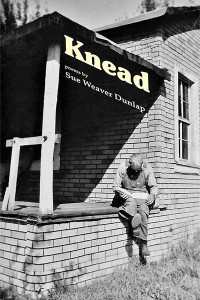
This morning, I read the final poems of Sue Weaver Dunlap’s poetry collection, Knead, published by Main Street Rag.  Knead is available through the Main Street Rag Bookstore.  Until you buy your own copy, here’s one of my favorite poems from the collection:

Soul Gathering

They came, no heralds,
no trumpets sounded
their arrival, not a group,
just one at a time, each
entered his room, at night
a pattern, men to the right
women to the left, sometimes
a semicircle at the foot
of his bed, as if in prayer
for this brother who feared
his going home as they
visited and took a piece,
offered him solace
in the darkest of night.

Recommended Reading 9/23/2016

I’ve been reading some great stories, poems and essays in the past few weeks.  If you’re looking for something to hold your attention over the weekend, try one (or all) of these:

Barrett Warner’s poem, Oxon Run, was recently featured at Autumn Sky Poetry Daily: https://autumnskypoetrydaily.com/2016/09/08/oxon-run-by-barrett-warner/.

Emily Mohn-Slate has two poems at Connotation Press: http://www.connotationpress.com/poetry/2862-emily-mohn-slate-poetry.

Linda Michel-Cassidy interviewed Tom McAllister and Mike Ingram, the creators of Book Fight!, over at Entropy: http://entropymag.org/book-fight-books-we-love-books-we-hate-books-that-inspire-us-baffle-us-infuriate-us/.

K.L. Browne’s fantastic story, Toucan, was published this week at Ascent: http://www.readthebestwriting.com/toucan-kelly-browne/.

Susan Pagani wrote this cool article about a cooperative grocery store in Minneapolis for Civil Eats, a national food justice mag: http://civileats.com/2016/09/20/this-minneapolis-cooperative-grocery-store-is-working-to-break-the-diversity-mold/.

Finally, I highly recommend you check out this essay by Jamie Zvirzdin in The Kenyon Review’s Poetics of Science issue: http://www.kenyonreview.org/kr-online-issue/2016-fall/selections/jamie-zvirzdin-656342/.  The essay is titled, “Observations of a Science Editor: If Romantic Scientists Pilfered Fiction’s Toolbox, You Can Too,” and it’s really fascinating.

Recommended Reading 9/9/2016

If you’re looking for something good to read this weekend, here are several worthy options:

Poetry lovers should check out Cassie Pruyn‘s three poems that were included as part of CutBank’s “All Accounts and Mixture” online series: http://www.cutbankonline.org/cutbank-blog/2016/7/all-accounts-mixture-cassie-prurn.

And Tanya Grae has some beautiful new work online at Agni and at Fjords Review: http://www.bu.edu/agni/authors/T/Tanya-Grae.html and http://fjordsreview.com/featured/current_issue.html.

And be sure to read a new poem by Larry Thacker‘s in The Rappahannock Review: http://www.rappahannockreview.com/larry-thacker/.

If Creative Non-Fiction is more your style, you should read Elizabeth Glass’s essay “A Series of Almosts” online at The Manifest-Station: http://themanifeststation.net/2016/08/24/a-series-of-almosts/#more-16645.

And Susan Pagani has a wonderful essay, “On Living with Geese,” online at Switchback: https://www.swback.com/issues/2016/living-geese.html.

Corina Zappia wrote a fantastic review of Seattle restaurants in The Stranger:http://www.thestranger.com/food-and-drink/2016/08/26/24520833/seattles-downtown-evolution. I promise it’s a fun read, even if you won’t be in Seattle anytime soon.

the-nest-1-courtesy-of-nic-lehoux_mag


Erica Anderson-Senter’s “Seven Days Now”

Erica - Seven Days Now

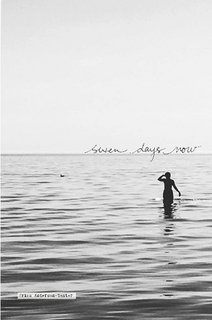
This morning, I sat down to read Erica Anderson-Senter‘s new chapbook, Seven Days Now, and it blew me away. I marked what I thought would be my favorite poems only to realize that I had marked over half of the collection. Anderson-Senter’s voice is strong. Her language is never dull; rather, line after line includes one subtle surprise after another. And so many poems take my breath away with their honesty. Click the link above to buy your own copy.  Until then, here is one of my favorites.

Saint Mary’s River Song

My mouth tastes like a river,
like I’m standing next to a river,
like I’m licking limestone.

I’ve made dinner with silt,
with silt and cattails,
cattails dressed with mallard feathers.

I will die on this rock-ribbed river-bed;
a rough river-bed will eat my flesh,
fresh like limestone, barefoot in this rill.

My body is fully-flooded, bloated
laying flat in the flood plain,
the night heron fishes in my hair.


Cathy Cultice Lentes’ “Ten Years”

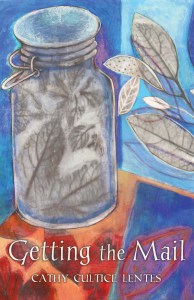
I was so happy yesterday to receive this beautiful new chapbook, Getting the Mail, by Cathy Cultice Lentes.  I met Cathy a couple of years ago at a weekend retreat at the Hindman Settlement School.  In addition to writing poetry, Cathy is also an essayist and children’s writer.  But it’s her poetry that is on full display in this collection, published by Finishing Line Press.  So many of Cathy’s poems explore everyday magic.  Pasted below is one of my favorites, “Ten Years.”  I hope you’ll read it and then buy the book.

340Lentes_Cathy_COV

Ten Years

Ten years this house stood vacant.
The woods never forgave us
for trying to take it back.
Birds insist the porch is theirs, nest
after nest, egg after egg. Uneven
floorboards sink toward soil, rotting
slowly back to earth.
Maple trees spread arms to block
our view of cars and people passing by
so even we forget to which world we belong.

Long ago we lost our fear of spiders,
bats, and other creatures that creep and claw.
We painted all the walls forest green, and it
is hard to tell where inside ends and outside
starts. Soon all semblance of civility will
be gone—
we’ll fail to dress, eat only what
presents itself, live hairy and howling
under a roof of stars.

Jim Elledge’s “Theotokos”

Elledge_BW_500

The writer Jim Elledge has moved into my community, and I recently bumped into him at our local coffee house.  Jim has received multiple Lambda Literary Awards and also won the Georgia Author of the Year Award in biography.  I’ve been reading and enjoying his collection of poems, “Tapping My Arm for a Vein.”  One of my favorites so far is the prose poem “Theotokos.” I’ve pasted the short poem below, but you can see it and four other poems in the online journal LocusPoint.

THEOTOKOS

Photosynthesis: digestion in midair, kisses sun and plant share, prayer aglitter. Light hovers when gulls zigzag then wheel. Light skims surf, a frieze of epiphany. As he creates other worlds, God hums to himself melodies we’re lucky to overhear. Thus: shadows crow beneath leaves, clocks snicker locked up indoors, herds of spiders weave webs they string in triangles littered with flies’ wings that flutter in dank breezes.

Ross Gay’s “Burial”

My friend Emily Mohn-Slate recently gifted me with Ross Gay‘s beautiful collection of poetry, Catalog of Unabashed Gratitude.  One of my favorite poems so far is “Burial,” originally published in Solstice.  I’ve copied the poem here, and I hope you’ll like it as much as I do.

Ross Gay

Burial
You’re right, you’re right,
the fertilizer’s good—
it wasn’t a gang of dullards
came up with chucking
a fish in the planting hole
or some mid-wife got lucky
with the placenta—
oh, I’ll plant a tree here!
and a sudden flush of quince
and jam enough for months—yes,
the magic dust our bodies become
casts spells on the roots
about which a dumber man than me
could tell you the chemical processes,
but it’s just magic to me,
which is why a couple springs ago
when first putting in my two bare root plum trees
out back I took the jar which has become
my father’s house,
and lonely for him and hoping to coax him back
for my mother as much as me,
poured some of him in the planting holes
and he dove in glad for the robust air,
saddling a slight gust
into my nose and mouth,
chuckling as I coughed,
but mostly he disappeared
into the minor yawns in the earth
into which I placed the trees,
splaying wide their roots,
casting the grey dust of my old man
evenly throughout the hole,
replacing then the clods
of dense Indiana soil until the roots
and my father were buried,
watering it in all with one hand
while holding the tree
with the other straight as the flag
to the nation of simple joy
of which my father is now a naturalized citizen,
waving the flag
from his subterranean lair,
the roots curled around him
like shawls or jungle gyms, like
hookahs or the arms of ancestors,
before breast-stroking into the xylem,
riding the elevator up
through the cambium and into the leaves where,
when you put your ear close enough,
you can hear him whisper
good morning, where, if you close your eyes
and push your face you can feel
his stubbly jowls and good lord
this year he was giddy at the first
real fruit set and nestled into the 30 or 40 plums
in the two trees, peering out from the sweet meat
with his hands pressed against the purple skin
like cathedral glass,
and imagine his joy as the sun
wizarded forth those abundant sugars
and I plodded barefoot
and prayerful at the first ripe plum’s swell and blush,
almost weepy conjuring
some surely ponderous verse
to convey this bottomless grace,
you know, oh father oh father kind of stuff,
hundreds of hot air balloons
filling the sky in my chest, replacing his intubated body
listing like a boat keel side up, replacing
the steady stream of water from the one eye
which his brother wiped before removing the tube,
keeping his hand on the forehead
until the last wind in his body wandered off,
while my brother wailed like an animal,
and my mother said, weeping,
it’s ok, it’s ok, you can go honey,
at all of which my father
guffawed by kicking from the first bite
buckets of juice down my chin,
staining one of my two button-down shirts,
the salmon colored silk one, hollering
there’s more of that!
almost dancing now in the plum,
in the tree, the way he did as a person,
bent over and biting his lip
and chucking the one hip out
then the other with his elbows cocked
and fists loosely made
and eyes closed and mouth made trumpet
when he knew he could make you happy
just by being a little silly
and sweet.

Saara Myrene Raappana’s “The Wolf in the Trailer”

I love this poem, “The Wolf in the Trailer” by Saara Myrene Raappana.  It arrived in my inbox this week, courtesy of Linebreak.  And it has stayed with me every day since I first read it.

The Wolf in the Trailer

The wolf in the trailer,
tired of drinking every meal, licked the last bowl
’til it was dry and fled into the darkened woods
because she couldn’t stand it here
(lamplight like snakes biting her eyes)
but soon returned because forest at daybreak fills
itself with such undimmability.
Panting with the kind of pain that makes
people forget which lie they told themselves,
she moves from chair to chair as if a ray
were chasing her (her feet crack scattered dishes like
they’re chipmunk bones). The paramedics, when
they force the door, will find her curled as if
in sideways prayer, head resting in a spot
of dawn so clear that they’ll mistake her fur
for hair. One man will crouch and touch two fingertips
below her ear to prove no sun beats there.