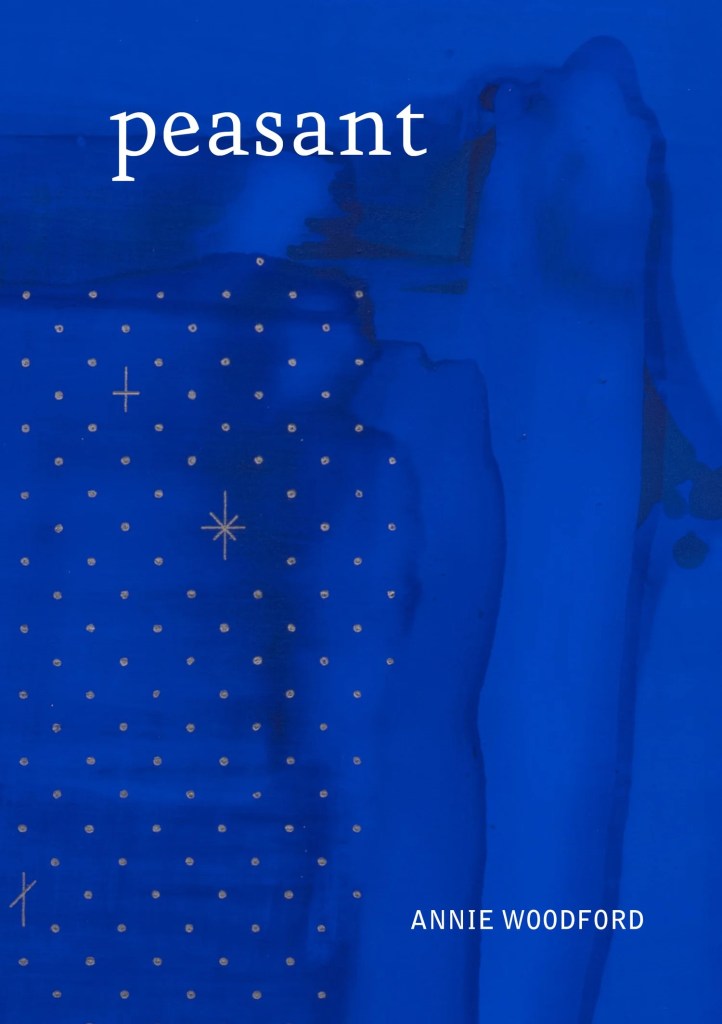
The first full week of January came in with a roar and a mountain of work. I already feel a bit behind in my goal to read more in 2026. But one title I can add to my reading list is Annie Woodford’snewest collection, Peasant. Peasant is a beautiful collection of work. But that’s not a surprise. Every poem I’ve ever read by Annie has been written with tenderness and a genuine love of the people and places she writes about, especially the natural spaces of our region, the fields and forests and everything that exists there. That is the kingdom that Annie writes about, and I’m always here for it.
Peasant is published by Pulley Press. I met Pulley Press founder and editor, Frances McCue, a few years ago when we were stationed in the same neighborhood on the AWP convention floor. I remember learning about Pulley Press then and their dedication to publishing writers and writing from rural places. And if you’re a writer from a rural place or just love to read about rural people and their spaces, you should definitely check them out.
Here is one of my favorite poems from Peasant.
A Song for the Daughters of Europa Annie Woodford
Every time we pass that pasture I point out the bull to my daughter, who was never taught to know a bull
and therefore to spot one, when needed, in a field of cows. But once you’ve seen one, they will always stand out—
the massive neck, the muscled shoulders more dangerous than any female Angus. I name the bull for Granny, who named them
for me and believed in the red myth and in getting over the nearest fence fast as you can. I know now
this was her only way, the lesson pressed in by the little stones of her eyes. I see the girl she must have been,
her hay-straw hair fine, like mine. and barely holding a rag curl, her canvas sneakers well-washed
but still stained by farmwork. She is out in the dawn, an hour before school, where she is the fastest
at math. She’s calling down the milk cow, the copper penny leaves of the locust tree, her footprints left in frost.
Once she grabbed my hand just as she grabbed the electric fence and, when the shock passed through her and into me, she laughed.
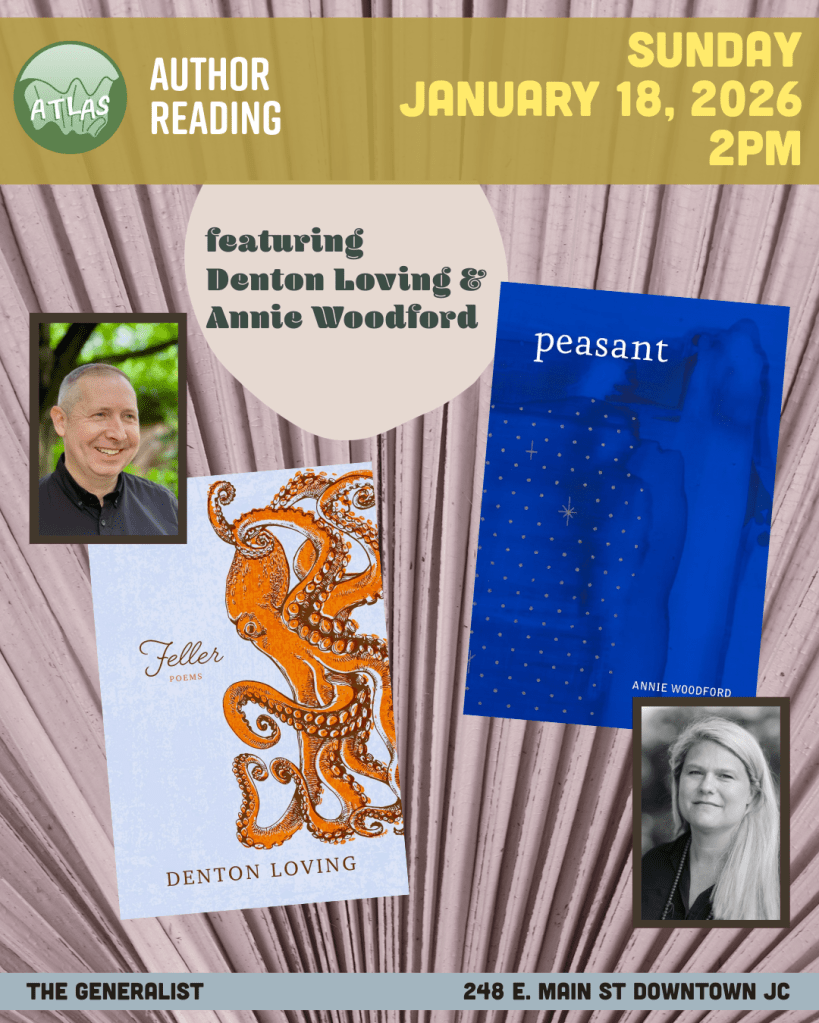
I feel so fortunate to be able to read with Annie next week at Atlas Books inside The Generalist. If you live in or near Johnson City, Tennessee, I invite you to come out on Sunday afternoon, January 18th. Our reading will start at 2:00 p.m. Huge thanks to Davis Shoulders for making this reading happen! I’m really looking forward to getting back to Johnson City, which has an amazing literary community, and it will be so much fun to read with Annie.
Earlier this month at the Kentucky Book Festival, I met Manny Grimaldi, who gifted me with a beautiful copy of Yearling: A Poetry Journal for Working Writers. Yearling is an annual publication that operates under the umbrella of Workhorse of Lexington, which in itself is a cool, wide-ranging operation that supports publishing and building community for writers. Manny is Yearling’s managing editor, and he agreed to answer a few questions about the journal that will be interesting and helpful for those of you looking for good publications where you can submit your writing.
DL: It was great to meet you at the Kentucky Book Festival, and to find out about Yearling. How long has Yearling been publishing? How long have you served as managing editor?
MG: It was a pleasure conversing with you, Denton. Yearling: A Poetry Journal for Working Writers is an offshoot of a poetry feedback program through Workhorse of Lexington. I approached our editor-in-chief for work, and he instructed I take helm of the feedback program where folks sent in work only for response. Soon after in 2021, we launched Yearling with that ethos.
DL: The fact that Yearling provides feedback to submitters really sets the journal apart from so many others. As an editor, I know that requires a lot of work, but it’s also such a benefit to submitters. As managing editor, do you still provide that feedback yourself?
MG: I do provide the feedback, and a resounding yes to what you are stating, this is difficult work. But I do this with the helpful impressions of team readers. Never in the community of artists, whether actors, poets, editors, musicians, or novelists do I claim to do and develop in a vacuum. We help each other. In the end, I re-read each poem, draw together our conversations, solidify my impressions, and compose meaningful feedback. I read much gratitude for the deep reads from our authors, and some encounters with poets create avenues to their outstanding revisions.
DL: Yearling is a journal dedicated strictly for poetry. Are there any specific forms or styles that you’re especially looking to publishing in Yearling?
MG: As managing editor, I focus upon this principle: Does the work move me to forget I am reading a poem? A sonnet can do that. A villanelle can transcend form. I also hold anyone can do that, Denton. Provided they are telling the truth, and telling it well! Short answer: any style, any length, any form, we can print—we enjoy a book format now. We take everything from single poem submissions, up to six poem. Currently, in this issue, I hope to cull the heart of Kentucky writers and our surrounds as much as possible. That said, everything is read, considered, and published if it sings.
DL: If I understand correctly, then Yearling publishes in December of every year, and acceptances for that issue are sent out by October 1st. Is Yearling currently accepting submissions for the 2026 issue?
MG: We process submissions all year. Yes. Yearling prints December of every year, once a year. In practice, we have closed a year’s volume with the requisite number of poets, which is 40, as soon as April. We respond generally, schedules permitting, as promptly as possible.
DL: In addition to being an editor, you have also published multiple books of your own writing. Where can readers find your work, and how can they connect with you?
Mothman and Finding are full length. ex libris is a satirical chapbook released by anonymus scriptus.Mothman connects people with a window into family and personal demons. Finding is about romance, reveling in poetic forms, from the historical persona poem, to the broken sonnet, to tanka.
Today, August 5th, is the official publication day for Feller, my new book of poems from Mercer University Press that explores themes of connection, longing, and the pursuit of a fully lived life. I’ve been writing these poems for about 12 years, so I’m really excited to finally be able to send this book out into the world, and to share it with you.
There’s a short window of time surrounding a book’s release where every action is amplified. If you’re inclined to help me help Feller reach more readers, here are a few things you can do.
1) Please buy the book. You can order Feller directly from Mercer University Press or from online retailers like Amazon, Barnes & Noble and Bookshop.org. Tertulia is offering a 25% discount if you order through their site by August 7th. You don’t even have to create an account. Just enter the code FELLER at checkout.
Feller is also available at great independent bookstores, such as City Lights, Parnassus Books, Novel Memphis, and others. If your local bookstore doesn’t already have copies of Feller in stock, please ask them to order it.
2) Pleaserate and review Feller or add it to your “Want to Read” shelf on Goodreads or any similar platforms such as StoryGraph, BookWyrm, or LibraryThing.
Remember that you don’t have to purchase a book from Amazon in order to rate and review it there. There are legitimate reasons not to support Amazon, but reviews there do make a difference. Reviews don’t need to be lengthy. Any short, simple message to recommend the book is appreciated.
3) Post about the book on social media and tag me. Photos of the book (with your pet or your baby, on a beach or a park bench, etc.) are especially great to share! You can find me on Facebook, Instagram and LinkedIn.
4) Come to events and invite me to read. I’ll be traveling a lot this fall. Check out my calendar of events to see if I’ll be near you. More dates are in the works and will be added soon. But I’m also still looking for opportunities to connect with more readers. If you host a book club or reading series, I’d love the opportunity to come talk about Feller. Let’s talk about getting something scheduled.
5) Teach it: If you’re a teacher and would like to teach from Feller, let me know. I’d love to connect with you and your students by visiting your classroom either in person or virtually.
PHOTO COURTESY OF KARI GUNTER-SEYMOUR.
In the days leading to publication, Feller has ranked as high as #9 on Amazon’s new releases chart for poetry, which feels remarkable! And look at these excepts from longer blurbs from three writers I deeply admire.
“Loving makes lyric sense of complex issues in poem after poem in Feller, with his special blend of eco-poetics and earthly reason.” — Elaine Sexton, Site Specific “At once timely and timeless, Feller is a superbly striking and essential book.” — Matt W. Miller, Tender the River “Reading Feller is a transformative, joyful, loneliness-alleviating experience.” — Annie Woodford, Where You Come From Is Gone
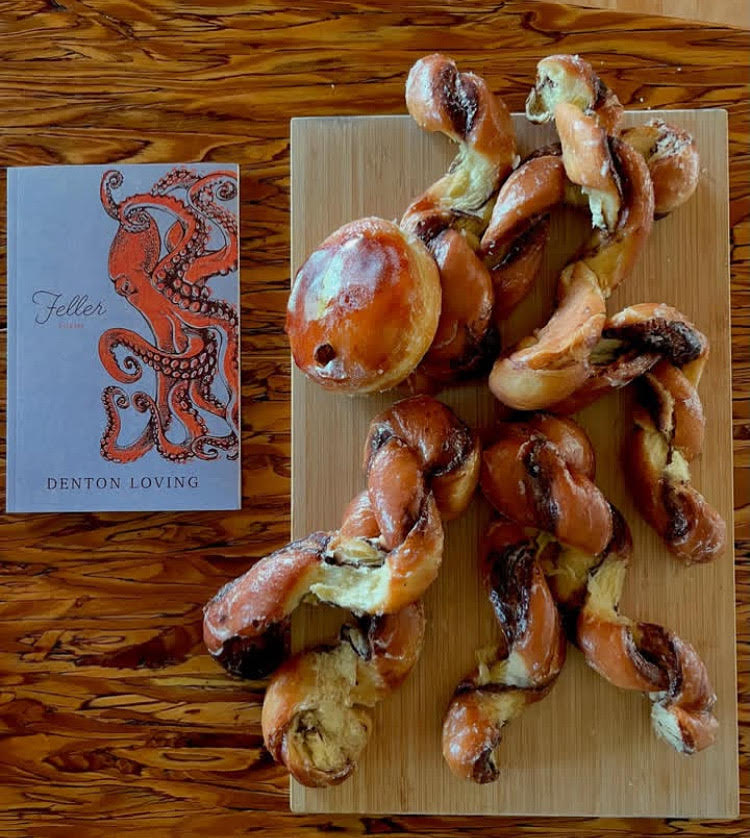
And my friend Davin Malasarn—who is a one of the most artistic and imaginative people I know—created one of his famous book-and-donut pairings to celebrate the launch.
One of the most exciting things about publishing a book is to see it interpreted and reflected through the eyes of readers. The other exciting thing is to connect with all of you. I can’t wait. Thanks for all you’ve done and what you still might do!
Friends, I’ve been really excited for today to come! After what feels like a long wait, I can finally share the cover for my new collection of poems, Feller. But first, here’s one last teaser:
To view the entire image, head over to Electric Literature who very graciously is hosting the official cover reveal. I’m incredibly grateful for Electric Lit’s support and help in launching this new book.
I’m also grateful to Mary-Frances and Jim Burt of Burt & Burt who designed this cover image. It’s really striking and hits the exact right emotional key. I’m always grateful to Mercer University Press, especially my editor Marc Jolley, for believing in my work in general and Feller in particular. And huge thanks to Kelly March for coordinating this cover reveal in the first place. She’s amazing!
Feller is a book that has been a long time in the making. Some of these pieces took over ten years to transform from first draft to finished poem. There will be more opportunities later to talk about the individual poems and what the collection is about. And as always, I’m more excited to hear what the poems and the book mean to you. So I hope you’ll read Feller. The official pub date is August 5th, 2025, but if you want to hear a few of the new poems, you can listen to this episode of The Beat, a poetry podcast hosted by Alan May.
I don’t ever remember a past April where I could visibly see poetry celebrated so often and in so many ways. Maybe one of the things we couldn’t predict about living in a dystopian world is how people would turn to poetry. Regardless, it was beautiful.
For my part, I had the privilege of reading poems to the monthly book discussion group, All Over the Page, at Lawson McGhee Library in Knoxville, Tennessee. I read poems from Tamp, as well as some new poems from a new book that will coming out in August.
Yeah, I sort of just buried the lede there, didn’t I? But that’s right. I have a new collection of poems coming out in August from Mercer University Press. It’s called Feller. I just saw the cover for the first time this week, and I love it so much. I can’t wait to share it with you all very soon.
Julia Wendell is a poet currently living in Aiken, South Carolina. She is also a three-day event rider, the experience of which considerably informs her newest collection of poetry, The Art of Falling, published by FutureCycle Press. Amanda Moore said this about The Art of Falling: “…knowing how to fall allows Wendell’s open-eyed work to acknowledge pain but not be weighed down by it, moving instead to consider what blossoms and grows each passing season. Love here is represented by and extended to plants and animals—reluctant gladiolas, bursting peonies, a menagerie of dogs and birds—but nothing so beloved as horses, an anchoring and comforting presence throughout.”
I found The Art of Falling to be a powerful book encompassing decades of Julia’s life, moving from childhood traumas to complexities of adulthood. In one poem, Julia describes the art of falling as a practice perfected through pain and intense self-awareness, visible in “the coat hook / of my separated shoulder, / my spine’s bumpy lane, / sunspots littering my back— / the parts of me / I can’t see without mirrors.” In other poems, the art of falling is also made known in far less visible ways. Julia was kind enough to speak to me about her new book, her writing process, ekphrastic poetry and what it’s like to be married to another poet.
DL: Many of the poems in “The Art of Falling” touch on a fall you suffered from a horse that caused significant physical pain. But these poems reveal other traumas as well. What’s your process like for transforming writing about trauma into a well-crafted poem?
JW: It wasn’t one fall from a horse, but many: actually, a lifetime of falls. The old directive is true for me—you fall off a horse, you get back on. You fall off a poem, you get back on. Some falls are worse than others. And the older you get, the worse they tend to be, and the harder it is to get back on. Several years ago, I broke my hip as well as my leg falling from one of my horses, and that fall transformed my life for a year, as well as the writing of The Art of Falling. I found ways to live through the pain and to see through it. I had to change my life pretty drastically during that time, and my poems became both a respite and a way to work through the ordeal. I couldn’t get on a horse, but I could go to my desk with the help of a cane or just steadying myself on furniture as I went across the room.
DL: I was thrilled to read your poem, “Horse in the Landscape” which is an ekphrastic work related to Franz Marc’s painting with the same name. This is also the image used for the book’s cover. I recently taught a workshop on ekphrastic writing. Can you talk about the relationship that can exist between visual art and written work? Are you also a visual artist?
JW: No, I’m not a visual artist, but the piano is my brush; has been all my life, and music often finds its way into my poems. In reference to the above question about writing through pain: while writing the poems in The Art of Falling, I re-visited Frida Kahlo’s life and work. Her example taught me how to keep making art while in terrible pain. I read everything I could get my hands on about her life and artistic process, and studied her strange, surreal self-portraits. I even went to Mexico City after I had partially healed and visited her house, Casa Azul. I was drawn to her for the obvious parallel between her life and mine at the time. Both of us had our hips gored by rods, except that hers was put there by a bus and mine was put there by a surgeon. Here was an artist who experienced a lifetime of pain, and yet she kept getting back on the horse of her art to create her organic, visceral, paintings. The poem “Portrait Chinois” came directly from my re-experience with Frida’s work.
Similarly, the figure of the broken girl in Wyeth’s Christina’s World reminded me of my own plight; and through her semi-reclined pull and yearning for the gray house on the hill, despite her infirmities and inability to walk, drew me to ponder what it would be like for her to crawl to the house, to go inside, to open up her world and reach her dream destination.
I have always loved Franz Marc’s work for its ebullience and movement, and of course for its subject matter. But what pulled me to Horse in the Landscape is also what struck me about Christina’s World—we see a still landscape through the girl’s and horse’s perspectives, as they turn their backs to us. It is a world of no movement, only thought and perspective, possibility and possible movement, which is what my life had become during the time I was so badly injured. I had to contemplate my life through quiet and stillness, and find my poems there.
I chose the cover for The Art of Falling before I had written Horse in the Landscape. The pdf’s of the interior of the book were almost ready for the printer. Suddenly, I had the urge to write the poem and spent last Christmas season writing and re-writing it, thinking I would save it for some other project. Then Diane Kistner, the editor at FutureCycle Press, contacted me. Did I have another poem that might fit into the book? The way the pages were laying out, she needed one. Uncanny coincidence.
DL: I always ask writers about the process of compiling, submitting and publishing their books, and I’m especially interested in asking you because this is, I believe, your eleventh book. How long did it take you to write and shape the poems in this collection? How did you find and form a relationship with FutureCycle Press?
JW: The poems in The Art of Falling span at least a decade. The last book, Take This Spoon, had a very specific theme of poems about family, and the relationship to food and eating and anorexia, and even incorporated old family recipes. I was already working on the poems in The Art of Falling when Take This Spoon came out in 2016. The manuscript has seen many, many revisions: different title, different order, new poems. It’s actually my sixth, full-length collection, having published a number of chapbooks in addition to the longer books. I submitted to FutureCycle at the suggestion of April Ossmann, with whom I worked on an earlier draft of The Art of Falling. Diane Kistner, editor at FutureCycle, was very good at managing the publication details of the book, though not so much involved with line edits or broader editorial suggestions. For those I relied on April, Jack Stephens, D.W. Fenza, and most especially my husband, Barrett Warner.
DL: I have to ask you about Barrett Warner who is also a writer. To what extent do you and he read and comment on each other’s work?
JW: Barrett reads and helps edit everything I write, as well as a tone of what other people are writing. When he likes reading something his hand twists up his hair, and if he comes back to me with really messy hair, I know he liked it. I am dependent upon him as my first reader. He is a bit more independent of me, perhaps because as an editor he has such rich connections with other writers. I am more of an artistic recluse, and I like it that way. But everyone needs a first reader, and Barrett’s mine. In sickness and in first drafts, as they say.
DL: In addition to being a writer, you’re a three-day event rider. It’s also clear in your poetry how much you love and respect horses. Are there lessons from the equestrian world that also apply to writing?
JW: Ride the rhythm, create the energy from behind, send it forward, don’t let the poem go against your hand. Talk to your poem. Give it confidence by having clear intentions. Give it treats. There must be a daily devotion to the art of riding, as there must be to writing. The development of a poem, as well as a horse, comes in the smallest of increments, and must be addressed day after day after day. Writing is re-writing; riding is re-riding. The daily devotional is how you get there.
DL: What are you working on now?
JW: The next poem. Then, the one after that.
Seriously, though: recently I’ve collected poems I’ve written about my daughter in her lifetime (and even before that), and have compiled a collection called “Daughter Days.” I have plans to get back to that manuscript to revise it and see if I still like it before I send it out into the world. Writing is re-writing, and submitting is re-submitting.
***
Find out more about Julia on her website, and don’t forget to order her newest publication, The Art of Falling. My next post will feature a writing exercise inspired by one of Julia Wendell’s poems. Make sure you never miss a post by subscribing here:
The first book I read this month was Jeff Hardin‘s collection, Notes for a Praise Book, published by Jacar Press. Jeff Hardin’s poems are always thoughtful and beautiful, and here’s one I wanted to share:
SEEDS HEADS BURSTING GOLD LIGHT
We need to busy ourselves with memorizing autumn in the puddles down the drive. A single forgotten reflection makes all the others tremble.
I didn’t think twice as a boy, lying prostrate to watch a dandelion bend with the breeze. Amazing! I knew already what to do with my life.
I’d wager Solomon, had he lived nearby, would have taken long walks in the sage grass field, just to watch how seed heads burst with gold light.
I’m an advocate of letting things lean as they must. When one tree rests its dying toward another, I go among them to listen in and take my place.
No big difference, I say, between years that lean that way and a shared gaze between me and some friend’s eyes. Some weakness unspoken may be the strongest voice we have.
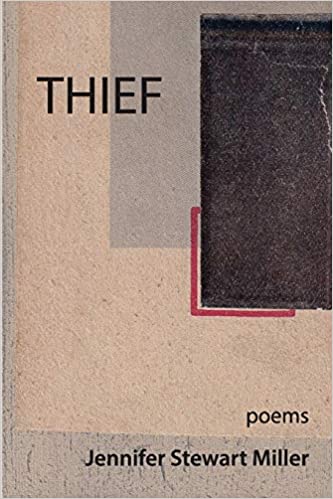
Jennifer Stewart Miller’s new collection, Thief, (Grayson Press 2021) begins with the poem, “My Dead,” wherein she says, “Maybe your dead / are kinder. But mine— / they won’t look you / in the eye. Won’t / say sorry or / bare their hearts.” Such are the privileges of death, one might argue. But not Miller. Instead, Thief is a collection of poems that gives voice to the deceased. They seldom say they’re sorry, but their hearts are revealed all the same.
Miller’s poems have a history of this sort of exploration. Her chapbook, The Strangers Burial Ground, recreates the lives of historical people found in New England cemeteries. But Thief hits far closer to home. These poems are more personal. In Thief, Miller explores many different forms of her own personal grief. There is the grief that follows the deaths of her father and her stepfather. But there is also the grief of a sister lost to addiction and ongoing mental health crises. In these poems are also incredible depictions of the ways that the living manage (or are forced) to endure, often because of everyday necessity. This is perhaps best explored in her poem, “The End,” where Miller writes:
I keep coming back to how my mother left my stepfather
at Rutland Regional Medical Center to hurry off to the bank in Granville—
thinking she could still add her name to some account or other by
bringing in a few shaky words he’d scribbled on a scrap of paper.
And that was that. After all the grand passion—
just an old married couple trying to sort things out.
One of Miller’s many strengths is the slantwise framework of her poetry as seen in “Poems I Probably Won’t Write About My Stepfather” that hints some parts of the past are better left unexplored no matter how much they haunt us. In “This poem has a highway in it” the poem takes on geographical qualities that reveal history, and yet, like the aforementioned highway, the poem and the narrative inside it move ever forward. It’s impossible to read this poem without feeling such forward momentum that you feel part of the narrative.
Another of Miller’s strengths is her knowledge of the natural world and a gift for mixing biological details with current events and elements of her own life, as in this poem:
To the Dead Striped Bass Swimming in Sunset
Swim on, beached beauty, agog in the chilly marsh, aglow without scales or skin. May the jut of your jaw, your eyeless eyes, guide you back to the sea. May your body—filleted of flesh— follow so lightly. Long, supple, golden spine. Ribs vaulted with air and light. Moony-white tail. Even the waves lap you a prayer— undulate, undulate. Striped bass— gather up my newly dead, school with them, show them the way out of the still-dead April grass.
And the title poem, “Thief” celebrates the masked banditry of a raccoon even though its life is fleeting. “Tonight, I’ll raise a glass to what moon there is,” Miller says in this poem, “and lick up every last tongue-full of grief.” And really, this entire collection is like a celebration of that sweet taste that comes alongside grief. How would we go on without it?
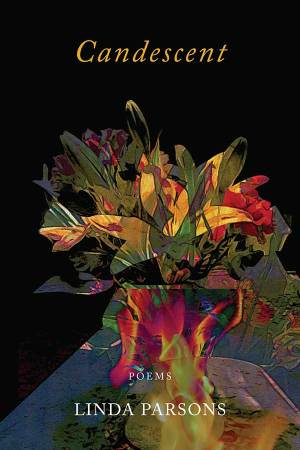
Linda Parsons’ fifth collection of poetry, Candescent, begins as a three-legged story of grief. There is the loss of a 24-year marriage that she describes as an utter surprise after so many years. There’s the loss of her fourteen-year-old German shepherd, an ever-watchful presence that views the narrator as his sole sheep to protect until the end. And then there is the loss of her aged father.
The question of memory is just as important in these poems as the pure element of grief. How the two twist and turn upon each other! Before her father’s death, there is the earlier insult of lost memory. When Parsons visits him in his hospital, she must introduce herself. Often, he asks his daughter if they’re kin, recognizing a familiarity but unable to name her or their true relationship. Memory and its many tricks enter the poems again in the aftermath of divorce. Perhaps no poem sums up the absence of a lover better than these lines from “Phantom.”
Ghost pain, phantom pain, a limb lopped clean, the dead bee’s sting. We are good amputees, efficient little starfish and lizards,
regenerating feet and tails in the shadows where no one watches us spin and weep, where no one sees me turn a corner
in the dark before bed, giving wide berth, my body’s radar still beeping and flashing to sidestep a bookcase no longer there.
In “The Only Way” Parsons writes, “Honor your grief with ragged breath and privation / in the body’s dark cell despite how the blithe / world cries enough.” And that is exactly what Parsons does in these poems. She honors her grief, but she also works her way through it.
As in real life, grief doesn’t disappear in these poems in any single instant. Rather, there are many shifting moments. One of the most exciting shifts occurs in the poem, “Stand Up.”
Lo these many years, I the peacemaker, the walker on eggshells, the biter of lips, the please pleaser, the clay not the molder, the stream not the bank, the moss not the rock, the stern not the bow, queen of if only I’d said, if only I’d done. Lo I say unto you, I’m done with sit down, sit down, done with the broom and its dust, old love and its rust, the future walking right out the door. Hear me, I’m here with a voice from the gloom, the moon-filled room, rise of wing to beat the band, however long I must stand is how long I’ll rock, rock, rock the boat.
Aside from the powerful narrative that emerges in this collection, Parson’s language is always delightful. She has a knack for sounds and rhythm, and she has the skill to employ all of these elements of craft without ever taking away from the poems’ accessibility. Candescent is a power collection, a perfect beacon to help readers enter into the new year.
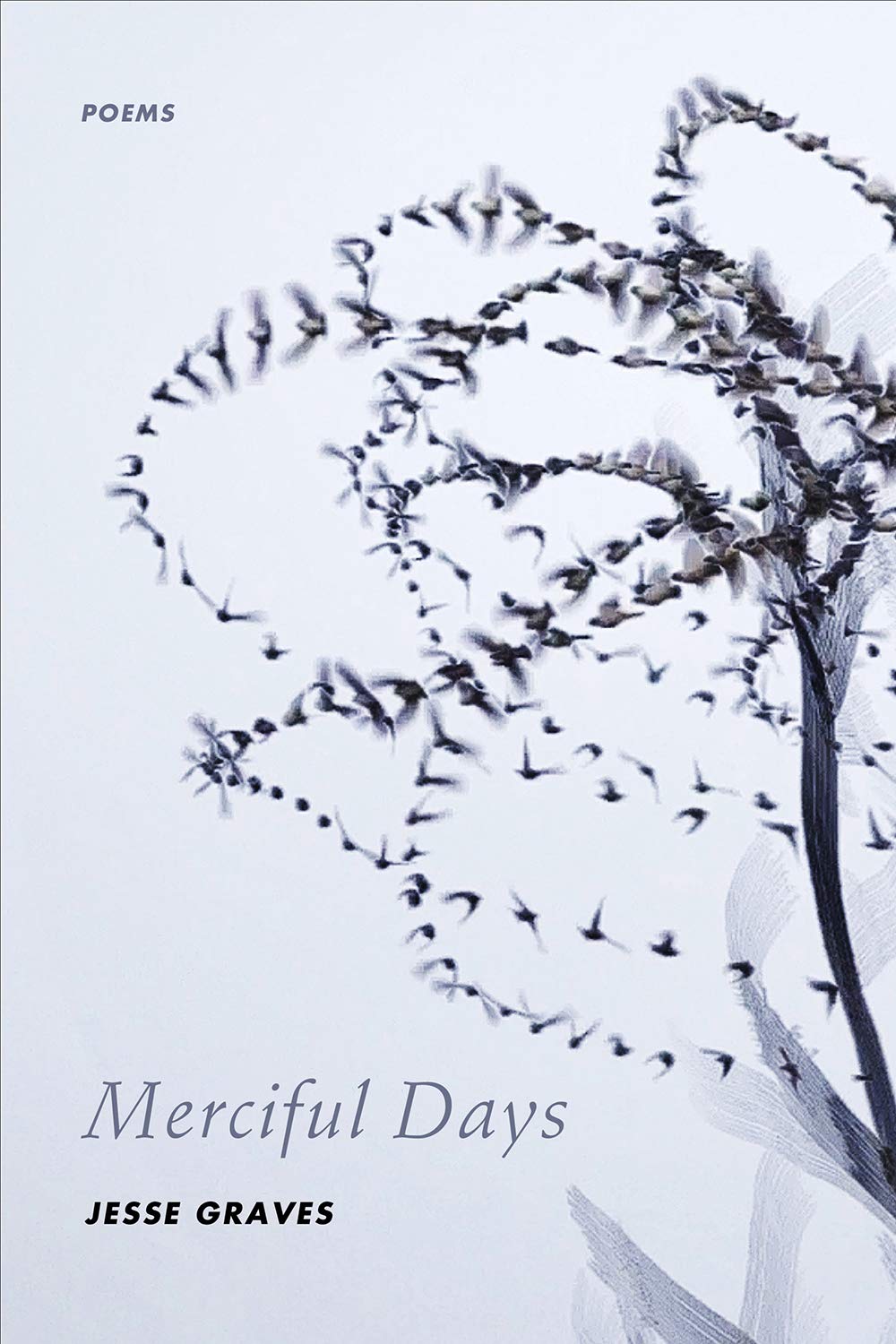
In his third solo poetry collection, Merciful Days, Jesse Graves returns to the East Tennessee farm of his youth. The land Graves writes about is also his ancestral home. Sense of place is almost a requirement for Tennessee writers, but Graves’ abiding connection to place gives exquisite life and meaning to his work. Many poems center around the loss of the author’s father and brother. Those poems are poignant in their own right, but they speak to a larger theme that flows throughout the collection: that we as individuals are only a fleeting part of something much larger and more mysterious than we can fully comprehend. This idea is evident in “Mossy Springs” where the narrator revisits a watering hole on the family farm:
…you wonder at the bloodlines
that drank here before you,
dating as far back as time records.
Hunters from the original tribes,
trackers chasing game upstream,
farmers drawn over from the fields,
and now you, looking for the lost
kingdom of your ancestors,
their eternal thirst to be found.
For Graves, this big examination of generations extending “as far back as time records” is inseparable from his own personal experience. His life is tied to the past in ways that are not completely understood even though they are tangibly felt. “Come Running” depicts this, and it is perhaps my favorite poem in this collection:
Come Running
They amble across the field, drawn to shade,
sniffing for uncropped clover and sprout,
their slowness measurable by galactic tilt.
From a distance the calves look identical,
but watch closely, and the shadings around
white faces range from salmon to maroon,
and the little curls on their foreheads
twist in tighter and looser tangles.
If a baby separates from its mother,
she calls for it like a foghorn, the lowing
anyone can tell means “find me now.”
But listen closer, and a mother can signal
her child with the slightest grunt
from the other side of the field—
no other calf will move or even look up,
yet one comes running, summoned home.
In many ways, Merciful Days is simply about the idea of memory—how memory keeps the past connected to the present and the future, and how memory sustains us through loss and sadness. Merciful Days is an elegy, but it’s not a dirge. These poems are full of joyous moments, as well as of the deepest sense of love, the kind that only expands and grows.






 Denton Loving