Writing Exercise 22.2

If you missed my previous post, please go back and read Sue Weaver Dunlap’s poem, “Place Names” from her new collection, A Walk to the Spring House.

Reading “Place Names” prompted me to think about some of the wonderful place names near where I live.  For this writing exercise, begin by making a list of location names near you. Or if not near you, consider making a list of location names that are important to you for one reason or another. You might even consider looking at some historical maps in case some more-interesting names have been replaced over the years.

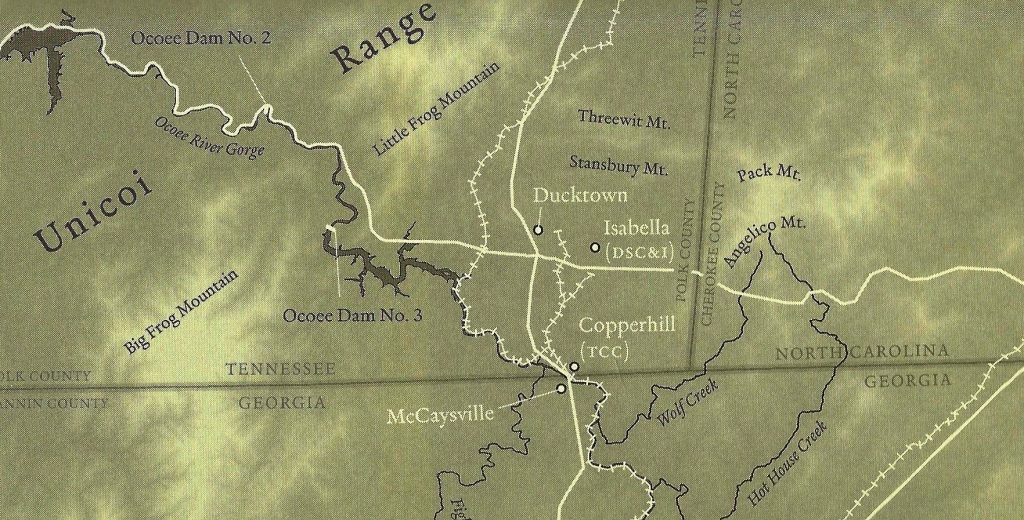
Historic map of the Copper Basin region of Tennessee, referenced in yesterday’s post.

“Place Names” should probably be considered a narrative poem because the story of the bear hunt leads the reader through the locations. But because the names of the locations are so musical and interesting, the place names tend to rise above the narrative, and for this reason, “Place Names” feels a bit like a list poem.

Caki Wilkinson’s poem “Flyover Country” is an actual list poem. There’s no narrative structure in this poem although the epigraph “Between Memphis and Bristol” does a lot of work. I love this poem in part because Wilkinson includes my home town, Speedwell, but also because of the sound and culminating meaning of the poem.

Once you have created your list of location names that are meaningful or relevant to you, you can think about how they might work as a poem. I love a well-designed list poem like “Flyover Country,” but use Sue Weaver Dunlap’s poem as an example for how to give your own poem a narrative structure.

There’s a writing exercise to be found here for prose writers too. Think of the narrative that holds the place names together in “Place Names.” Think also of the original essay by Horace Kephart. And there’s always the question of how these place names originated. Who bestowed these names. A little research might go a far way.

Sue Weaver Dunlap’s “Place Names”

A Walk to the Spring House, Iris Press

I received a wonderful surprise in the mail last week in the form of Sue Weaver Dunlap’s newest collection of poems, A Walk to the Spring House, published by Iris Press. Sue Weaver Dunlap is a retired teacher who lives deep in the Southern Appalachian Mountains near Walland, Tennessee, where she and her husband Raymond live and work a mountain farm. She has published poems in venues such as Appalachian Journal, Anthology of Appalachian Writers, Pine Mountain Sand and Gravel, and Southern Poetry Anthology, and elsewhere. “A Walk to the Spring House” includes many beautiful poems, but one that especially caught my attention is “Place Names” which I’m sharing here.

Place Names

from “A Bear Hunt in the Smokies”
Our Southern Highlanders by Horace Kephart

Mountain men slide through place names, their bear dogs ready.
They rest at Siler’s Meadow, slap cold water on stubbled faces
at Fortney’s Creek, camp at Rip Shin Thicket near Gunstick Laurel,
head out at day’s first break, think to find meat at Clingman Dome.
They don’t cross Sugarland Mountains, follow sign from Little River
near Thunderhead and Briar Knobb, track an old fellow around
Devil’s Court House, Block House, and Wooly Ridge near Bear Pen.
Dogs take chase between Briar Knob and Laurel Top, end him near
Saddle-back. Two shots. His parts shared among highlander hunters.

After reading this poem several times, I wrote Sue to ask her if she’d share the background of this poem. Here is what Sue was kind enough to write back to me:

“My first memory is of me standing between my parents in our Chevrolet truck, Dad driving us back from visiting my maternal grandparents. It’s December, 1956. A Sunday. We’ve left Ducktown through the Boyd Gap and across the White Bridge, and then along the Ocoee River Road, flanked on either side by the Big and Little Frog Mountains. I know this because Mama wrapped my memory in place names, places my people rooted long before I was born. The complexity and beauty of mountain language hypnotized me then and now. My mama grew up in places like Turtletown, Ducktown, Isabella, and Farner. The train depot was at Postelle. My Poppy worked mines in the Copper Basin, mines with names like Burra Burra and Mary. Place names like these girded me. In college, I listened to my older brother talk about his hikes in the Southern Appalachian Mountains, his love of places like Siler’s Bald, Gunstick Laurel, and Clingman’s Dome. All those place names rolled off his tongue like the language of our people. I also encountered the writings of Horace Kephart for the first time, especially his Our Southern Highlanders, his comprehensive accounting of his time spent with the people and places of our region. Over the last fifty or so years, I continue to visit Kephart’s book, a beautiful written reminder of what threads through my DNA. It was one of those “pick up the book and open to a random essay” entitled “A Bear Hunt in the Smokies” that I was inspired to write my poem “Place Names.” I could see those mountain men on their hunt for bear and hear the dogs tracking the scent. The catalogue of places they passed through became part of my own catalogue of place names. And then the poem was born, basically as it appears on the page.”

Many thanks to Sue Weaver Dunlap for sharing the history and inspiration of her poem “Place Names.” In my next post, I’ll share a writing exercise based on “Place Names.”

Writing Exercise 22.1

If you missed my previous post, please check out my conversation with Rosemary Royston where Rosemary talked about the process that inspired the poems in her poetry collection, Second Sight. She also talked about how writers should think about writing about traumatic events, and some revision tricks to make poetry sound and feel less prosaic. The poems in Second Sight combine folk traditions, superstitions, sixth sense, and the powers of suggestion and intention. Now, I’m sharing a writing exercise that Rosemary shared with me. Before you start, read Rosemary’s “Appalachian Ghazal” online at the museum of americana, and “Rumex acetosella” online at Split Rock Review.

Writing Exercise 22.1: I challenge readers to do some quick research on a superstition, belief, colloquialism, or a nagging question they’ve had, and to take what they find and turn it into a poem (or an essay or a scene for a short story or a novel chapter). It can be a narrative or list poem or even a lyric! Whatever comes out, but be sure to pay close attention to sound, imagery, and diction.

I love prompts like this one that involve a little research. For this one, I suggest writing into any superstition or belief that you already hold, but if you need more help to get started, check out ScaryMommy.com’s list of common superstitions, or Good Housekeeping’s list of 55 of the Strangest Superstitions From Around the World.

Rosemary Royston, author of Second Sight

I’m so grateful for the time and energy Rosemary took to talk about her writing and to offer this prompt. Please buy Rosemary’s book, Second Sight, available through Kelsay Press and Amazon), and give her a follow for regular updates at her blog “The Luxury of Trees.”

Rosemary is also teaching at two upcoming events, both of which I highly recommend:

February 5, 2022Poetry Workshop, Mildred Haun Conference, Walters State Community College. Rosemary says, “In this poetry workshop, I’m addressing the overall theme of the conference: Coming or Staying Home: the Appalachian Dilemma, by focusing on places/emotions/relationships/etc. that we wrestle leaving or staying with. So the workshop will be both place-based and universal.”

May 8-14, 2022 Creative Writing across the Genres, John C. Campbell Folk School. Rosemary says, “In this week-long class at the wonderful John C. Campbell Folk School in North Carolina, participants will read, write, and discuss poetry, creative nonfiction, and fiction. It is always lovely to be at the Folk School.”

Conversation with Rosemary Royston

According to Rosemary Royston’s own description, she is a poet, writer, re-imaginer of things. I couldn’t agree more, especially with that last part. Her most recent publication—a full-length collection of poetry, Second Sight, available through Kelsay Press and Amazonis all about reimagining things. Reading the poems in Second Sight causes me as a reader to want to reimagine things too.

Rosemary agreed to answer some questions about Second Sight as well as about the writing and publishing process. Come back tomorrow for a writing prompt from Rosemary, inspired by her new collection.

* * *

DL: The poems in Second Sight are often about intuition and premonition. A number of poems such as “Mountain Hoodoo” explore rich traditions of superstition. How did you first become interested in these traditions, and why/how did it occur to you that they were ripe for poetry?

RR: Having lived in many places in northeast Georgia, I found Appalachia, where I’ve spent the last 30 years, to be full of wonderful traditions and superstitions that intrigued me greatly. Always one open to the sixth sense and the power of suggestion or intention, I wanted to know more. Where did these “spells” come from? Why did some contain scripture from the Bible (something I stumbled upon), and why were others different? These questions led me in two directions: one, asking my friends and acquaintances in Southern Appalachia for their stories, and two, doing research that ranged from academic to collections based totally on experience or wisdom passed down. There were two sources that were very rich with history and on both ends of the spectrum: Anthony Cavander’s Folk Medicine in Appalachia, and Edain McCoy’s Mountain Magick: Folk Wisdom from the Heart of Appalachia. Cavender’s text is based on significant research, and identifies the “magic” or superstitions that have a level of legitimacy (such as medical magic that uses herbs of the region), along with identifying folk” treatments” that can be confounding and not based on scientific evidence. One of the examples Cavender shared that stayed with me is the act of “passing” a colicky baby around table legs nine times to end the colic. On the other hand, Edain McCoy (an actual relative of the famous McCoy’s) recorded a substantial amount of wisdom that had been passed down from her family. So before I began crafting the poems, I did a good bit of research as I wanted to honor the traditions and be as accurate as possible. Nothing in the poems with “Mountain Hoodoo” are totally made-up by me: they are references to the texts listed in the end of the book, or based on oral traditions shared with me by those who have lived in Appalachia for the majority of their lives.

As for their ripeness for poetry, I know that the traditions of any culture begin to slip away as society changes. I do not want the heritage of Southern Appalachia to evaporate. To capture them in poems allowed me to not only practice my well-loved craft of poetry, but also pass on some of the practices that I found most intriguing.

Second Sight, available through Kelsay Press and Amazon


DL: The third section of Second Sight begins with your son’s at-first undiagnosed illness, but the section includes poems about other traumatic experiences from your life. Can you talk about the benefits of writing about trauma? What’s your process like for transforming that kind of therapeutic writing into a well-crafted poem?

RR: Early in my writing career, I had the luxury of working with Heather McHugh. I had written a poem about my (favorite) dog passing away. She read the poem and put it down and said in the kindest way, “this is too close.” What she meant was that not enough time had not passed. I needed time to grieve. To reflect. She was 100% correct. So my thoughts on trauma are to definitely journal the pain and spiraling that trauma throws us in. But then let it sit. Because if a writer does not, the writing can be too painful to process, or come out in a way that is too sentimental. Even today, when I read “Type 1” or “Sudden Awareness of Embodying the Dialectical” I may tear up. It took years for me to be able to write poetically and with somewhat of a psychic distance about our son’s near-death experience, and my own experiences in this miraculous but aging body. I’m glad I did, but processing and grieving take time, and the writer must honor that. I’d also posit that turning therapeutic writing into poetry is not unlike writing creative nonfiction. The writer must decide what details are necessary, and they must be comfortable editing details or events in order to support the essence of the poem—this includes language, chronology, and the actual event in order to convey the emotions that the writer wishes the poem to convey to its audience.


DL: One of the questions I’m asked the most, especially by poets early in their career, is how to not sound overly prosaic. What kind of craft elements do you employ to identify and modify those prosaic turns of phrase?

RR: Oh, this is a great question and extremely relevant. In the first drafts of many of these poems, I would go back and read them and see that I’d just made more or less a list of my research findings. Making the language poetic was a big factor in taking research and shaping or conjuring it into poetic form. To do this, I had multiple drafts, with specific attention to diction, sound, line breaks, and form. I think that those of us who have grown up in the South have an innate ear for sound, and we often incorporate it without even thinking about it, but I made a concerted effort to take advantage of sound. I turned some of the research I’d gathered into narrative poems. Also, I used the ghazal form, which is a Persian form that allows for repetition. Since spells often involve repetition, I found this to be an applicable form. I intentionally steered away from ballads because not only was I not good at doing them, I felt they were a form already done well by my Appalachian literary aunts and uncles. Finally, I went for the scientific—Latinate titles for some of the poems with the intent that the reader be both aware of sound and craft, but also intellectually engaged—having to read further or deduce exactly what is being described.


DL: My first book took two years to find the right publisher, and that time while you’re searching can be really disheartening. What was the submission and publication process like for Second Sight?

RR: Just as hard as the first process! However, I’m grateful for both opportunities, which took about six years of reorganizing, resending, and hoping. I was proud of myself for being more assertive this go around, though. Initially, Kelsay Books accepted a chapbook submission. But I felt that the submission was too thin for the work I’d done; it did not feature everything I wanted. I asked if they would consider my full-length, and they did! It was very rewarding.


DL: What are you working on now?

RR: Of all the questions, this one (which should be easy) was the most challenging to answer! I will always write poetry. It’s in my bones. However, I’ve found that I’m branching out and experimenting with all types of art, from mixed media, needle felting, and playing barbies! LOL. Yesbarbies. But not only in the sense of play, but also of conveying a message, which is often based on issues such as gender, feminism, and sexism. Often, I’ll “enact” the essence of a poem in one of these forms (for readers who want to see this, follow midge_and_midge on Instagram). I’ve also done some collaborative work with the painter and artist Larry Caveney through ekphrastic poems based on his paintings. For the most part, I feel like I’m in that necessary lull between poetic projects, and I’m enjoying it (as opposed to berating myself!).

* * *

My next post will feature a writing prompt supplied by Rosemary Royston, as well as more information for opportunities to study with Rosemary this spring.

Cathey Smith Bowers’ “Paleolithic”

While waiting for the snow that still hasn’t truly arrived, I finished reading Cathy Smith Bowers’ debut collection The Love That Ended Yesterday in Texas. This book was first published by Texas Tech University Press in 1992 and later reprinted by Iris Press. There are so many memorable and beautiful poems in this book, but I thought I’d share the very first one from the collection. First poems in collections have a heavy burden to speak to the overall theme of the book while also drawing the reader in. This first poem, “Paleolithic,” does all of that and more.

PALEOLITHIC

We love these old caves—Lascaux,
Altamira—and walk carefully
the way we always enter the past,
our hands bearing
the artificial light of this world.

We imagine those first hunters
crouched, conjuring luck,
carving into rock-swell
their simple art—whole herds of bison,
the haunches, the powerful heads, floating
orderless along the walls.
And some are climbing sky
as if they were stars, planets
orbiting something they cannot see.
Centuries will pass before they
right themselves, their hooves
coming down on to the deep
wet floor of leaf-fall.
Remembering where it was
they were headed.

Jeff Hardin’s “Seed Heads Bursting Gold Light”

The first book I read this month was Jeff Hardin‘s collection, Notes for a Praise Book, published by Jacar Press. Jeff Hardin’s poems are always thoughtful and beautiful, and here’s one I wanted to share:

SEEDS HEADS BURSTING GOLD LIGHT

We need to busy ourselves with memorizing autumn
in the puddles down the drive. A single
forgotten reflection
makes all the others tremble.

I didn’t think twice as a boy, lying prostrate
to watch a dandelion bend with the breeze.
Amazing!
I knew already what to do with my life.

I’d wager Solomon, had he lived nearby,
would have taken long walks in the sage grass field,
just to watch how seed heads
burst with gold light.

I’m an advocate of letting things lean as they must.
When one tree rests its dying toward another,
I go among them
to listen in and take my place.

No big difference, I say, between years that lean that way
and a shared gaze between me and some friend’s eyes.
Some weakness unspoken
may be the strongest voice we have.

Submission Calls for Writers 3/16/2021


submissions

Where I live in East Tennessee, it feels like the weather is finally shifting to spring in a more permanent way. Not just a flirtation but the real thing with daffodils blooming everywhere you look. I hope you’re getting a taste of this kind of reawakening wherever you are. Here are ten new submission opportunities where you should consider sending your writing. Good luck.

Cortland Review

TCR considers poetry, prose, essays, translations, book reviews. Editorial decisions are based on content and quality. TCR does not accept simultaneous submissions or previously published work. Submit 3-5 poems at a time. For fiction, submit one story only, and nothing longer than 3500 words.

https://www.cortlandreview.com/submissions/


South Florida Poetry Journal

We want poetry, flash fiction and essays that inspire, stimulates, evokes, emotes, shocks and surprises. We want to be transported by your words to wondrous and strange places, and familiar places that you have made new. We read year-round and publish quarterly. Send 3-5 unpublished pieces.

https://www.southfloridapoetryjournal.com/submission-guidelines.html


Summerset Review

Prose writers are invited to submit literary fiction/nonfiction of up to eight thousand words. Poets may submit up to five poems. This literary journal is primarily an online publication. We read year-round.

http://www.summersetreview.org/guidelines.htm


Ghost Ocean Magazine

Founded in Chicago in 2010, Ghost Ocean is an award-winning literary magazine whose work has been reprinted in Best of the Net, Pushcart Prize: Best of the Small Presses, Fiction Daily, and has been shortlisted for the Wigleaf Top 50. Ghost Ocean is open for submissions year-round. We accept simultaneous submissions, but please notify us immediately if your work is accepted elsewhere. You may submit up to 5 poems, 3 pieces of flash prose, or 1 work of fiction under 3,000 words in a single document; submissions in multiple genres are accepted, but please do so separately.

http://ghostoceanmagazine.com/


Bearings Online

Bearings Online is accepting poetry submissions. We are seeking clear, accessible poetry (30 lines or less) that addresses faith, culture, or what it means to be human. Submit as a Word document to poetry editor Susan Sink: ssink (at) collegevilleinstitute (dot) org.

https://collegevilleinstitute.org/bearings/submission-guidelines/   


Split Lip Magazine

Split Lip Review is a literary journal of voice-driven writing with a pop culture twist. We publish online monthly and in print yearly. We accept fiction between 1,000 and 5,000 words, flash fiction under 1,000 words, and memoir up to 2,000 words.  We accept only one (yes, just one) poem at a time. Please do not send us more than one poem. Send your best poem, but only one. We mean it. Free submission in March. https://splitlipthemag.com/submit


The Hudson Prize in Fiction / The Hudson Prize in Poetry

Each year Black Lawrence Press will award The Hudson Prize for an unpublished collection of poems or short stories. The prize is open to new, emerging, and established writers. The winner of this contest will receive book publication, a $1,000 cash award, and ten copies of the book. Prizes awarded on publication. $27 Submission Fee. Deadline: March 31, 2021.

https://blacklawrencepress.com/submissions-and-contests/


Passages North

Passages North is open for submissions for Issue 40 until April 15, 2021. http://passagesnorth.com/submissions/


Consequence

Consequence is reading submissions until May 1, 2021. We publish short fiction, poetry, non-fiction, interviews, visual art, and reviews primarily focused on the culture of war. For fiction and non-fiction: please submit one piece of no more than 5,000 words. For poetry: please submit up to five poems of any length.

https://www.consequenceforum.org/submissions


The Writer’s Chronicle Seeks Articles on the Craft of Writing

The editors read submissions for the Writer’s Chronicle through September 30 of each year. All craft essays must analyze an element of creative writing. Articles should not overlap with topics covered in recent issues of the Chronicle. Craft essays should contain concrete examples to illustrate the writerly advice they offer. Many of our published essays combine appreciations with a study of elements of craft. Using more than one author to illustrate your analysis is recommended. A query on a specific topic is always welcome. Craft essays run between 2,000 and 6,000 words, depending on the topic.

https://www.awpwriter.org/magazine_media/submission_guidelines


IMG-1280

Submission Calls for Writers 2/14/2021

submissions

This Valentine’s Day is maybe the coldest I ever remember. If you’re stuck inside, I hope this list of journals and contests will inspire you to start submitting. Until next time, stay safe and stay warm.

Litbreak
Writers are invited to submit prose and poetry to Litbreak, an online literary journal that publishes poetry, fiction, book reviews, and essays on literary subjects. All prose submissions should range from 500 words to a maximum of 5,000 words. Submission is open year-round. We pay all contributors on a case-by-case basis from $25 upward. There is no submission fee. With regard to fiction, there are no specific requirements on style and content. Some literary sites suggest you look at what they publish to get an idea of what they would accept. We would rather suggest that you look at what we have published and come up with something else. We will consider excerpts from novels. For book reviews, although we are paying special attention to contemporary releases, we won’t rule out reviews of older books or critical surveys of a writer’s body of work. For poetry, we suggest but don’t require a minimum of one hundred words. We may also accept essays on literary subjects or ideas.
https://litbreak.submittable.com/submit

Western Humanities Review
Western Humanities Review accepts unsolicited submissions of original poetry, fiction, nonfiction, hybrid work, audio/visual work, essays, and reviews year round. Because of the volume of submissions we receive, we are only able to publish about 2% of them—so please send us your best work. We’re looking for dynamic writing that engages, surprises, and moves us, work that is, in fact, out to get us.
http://www.westernhumanitiesreview.com/submissions/

Bearings Online
Bearings Online is accepting poetry submissions. We are seeking clear, accessible poetry (30 lines or less) that addresses faith, culture, or what it means to be human. Submit as a Word document to poetry editor Susan Sink: ssink (at) collegevilleinstitute (dot) org.
https://collegevilleinstitute.org/bearings/submission-guidelines/

Valparaiso Fiction Review
Publishing since 2011, Valparaiso Fiction Review is a biannual publication of Valparaiso University and its Department of English. Valparaiso Fiction Review is seeking submissions of short stories for its upcoming 2019 issues (Summer & Winter). Submissions to VFR should be original, unpublished works that range from 1,000 to 9,000 words. There is no set deadline, and submissions are considered on a rolling basis.
https://scholar.valpo.edu/vfr/guidelines.html

Booth
Booth was established in 2009. Our staff is comprised of MFA faculty and students in the Butler University graduate writing program. Booth publishes one new piece or author every Friday, square on our home page. We are now open to new submissions in all genres. All accepted work will appear on our website and may appear in our subsequent print issues. Submit up to 3 poems or up to 7,500 words of fiction or creative nonfiction.
https://booth.submittable.com/submit

Copper Nickel
Copper Nickel accepts submissions of poetry, fiction, essays, and translation folios through March 1, 2021. Please submit four to six poems, one story, or one essay at a time. For prose we do not have any length restrictions—but longer-than-normal pieces have to earn their space.
http://copper-nickel.org/submit/

Pittsburgh Poetry Journal
Pittsburgh Poetry Journal PPJ seeks work that clangs with grit, passion, and a multitude of voices. We want poems that celebrate or break traditions and strive for progress. We do not restrict our journal to Pittsburgh poets or poetry. All writers and themes are welcome! Please submit no more than three (3) poems, or seven (7) pages total. Our open reading period runs through March 21, 2021.
https://pittsburghpoetryjournal.submittable.com/submit

The Hudson Prize in Fiction / The Hudson Prize in Poetry
Each year Black Lawrence Press will award The Hudson Prize for an unpublished collection of poems or short stories. The prize is open to new, emerging, and established writers. The winner of this contest will receive book publication, a $1,000 cash award, and ten copies of the book. Prizes awarded on publication. $27 Submission Fee. Deadline: March 31, 2021.
https://blacklawrencepress.com/submissions-and-contests/

The National Poetry Review
The National Poetry Review is an annual online journal of poetry (previously a print journal published from 2003 to 2015 by our sister press, The National Poetry Review Press). Our reading period is January 1 – April 1 annually. Please submit all poems in one file. Include a brief bio with previous publications.
http://www.nationalpoetryreview.com/

Landlocked
We love found pieces, eco-poetics, works about displacement, and stories of how your body fits (or how it doesn’t) into the world. Imagism and hybrid genres, including experimental and visual works, lyric essays, and prose poems are all welcome. Please send 3–5 poems per submission with no more than 10 pages in total. We want stories of literary quality and encourage fantastic, speculative, and weird literature. Send us your most imaginative and challenging writing in 4,000 words or less. We also encourage flash fiction of 1,000 words or less. Finally, we are especially drawn to nonfiction pieces that challenge the boundaries of the genre, incorporate fictional and poetic elements, and make us question how “creative” nonfiction can be. As far as length, we prefer under 4,000 words. Landlocked is open for submissions through April 1, 2021. https://landlockedmagazine.com/submission-guidelines/

Bennington Review
Bennington Review is published twice a year in print form, Summer and Winter. For poetry, please send no fewer than three and no more than five poems per submission. For fiction and creative nonfiction, please send no more than thirty pages per submission; any excerpts from a longer project must work as self-contained essays or stories. Deadline: May 18, 2021.
http://www.benningtonreview.org/submit/

Posit Journal
Posit is currently considering submissions for late 2021 and beyond. Send 1-3 pieces of prose, including fiction and hybrids, but no nonfiction please, 1000 words or less each. However, if you are submitting very short pieces, please send us at least three to choose from. Please include a minimum of five and a maximum of six poems for us to consider. Deadline: May 31, 2021.
https://posit.submittable.com/submit 

Sunset - February 2021

Submission Calls for Writers 1/5/2021

submissions

Happy New Year. It seems as though we have a ways to go before we escape the shadow of 2020. But the new year is really here, and I want to embrace that certain feeling of optimism that comes from the change of calendars. In that spirit, I offer you 12 submission opportunities for this month.

Last month, Bill Griffin contacted me to share his unique and super thorough submission calendar. If you struggle to keep track of so many different journals and when they do and don’t accept submissions, you’ll want to check out the pdf document on Bill’s page, here: https://griffinpoetry.com/2020/11/18/poetry-submissions-calendar/griffin-submissions-calendar-2020-11/?unapproved=59650&moderation-hash=e5c05a1237c73e68ffcfc085aef83a9b#comment-59650         (Thank you, Bill!)

StorySouth

StorySouth accepts unsolicited submissions of fiction, poetry, and creative nonfiction through January 15, 2021. Authors should limit submissions to 3-5 poems, one story, or one essay. There are no word limits on submissions. Long pieces are encouraged. Please make only one submission in a single genre per reading period. Response time is approximately 2-6 months.

http://storysouth.com/submissions/   


Gigantic Sequins

Gigantic Sequins is a print literary arts journal whose issues come out twice a year. Twice a year, we read submissions for these issues. When our current issue debuts, we select a few pieces from the most recent past issue to publish online. Submit 3-5 previously unpublished poems, or either one long (up to 3500 words) short story/novel excerpt or up to 3 short (1000 words each) pieces of flash fiction/micro fiction. Essays may go as long as 4000 words. Deadline: January 16, 2021.

https://giganticsequins.submittable.com/submit


10th Annual Zocalo Public Square Poetry Prize

Zócalo is accepting submissions for the 10th annual Zócalo Public Square Poetry Prize, awarded to a U.S. poet whose poem best evokes a connection to place. “Place” may be interpreted in many ways, be it of historical, cultural, political, or personal importance; the landscape may also be literal, imaginary, or metaphorical. The deadline for entries will close on January 29, 2021. Send up to three poems to enter. There’s no submission/entry fee.

https://www.zocalopublicsquare.org/2020/09/04/zocalo-public-square-is-accepting-entries-for-its-ninth-annual-poetry-prize-2/inquiries/prizes/


The Rumpus

We welcome essay submissions between 1500-4000 words in length. In addition to personal narrative-driven essays we are interested in non-traditional forms of nonfiction. Essays should explore issues and ideas with depth and breadth, illuminating a larger cultural context or human struggle. Regardless of topic, we are looking for well-crafted sentences, a clear voice, vivid scenes, dramatic arc, reflection, thematic build, and attention to the musicality of prose. Our Rumpus Original Poetry reading period is from January 15 through January 31, 2021.

https://therumpus.net/about-4/?mc_cid=0aaa00764e&mc_eid=508eb4b613#WritersGuidelines


Ecotone

Ecotone, the literary magazine dedicated to reimagining place, welcomes work from a wide range of voices. Our upcoming submissions windows will be open from January 26 to February 2, 2021. For Issue 30, we want to hear about gardens, be they literal or metaphorical. What do you tend? Where do you find green? We’re interested in permaculture and flower clocks, pollinators and pesticides, heirlooms and hybrids, plant poetics, the Old Farmer’s Almanac, flower reports, community gardens, food deserts, citizen science, ecological anthropology.  And don’t forget seeds—seed saving, seed banks and libraries, seeds carried across seas in the lining of people’s clothing. We’d like to see more nonfiction that delves into ecology, botany, entomology; we want stories that show us the effort and reward of gardening; we do love a good flower poem, and a bee poem is not bad either. Send one prose piece of no more than 10,000 words (ca. thirty double-spaced pages). We are also interested in brief prose works (minimum 2,000 to ca. 3,000 words), one per submission. Send three to five poems at a time.

https://ecotonemagazine.org/submissions/upcoming-issues/


Good Hart Artist Residency

Located in Good Hart, Michigan. The call is now open for writers and composers/songwriters. Application deadline is February 17, 2021. We will limit the number of applications for the writer residencies to 40 applicants, so we may close the application deadline early. One- week, two-week, or three-week residencies are available depending on the program selected.  Most residency time slots are two weeks long. Food is provided as well as a $500 stipend.

https://goodhartartistresidency.org/


The Puritan

Baffle us, tangle us up, or break our hearts. We’re looking for poems of any length (including sequences and long poems). Send up to four poems at a time. Feel encouraged to push boundaries with your fiction. We have diverse tastes; try us out. Length is up to you, but a story over 10,000 words will only be considered if it is of exceptional quality (and nothing over 12,000 words, please). Only send one story at a time, unless you are writing flash fiction (or stories under 500 words), in which case you can send up to three. We accept essays as pitches–no more than 250 words–or finished essays. Deadline: March 25, 2021.

http://puritan-magazine.com/submissions/


Black Moon Magazine

Black Moon is a brand-new literary magazine, and our first issue will be released in January 2021. We operate on a rolling submission basis and publish quarterly. Submissions received from January through March will be considered for our April issue. We will accept up to 3 short stories between 1,000 and 8,000 words. We will also accept up to 5 flash fiction pieces (1,000 words or less). We will accept up to 5 poems up to 5 pages each.

http://box5887.temp.domains/~blackmy8/sample-page/


Quarterly West Special Feature “100 Syllables”

Quarterly West invites submissions of pieces totaling 100 syllables or fewer (excluding the title). Whether poetry, prose, hybrid, or fragment, we’re interested in texts that offer–however fragmentary or disjointed their forms–wholenesses. Whole scenes, whole stories, whole emotions all contained within a small shell. The editors will select 21 pieces by 21 separate artists. Please send no more than five individual pieces per submission packet. Deadline April 16, 2021.

https://quarterlywest.submittable.com/submit


Puerto del Sol

Puerto del Sol accepts submissions year round but only reads from August to April. Poetry submissions are limited to five (5) poems. Prose submissions are limited to one (1) self-contained work (no excerpts), including flash prose.

https://www.puertodelsol.org/submit


South Florida Poetry Journal

We want poetry, flash fiction and essays that inspire, stimulates, evokes, emotes, shocks and surprises. We want to be transported by your words to wondrous and strange places, and familiar places that you have made new. We read year-round and publish quarterly. Send 3-5 unpublished pieces.

https://www.southfloridapoetryjournal.com/submission-guidelines.html


The London Magazine

We publish literary writing of the highest quality. We look for poetry and short fiction that startles and entertains us. Reviews, essays, memoir pieces and features should be erudite, lucid and incisive. We are obviously interested in writing that has a London focus, but not exclusively so, since London is a world city with international concerns. Non-Fiction pieces should be between 800 and 2,000 words. For Short Fiction, above all we look for elegance in style, structure and characterization. We are open to both experimental and traditional forms, although we do not normally publish genre fiction such as science fiction or fantasy writing, or erotica. Please make sure they are no more than 4,000 words in length. Poetry should display a commitment to the ultra-specificities of language, and show a refined sense of simile and metaphor. The structure should be tight and exact. Poems should be no longer than 40 lines.

https://www.thelondonmagazine.org/submission-guidelines/

Submission Calls for Writers 12/8/2020

submissions

After a long hiatus, here are a dozen submission opportunities for writers to consider before the end of the year. I hope to return to regularly posting submission opportunities in 2021. If these listings are helpful to you, I’d love to hear about it. Feel free to share with others.

Adirondack Review

The Adirondack Review accepts submissions year-round in poetry, short stories, art, photography, creative nonfiction, book reviews, and translations from the French, German, and Russian. We do not accept simultaneous submissions.

http://www.theadirondackreview.com/submissions

Free State Review

We are looking for poetry, fiction, personal essay, and one-minute plays. Prose should be 500-4,000 words; poetry can be any length or style. Poetry submissions can include 3-5 poems in a single document. Strange is not always better; simple and clear are not always memorable. Try to split the difference between the abstract and the concrete.

https://freestatereview.com/submissions/

The Journal, a Literary Magazine (formerly The Ohio Journal)

We are interested in quality fiction, poetry, nonfiction, photo essays, author interviews, and reviews of new books of poetry and prose. We impose no restrictions on category or type of submission for fiction, poetry, and nonfiction.   Fiction and essays: All prose submissions should be double-spaced. We are happy to consider self-contained excerpts of novels and long stories and essays, but please note that historically it is unusual for us to publish stories longer than 10,000 words and essays longer than 6,000 words.   Poetry: Please limit poetry submissions to 3 – 5 poems grouped in a single .doc or .pdf document.    Reviews and Interviews: Reviews should double-spaced be no more than 1,200 words. We are particularly interested in reviews of new books that have been published within the last two years. Interviews should be double-spaced and between 6 – 12 pages.

http://thejournalmag.org/submit

Foundry

Submit 4-6 original, previously unpublished poems through Submittable. All poems should be included in a single .DOC/.DOCX or PDF file with one poem per page (eight pages maximum). Enter a cover letter with a brief third-person bio in the space provided by Submittable. We do not consider translations. Submissions are free.

https://www.foundryjournal.com/submit.html

Frontier Poetry

Submissions for our New Voices poetry category are open year round to any new and emerging poet who has not published more than one full-length collection of poetry. New Voices are published online only and will feature a number of poems from new authors each month. We also warmly invite under-represented and marginalized voices to submit. All submissions must be no more than 10 pages and no more than 5 poems.

https://frontier.submittable.com/submit

Cosmonauts Avenue

For poetry, send 5 poems or less, no matter the length. For prose, submit up to 8,000 words. We do accept novel excerpts. We are open to reading writing in any genre, including multi-media and experimental. Send us original work; get our attention.

https://cosmonautsavenue.submittable.com/submit

Mississippi Review Contest

Our annual contest awards prizes of $1,000 in poetry, fiction, and nonfiction. Winners and finalists will make up next summer’s print issue of Mississippi Review. Fiction and nonfiction entries should be 1000-8000 words; poetry entries should be three to five poems totaling ten pages or less. Please attach as one document. There is no limit on the number of entries you may submit. Online entry fee is $16 per entry. Each entrant will receive a copy of the prize issue. All submissions will be read anonymously. Please remove or redact any contact information from your submission. Contest deadline is January 1, 2021.

http://sites.usm.edu/mississippi-review/contest.html

Cincinnati Review

The Cincinnati Review welcomes submissions from writers at any point in their careers. We read through January 1, 2021. Please submit up to five poems, which should total no more than ten manuscript pages, at a time. Fiction submissions should be no more than forty double-spaced pages. We’re interested mostly in pieces of nonfiction less than twenty double-spaced pages, though you can try us for longer pieces if you think they’ll knock our socks off.

https://www.cincinnatireview.com/submission_guidelines-2/

Rattle’s Tribute to Appalachian Poets

Our Summer 2021 issue will be dedicated to Appalachian Poets. The poems may be any subject, style, or length, but must written by poets who themselves identify with Appalachia and were born or have lived in the region for a large portion of their lives. The poems need not be about Appalachia—our goal is to honor these poets by sharing the diverse creative work that they’re producing. Deadline: January 16, 2021.

https://rattle.submittable.com/submit/34382/tribute-to-appalachian-poets

Parabola / Theme issue: “Young & Old”

Parabola welcomes original poetry, essays and translations. We look for lively, penetrating material unencumbered by jargon or academic argument. We prefer well-researched, objective, and unsentimental pieces that are grounded in one or more religious or cultural tradition; articles that focus on dreams, visions, or other very personal experiences are unlikely to be accepted. All articles must be directly related to the theme of an issue. Poetry submissions should be limited to a maximum of five (5) poems per author. Deadline: Mar 1, 2021.

http://parabola.org/submissions/

The Account

We are open to a diverse range of styles, including experimental and hybrid work. We require that you send us not only your creative work, but also an account of that work. The account is an opportunity for the artist to lift the curtain and say something that might not be present on the page. We are interested in exploring the relationship between what is known (the work on the page) and what is often left unknown (the artist’s intentions behind that work). Poets: Send 3-5 poems, with your 150-500 word account. Creative nonfiction writers: Send us your essay of no more than 6,000 words. Include your 150-500 word account as the last page of the file. Fiction writers: Send us your short stories of 1,000-6,000 words. Include your 150-500 word account as the final page of the file. Deadline: Mar 1, 2021.

http://theaccountmagazine.com/guidelines

Green Mountain Review

Green Mountain Review is currently accepting submissions for the Black Voices issue, guest edited by Naomi Jackson and Keith Wilson. Please submit a cover letter and include up to 5 poems or up to 25 pages of prose. We publish poetry, essays, fiction, interviews, book reviews, and art. We are also always looking for work that pushes these boundaries and are open to audio and video submissions; we’re also happy to be surprised. Surprise us.

https://greenmountainsreview.submittable.com/submit